Night Riding on Utah Roads
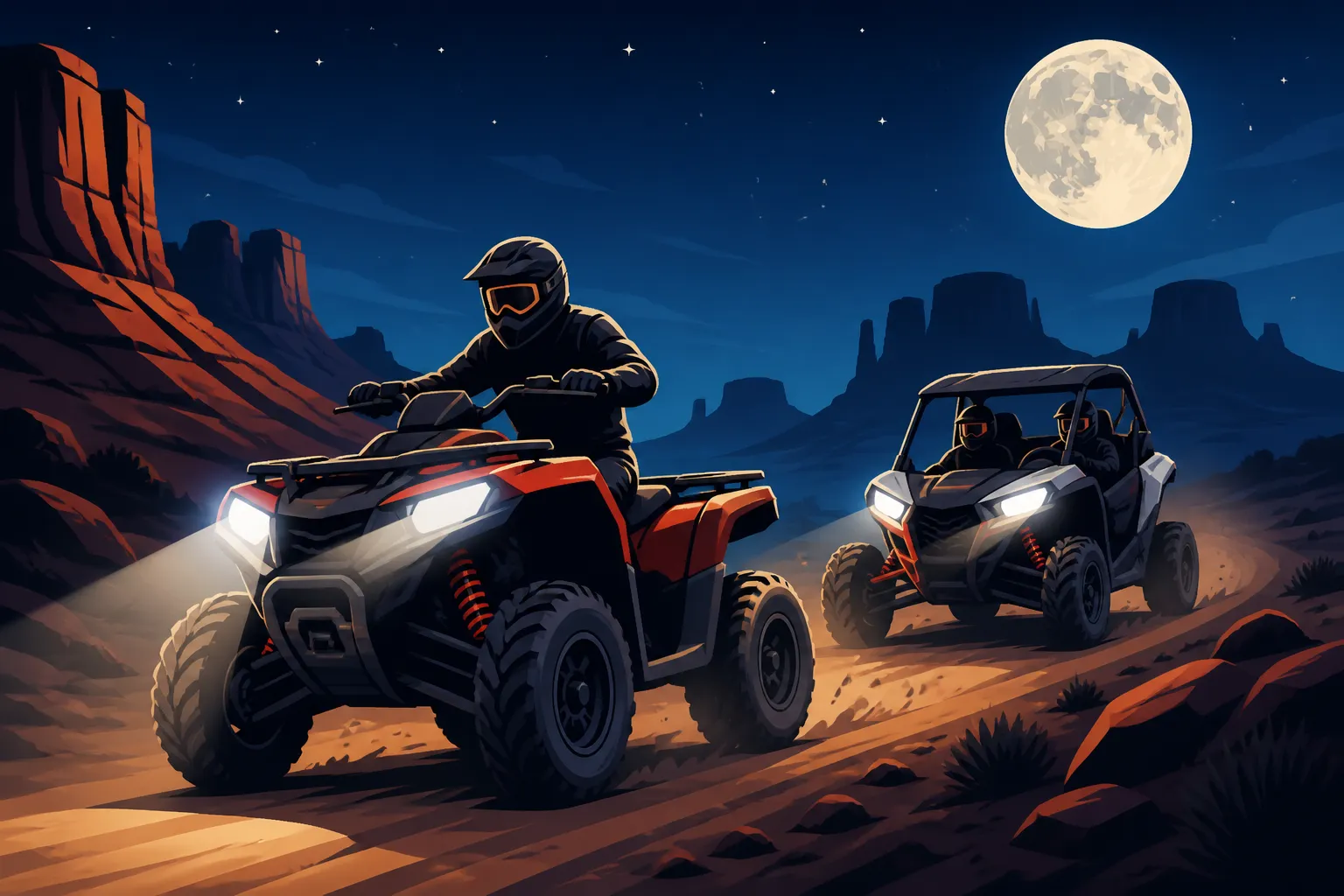
There's nothing quite like extending a perfect day of riding into the cool, quiet hours of the evening, especially when the stars begin to pop in the vast Utah sky. But if you're thinking about taking your ATV or UTV onto public roads after dark, you've probably got a bunch of questions swirling around in your head: Is it even legal? What special gear do I need? And most importantly, how do I stay safe out there when visibility drops to zero? This guide is here to shed some light on those questions, making sure you're well-prepared for responsible and legal night riding on Utah's roads.
Utah's Rules for Night Riding on Public Roads
Let's get one thing straight from the start: riding your ATV or UTV on public roads in Utah, whether it's day or night, means your machine absolutely must be street-legal. This isn't just a suggestion; it's the law. The moment your tires hit a paved or maintained public road, you're expected to comply with the same basic vehicle requirements as any car or truck, especially when it comes to being seen and seeing where you're going after the sun sets. Ignoring these rules can lead to serious fines, or worse, put you and others in danger.
The Foundation: Street-Legal Status
Before you even dream about hitting the roads after dark, your OHV needs to have gone through the process of becoming street-legal. This transformation involves more than just a quick sticker; it's about equipping your machine with specific safety features that allow it to safely share the road with other traffic. Utah's laws are pretty clear about what's required, and these requirements are amplified when you're talking about night use. Things like proper headlights, tail lights, and turn signals become absolutely non-negotiable once dusk settles. You can find a deep dive into all the specifics in our guide on [Utah Street-Legal ATV Equipment Requirements]. Without this fundamental step, any night riding on public roads is simply illegal and unsafe.
Many riders, especially those new to the street-legal world, can feel a bit overwhelmed by the checklist. You might be wondering if your machine is even capable of meeting these demands or if it's going to be a huge financial burden. While it does require an investment of time and money, think of it as investing in your safety and the freedom to explore more of Utah's incredible landscapes, day or night. This status opens up so many possibilities, from riding directly from your campsite to the trailhead without trailering, to simply running into town for supplies after an epic day on the dirt.
Specific Lighting Requirements After Dark
Once your machine is street-legal, the specifics of night riding on roads come into play, primarily focusing on lighting. It's not enough to just have lights; they need to be functional and meet certain standards. Utah law mandates that any vehicle on a highway or public road between sunset and sunrise, or during periods of insufficient light, must have its headlamps, tail lamps, and other specified lights illuminated. This isn't just for your benefit; it's crucial for other drivers to see you clearly.
Your headlights need to be capable of illuminating persons and vehicles at a certain distance, typically 200 to 300 feet, which is standard for any motor vehicle. This is particularly important on those dark, unlit rural roads common in many of Utah's riding areas. Having bright, properly aimed headlights isn't just about avoiding hazards; it's about giving yourself enough reaction time to unexpected wildlife or turns in the road. Similarly, tail lamps must be visible from 500 feet to the rear, ensuring that anyone approaching from behind can spot you well in advance. And don't forget those essential license plate lights to illuminate your rear plate, because even that detail is part of being road-legal after dark. You can learn more about these specifics in [Headlights and Tail Lamps Utah Requires] and [License Plate Lights and Mounting in Utah].
It's common for riders to invest in aftermarket lighting for off-road adventures, like powerful LED light bars. While these are fantastic for the trail, remember that they are often too bright and illegal for use on public roads. You need to have a way to easily switch between your road-legal headlights (high and low beams) and any auxiliary off-road lighting. Many kits, like those from SuperATV, are designed with this in mind, offering components that help you meet both street-legal and off-road illumination needs. It's all about being seen and seeing effectively, without blinding oncoming traffic.
Essential Lighting and Equipment for Night Riding
Preparing your OHV for night riding on Utah roads goes beyond just having working headlights. It's about a complete setup that ensures you're both highly visible to others and have excellent visibility for yourself. Think of it as creating a bubble of safety around your machine and yourself, especially when the natural light vanishes.
Beyond Headlights: Turn Signals, Tail Lights, and Reflectors
While headlights are critical for seeing ahead, turn signals and tail lights are your primary means of communicating your intentions and presence to other drivers. Utah law demands functional turn signals for street-legal OHVs, just like any other vehicle. This means front and rear turn signals that are clearly visible and indicate your direction changes, preventing confusion and potential accidents on the road. Without them, pulling onto a main road from a side trail, or making a turn in town, becomes incredibly risky.
Tail lights, as mentioned, need to be bright enough to be seen from 500 feet, but they also often integrate brake lights, which are arguably even more important. When you hit the brakes, those lights need to illuminate brightly and immediately to warn following traffic. Many street-legal kits include these integrated solutions, but it's vital to test them regularly. Beyond active lighting, strategically placed reflectors can offer a passive layer of safety. While not always strictly mandated as active lighting, they enhance your visibility, particularly from the sides, if your primary lights were to ever fail.
| Component | Purpose | Utah Road Requirement (Night) | Aftermarket Options (e.g., SuperATV) |
|---|---|---|---|
| Headlights | Illuminate road ahead, be seen by others | Required (High/Low Beam) | LED conversions, brighter bulbs |
| Tail Lights | Be seen from behind | Required (500ft visibility) | Integrated with brake lights |
| Brake Lights | Signal braking to following vehicles | Required | Bright LED versions |
| Turn Signals | Indicate turns/lane changes | Required (Front & Rear) | Integrated kits, sequential signals |
| License Plate Light | Illuminate rear license plate | Required | Small LED units |
| Mirrors | See traffic behind and to sides | Required (Both sides) | Breakaway, wide-angle, convex |
| Windshield/Eye Prot. | Protect eyes from debris, wind, bugs | Required | Full windshields, half windshields |
| Horn | Alert others to your presence | Required | Electric horns, air horns |
| Speedometer | Monitor speed for legal limits | Required | Digital/analog gauges |
| Whip Flag | Increase visibility in dusty or dune areas (off-road) | Recommended (Off-road) | LED lighted whips |
| Auxiliary Lighting | Enhance off-road visibility (e.g., light bars) | Off-road use only on roads | Wide variety, check local laws |
Many riders rely on aftermarket parts to meet these requirements. Brands like SuperATV offer a fantastic range of street-legal kits and individual components, from robust turn signal kits that integrate seamlessly into your existing wiring, to brighter LED tail lights that improve your visibility exponentially. Just remember that even the best aftermarket parts need to be installed correctly and regularly maintained to ensure they perform when you need them most.
Personal Visibility and Safety Gear
Your machine isn't the only thing that needs to be visible; you do too! Wearing appropriate safety gear is always paramount when riding an OHV, but it takes on an added layer of importance after dark. Think about what makes a cyclist or pedestrian visible at night: reflective clothing, bright colors, and sometimes even active lighting. The same principles apply to you.
Consider wearing a helmet with reflective tape or a reflective vest over your riding jacket. Even your riding gear itself can contribute to your visibility; many modern jackets and pants incorporate reflective panels for this very reason. While Utah's helmet laws primarily focus on riders under 18, it's always a good idea to wear one, and after dark, one with reflective elements can be a lifesaver. You can review [Helmet and Age Rules on Utah Roads] for the full rundown. Furthermore, clear goggles or a clean, clear visor on your helmet are absolutely essential. Tinted visors or sunglasses are a no-go at night, as they severely reduce your ability to see hazards. Ensuring your vision is unobstructed and your personal presence is as bright as possible adds a critical layer of safety to your night riding adventures.
Safety Considerations and Best Practices for Night Riding
Even with all the right equipment and a street-legal machine, night riding presents unique challenges. Reduced visibility, altered depth perception, and the presence of other nocturnal hazards mean you need to be extra vigilant and adjust your riding style accordingly. It's about riding smarter, not necessarily slower, but with heightened awareness.
Reduced Visibility and Depth Perception
The most obvious challenge of night riding is the lack of natural light. Your headlights can only illuminate so much, and your peripheral vision is significantly reduced. This makes it harder to spot hazards like potholes, loose gravel, wildlife crossing the road, or even the subtle nuances of the road surface itself. Your depth perception also suffers, making it difficult to accurately judge distances to objects, other vehicles, or turns in the road.
To combat this, slow down. Seriously. The speed limit might be 45 mph, but if you can only see 100 feet ahead with confidence, you need to adjust your speed to match your visibility. This gives you more time to react to anything unexpected. Look further down the road than you normally would, trying to pick out faint reflections or shadows that might indicate a curve or an obstacle. Also, be mindful of "tunnel vision" – the tendency to focus only on what's directly in your headlight beam. Try to consciously scan the road edges for potential hazards that might lurk just outside your direct illumination. This is where high-quality headlights and perhaps even auxiliary ditch lights (used off-road only, of course) can make a huge difference, giving you a wider field of view.
Wildlife and Other Nocturnal Hazards
Utah's landscapes are teeming with wildlife, and many species are most active during dawn, dusk, and nighttime hours. Deer, elk, coyotes, and even smaller critters can suddenly dart across the road, especially in rural or mountainous areas. Hitting an animal, particularly on an OHV, can have catastrophic consequences for both you and the animal. Be constantly on the lookout for eyes reflecting in your headlights along the road edges. If you see one, assume there are more and be prepared to slow down or stop safely.
Beyond wildlife, other less common but equally dangerous hazards can pop up after dark. Farm equipment moving slowly on rural roads, pedestrians or cyclists without proper lighting, or even illegally parked vehicles might be harder to spot. It's also a good practice to be extra cautious around turns and crests where visibility is already limited, as these are common spots for such encounters. Keeping your speed in check, maintaining a safe following distance, and being aware of your surroundings are your best defenses. Remember, even with your best efforts, sometimes the unexpected happens, which is why having the right [Insurance for a Street-Legal Machine in Utah] is another layer of critical protection.
Planning Your Night Rides and Carrying Essentials
Thoughtful planning is crucial for any OHV adventure, but it becomes even more vital when you're riding after dark. Don't just head out on a whim; consider your route carefully. Stick to roads you're familiar with if possible, or at least routes that are well-mapped and relatively simple. Avoid overly complex or poorly maintained roads unless absolutely necessary.
Always carry essentials, even for a short night ride. This includes a fully charged cell phone, a first-aid kit, extra water and snacks, and a way to signal for help if needed (a whistle, reflective blanket, or even a small flashing beacon). A powerful flashlight or headlamp for yourself is also indispensable if you need to stop and perform a roadside check or fix a minor issue. An OHV might be tough, but breakdowns happen. Having basic tools, tire repair kits, and perhaps a small air compressor can save you a long, cold walk home. For those venturing further out, a satellite messenger or GPS device with pre-loaded maps can be a lifesaver, especially in areas with spotty cell service. Being prepared means you can handle minor inconveniences yourself and focus on the enjoyable aspects of your night ride. Remember, what a [What a Utah Officer Looks for on a Street-Legal ATV] often includes proper registration and proof of insurance, so have your documents handy and readily accessible.
Disclaimer
This article is for general informational purposes only and does not constitute professional advice. Laws, prices and regulations vary by location and change over time. Consult a qualified professional for guidance on your specific situation.