Cell Phone Use While Driving a UTV
It's incredibly tempting to glance at that buzzing phone when you're out on a UTV ride, whether you're navigating backcountry trails or cruising through a small town. We've all been there – a quick check of the map, a rapid response to a text, or just seeing who's calling. But the truth is, using your cell phone while driving any vehicle, including an off-highway vehicle (OHV) in Utah, carries significant risks and legal implications that can quickly turn a fun day into a costly or dangerous one. This guide will walk you through Utah's laws, the very real dangers involved, and how to stay safe and connected without putting yourself or others at risk.
Understanding Utah's Distracted Driving Laws for OHVs
When you're behind the wheel or handlebars of an off-highway vehicle in Utah, whether it's an ATV, UTV, or dirt bike, you're expected to operate it safely and responsibly. This isn't just a suggestion; it's the law. Utah has specific distracted driving statutes that apply to all motor vehicles, and when your UTV is street-legal and on a public road, it absolutely falls under these rules. Even on a designated trail, while direct cell phone laws might feel less defined, the principles of safe operation and avoiding negligent driving still apply.
The "No Texting While Driving" Rule
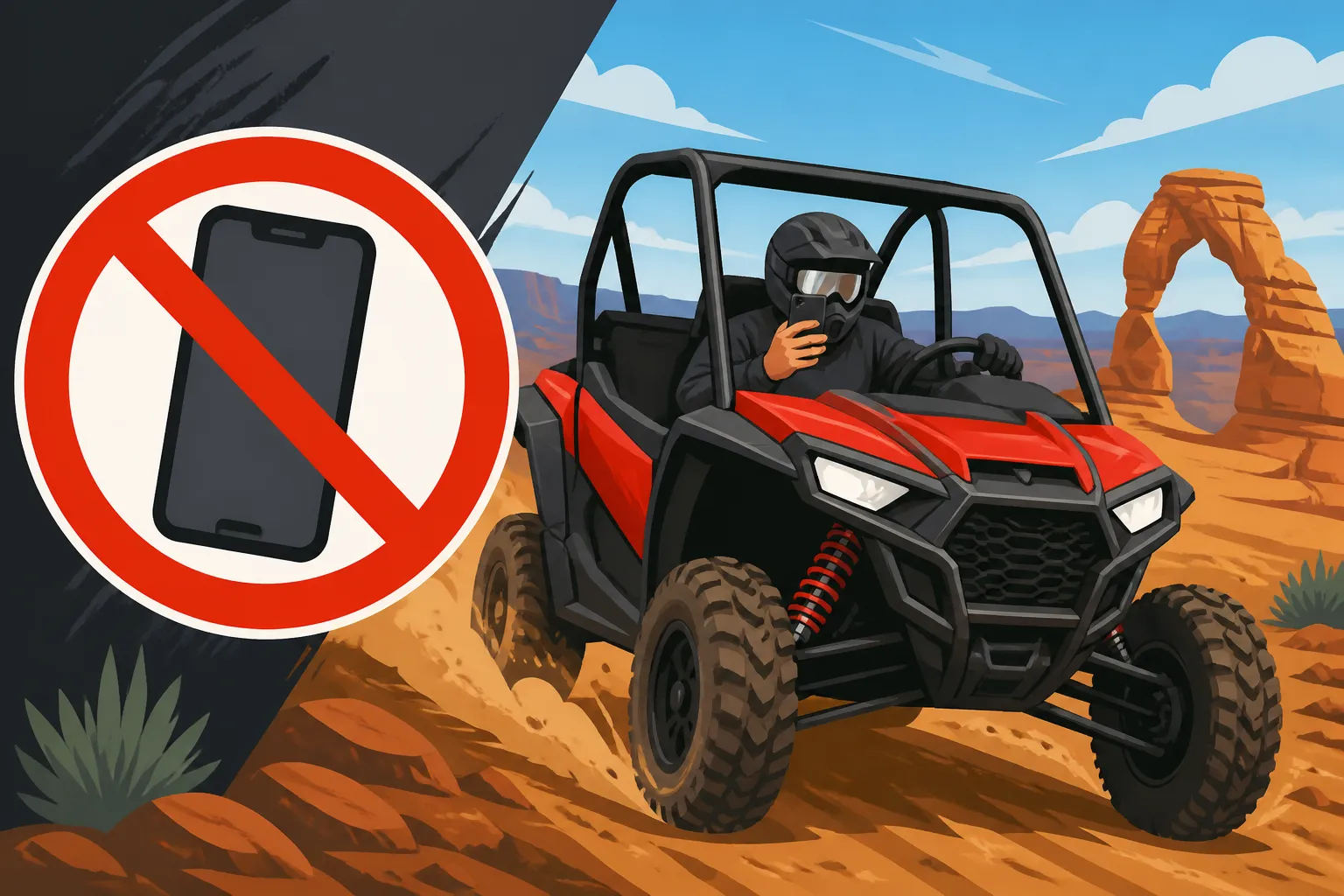
Let's be clear: texting while driving is a big no-no in Utah, no matter what kind of vehicle you're operating. This isn't just about sending messages; it includes reading, composing, or sending any electronic message. So, if you're navigating a rocky trail, pushing through some mud, or (especially) driving through Moab on a street-legal side-by-side, picking up your phone to type or read a text is against the law. The penalties can vary, but generally, it's a moving violation that can come with a fine. It's crucial to remember that your focus needs to be 100% on your surroundings, the terrain, and any potential hazards. A quick text can distract you for critical seconds, and at UTV speeds, those seconds can lead to a serious incident. This rule applies equally to your street-legal UTV as it does to your family sedan.
Hands-Free vs. Handheld: What the Law Says
Utah's law around cell phone use is primarily focused on handheld devices. It generally permits the use of a cell phone for voice communication if it's hands-free. This means you can talk on the phone if you're using a Bluetooth headset, your UTV's built-in communication system, or the speakerphone feature, as long as you're not physically holding the phone. However, the law prohibits drivers from using a handheld wireless communication device to manually enter data, send or read text messages, or use any other non-voice electronic functions while driving. Even for street-legal UTVs, the intention is to keep your hands on the controls and your eyes on the road or trail. Many riders find that adding a secure phone mount, like those offered by SuperATV, can help keep their device visible for GPS navigation without requiring them to hold it, but it's still paramount to use it only when it won't distract from driving.
General Distracted Driving Principles on and Off-Road
Beyond specific cell phone statutes, Utah law also covers general distracted driving. If your use of a cell phone, even hands-free, causes you to drive carelessly, unsafely, or in a way that endangers others, you can still be cited for negligent operation. On trails, even if you're not on a public road, principles of responsible riding dictate that you should always be in full control and aware of your surroundings. A moment's distraction could mean missing a sharp turn, failing to see an obstacle, or losing control. Think about it: if you crash because you were distracted by your phone, regardless of whether it was technically "illegal" on that particular stretch of trail, the consequences are still very real and potentially severe. This also extends to other distractions, like eating, adjusting complicated navigation systems, or even having an intense conversation with a passenger that takes your focus away from the task of driving. [What a Utah Officer Looks for on a Street-Legal ATV] often includes signs of distracted operation, not just equipment compliance.
The Real Dangers of Distracted Driving in a UTV
When you're out on the trails or even driving a street-legal UTV on a paved road, the environment demands your full and undivided attention. Unlike a car, UTVs are often subjected to unpredictable terrain, sudden changes in grip, and exposure to the elements. The consequences of distraction are amplified.
Increased Risk of Accidents and Rollovers
This is perhaps the most obvious danger, but it bears repeating: taking your eyes off the trail or road for even a split second can have catastrophic results. When you're driving a UTV, you're often dealing with varying speeds, uneven surfaces, sharp turns, and potential obstacles like rocks, trees, or other riders. A brief glance at your phone can mean you miss a crucial dip, a sudden drop-off, or an oncoming machine. The risk of rolling over, colliding with another vehicle, or hitting a stationary object goes up dramatically. These aren't just fender-benders; UTV accidents can result in serious injuries, broken bones, or worse. Imagine trying to navigate a technical section of the [Hell's Revenge, Utah's Signature Slickrock] trail while distracted by a text – it's a recipe for disaster. Your hands belong firmly on the wheel, and your eyes should always be scanning the path ahead.
Impaired Reaction Time and Decision-Making
Even if you're not actively texting, simply having a phone conversation, even hands-free, can significantly impair your reaction time. Studies have shown that talking on a cell phone can make you as impaired as a drunk driver in terms of reaction speed. When you're riding a UTV, quick decisions are often necessary to avoid hazards. You might need to swerve to avoid a washed-out section of trail, brake suddenly for an animal, or adjust your line to climb over an unexpected obstacle. If your brain is partially engaged in a conversation, those critical milliseconds of processing time can be lost. This delay can mean the difference between successfully navigating a challenge and losing control of your machine. When you consider the speeds some UTVs are capable of, and the varied terrain on popular routes like the [Paiute ATV Trail], every moment of full mental focus counts.
Environmental Hazards and Group Safety
Riding a UTV often involves interacting with a dynamic environment. Dust, sun glare, changing weather conditions, and other riders are all factors that demand your attention. If you're distracted by your phone, you might not notice a change in the trail surface, a sudden gust of wind, or a fellow rider who's slowed down unexpectedly. This isn't just about your own safety; it's about the safety of everyone in your riding group. If you're leading a group, your distraction could cause others to get lost or encounter unexpected hazards. If you're riding in the middle or back, you could create a dangerous chain reaction. Part of being a responsible rider is being aware of your surroundings and your riding companions at all times. A good general practice is to pull over to a safe spot, well off the main path, before engaging with your phone for anything other than an immediate, critical emergency.
Practical Tips for Staying Connected (Safely) While Riding
We live in a connected world, and sometimes, being reachable or having access to information on your phone is essential. Whether it's for navigation, coordinating with a riding group, or handling an emergency, there are ways to manage your phone use safely without breaking the law or risking an accident.
Secure Phone Mounts and Hands-Free Communication
If you need your phone for GPS navigation, a robust and secure phone mount is your best friend. Products from brands like SuperATV offer durable mounting solutions designed to withstand the vibrations and jostling of off-road riding. These mounts keep your phone in a visible, easily glanceable position (when safe to do so) without requiring you to hold it. Combine this with Bluetooth communication devices, such as helmet communicators or intercom systems, that allow you to take calls or use voice commands hands-free. This way, your hands stay on the wheel or handlebars, and you can focus on driving. Remember, even with a mount, glancing at your phone for navigation should be done sparingly and only when the trail allows for it without compromise to safety. It's often best to glance at your route during a short stop, not while actively driving.
Pre-Plan Your Routes and Notifications
Before you even hit the trail, take some time to pre-plan your route. Download offline maps if you're heading to areas with no cell service. Many GPS apps allow you to do this, ensuring you have navigation even when you're deep in the wilderness. If you're coordinating with a group, establish communication protocols beforehand. Will you use two-way radios, or rely on specific check-in points?
Regarding notifications, consider turning off non-essential alerts while you're riding. A constant stream of texts, emails, or social media updates can be incredibly distracting. Most phones allow you to customize notifications, setting them to silent or vibrate-only, or even using a "driving mode" that limits interruptions. This helps reduce the temptation to check your phone unnecessarily. If an urgent call comes in, you can pull over safely to address it. [Downloading Utah Trail Maps for Offline Use] is a prime example of planning ahead.
Designate a "Phone Person" or Use Stop-and-Go Tactics
For group rides, consider designating a "phone person" – someone who is not driving – to handle communications, take pictures, or check maps while the UTV is in motion. This allows the driver to concentrate fully on the trail. If you're riding solo or everyone is driving their own machine, the best and safest approach is to adopt a "stop-and-go" tactic. Need to send a text? Pull over to a safe, visible spot, come to a complete stop, send your message, and then get back on the trail. Need to take a call? Again, pull over. This might take a few extra minutes over the course of your ride, but those minutes are a small price to pay for safety. Trying to multitask on a UTV is rarely worth the risk. Many riders find that having a dedicated spot where they can pull over to check their phone, like designated viewpoints or rest areas, actually enhances their riding experience by forcing them to pause and take in their surroundings.
| Activity | Legal Status (On Public Roads) | Safety Impact | Best Practice |
|---|---|---|---|
| Texting/Typing | Illegal (handheld) | High risk of severe accident | Never do while driving. Pull over completely. |
| Talking (Handheld) | Generally Illegal | High risk of accident, impaired reaction | Use hands-free, or pull over. |
| Talking (Hands-Free) | Legal (voice only) | Moderate risk of distraction, impaired reaction | Use sparingly, focus on driving. |
| GPS Navigation (Mount) | Legal (if not manually entering data) | Moderate risk if over-glanced | Pre-load maps, glance only when safe, audible directions preferred. |
| Taking Photos/Video | Illegal (handheld) | High risk of severe accident | Never do while driving. Stop completely. |
What to Do If You Need to Use Your Phone in an Emergency
While routine phone use should always be handled responsibly and when stopped, there are situations where using your phone becomes a necessity for safety. Knowing how to react in an emergency, and using your phone effectively, can be critical when you're out in Utah's vast wilderness.
Calling for Help: When It's Essential
In the event of an emergency – such as an accident, a medical issue, a mechanical breakdown, or getting lost – your phone becomes your most important tool for calling for help. Utah's emergency services (911) are accessible from cell phones, and in many popular riding areas, you'll have at least intermittent service.
When making an emergency call:
- Pull over immediately and safely. Stop your UTV completely, turn off the engine, and put it in park. Ensure you're not in the way of other trail users or traffic.
- Assess the situation quickly. What kind of help do you need? Medical, mechanical, or directional?
- Provide precise location details. This is crucial. Use your phone's GPS or mapping app to get exact coordinates if possible, or describe landmarks, trail names, and the direction you were heading. The more detail you can give, the faster help can reach you. Services like OnX Offroad can provide these exact coordinates easily.
- Stay calm and follow instructions. Emergency dispatchers are trained to guide you. Listen carefully to their questions and provide clear answers.
Remember, in an actual emergency, the legal restrictions on handheld use are secondary to obtaining help. However, the best way to ensure effective communication is to be pulled over, safe, and focused on the call. [Search and Rescue Costs in Utah Counties] are a reminder of the importance of good preparation and communication.
Communicating Mechanical Issues or Getting Lost
Beyond severe emergencies, you might encounter situations like a minor mechanical problem that leaves you stranded or simply losing your way on an unfamiliar trail. In these scenarios, your phone is invaluable for contacting fellow riders, roadside assistance, or reviewing maps.
- Mechanical Breakdown: If your UTV breaks down, pull it to the side of the trail or road if safe to do so. Use your phone to contact a friend, family member, or a local repair service. Having a list of emergency contacts and local UTV repair shops saved in your phone (or a physical copy) is a smart move. You might even find online forums or communities to troubleshoot minor issues.
- Getting Lost: It happens to the best of us! If you find yourself disoriented, pull over to a safe location. Don't try to navigate while driving. Open your map app, check your current location, and try to retrace your steps or find a known landmark. If you're with a group, call or text them to let them know your situation and coordinate a meeting point. Consider carrying a portable power bank to ensure your phone doesn't die when you need it most, especially if you're relying on it for GPS on longer rides through areas like the [San Rafael Swell: Utah's Desert Maze].
Always prioritize your safety and the safety of others. While the allure of instant communication is strong, the dangers of distracted driving a UTV far outweigh the convenience. A quick pull-over is always the safest and smartest option for any non-emergency phone interaction.
Disclaimer
This article is for general informational purposes only and does not constitute professional advice. Laws, prices and regulations vary by location and change over time. Consult a qualified professional for guidance on your specific situation.