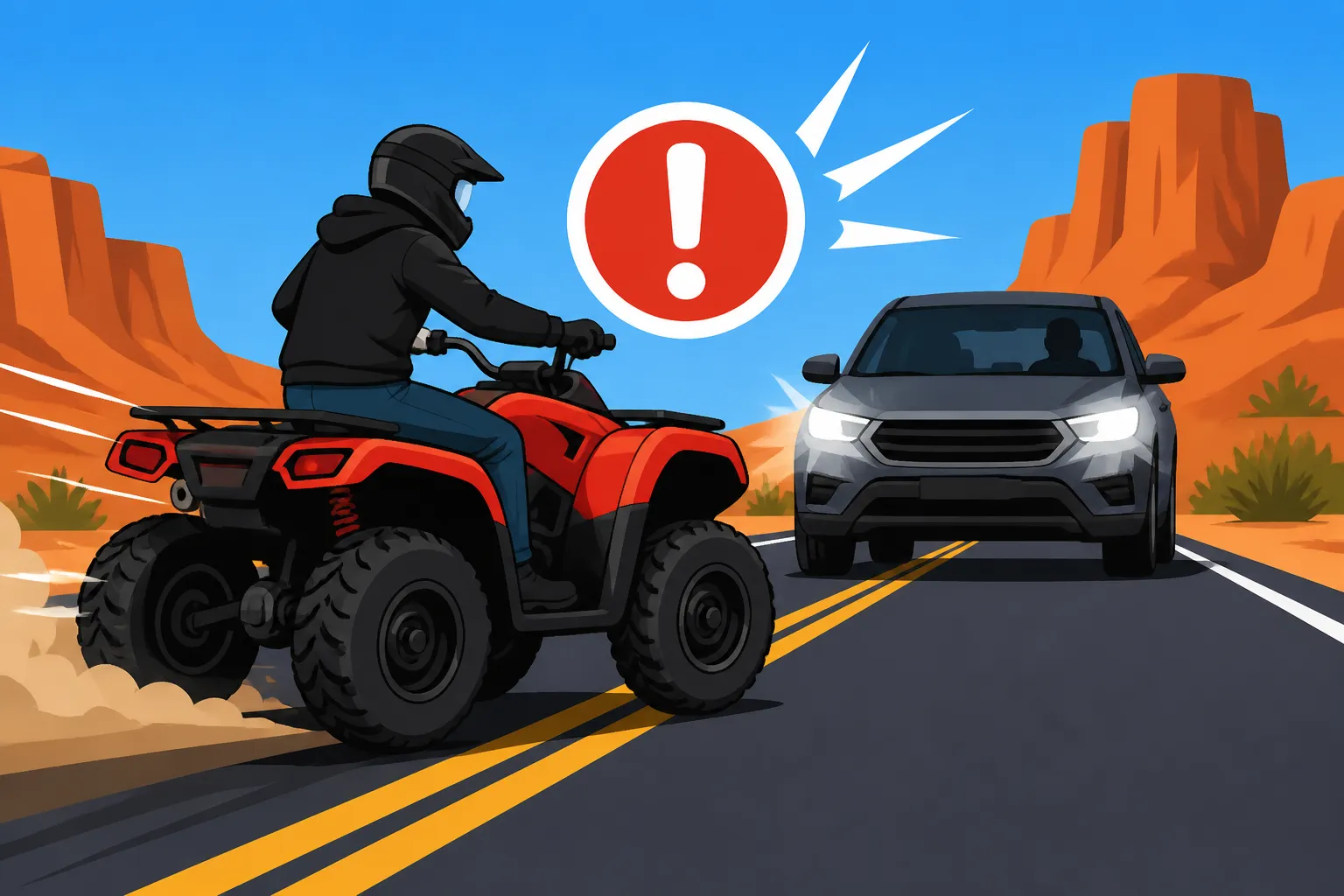
Crossing a Utah Highway on an Unregistered Quad
We've all been there: you're just trying to get your ATV or UTV from point A to point B, maybe crossing a short stretch of pavement to link up with the next glorious section of trail. But if your quad isn't registered, that seemingly innocent hop across a Utah highway can land you in a world of trouble. This guide is all about helping you understand the real risks and legalities of riding an unregistered machine on public roads in Utah, and what you can do to stay safe and legal.
The Tricky Terrain of Public Roads and Unregistered OHVs
It's a common dilemma for riders: you've got your off-highway vehicle (OHV) ready for adventure, but the trailhead is just across a main road, or maybe a quick dash down a paved county road seems like the easiest way to connect two trail systems. The temptation to just "go for it" is strong, especially if it's only a few hundred feet. However, when your quad or side-by-side isn't properly registered for highway use, you're stepping into a legal gray area that Utah law tends to see as pretty black and white.
The core issue here is that most highways and public roads in Utah are designated for vehicles that are street legal and carry current registration for on-highway operation. This is distinct from an OHV registration, which allows you to ride on designated off-highway trails and roads. Many riders assume that as long as their machine is registered as an OHV, they're good to go for a quick road crossing. Unfortunately, that's generally not the case for state highways or other public roads not specifically designated for OHV use.
The frustration is understandable. You bought your machine for trail riding, not for navigating city streets. Why should a five-second pavement crossing be an issue? But the law views public roads as shared spaces with different rules, primarily focused on safety and regulation for all types of traffic. It's not just about getting caught; it's about the potential for accidents and the significant liabilities that can arise when an unregistered vehicle is involved.
The Core Restriction: Public Roads and Unregistered OHVs
Utah's regulations are quite clear: operating an off-highway vehicle on a public highway or road that is not designated for OHV use requires the vehicle to be street legal and properly registered for highway travel. This means having things like a license plate, working lights, mirrors, a horn, and all the other equipment that allows it to safely integrate with standard road traffic. An OHV registration decal, while crucial for trail access, doesn't grant you this privilege.
Think of it this way: your trail-ready side-by-side, while powerful and fun off-road, isn't designed with the same safety features or visibility standards as a car or truck meant for highway speeds. Local authorities, including the Utah Highway Patrol and county sheriff's departments, are tasked with enforcing these regulations to prevent accidents and ensure everyone's safety on the roads. They're not necessarily trying to spoil your fun, but rather to uphold public safety standards.
For instance, imagine you're riding your unregistered UTV on a gravel county road that suddenly turns into asphalt for a mile before the next trail spur. That stretch of asphalt, even if it feels like a continuation of the trail, is legally a public road. A quick visual check by a passing trooper is all it takes to identify a non-street-legal OHV without an on-highway license plate, potentially leading to a stop. This isn't a rare occurrence; law enforcement officers are keenly aware of the routes riders use to link trails, and they often patrol these transitional areas.
Exceptions and Nuances: Agricultural Use and Emergencies
While the general rule is strict, Utah law does have a few narrow exceptions for operating OHVs on public roads, though these rarely apply to recreational riders simply trying to connect trails. One significant exception often discussed is for bona fide agricultural purposes. If you're using your ATV or UTV as part of an active farming or ranching operation, you may be permitted to cross or even briefly travel on certain public roads to move between fields or properties. However, this isn't a blanket pass; there are often restrictions on distance, speed, and specific roads. It's generally not applicable if you're just heading out for a weekend ride.
Another rare exception might involve genuine emergencies, where using an OHV on a road is the only feasible way to address an immediate threat to life or property. Again, this is not for recreational purposes and would be judged on a case-by-case basis by law enforcement. It's definitely not something you can plan for or rely upon when linking up trail segments.
It's also worth noting that some local jurisdictions, particularly small towns heavily integrated with OHV trail systems, might have specific ordinances that allow OHVs on certain town streets for direct access to trails or services. However, these are local ordinances and typically apply only to specific, clearly marked roads within that town's limits, and often only to properly registered OHVs (not necessarily street-legal ones). They do not extend to state highways or county roads outside those specific designations. Always check with the local city or county offices for their specific rules, as these can vary greatly across the state. Without these explicit local allowances, the default state law regarding street legality on public roads applies.
The Risky Business: Consequences of Unregistered Road Crossing
So, you decide to risk it and cross that highway. What's the worst that can happen? Well, beyond the obvious risk of an accident with another vehicle, there are a number of significant legal and financial consequences you could face. It's not just a slap on the wrist; these penalties can quickly add up and really put a damper on your riding season. Understanding these risks is crucial for making informed decisions about how you transport your machine. For more details on what happens when you don't follow the rules, you might want to read [Penalties for Riding Unregistered in Utah].
The thought of getting pulled over is often enough to deter most riders. But what if there's an accident? The legal ramifications can escalate dramatically, making a quick, unregistered road crossing a very expensive shortcut. It's about more than just a fine; it's about the potential loss of your machine, significant legal fees, and the stress of dealing with an already bad situation made worse by non-compliance.
Financial Penalties and Fines
The most immediate consequence of being caught riding an unregistered OHV on a public highway is a citation, which comes with a fine. The exact amount can vary depending on the jurisdiction and the specific violation, but it's typically a few hundred dollars. This isn't like a parking ticket; it's a moving violation that reflects the serious nature of operating an unauthorized vehicle on a public road. Law enforcement officers are trained to spot the lack of a standard license plate and other street-legal equipment.
Consider a scenario: you're riding with a friend near Moab, trying to get to a new section of trail. You see a clear, short stretch of highway and think, "It's just a hundred yards, what's the harm?" A Utah Highway Patrol officer, however, views that hundred yards as a direct violation. You could be stopped, issued a citation, and suddenly your fun day on the trails turns into a costly mistake. And it’s not just the officer on the road; sometimes concerned citizens will report OHVs they see on highways, leading law enforcement to investigate.
It's also important to remember that this fine is separate from any potential fines for not having your OHV registered at all, which is another common issue. If your machine is unregistered for both off-highway and on-highway use, you're looking at compounding problems. Staying on top of your registration is key, and you can learn more about the process in [How to Register an ATV or UTV in Utah].
Impoundment and Recovery Headaches
Beyond the fine, there's a very real risk that your unregistered OHV could be impounded. If an officer determines that your machine is being operated illegally on a public road and cannot be legally driven from the scene, they have the authority to have it towed and stored. This is where things get really expensive and inconvenient. Impound fees include the tow truck charge, daily storage fees, and administrative fees from the impound lot. These charges can quickly spiral into hundreds, even thousands, of dollars.
Imagine your UTV, equipped with all your SuperATV accessories, sitting in an impound lot in a town far from home. You'd have to arrange transportation to the impound lot, pay all outstanding fees, and then find a way to legally transport your machine out of there – likely on a trailer, since you couldn't legally ride it away. This not only eats into your wallet but also completely derails your riding plans, adding immense stress and hassle. To understand this specific risk, take a look at [Impound Risk for Unregistered Machines in Utah].
This scenario becomes even more complicated if you're visiting from out of state or if the impound lot is closed on weekends. You might be stranded without your machine for days, incurring even more storage fees. It's a logistical nightmare that far outweighs the perceived convenience of a quick road crossing.
Insurance Implications in an Accident
This is perhaps the most serious consequence. If you're involved in an accident while operating an unregistered OHV on a public highway, your liability insurance for that OHV may be voided or severely limited. Most standard OHV insurance policies are designed for off-road use and may not cover incidents that occur on public roads where the vehicle is operating illegally. This means if you cause damage to another vehicle, property, or injure someone, you could be held personally responsible for all the associated costs.
Consider an unfortunate hypothetical: you're making that quick dash across a highway, and another driver, perhaps not expecting an OHV to be on the road, misjudges your speed, leading to a collision. If your machine isn't street legal and registered for highway use, your insurance company could deny coverage. This leaves you vulnerable to lawsuits for vehicle repairs, medical bills, lost wages, and pain and suffering – potentially bankrupting consequences.
Even if you have a personal auto policy, it's highly unlikely to cover an OHV operating illegally on a public road. The financial and legal exposure in such a situation is immense. The peace of mind that comes with knowing you're fully covered is completely lost when you're operating outside the legal framework. It’s a sobering thought that should give any rider pause before making that choice.
| Consequence | Description | Immediate Impact | Long-Term Impact |
|---|---|---|---|
| Fines & Citations | Issued for operating an OHV illegally on a public road. | Monetary fine (hundreds of dollars), negative interaction with law enforcement. | Can accumulate if repeated, impacts riding reputation. |
| Impoundment | Vehicle is towed and stored at an impound lot. | Significant tow and storage fees, loss of riding time, logistical headache. | Potential for permanent loss if fees aren't paid, major financial burden. |
| Insurance Issues | Your OHV liability insurance may not cover accidents on public roads if illegally operated. | Personal liability for all damages, legal fees if sued. | Financial ruin, severe credit damage, ongoing legal battles. |
| Accident Risk | Increased risk of collision with other vehicles due to differing speeds, visibility, and expectations. | Injury or death to yourself or others, property damage. | Trauma, medical bills, legal charges, emotional distress. |
Clearing the Path: Understanding Utah's Registration Requirements
Before we dive into ways to legally navigate public roads, it's important to have a solid grasp on what Utah requires for OHV registration in general. Many riders confuse OHV registration with street-legal registration, and while they're both about getting a decal and staying compliant, they serve very different purposes. Knowing the difference is the first step toward staying out of trouble.
Utah wants its riders to be registered for a few good reasons, primarily revolving around funding and accountability. It's not just a bureaucratic hoop; it directly impacts the trails we all love to ride. Understanding these basics will help you appreciate why the rules are in place and why skirting them, even for a moment, can have consequences. You can find detailed information on the full process in [Utah OHV Registration Fees, Start to Finish].
Why Utah Registers OHVs
Utah requires OHV registration primarily to fund the maintenance and development of its extensive trail system. When you pay your registration fees, a significant portion of that money goes directly back into the OHV program, supporting trail grooming, signage, land acquisition, enforcement, and education efforts. Without these funds, our amazing riding areas, like the Paiute Trail system or the trails around Sand Hollow, wouldn't be as well-maintained or accessible.
It's a user-pay, user-benefit system. Every registered machine contributes to the infrastructure that makes Utah one of the premier OHV destinations in the country. This ensures that generations of riders can continue to enjoy the diverse landscapes Utah has to offer, from the red rocks of Southern Utah to the high mountain trails of the Uintas.
Additionally, registration provides a level of accountability. It helps track ownership, which can be crucial in cases of theft or accident. It also provides law enforcement with a way to identify machines and ensure they are being operated by responsible owners. So, while it might feel like another chore, OHV registration is really about contributing to and protecting the sport we all love.
How to Get Your Machine Registered
Getting your ATV or UTV registered in Utah is a straightforward process, typically handled through the Utah Division of Motor Vehicles (DMV). For new machines bought from a dealer, they often handle the initial paperwork for you, ensuring you get your temporary permit and permanent decal. If you're buying privately or bringing a machine in from out of state, you'll need to gather a few key documents and visit the DMV yourself.
Generally, you'll need your vehicle's title, a bill of sale (especially for private party purchases), and proof of a VIN inspection for some machines. Once the paperwork is processed and fees are paid, you'll receive your OHV registration decal, which needs to be prominently displayed on your machine. This decal confirms you're legal for off-highway use. Remember, this decal does not make your machine street legal. For that, you need a different set of requirements and a separate process, as highlighted in [Utah OHV Registration vs Street-Legal Registration].
Many people wonder if they can do this process online. While some aspects of renewal can be done online, initial registrations often require an in-person visit to the DMV, especially for title transfers or out-of-state vehicles. It's always best to check the official Utah DMV website for the most current requirements and options. Don't let the process intimidate you; it's a necessary step to ensure your machine is ready for the trails and to avoid those unnecessary fines for riding unregistered.
Smart Choices: Alternatives to Illegal Highway Crossing
Given the serious risks associated with riding an unregistered OHV on a public highway, it's clear that finding legal and safe alternatives is paramount. Luckily, there are several straightforward options that can help you avoid potential fines, impoundment, and catastrophic liabilities. These solutions require a bit of planning, but they offer immense peace of mind.
Most riders, once they understand the full scope of the risks, quickly realize that a few minutes of convenience isn't worth jeopardizing their machine or their financial well-being. Investing in the right gear or a little extra time for transport pays dividends in safety and legality.
Trailering Your Machine: The Safest Bet
Without a doubt, the safest and most legally sound way to get your OHV across a public highway is to trailer it. This means loading your ATV or UTV onto a dedicated utility trailer or into the bed of your truck and transporting it like any other cargo. This completely removes your machine from the category of "operating illegally on a public road" because it's being transported, not driven.
This method completely bypasses all the issues of street legality, registration, and insurance coverage on public roads. You can pull your SuperATV equipped UTV with confidence, knowing you're in full compliance. It's what most responsible riders do when they need to cover significant distances on pavement or cross busy highways to reach new trailheads. Plus, trailering helps keep your tires in better shape for the trails, as asphalt can wear them down quickly.
While it might add a few extra minutes to load and unload, the benefits far outweigh the minor inconvenience. It ensures your machine is safe, you're legal, and you won't be facing any unexpected conversations with law enforcement or, worse, dealing with the aftermath of an accident without proper coverage. For tips on managing your OHV gear, including trailers, consider the information in [What Utah Riders Must Carry].
The Street-Legal Conversion Option
For those who frequently find themselves needing to use public roads to connect trails, or who simply want the freedom to ride from their campsite directly to the trailhead, converting your OHV to be street legal is an excellent long-term solution. This involves outfitting your ATV or UTV with specific equipment that meets Utah Department of Transportation (UDOT) standards for on-road operation, and then getting it inspected and registered for highway use.
What does this typically entail? You'll need things like a horn, mirrors on both sides, turn signals, a license plate bracket with a light, a windshield or eye protection, and often a speedometer. Many aftermarket companies, like SuperATV, offer comprehensive street-legal kits that include most of these components, making the conversion process much easier. Once modified, you'll take your machine to a certified inspection station, get it approved, and then visit the DMV to get an actual license plate and street-legal registration.
This route provides the ultimate flexibility, allowing you to ride your OHV on most public roads (with some exceptions like interstates and high-speed highways) just like any other vehicle. It requires an initial investment in parts and inspection fees, but for frequent road users, it's often worth every penny. You can delve deeper into this process by checking out [Making a UTV Street Legal in Utah] and [Utah Street-Legal ATV Equipment Requirements].
Temporary Permits: Do They Apply Here?
Riders sometimes wonder if a temporary permit can bridge the gap for road crossings. Generally, temporary permits in Utah are issued for very specific purposes, such as allowing you to legally transport a newly purchased OHV directly home from a dealer before its permanent registration is finalized, or for certain organized events.
A temporary permit does not typically grant you permission to operate an unregistered or non-street-legal OHV on public highways for general trail access. The intent of these permits is usually limited to moving the vehicle for administrative reasons or within controlled environments. Attempting to use a temporary permit as an excuse for crossing a highway to get to a trail will likely still result in a citation if you're stopped. For more on initial registration and temporary solutions, see [Riding Home From the Dealer Before Registering].
Always clarify the exact terms and limitations of any temporary permit you might obtain. Assume that if your OHV isn't street legal and fully registered for highway use, you should not be riding it on public roads, regardless of a temporary OHV registration permit. When in doubt, always default to trailering your machine.
Riding Smart: Practical Steps for Safer Riding (Even if You're Taking Risks)
While the explicit advice is always to avoid riding an unregistered OHV on public roads, we understand that sometimes, despite best intentions, situations arise where a quick, short crossing might seem unavoidable to some riders. If you ever find yourself in such a situation, or if you're navigating areas where local ordinances allow limited OHV road use (which should always be verified!), there are practical steps you can take to minimize risk and maximize safety. These steps are not a substitute for legal registration or street-legal conversion, but they are about mitigating danger.
Being visible, predictable, and aware of your surroundings are universal safety principles that apply even more acutely when you're operating an OHV on or near public roads. Think defensively, always.
Minimizing Exposure: Quickest Route Possible
If you absolutely must cross a public highway with an unregistered OHV (and again, we highly recommend against it unless explicitly allowed by local ordinance), your goal should be to minimize your time on the pavement. Plan your route to take the shortest, most direct path across the road. Avoid any unnecessary travel along the road or making multiple stops. The less time you spend in a risky situation, the lower your chances of encountering an issue.
This means scouting your connections ahead of time. Don't just guess where the next trail entrance is. Use maps, GPS, or even a pre-ride in your truck to identify the exact spot where you need to re-enter the off-highway system. Choose intersections that offer good visibility for both you and oncoming traffic, and avoid busy roads during peak traffic hours. The fewer cars, the better.
For instance, if you're exploring the San Rafael Swell and need to hop across a lesser-used county road to link two sections of trail, assess the visibility. Can you see far enough in both directions? Are there blind spots or crests that would hide approaching vehicles? Every second you're on that pavement, you're exposed. Make it quick, direct, and purposeful.
Visibility and Safety Gear
Visibility is paramount whenever an OHV is near or on a public road, especially for machines that aren't designed to blend into road traffic. Wear bright, high-contrast clothing. Helmets are always a good idea for OHV riding, but on a road, they also add a layer of visibility. Consider adding a whip flag to your OHV, even if not explicitly required for a road crossing, as it significantly increases your profile, especially in areas with hills or limited sightlines.
If you're operating an unregistered OHV on a road in low light conditions (dawn, dusk, or night), the risk escalates dramatically. Your OHV's factory headlights and taillights might be sufficient for the trail, but they are often not as bright or as legally compliant as those on street-legal vehicles. This is why street-legal conversions require specific lighting standards. If you absolutely must cross at these times, ensure all your lights are functioning perfectly, and consider adding auxiliary lights for extra visibility.
Remember, the goal is to be seen. Other drivers on public roads are not expecting to encounter an OHV, so you need to overcompensate with your visibility efforts. This goes hand-in-hand with being predictable in your movements – no sudden swerves or unexpected stops.
Knowing Your Local Ordinances
As mentioned earlier, some cities and counties in Utah do have ordinances that allow OHV use on specific public roads within their boundaries. These are usually in popular OHV destination towns like Moab, Kanab, Marysvale, or Hurricane, where OHV tourism is a major part of the local economy. These ordinances are often designed to allow riders direct access from lodging to trailheads, fuel, or restaurants.
However, it is critically important to understand that these local ordinances have strict limits. They typically apply only to certain designated streets, often have speed limits (e.g., 15 mph in Moab), and usually require your OHV to be properly registered with the state of Utah (though not necessarily street legal for state highways). They do not extend to state highways that pass through these towns unless explicitly stated, and they certainly don't apply to general county roads or highways outside the specified city limits.
Before you rely on a local ordinance, do your homework! Check the city's official website or call their local law enforcement. Look for signage. For example, in many southern Utah towns, there will be clear "OHV Route" signs. If you don't see them, assume the general state law applies. Never assume that because one town allows it, all towns or all roads will. Ignoring these specific rules can still lead to fines and legal issues, even if you thought you were complying. This local variability is why understanding the rules laid out in [City and County OHV Rules Across Utah] is so important.
Disclaimer
This article is for general informational purposes only and does not constitute professional advice. Laws, prices and regulations vary by location and change over time. Consult a qualified professional for guidance on your specific situation.