Interstates, Freeways and Utah OHV Law
One of the most common questions and biggest areas of confusion for off-highway vehicle (OHV) riders in Utah revolves around where you can and cannot legally ride, especially when it comes to higher-speed roads. Many riders dream of the ultimate freedom, but the reality is that certain major arteries of travel are strictly off-limits, even for machines that are otherwise street-legal. This guide will clarify Utah's OHV laws concerning interstates and freeways, helping you navigate the state safely and legally.
The General Rule: No OHVs on Interstates and Freeways
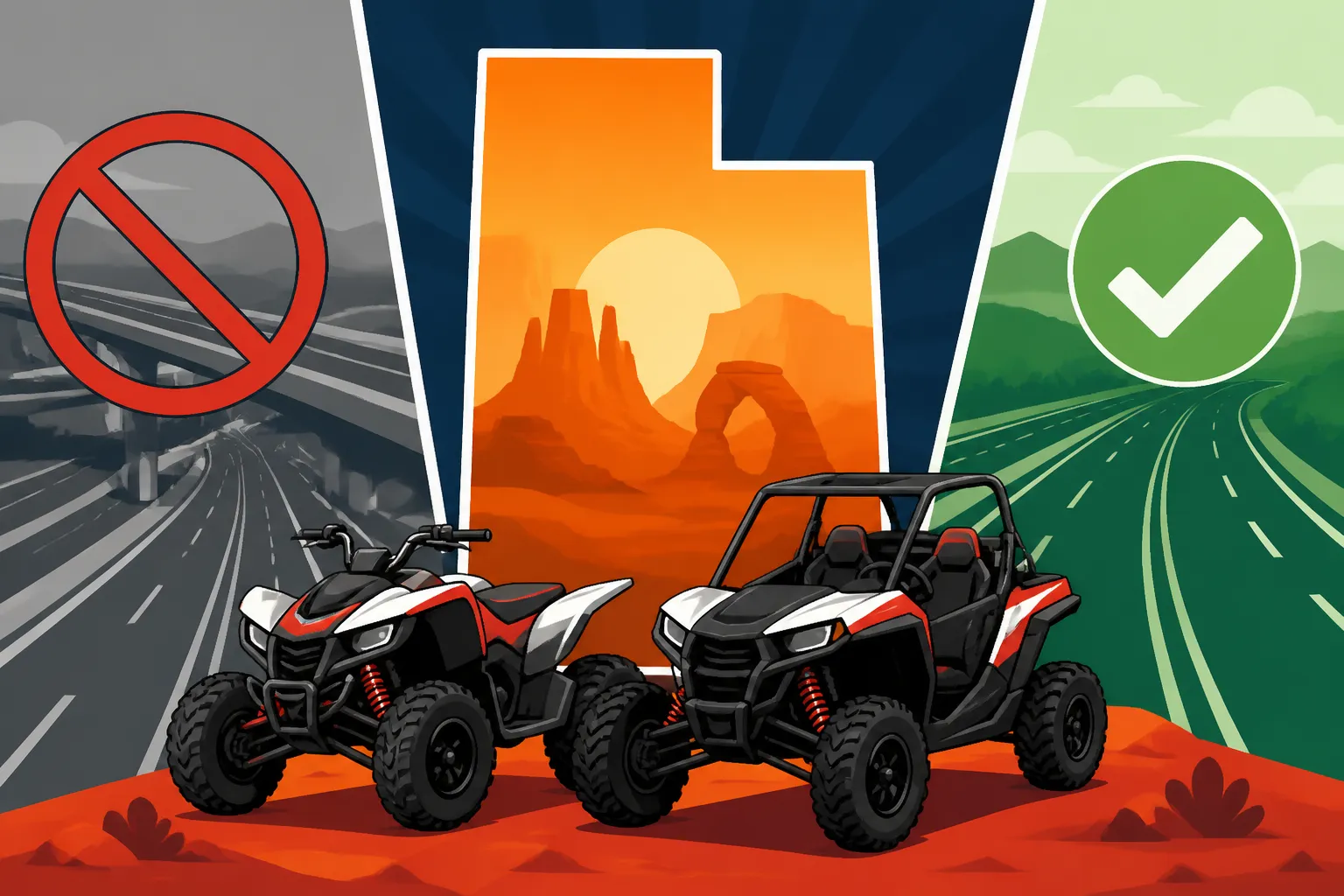
Let's cut right to it: Utah law is very clear on this. You absolutely cannot ride an off-highway vehicle, whether it's an ATV, UTV, or dirt bike, on an interstate highway or a freeway. This isn't just a suggestion; it's a hard and fast rule designed for your safety and the safety of everyone else on the road. It can be frustrating when you see a direct route on a map that would shave off miles, but choosing convenience over legality and safety is a risk that comes with severe consequences.
Why This Rule Exists
The primary reason for this strict prohibition is safety. Interstates and freeways are engineered for high-speed traffic, typically 65 to 80 miles per hour, and the design doesn't account for slower-moving vehicles like OHVs. The significant speed differential between a typical passenger car or semi-truck and an OHV creates an extremely dangerous situation. Even the fastest UTVs, which might top out at 70-80 mph, often aren't built for sustained high-speed road travel, and their handling characteristics are very different from a car's. They lack the mass, braking capability, and crash protection that larger vehicles offer, making any collision at freeway speeds catastrophic. Think about trying to merge onto I-15 at 60 mph on a machine that might only hit 70 mph at its absolute limit, with a semi-truck bearing down on you — it’s simply too risky.
Furthermore, these roads are designed for specific types of vehicles and traffic flow, with limited access points and high-volume merging lanes. OHVs are not typically equipped with all the same safety features as conventional highway vehicles, such as robust crumple zones or extensive lighting systems for all conditions. The risk of an accident, congestion, or even debris from off-road tires creating hazards for other drivers is just too high to permit OHV use on these critical transportation corridors.
Defining Interstates and Freeways in Utah
It's important to understand exactly what constitutes an "interstate" or "freeway" under Utah law, as confusion can arise with other state highways. Generally, an interstate highway is part of the national Dwight D. Eisenhower National System of Interstate and Defense Highways, easily identified by signs with red, white, and blue shields (e.g., I-15, I-70, I-80). Freeways, while not always part of the interstate system, share similar characteristics: they are multi-lane, divided highways with controlled access, meaning there are no at-grade intersections, driveways, or traffic signals. Access is limited to on- and off-ramps. Examples in Utah include parts of US-89 in certain areas or certain sections of state routes that are built to freeway standards.
What helps distinguish them is the signage. If you see signs indicating "Freeway Entrance," "No Pedestrians," or "Minimum Speed Limit," you're almost certainly on a road where OHVs are prohibited. Sometimes, a state highway might feel like a freeway because it's divided and fast-moving, but it might still have intersections or driveways at grade level, which means it isn't a true freeway. The core distinction is that controlled access, which eliminates cross-traffic and dictates high-speed flow. Riders often mistakenly assume that because a road is paved and fast, it's a freeway, but the legal definition is crucial. [Roads Utah Keeps Closed to Street-Legal ATVs] delves deeper into these distinctions for other road types as well.
Penalties for Violating the Rule
Riding an OHV on an interstate or freeway in Utah is not just a minor infraction; it carries significant legal consequences. If a Utah Highway Patrol trooper or local law enforcement officer catches you, you're likely facing a citation for an illegal operation of an off-highway vehicle, which can result in a hefty fine. Beyond the monetary penalty, your OHV could be impounded, leaving you stranded and incurring towing and storage fees. This can be a huge hassle and a drain on your wallet.
More importantly, if you're involved in an accident on such a prohibited road, even if it's not your fault, you could face additional charges and significant liability issues. Your insurance might not cover damages if you were operating the vehicle illegally on a restricted roadway. Imagine the nightmare of a totaled machine, medical bills, and a lawsuit, all because you took a shortcut down the interstate. It's simply not worth the risk. [What a Utah Trooper Checks at a Trailhead] offers more insights into what law enforcement looks for in general when encountering OHVs.
Limited Exceptions for Crossing
While traveling on an interstate or freeway is forbidden, there are very specific and limited circumstances where an OHV might legally interact with these roads, primarily involving crossing them. These aren't exceptions to ride along the freeway, but rather to traverse it when necessary to get from one legal riding area to another.
Crossing at Designated Intersections
In some rare instances, a state highway that an OHV can legally use might have an at-grade intersection that crosses an interstate's on-ramp or off-ramp, or even the interstate itself if it's a very old or unique setup. This is incredibly uncommon for the main lanes of an interstate, as most are designed with overpasses or underpasses. However, it is more plausible for state roads that run parallel to or cross what feels like a freeway but is technically a divided highway with some at-grade crossings. The key here is "designated intersection." You can only cross where there's a clear, marked intersection, complete with traffic signals or stop signs, and where the connecting road itself is legal for OHV use. You must treat it like any other intersection, obeying all traffic laws. This is about crossing over or through the connecting road at a specific point, not getting onto the freeway itself.
Riding Under or Over an Interstate
This is generally the most common and legal way an OHV interacts with an interstate or freeway. Many county roads, state routes, and even city streets pass under or over these major highways. If the road you are on is legal for OHV use, and it simply happens to pass beneath an interstate bridge or crosses over an interstate on an overpass, that's perfectly fine. You are not on the interstate itself; you are on a separate, parallel, or perpendicular roadway. For instance, if you're on a county road heading to a trailhead and that road takes you under I-15, you're not breaking any laws, assuming the county road itself permits OHVs. This allows riders to access trail systems or towns separated by these large roadways without ever having to put a tire on the restricted pavement. It's all about ensuring your OHV remains on the legal route, even if that route happens to weave around or under major highways.
Emergency and Authorized Use
As with most traffic laws, there are usually specific exceptions for emergency vehicles or authorized personnel. For instance, law enforcement, search and rescue teams, or maintenance crews operating within their official duties might be authorized to use OHVs on certain parts of interstates or freeways, particularly for tasks like accident response, construction, or roadside emergencies where specialized off-road capability is needed. These are highly specific, controlled situations and do not apply to the general public. Unless you are a licensed professional operating under specific authorization, these exceptions do not give you permission to ride your OHV on these roads. This is generally covered under [Government and Volunteer Machines in Utah] in broader terms.
Distinguishing Freeways from Other Public Roads
One of the biggest sources of confusion for OHV riders in Utah is knowing exactly which roads are considered "freeways" or "interstates" and which are merely high-speed state highways or county roads where OHVs might be allowed under certain conditions. The consequences of guessing wrong can be severe, so understanding the distinctions is crucial.
Understanding Different Road Classifications in Utah
Utah's road network is diverse, ranging from primitive dirt tracks to bustling multi-lane highways. It's not all black and white, and what looks like a freeway might not be one in the legal sense.
- Interstates (e.g., I-15, I-80): These are always off-limits for OHVs. They are part of the federal highway system, designed for high-speed, long-distance travel, and have fully controlled access.
- Freeways (State-Designated): These are state highways built to freeway standards (controlled access, divided, multi-lane, no at-grade intersections). While not part of the interstate system, they are treated the same for OHV prohibitions.
- State Highways (Non-Freeway): Many state routes (e.g., US-89, SR-12, SR-24) are not freeways. They might be two-lane or four-lane, but they often have at-grade intersections, driveways, and traffic lights. In certain areas, and particularly if your machine is street-legal, these roads may be accessible for short distances or specific purposes, often with a 50 mph speed limit restriction for OHVs. You'll need to know [Where Street-Legal ATVs Can Drive in Utah] to be sure.
- County Roads: These are maintained by counties and can range from paved routes to gravel and dirt roads. Many county roads are open to street-legal OHVs, often serving as crucial links to trailheads or between small towns.
- City Streets: Rules vary greatly by municipality. Some cities are very OHV-friendly, allowing street-legal machines on most streets, while others have strict prohibitions. [City and County OHV Rules Across Utah] provides much more detail on this patchwork of regulations. For example, Moab has specific rules about speed limits and noise that riders must respect.
The key is that while some roads may look like freeways due to high speeds and multiple lanes, if they have traffic lights, stop signs, or direct access from private property, they are generally not classified as freeways. This distinction is vital for OHV riders.
The Speed Limit as a Clue
While not a definitive legal indicator, the posted speed limit can offer a strong clue about whether a road is an interstate or freeway, or a more permissible state highway. Interstates and freeways in Utah typically have speed limits ranging from 65 to 80 mph. If you're on a road with these kinds of high-speed limits, it's a very strong indicator that OHVs are not allowed. Street-legal OHVs on permissible public roads, on the other hand, are typically subject to a maximum speed limit of 50 mph in Utah, regardless of the posted limit for other vehicles. [What Utah's 50 mph Limit Means for Riders] is a critical piece of information for street-legal riders. If you're encountering a road where the flow of traffic is regularly above 50 mph, you should be very cautious and question if your OHV belongs there.
Signage and Markings to Look For
The easiest way to tell if you're on a prohibited road is to pay attention to signage.
- Interstate Shields: The unmistakable red, white, and blue interstate shields (I-15, I-70, I-80) are your clearest warning.
- "No Pedestrians / No Bicycles / No Motor-Driven Cycles" signs: These often indicate a controlled-access freeway, where OHVs are also prohibited.
- Green Freeway Entrance/Exit Signs: While these sometimes pop up on state highways, if you see them consistently along with restricted access, it's a good sign you're on a freeway.
- Absence of At-Grade Crossings: If you notice there are no traffic lights, stop signs, or direct driveways for miles, and all access is via ramps, you're on a freeway or interstate.
- On-Ramp/Off-Ramp Markings: These are characteristic of controlled-access roads.
If you have any doubt, it's always safer to assume the road is prohibited and seek an alternative route. Planning your route in advance with appropriate maps is always the best strategy.
Street-Legal Conversions: What They Don't Allow
Many riders make the investment to convert their OHV to street-legal status in Utah, adding all the necessary equipment like turn signals, mirrors, a horn, and a license plate. This is fantastic for accessing a vast network of county roads and city streets, even riding [Riding Through Town to the Trailhead in Utah]. However, there's a significant misconception that making your OHV street-legal grants you access to all public roads, including interstates and freeways. This is simply not true.
The Limits of Street-Legal Status
Even when your UTV or ATV proudly displays a Utah license plate and meets all the [Utah Street-Legal ATV Equipment Requirements], it's still fundamentally classified as an Off-Highway Vehicle by state law. Utah's street-legal OHV laws grant conditional access to certain public roads, but they do not reclassify your machine as a conventional motor vehicle for all purposes. The law specifically carves out exceptions for OHV use on certain state highways, county roads, and city streets, typically limited by speed and by the type of road. Interstates and freeways remain outside of these exceptions. You're getting extended access, not unlimited access. Think of it as a special privilege for specific roads, not a blanket permission slip for everything with asphalt.
Equipment Requirements Versus Road Access
Adding equipment like SuperATV street-legal kits is a necessary step for meeting the inspection requirements for street-legal conversion. You'll need headlights, taillights, brake lights, turn signals, a horn, a license plate light, mirrors on both sides, and a windshield or eye protection. But simply having these components doesn't magically change the legal designation of an interstate or freeway. These equipment requirements are about making your OHV visible and controllable enough for lower-speed, general-purpose roads where OHV use is permitted. They don't make your machine suddenly safe or appropriate for the speeds and traffic volumes of an interstate. You can install the best SuperATV horn or the brightest LED turn signals, but they won't change the underlying legislation that prohibits OHVs on those high-speed, controlled-access highways.
Why Street-Legal Still Means No Interstates
The core reason why street-legal OHVs are still banned from interstates and freeways comes back to the fundamental design and purpose of these roads. Even a fully equipped street-legal UTV is still slower, lighter, and less protected than a typical passenger car. The state of Utah, like most states, has determined that the inherent dangers of mixing these vehicles with high-speed, high-volume interstate traffic outweigh any convenience. The laws are designed to channel OHV traffic onto appropriate roadways where the risks are minimized and where their unique characteristics are better accommodated. So, while [Making a UTV Street Legal in Utah] opens up a world of adventure on other roads, it doesn't open up the interstate system.
Practical Advice for Navigating Utah's Road Network
Understanding the specific laws about interstates and freeways is one thing, but practically applying that knowledge to your riding adventures in Utah is another. It requires a bit of planning and strategic thinking to ensure you stay on legal roads and avoid any costly mistakes.
Using Maps and GPS for Route Planning
Never head out on a long ride that involves road segments without a clear plan. Relying solely on your memory or a general sense of direction can lead you onto prohibited roads. Instead, invest in good GPS apps or physical maps that are specifically designed for OHV use or allow you to filter for OHV-legal roads. Many modern GPS units and smartphone apps, like OnX Offroad or the Avenza Maps app with Utah State Parks OHV maps, can clearly show which roads are open to OHVs and which are not.
Before you leave, plot your entire route, including any sections on paved roads. Look for alternative routes that parallel interstates, such as older state highways or well-maintained county roads. Sometimes, a slightly longer route that avoids a freeway can save you a huge headache (and fine!). This is especially important if you're trying to connect between trail systems or travel through towns. [Utah OHV Trail Maps and How to Read Them] is an excellent resource for learning how to interpret these maps and plan your trips effectively.
Trailering as the Primary Solution
For any significant distance that would otherwise require interstate or freeway travel, trailering your OHV is almost always the safest and most legal option. Don't view trailering as an inconvenience; view it as a necessary part of responsible OHV ownership in Utah. Load up your ATV or UTV, hop in your truck, and drive it to the trailhead or to a town where you can legally access OHV-friendly roads. This eliminates all risk of encountering an interstate fine and allows you to enjoy your ride without worrying about legal complexities.
Remember to ensure your trailer is properly registered and maintained. [Trailer Registration Utah ATV Owners Forget] is a good reminder for many riders. For those planning a big trip to a popular destination like Moab or Sand Hollow, trailering to the staging area is standard practice. You might even find that you can rent a trailer if you don't own one.
Understanding Local Ordinances
Even once you're off the interstates and freeways, local city and county ordinances play a huge role in where you can legally ride your street-legal OHV. A county road might be legal, but the moment you enter a city, their rules can change everything. Some cities, like Marysvale or Kanab, are incredibly OHV-friendly and allow access on most city streets, often with a reduced speed limit. Others, especially larger urban areas, might have very restrictive ordinances or even outright bans on OHVs on city streets.
Always check the local rules for any town you plan to pass through or stay in. City and county websites are good places to start, or you can often find information at local visitor centers. Not knowing the local rules is not an excuse, and violations can still result in fines. This patchwork of rules means it's crucial to consult resources like [City and County OHV Rules Across Utah] to ensure you're compliant wherever your adventures take you.
Here's a quick comparison of road types and OHV legality:
| Road Type | General Description | OHV Legal (Street-Legal) | Notes |
|---|---|---|---|
| Interstate | Multi-lane, divided, high-speed, controlled access | NO | Strictly prohibited. No exceptions for travel ON the interstate. |
| Freeway | Multi-lane, divided, high-speed, controlled access | NO | State-designated freeways also prohibited. |
| State Highway | Varying lanes, can be divided or undivided | YES (Conditional) | Allowed in many areas if street-legal, usually with a 50 mph speed limit. |
| County Road | Paved, gravel, or dirt roads | YES (Conditional) | Generally allowed if street-legal; check local county ordinances. |
| City Street | Roads within municipal limits | YES (Conditional) | Highly variable by city; always check local ordinances for specific rules. |
| OHV Trail | Designated off-road routes | YES | Main purpose for OHVs; requires state registration/non-resident permit. |
Disclaimer
This article is for general informational purposes only and does not constitute professional advice. Laws, prices and regulations vary by location and change over time. Consult a qualified professional for guidance on your specific situation.