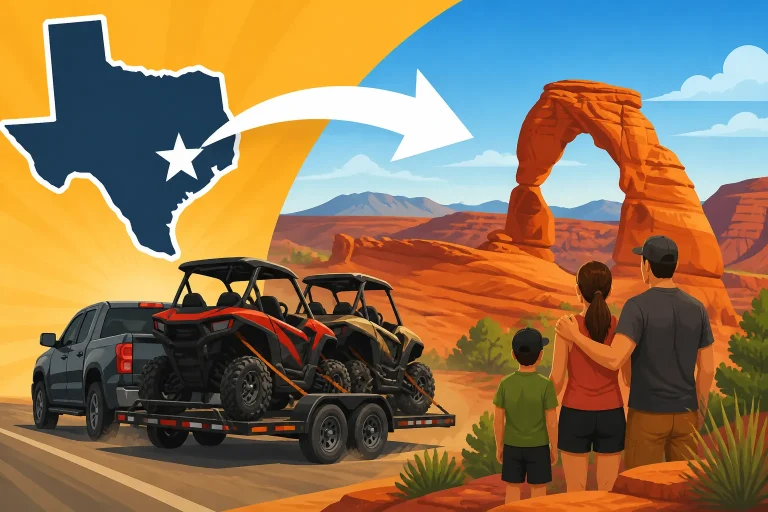
Street-Legal Vehicles and the Permit Question
A street-legal plate can change whether a visitor needs a Utah nonresident OHV permit, but it does not make every road or trail open to the vehicle. The key is to separate the machine’s registration status from where you plan to ride. Here’s how to assess the permit question and what to check before unloading.
The short answer: street-legal status can affect the permit requirement
Utah generally requires an out-of-state visitor to have a Utah nonresident OHV permit when operating an off-highway vehicle on public land, unless an exemption applies. A vehicle that is genuinely street legal and registered in another state may be exempt from that permit requirement.
The important word is “genuinely.” A license plate by itself is not enough to establish that a machine is street legal. Its registration must authorize it for road use under the rules of the state that issued it, and the registration must be current. A homemade plate, an expired registration, or a trail-only registration does not necessarily qualify.
There is a second, separate question: whether the street-legal vehicle may use the particular road or trail you have in mind. An exemption from the nonresident permit does not grant access to every route. Roads may have their own vehicle restrictions, and a trail may be closed to street-legal machines even when the vehicle is properly registered.
| Your vehicle and planned use | Permit question to check | What still matters |
|---|---|---|
| Street-legal ATV or UTV, currently registered in another state | It may qualify for an exemption from Utah’s nonresident OHV permit | Whether the route is open to that type of vehicle, and whether the operator meets road-use requirements |
| Trail-only ATV or UTV registered in another state | A Utah nonresident OHV permit is generally required for public-land OHV use unless another exemption applies | Permit display, land access rules, and any rider education requirements |
| Vehicle with a plate but unclear or expired registration | Do not assume the plate means the vehicle is exempt | Confirm the registration status with the issuing state and Utah’s current permit rules |
| Street-legal vehicle used on a public road | The OHV permit may not be the main issue | Valid registration, insurance, driver requirements, equipment, and road restrictions |
| Any vehicle entering a state park or other fee area | The OHV permit may not cover entry costs | Separate access fees, passes, closures, and local rules |
Before a trip, verify the current exemption with Utah’s official OHV information, especially if your machine has an unusual registration category or has been converted for road use. The overview in The Utah’s Non-Resident OHV Permit Explained can help clarify how the visitor permit works, while Who Needs a Utah Non-Resident OHV Permit focuses on who may need one.
Why road registration and an OHV permit are different
The terms “street legal,” “registered,” and “permitted” refer to different things. Mixing them together is a common reason visitors arrive with the wrong paperwork or assume they can ride a route they cannot use.
Registration establishes the vehicle’s legal status
A street-legal registration generally authorizes a vehicle to be used on certain public roads, subject to the issuing state’s laws and the laws where it is being driven. For an out-of-state visitor, that registration can be relevant to whether the vehicle qualifies for Utah’s nonresident OHV permit exemption.
That does not mean Utah has inspected or approved every individual vehicle. It also does not mean that any vehicle with a plate is automatically street legal. The registration document and the vehicle’s actual status matter. If your machine was converted from trail-only use, confirm that the conversion was completed and registered properly in your home state.
Utah residents face a different paperwork situation from visitors. A resident may need Utah registration for off-highway use, and some machines used on roads may have additional requirements. For more on the distinction between the two systems, see Utah OHV Registration vs Street-Legal Registration.
A nonresident OHV permit concerns public-land riding
Utah’s nonresident OHV permit is a visitor requirement for certain off-highway use. It is not a general road permit, a trail pass that overrides closures, or proof that a machine is street legal. When the machine meets the conditions for a street-legal exemption, the visitor may not need the OHV permit—but must still follow the rules that apply to the vehicle and the route.
An OHV permit also does not replace a recreation-area entrance fee or a special access requirement. Some destinations charge separate fees, and land managers can impose rules beyond the state permit requirement. Before setting off, check the specific area’s access information as well as Utah’s statewide rules. Permits and Fees for Utah’s Riding Areas explains why the permit and an area’s entry fee are separate questions.
Route access is its own decision
A valid street-legal registration does not turn every OHV trail into a public road. Some routes are open to certain types of vehicles and not others; some are open only to vehicles meeting specified width, equipment, or designation rules. Others may be closed temporarily or permanently.
Likewise, being on a trail does not cancel a vehicle’s road obligations when the route includes public roads. If your trip connects trail segments using roads, check what roads your vehicle may use and whether your registration, insurance, equipment, and operator meet the applicable requirements.
For Utah route planning, check current maps and signs rather than relying on a route shown in an old trip report or a navigation app alone. Utah OHV Trail Maps and How to Read Them covers how to distinguish open routes from restricted ones.
How to check your vehicle and trip
Use these steps before you travel. They help separate the permit issue from the registration and route questions that can otherwise get tangled together.
-
Read the registration document. Confirm that the vehicle is currently registered for street use in the state that issued the registration. If the document describes an off-road-only category, do not treat a plate or decal as proof of street-legal status.
-
Confirm the machine matches its paperwork. Check that the vehicle identification number and other identifying details on the machine correspond to the registration. If it has been modified, verify that the conversion did not leave the registration status unclear or invalidate its road-use authorization.
-
Identify the planned route. Separate public roads from OHV trails, and note whether the route is on state, federal, municipal, private, or other managed land. The permit exemption question is not the same as the question of whether you have permission to use a particular route.
-
Check the permit rule for your situation. If the machine is not street legal, or you are unsure whether its registration qualifies, confirm whether you need a Utah nonresident OHV permit before riding. Do not assume that a permit purchased for one machine covers another; check the current terms for each vehicle.
-
Check rider and road requirements. A machine’s registration does not determine whether a particular person can operate it. Review current rules for driver licensing, insurance, required equipment, and any age or education requirements that apply to the planned activity.
-
Check destination-specific fees and restrictions. A permit exemption does not necessarily waive an entrance charge, parking rule, or land manager’s restrictions. Confirm details with the destination or responsible agency before you tow.
If you are still sorting out whether your machine is treated as an OHV or a street-legal vehicle, Street-Legal Vehicles and the Permit Question is this topic’s central issue; for a broader explanation of visitor eligibility, see Utah OHV Rules for Visiting Families. If your machine is plainly trail-only, Buying the Non-Resident Permit Online can help with the next step. Always check the current official instructions before purchasing or setting out.
What to carry and verify before you ride
Even when you believe the vehicle is exempt from Utah’s nonresident OHV permit, carry documents that make its status easy to establish. A roadside or trailhead check is simpler when you can show clear, current paperwork rather than relying on memory or an assumption about the plate.
Keep the registration evidence accessible
Carry the current registration for the vehicle, in a format accepted for the trip. Make sure the name, vehicle details, and expiration status are clear. If the issuing state provides digital proof, confirm that it is valid for the situation and that you can access it without a reliable signal. A screenshot may be useful as a backup, but it is not wise to assume that a phone image will be accepted in every circumstance.
If you are hauling the machine to a trailhead, keep the registration where you can retrieve it after unloading. Store a copy separately from the original if doing so is practical, and protect paper documents from dust and moisture.
Carry other documents required for the ride
Street-legal status does not remove other requirements. Depending on the route and the operator, you may need to show proof of insurance, a driver license, or other documentation. If a permit is required for your vehicle, carry proof of that permit and display it as directed. A permit receipt, registration card, and proof of insurance serve different purposes; one should not be treated as a substitute for another.
If the trip includes both roads and trails, plan for both kinds of checks. What Utah Riders Must Carry on Public Land is useful for reviewing the paperwork question more broadly. For permit display and proof, Carrying Your Certificate and Permit on the Trail addresses what visitors should have available.
Verify route rules close to departure
A route that was open last season may be closed or restricted when you arrive. Weather, maintenance, seasonal closures, fire conditions, wildlife protections, and land-management decisions can change access. Check current information from the agency or destination managing the route, and pay attention to signs at the trailhead.
This matters particularly when a route crosses several jurisdictions. A street-legal vehicle may be authorized for one public road but not for an adjacent trail. A nonresident permit, when required, does not authorize riding on closed routes or private property without permission. If the route crosses private land, confirm that the crossing is open and permitted; do not treat an open gate as proof of public access.
Check rules for every machine in the group
A group may include a plated side-by-side, a trail-only quad, and a youth machine. The vehicles can have different registration and permit requirements even when they travel together. Check each machine separately, including whether it is covered by a permit and whether its operator meets applicable requirements.
Do not assume that one adult’s permit or certificate covers all riders or vehicles. Do You Need a Permit for Each Machine? addresses that question, and Utah OHV Rules for Visiting Families can help families think through different machines and riders in one group.
Common situations that cause confusion
The machine has a plate, but its registration is trail-only
A plate can be easy to misread. It may identify a vehicle without authorizing it for general road use. Look at the actual registration category and the issuing state’s rules. If the machine is not street legal, treat it as an OHV and check the nonresident permit requirement before riding on public land.
The vehicle is street legal at home, but you plan to ride only on trails
The fact that you intend to ride off-road does not automatically make the street-legal registration irrelevant, nor does it automatically grant trail access. First confirm whether the vehicle’s out-of-state street-legal registration qualifies for the Utah permit exemption. Then check that the specific trail permits that type of vehicle.
If an agency or land manager has a separate rule for the route, follow that rule. When the answer is unclear, ask the responsible office and describe the exact vehicle, its registration state, and the route you plan to use.
The machine is street legal, but you plan to connect trails by road
This trip involves both off-highway access and road use. Confirm that the road segment is open to the vehicle, and check the requirements for the operator, insurance, and equipment. A public road shown on a map is not automatically open to every OHV, and a route that works for a full-size vehicle may not be appropriate or legal for a side-by-side.
For details about road use, Utah’s limits, and the distinction between road travel and trail access, see Utah Street-Legal ATV Equipment Requirements and Roads Utah Keeps Closed to Street-Legal ATVs.
You have modified a trail machine for road use
A set of lights, mirrors, or a horn does not by itself establish street-legal status. The vehicle must be registered appropriately under the rules of the state where it is registered. A conversion that has not been inspected or recorded as required may leave the machine in an uncertain category.
Do not rely only on the seller’s statement that the vehicle is street legal. Review the registration and any supporting documents, and confirm the status with the issuing authority. If you are deciding whether to convert a machine, Making a UTV Street Legal in Utah explains the separate Utah process; a visitor should also check their home state’s requirements.
You are renting or borrowing a vehicle
Ask the owner or rental company for the vehicle’s registration status and confirm which routes you may use. Do not assume the rental’s plate eliminates every permit or area fee, or that the company’s paperwork covers every rider. The vehicle’s status, the permit rules, and the trip’s route all need to line up.
If you are renting, clarify whether the company handles any required permit and whether its agreement restricts particular trails. If you are borrowing a friend’s machine, make sure you can access the registration and any required permit information before leaving.
You are entering a fee area
A vehicle may be exempt from a nonresident OHV permit and still owe a destination fee. These charges serve different purposes and may be collected by different agencies. Check whether the place you plan to ride requires payment, a pass, or a reservation, and confirm whether the charge applies per vehicle, person, or visit.
The safest approach is to make two checks: first, whether the vehicle needs the state nonresident permit; second, whether your destination has separate access requirements. A “no permit needed” answer does not settle the second question.
Frequently Asked Questions
Does a street-legal out-of-state UTV need a Utah nonresident OHV permit?
A properly street-legal vehicle registered in another state may qualify for an exemption. Confirm that the registration is current and actually authorizes road use, then check Utah’s current official instructions for your vehicle and planned use.
Does a plate prove that my ATV or UTV is street legal?
No. A plate alone does not establish that the vehicle is registered for street use. Check the registration document and the issuing state’s rules. If the status is unclear, verify it before relying on an exemption.
Does the permit exemption let me ride any Utah OHV trail?
No. Permit requirements and route access are separate. A trail can be closed or restricted to certain vehicles even if your vehicle is street legal and you do not need a nonresident permit.
Do I still need to check Utah road requirements?
Yes. Street-legal status in another state does not remove the need to follow applicable Utah road rules. Check requirements for the road, the operator, insurance, and vehicle equipment before using public roads.
Does the Utah nonresident OHV permit cover park entry fees?
Not necessarily. An OHV permit and a recreation-area fee are separate requirements. Check the destination’s current access rules and charges before you ride.
Disclaimer
This article is for general informational purposes only and does not constitute professional advice. Laws, prices and regulations vary by location and change over time. Consult a qualified professional for guidance on your specific situation.