Utah’s Non-Resident OHV Permit Explained
A Utah riding trip can go sideways before the first trail if your out-of-state ATV or UTV needs a permit you didn’t know about. Utah’s nonresident OHV permit rules can be confusing because they sit alongside vehicle registration, education requirements, and land-access rules. This guide explains what to check, how to prepare, and what to carry before you unload.
What Utah’s nonresident OHV permit is
A permit for visiting machines, not a replacement registration
Utah’s nonresident OHV permit is a requirement for many off-highway vehicles brought into the state by visitors. It is separate from the registration or permit issued where your machine is normally kept. Having a current registration sticker from your home state does not automatically mean you can ride every Utah trail without doing anything else.
Think of the paperwork as serving different purposes. Your home-state registration identifies or authorizes the machine under your home state’s rules. Utah’s nonresident permit addresses Utah’s visitor requirements. The permit does not convert your ATV or UTV into a Utah-registered machine, and it does not make the machine street legal.
The details can depend on the type of vehicle, how it is registered, and where you plan to ride. Before leaving home, compare your machine and intended trip with Utah’s current requirements rather than assuming that a registration card or decal from another state settles the question. The overview Who Needs a Utah Non-Resident OHV Permit is a useful place to start.
Why home-state registration may not be enough
Riders sometimes assume that a registration sticker accepted in their home state will be recognized everywhere. That assumption is easy to make, especially if they have traveled between states for years without being asked about a separate permit. Utah ended its OHV reciprocity arrangement, so visitors should not rely on old advice or on a previous trip as proof that no Utah permit is needed.
The practical change is that an out-of-state registration may still be important paperwork, but it may not satisfy Utah’s separate nonresident permit requirement. This is particularly easy to miss when a group includes machines registered in different states, a recently purchased UTV, or a vehicle that has been stored and not ridden for a long time. Each machine should be checked individually.
If someone in your riding group says, “My state sticker worked last time,” ask when that trip took place and whether the rules have changed since then. The explanation in Utah Ended OHV Reciprocity: What Visitors Do Now can help clarify why relying on older trip stories can lead to a frustrating surprise at the trailhead.
The permit is only one part of riding legally
A permit does not guarantee that a route is open, that your machine is allowed on it, or that every rider in the vehicle meets Utah’s safety requirements. It also does not replace a park entrance fee, campground payment, or any separate authorization required for a particular area or activity.
For example, a visitor headed to Sand Hollow State Park may need to think about the Utah permit question and the park’s own entry rules. A rider near Moab still needs to confirm that the route is open to the machine they brought. At the Paiute ATV Trail, route choice, fuel planning, weather, and elevation matter even after paperwork is squared away.
It helps to treat compliance as a short checklist rather than one sticker that solves everything. Confirm the vehicle’s status, permit requirement, education requirements for each operator, route access, and any area-specific fees or rules. That extra planning is far less stressful than reaching a staging area and discovering that one part of the group’s paperwork is missing.
Who should check the permit requirement
Visitors bringing their own ATV or UTV
If you are trailering an ATV or UTV from another state, check the Utah permit requirement for each machine before the trip. Do not assume that a family can buy one permit and use it across several quads, or that a permit attached to one vehicle covers a second one. The requirement is generally handled by machine, so make a separate line on your planning list for each vehicle.
This is especially important for a family trip. One parent may bring a side-by-side, while a teenager brings a youth quad and another adult brings a second machine. Those vehicles can differ in registration status, age category, or equipment. A single “we have the permit” answer may not be enough to establish that every machine is covered.
Also check the ownership and registration paperwork for a recently purchased or borrowed machine. If you are borrowing a friend’s ATV, make sure you know which state it is registered in, whether the registration is current, and whether the owner has given you the documentation you need. The permit question is easier to resolve at home than beside a trailer on a busy weekend.
Renters and riders using someone else’s machine
Visitors renting a machine should ask the rental company directly whether the Utah nonresident permit is included, required, or handled as part of the rental. Do not assume that the rental company’s general statement that a machine is “ready to ride” answers every question about where it may be operated or what the renter must carry.
Ask the shop to explain what paperwork comes with the machine, where the permit or proof is displayed, and whether the machine can be taken to your planned riding area. Rental rules may limit trails or destinations for reasons beyond the permit. For instance, a rental agreement may prohibit certain difficult routes even when those routes are open to privately owned machines.
If you are borrowing a friend’s registered quad rather than renting, the owner’s paperwork may not automatically satisfy every requirement for you as the operator. Confirm that the machine is eligible for the trip and that you have access to the required proof. The related guide Borrowing a Friend’s Utah-Registered Quad can help visitors think through the paperwork side of borrowing.
Street-legal machines and unusual vehicle categories
A machine described as street legal deserves a closer look rather than a quick assumption. Street-legal status, OHV registration, and the visitor permit question are related but distinct issues. A plate from another state may affect how a vehicle is categorized, but riders should verify the rules that apply to their specific vehicle and planned use.
Likewise, an electric UTV, dirt bike, youth machine, or specialized vehicle may not fit a visitor’s assumptions about what counts as an OHV. A model’s marketing label is not necessarily the legal category that determines permit requirements. Identify the machine by its actual design, registration documents, and intended operation.
If your machine is modified or carries both on-road and off-highway paperwork, bring the documents that show its status and check the relevant rules before travel. The guide Street-Legal Vehicles and the Permit Question addresses a common point of confusion: a street-legal registration does not automatically answer every question about riding off road.
| Trip situation | What to check before leaving | Common mistake to avoid |
|---|---|---|
| Bringing an out-of-state ATV or UTV | Whether each machine needs a Utah nonresident permit | Assuming the home-state decal is sufficient |
| Bringing several family machines | Permit status and paperwork for every machine | Treating one permit as coverage for the whole group |
| Renting in Utah | What the rental company provides and where the machine may go | Assuming “ready to ride” means every trail is allowed |
| Borrowing a machine | Registration status, owner authorization, and required proof | Relying on the owner’s verbal assurance alone |
| Using a street-legal or modified machine | How Utah classifies the vehicle for the planned use | Assuming a plate resolves off-highway requirements |
| Riding on a state park or managed area | Permit rules plus separate entry, route, and land rules | Treating the OHV permit as an all-access pass |
How to prepare and obtain the permit
Confirm the machine and trip details first
Before purchasing anything, write down the information that describes each machine: make, model, vehicle type, registration state, and current registration status. Note whether it is a conventional ATV, side-by-side, dirt bike, electric machine, or another category. Those details help you avoid selecting the wrong permit or overlooking an exception that may apply.
Then map out where you plan to ride. “We’re going to southern Utah” is not specific enough to plan a legal route. A weekend near St. George may involve Sand Hollow, Sand Mountain, and local roads, each with different access considerations. A Moab trip can combine public-land routes, a state recreation area, town travel, and roads where OHV use may be restricted.
Once you know the vehicle and destination, check the relevant permit instructions and purchase channel. The guide Buying the Non-Resident Permit Online can help you understand the steps to investigate. Follow the current instructions on the official transaction page, including any directions about entering vehicle details, receiving proof, printing the permit, or displaying it.
Complete the purchase carefully
Online permit purchases are convenient, but the form is only useful if the information matches the machine. Read each field before submitting it. A rushed typo in a vehicle identifier, a wrong vehicle category, or an incorrect registration detail can create avoidable questions later, particularly if an officer or ranger compares the permit with the machine.
Keep a record of the transaction after purchase. Save the confirmation, receipt, and any permit document in a place you can access without reliable cell service. If the system provides a printable permit or instructions for displaying it, follow those directions rather than assuming a screenshot is enough. A phone can lose charge, break, or have no signal at exactly the wrong moment.
If you are arranging the trip for several riders, have one person check the permit status against a written list of machines. That small review catches mix-ups such as buying for the adult ATV but forgetting the youth quad. More detail about the permit’s scope and cost categories is available in What the Non-Resident Permit Costs and Covers; always use the official page for the actual current figures and terms.
Check validity dates rather than guessing
Do not assume a permit runs on the same schedule as your home-state registration, a calendar year, or a particular riding season. Permit validity is a separate detail and should be checked on the official instructions when you buy it. A permit bought for one trip may or may not remain valid for a later trip, depending on its stated term and the date it was issued.
This matters for people who visit Utah more than once. A family might come for a spring trip to Moab, then return later in the year for a ride near Marysvale. If the first permit has expired, is tied to a different machine, or was not valid for the later travel dates, the group can arrive with an incomplete set of documents despite having purchased a permit before.
Record the purchase date and the stated expiration or validity information next to the machine’s trip checklist. The guide How Long a Utah Non-Resident Permit Lasts is relevant when you are planning more than one visit, but the permit document and official instructions should be your final reference for its exact validity.
What to carry and display while riding
Keep proof with the machine
Once the permit is obtained, make sure the proof stays with the vehicle or is accessible to the operator in the way Utah’s instructions require. Do not leave all documents in a tow vehicle that is parked miles away from the route. If a rider is stopped or asked to show paperwork at a trailhead, the proof needs to be available then, not back at the campground.
A practical approach is to keep a paper copy with the vehicle’s registration documents and save a digital copy on a phone as backup. Paper can get dusty or wet, so use a protective sleeve if the official instructions allow the document to be carried that way. A basic document pouch or clear protective sleeve is the kind of accessory visitors can find at outdoor retailers or on Amazon, but the pouch does not change where or how the permit must be displayed.
Before packing, compare the permit with the machine itself. Check that the vehicle details are legible and appear to match. Make sure every machine in a multi-vehicle group has its own correct paperwork, rather than putting several permits in one person’s wallet and hoping the group stays together.
Follow display instructions exactly
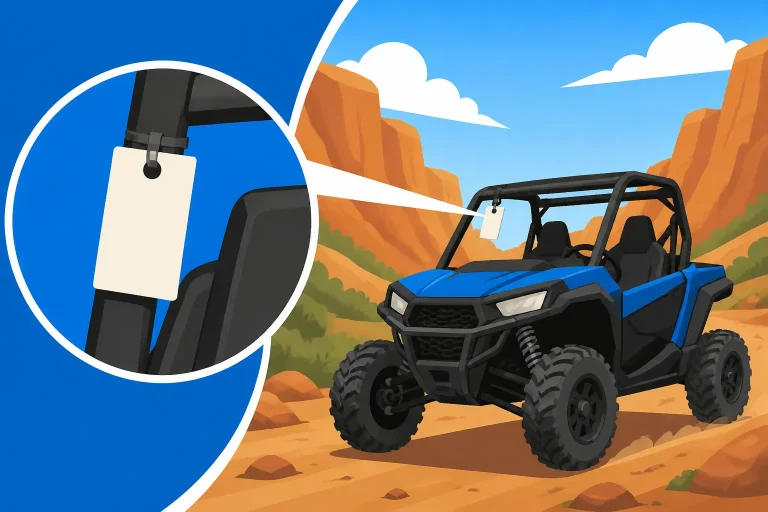
A permit may have specific display instructions. Read them carefully, because keeping a copy in a glove box may not be equivalent to displaying a decal or other proof in the required location. Do not put a sticker where it can be immediately scraped off, covered by a cargo bag, or hidden behind a windshield frame.
If you are unsure where the permit goes, check the official directions before applying it. This is particularly sensible for a machine with aftermarket body panels or a design that does not have the obvious flat surface found on another model. Once an adhesive permit is placed, removing it and reapplying it can damage it or make it difficult to read.
If two machines are similar, label their document pouches or store their permits separately. On a dusty trail weekend, several black side-by-sides can look nearly identical in a staging area. Matching the document to the correct VIN or vehicle identifier before departure avoids confusion if a ranger asks to see a particular machine’s proof.
Carry education and registration records too
The permit is not necessarily the only document an operator may need. Carry the machine’s registration information and any education certificate or proof required for the rider. A permit for the vehicle does not establish that a particular operator has completed the necessary training or meets age and supervision requirements.
Requirements can differ depending on the operator’s age, birth date, residency, and training history. If riders in your group were educated in different states, check whether their certificates are accepted in Utah rather than assuming all state cards are interchangeable. The guide Carrying Your Certificate and Permit on the Trail is useful for planning how to keep the different pieces of proof organized.
Keep important documents protected from water, dust, and heat. Some people keep a paper copy in a sealed pouch and a digital copy on a phone; others place copies in the tow vehicle as a backup. If you use a phone holder purchased through Amazon or elsewhere, remember that mounting a phone does not make it a reliable sole storage location. A phone can be damaged in a rollover or left behind during a machine swap.
Understand the limits of the permit
A permit does not open every route
Public land does not mean every road or trail is open to every vehicle. Routes can have restrictions based on vehicle width, season, land manager, resource protection, or local closures. A permit does not override a closed gate, a posted restriction, or a route designation that excludes your machine.
Before riding, check the route information for the land you plan to visit. Around Moab, for example, visitors may travel between designated OHV routes, county roads, and areas managed under different rules. In central Utah, a route on the Paiute system may be affected by seasonal conditions, weather, or a closure. Near dunes, the permitted riding area may have marked boundaries that riders should not cross.
Plan a route using reliable maps and current land-management information, not just a line shared in a group chat. Offline maps are particularly useful where cell service is weak. The broader question is covered in Does a Utah Permit Cover Federal Land?, but the important practical point is that a permit and land access are separate checks.
State parks, fees, and land rules are separate
A Utah nonresident OHV permit is not the same as a state park entrance fee or a campground reservation. At a state park or developed riding destination, you may need to pay an additional fee or follow local rules even after you have the required OHV paperwork. These charges and requirements serve different purposes.
For example, if your trip includes Sand Hollow State Park or Coral Pink Sand Dunes State Park, check the park’s entry and riding information as well as the permit rules. If you are planning a Moab weekend, confirm whether your chosen area has a separate day-use charge, camping fee, or special access condition. Do not rely on a previous year’s receipt or a friend’s pass unless you have verified that it applies to your trip.
Land managers may also set rules about speed, noise, safety equipment, camping, fires, and where machines can be unloaded. Even a fully documented machine can be cited or turned around if the group ignores those rules. Read the area-specific information before you tow, especially for a first visit.
Private land and organized events need separate attention
A Utah nonresident OHV permit should not be treated as permission to ride across private property. A route that appears to connect two public roads may cross private land, tribal land, or another restricted area. Get permission where required and use mapped, designated routes rather than assuming that an open-looking track is public.
Organized events can have their own arrangements or exceptions, but riders should not assume that an event’s registration automatically settles every participant’s permit obligation. Ask the event organizer exactly what is covered, which machines are included, and what each rider must bring. If the event route includes public land, ask how the organizer handles required permits and whether individual riders still need to complete any steps.
This is particularly important for group rides and charity events. One machine may be owned by a Utah resident, another may be rented, and a third may have come from out of state. Their paperwork situations can differ. Confirm the rules for each machine with the organizer and relevant land manager before the event date.
Exceptions and situations that need extra checking
Do not infer an exemption from a machine’s name
Some visitors hear that a particular class of vehicle is exempt and apply that statement broadly. Exemptions can be limited to specific machine types or circumstances. A small youth quad, an electric dirt bike, a snowmobile, or a machine used only in a narrowly defined setting may be treated differently, but the category needs to match the actual legal rule.
Start with the machine’s real characteristics and documents, not the name in an online listing. Two machines called “utility vehicles” may have different classifications, registrations, or intended uses. A machine’s engine size or electric motor does not automatically settle the question without checking the applicable Utah requirements.
The guide Machines Exempt From the Utah Permit is a useful prompt for identifying questions to verify. If your machine seems unusual, check the official instructions and, when necessary, ask the relevant Utah office or land manager before traveling. It is better to get a clear answer before you load the trailer than to debate an uncertain exemption at a trailhead.
Youth machines and riders need two checks
A youth machine can raise separate questions about the vehicle and the child operating it. The permit status of the quad is one issue; the rider’s age, training, supervision, and ability to operate safely are other issues. Solving the vehicle paperwork does not automatically settle the rider’s eligibility.
Parents should check the rules for each child well before departure. A child who is allowed to ride on private property at home may face different requirements on Utah public land. Make sure the child has the required education or proof, understands trail etiquette, and rides a machine suited to their size and experience.
Also plan for the practical side of a family ride. A child’s small quad may have limited fuel capacity and a different pace from an adult side-by-side. Choose routes that match the youngest rider, allow room for breaks, and avoid terrain that could overwhelm the child. The Utah permit is important, but it is only one piece of a safe family outing.
Machines used only on private property
Riders sometimes ask whether a machine used only on their own land needs the same paperwork as one used on public trails. The answer can depend on where the machine is operated, how it is registered, and whether it enters a public route or other regulated area. Do not extend a private-land assumption to a ride that crosses a road, trail, or neighboring property.
A ranch or cabin owner, for example, may use a UTV on private ground but also want to ride a nearby public route. The moment the machine leaves the private property or enters a public OHV area, a different set of rules may apply. Crossing a road can also bring additional legal and safety considerations.
If the vehicle will stay entirely on private property, confirm the relevant rules for that specific use. If the plan includes any public land or route, treat it as a separate trip and verify the permit and registration requirements before riding. The article Private-Land-Only Machines and Utah Registration explores this distinction in more detail.
A practical planning checklist for your Utah trip
Before towing
Start by listing every machine, the state where it is registered, and the person who will operate it. Verify the Utah permit requirement for each machine, then check validity dates and make sure the permit information matches the vehicle. If anything about the machine’s classification is unclear, resolve it before leaving home.
Next, confirm operator requirements. Identify which riders need an OHV education certificate or other proof, whether out-of-state training is accepted, and what age or supervision rules apply. The course and certificate information in Utah OHV Education Certificate can help you identify the training question, but check the applicable rules for each rider.
Finally, build a destination-specific plan. Identify your riding area, open routes, staging point, fuel options, and any separate entry or camping fees. Check for seasonal closures and weather-related concerns. A Utah trip might mean extreme summer heat around St. George, snow or mud at higher elevations, or long stretches with limited services in the West Desert.
At the trailhead
Before unloading, match each permit and registration document to its machine. Check that display requirements have been followed and that the operator has access to required proof. If your group is splitting up, make sure each rider knows where their paperwork is and how to contact the group if plans change.
Take a moment to check posted trailhead signs. Closures, route restrictions, and local instructions can change from one area to another. Confirm the planned route still matches your machine’s width, equipment, and rider experience. If a route is closed or unsuitable, choose a legal alternative rather than following another group onto an unmarked track.
Set expectations for the ride: who leads, who sweeps, where the group stops, and what to do if someone gets separated. A valid permit is no substitute for water, tools, communications, and conservative riding choices. Carry enough supplies for the day and do not plan a route that depends on finding a store or fuel stop where none may exist.
After purchase and after the trip
Save permit receipts and copies with the machine’s ownership and registration records. That makes it easier to plan a future trip, answer questions about the permit’s validity, or resolve a record mismatch. Keep copies separate from the original documents so one lost pouch does not erase every record.
If you sell or replace a machine, do not assume the permit automatically transfers to the new vehicle. Confirm the terms for that permit and the procedure, if any, for a change. A permit associated with one machine may not be appropriate for another, even if the same family owns both.
Before your next Utah visit, review the requirements again. A route can close, a permit term can expire, or a machine can move from one registration category to another. A short review of the official permit information, land rules, and trip details is far easier than relying on paperwork remembered from a previous season.
Disclaimer
This article is for general informational purposes only and does not constitute professional advice. Laws, prices and regulations vary by location and change over time. Consult a qualified professional for guidance on your specific situation.