Registration for a UTV Used in Search and Rescue
It's incredibly frustrating when you're trying to get a UTV ready for critical search and rescue operations, and the paperwork process feels like another rescue mission in itself! You'd think there'd be a clear, streamlined path for vehicles serving such an important public safety role, but often, the rules aren't as straightforward as we hope. This guide aims to cut through the confusion and provide clear, actionable steps for registering a UTV used in search and rescue here in Utah, ensuring your team's vital equipment is always trail-ready and fully compliant.
Understanding Utah's Approach to Search and Rescue UTV Registration
When it comes to registering an Off-Highway Vehicle (OHV) in Utah, many folks assume that if a UTV is used for search and rescue (SAR), it must fall under some special category or exemption. It’s a completely logical thought process, especially given the public service nature of these machines. However, the reality on the ground often looks a little different than what you might initially expect.
Dispelling Myths: Are SAR UTVs Treated Differently?
Let's address a common misconception right off the bat: generally speaking, UTVs used by volunteer search and rescue organizations or even county-level SAR teams are not automatically exempt from standard OHV registration requirements in Utah. The idea that these essential vehicles would get a pass comes from a good place – after all, they're not being used for recreational joyrides, but for potentially life-saving missions. People often think of fire trucks, ambulances, or police cruisers, which absolutely operate under different rules. Those vehicles, however, are typically owned directly by government entities (state, county, municipal) and are clearly marked as official emergency apparatus.
For many community-based or volunteer SAR groups, even if they work closely with law enforcement or fire departments, their UTVs are often owned by the organization itself, or sometimes even by individual volunteers. In these scenarios, the state's standard OHV registration laws apply. The purpose of the machine is noble and critical, but the legal framework for its operation on public lands largely remains the same as for any other privately or organizationally owned OHV. It's not about devaluing the mission; it's about the state's classification of vehicle ownership and use.
Why Standard OHV Registration Still Applies
The Utah Division of Outdoor Recreation, which oversees OHV registration, has a vested interest in ensuring all machines using public lands are registered. The fees collected from OHV registration are crucial. They directly fund trail maintenance, safety education, enforcement, and the development of new riding areas across the state. Whether a UTV is used for weekend recreation, ranch work, or search and rescue, if it's operating on designated OHV trails, public lands, or even crossing public roads (where permitted), it benefits from these programs.
Therefore, for the vast majority of UTVs deployed in SAR efforts, completing the standard Utah OHV registration process is a non-negotiable step. This ensures that the vehicle is properly accounted for, that its ownership is clear, and that it contributes to the very infrastructure that makes its SAR missions possible. It also provides a layer of accountability and helps track machines in the event of theft or if required for official incidents. Essentially, the state views it as: if you're using the trails, you're helping maintain the trails, regardless of your purpose.
The Standard Registration Pathway for Your SAR UTV
Since most search and rescue UTVs will follow the standard OHV registration process in Utah, it's vital to understand each step. This isn't a "special" process, but rather the same one any other OHV owner goes through. Being prepared with the right documents and understanding the fees involved can save your organization valuable time and prevent frustrating delays.
Essential Documents for Registration
Gathering the correct paperwork is often the biggest hurdle in getting any OHV registered. For a SAR UTV, you'll need the same core documents as anyone else. First and foremost, you'll need the Certificate of Title for the UTV. This proves legal ownership. If you've just purchased the UTV, whether new from a dealer or used from a private seller, you'll also need a Bill of Sale. This document verifies the transaction and the purchase price, which is critical for calculating sales tax and the uniform fee. Make sure the bill of sale includes the UTV's Vehicle Identification Number (VIN), the sale date, the purchase price, and the names and signatures of both the buyer and seller. If your SAR organization has specific internal forms or agreements, you might even consider using a service like LawDepot to draft a comprehensive bill of sale, ensuring all legal requirements are met, especially if the machine was donated or transferred internally.
In some cases, especially if the UTV is older or has changed hands multiple times, you might encounter situations like a missing title or an out-of-state title. Utah has specific procedures for these scenarios, which can involve applying for a duplicate title or providing additional proof of ownership. A VIN inspection might also be required, particularly if the UTV is from out-of-state or has a salvage title. Finally, don't forget proof of identity for the person registering the UTV on behalf of the organization. You can find a detailed list of what you need by reviewing [Documents to Bring to the Utah DMV for an ATV].
Step-by-Step Registration at the DMV
Once you have all your documents in order, the actual registration process typically happens at a Utah Division of Motor Vehicles (DMV) office. Here’s a general rundown:
- Visit a DMV Office: Locate a DMV office that handles OHV registrations. Not all offices offer all services, so it's wise to check beforehand.
- Submit Paperwork: Present your title, bill of sale, VIN inspection (if required), and any other supporting documents. The DMV agent will review everything for completeness and accuracy.
- Complete Forms: You'll likely need to fill out an application for Utah title and registration (Form TC-656).
- Pay Fees: This is where the registration fees, uniform fees, and sales tax (if applicable) come into play.
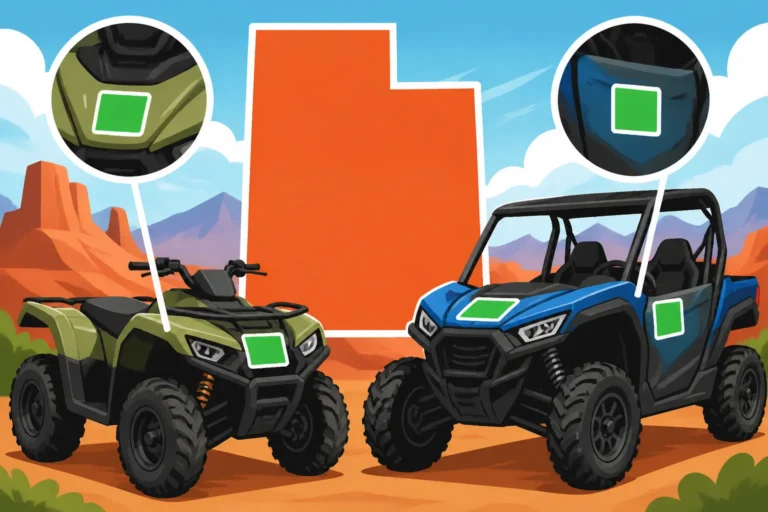
- Receive Registration and Decals: Once everything is processed and paid for, you'll receive your new registration certificate and the necessary OHV decals to affix to your UTV.
While the process at the DMV can sometimes feel lengthy, going prepared will drastically speed things up. If your UTV was bought privately, be sure to understand [How to Register an ATV Bought Privately in Utah]. For a comprehensive overview, consider consulting [How to Register an ATV or UTV in Utah].
Understanding Utah OHV Fees and Their Impact
When registering your SAR UTV, you'll encounter a few different fees. The primary components are the registration fee and the uniform fee. The registration fee is a set amount paid periodically (often every two years) to legally operate your OHV on Utah's public lands. This fee is a direct contribution to the Utah Off-Highway Vehicle Program, funding trail development, maintenance, and educational initiatives.
The uniform fee, on the other hand, is an age-based fee that varies depending on the age of your UTV. This fee is in lieu of property tax and contributes to local government services. You can learn more about this by reading [The Age-Based Uniform Fee on Utah OHVs]. Sales tax will also be collected if the UTV was recently purchased and sales tax wasn't already paid to a licensed dealer. These fees are standard for all OHVs, and there are generally no waivers or exemptions specifically for SAR UTVs that are not government-owned. Understanding [Utah OHV Registration Fees, Start to Finish] will give you a clear picture of the costs involved. It's important for SAR organizations to budget for these ongoing costs to ensure their machines remain compliant and ready for service.
Special Considerations for SAR Organizations and Volunteers
While the basic registration process for a SAR UTV largely mirrors that of any other OHV, there are specific nuances when the machine is owned by an organization, or when considering its operational context. These considerations are vital for ensuring not just legal compliance, but also operational effectiveness and liability protection.
Registering Under an Organization's Name
If your search and rescue UTV is owned by a non-profit organization, a volunteer group, or a county-affiliated SAR team rather than an individual, the registration process will involve using the organization's name and details. This means that instead of an individual's driver's license, you'll need to provide documentation proving the legal existence of your organization. This might include:
- Articles of Incorporation: For registered non-profits.
- Employer Identification Number (EIN): The federal tax ID for your organization.
- Bylaws or Organizational Documents: To show who has the authority to register vehicles on behalf of the group.
- Proof of Authorized Signatory: A letter or resolution from the organization stating who is authorized to act on its behalf for vehicle registration purposes.
When drafting or reviewing such organizational documents, especially if your group is newly formed or formalizing its structure, resources like LawDepot can be incredibly helpful. They provide templates for bylaws, resolutions, and other legal documents that ensure your organization is properly structured and that the authority to manage assets like UTVs is clearly defined. Registering the UTV directly under the organization's name provides clarity of ownership and can be important for insurance purposes and asset management. For more details on this specific scenario, check out [Registering a Utah OHV to a Business or Trust].
Liability, Insurance, and Street-Legal Status
Beyond mere registration, liability and insurance are paramount for any UTV, but especially for one used in high-stakes search and rescue operations. While Utah generally doesn't require liability insurance for off-highway use unless the machine is also street-legal, most SAR organizations would be remiss not to carry comprehensive coverage. This includes liability coverage to protect against claims resulting from accidents, and often comprehensive/collision coverage to protect the UTV itself. If your SAR UTV ever needs to travel on paved roads to get to a staging area or cross a highway, a street-legal conversion might be considered. This involves adding specific equipment like turn signals, mirrors, and a horn, and it will require liability insurance to be carried. The benefits of being street-legal for SAR could include quicker deployment or easier access to remote trailheads that require road use. Exploring [Making a UTV Street Legal in Utah] and [When Utah Requires Insurance on an OHV] can provide further insights.
Exemptions and What They Mean (Rare Cases)
While we've established that most volunteer SAR UTVs follow standard registration, it's worth briefly touching on the rare instances where exemptions might apply. These typically involve UTVs that are directly owned and operated by bona fide government agencies – think a UTV purchased and maintained by a Sheriff's Office, a Forest Service ranger, or a state park. In such cases, these vehicles are usually exempt from standard registration fees and requirements because they are considered official government property and are governed by different departmental regulations.
It's crucial to understand that simply assisting a government agency does not automatically grant a volunteer SAR organization this exemption. The legal ownership and official designation of the vehicle are what matters. For the overwhelming majority of volunteer SAR groups and their equipment, playing by the standard OHV registration rules is the safe and compliant path.
Keeping Your SAR UTV Compliant and Ready
Having your SAR UTV registered is a fantastic first step, but it's an ongoing commitment to keep it compliant and operationally ready. Just like a personal vehicle, OHV registration requires periodic renewal, and there are specific requirements for what documentation should accompany the machine when it's out in the field. This proactive approach ensures your team can focus on its mission without worrying about bureaucratic hurdles.
Renewing Registration and Decals
Utah OHV registrations are typically valid for two years. Before your registration expires, you'll need to renew it. The state usually sends out renewal notices, but it's ultimately the owner's responsibility to keep track of the expiration date. Renewing on time is crucial to avoid penalties and ensure continuous legal operation. The renewal process is generally straightforward and can often be completed online or by mail, though an in-person visit to the DMV is always an option. Once renewed, you'll receive updated decals that must be properly affixed to your UTV, typically on the front fender or another clearly visible location. These decals serve as immediate visual proof to law enforcement or land managers that your UTV is currently registered. Delaying renewal or operating with expired decals can lead to fines, which is the last thing a SAR team needs during an emergency. For details on how to manage this, refer to [Renewing Your Utah OHV Registration] and [Late Renewal on a Utah OHV Registration].
What Paperwork to Carry on a Mission
When your SAR UTV is out on a mission, whether it's a training exercise or an active search, it's essential to have the correct paperwork readily accessible. While digital copies on a phone might be acceptable in some situations, having physical copies, perhaps in a weatherproof bag stored in the UTV, is always a good practice. At a minimum, you should carry:
- Current OHV Registration Certificate: This is your proof of legal registration.
- Proof of Insurance: If your UTV is street-legal or if your organization carries comprehensive coverage, have proof of insurance handy.
- Operator Safety Certificate: For any operators under 18, or if your organization requires all members to complete an OHV safety course.
These documents might be requested by land managers, park rangers, or law enforcement officers during routine checks or in the event of an incident. Being able to quickly provide them demonstrates your organization's commitment to compliance and professionalism. To understand the full scope of what you and your team need, consult [What Paperwork Utah Riders Must Carry].
Maintenance, Inspections, and Safety Gear
While not directly tied to registration, the operational readiness of a SAR UTV is inextricably linked to proper maintenance, adherence to safety standards, and having the right gear. A UTV used in search and rescue is a critical piece of equipment; its reliability can literally be a matter of life and death. Regular maintenance checks, including fluid levels, tire pressure, brakes, and lighting, are not just good practice but essential for mission success and rider safety.
Furthermore, ensuring the UTV meets basic safety equipment requirements (like functional headlights, taillights, and spark arrestors) can prevent issues with trail enforcement. If your organization is involved in creating internal protocols for equipment use, maintenance schedules, or volunteer agreements, a tool like LawDepot could be beneficial for drafting these important documents. It helps formalize procedures, ensuring that maintenance logs are kept, and that all safety protocols are understood and followed by every team member. Investing time in maintenance and ensuring all safety gear is present means one less thing to worry about when the call for help comes in.
Registration Requirements: Standard vs. Organizational
To help clarify the typical requirements, here's a table summarizing the general differences or specific needs when registering a UTV, particularly contrasting individual ownership with organizational ownership for SAR purposes.
| Requirement/Document | Individual Ownership (Typical) | Organizational Ownership (SAR Groups) |
|---|---|---|
| Title | Mandatory, in individual's name. | Mandatory, in organization's legal name. |
| Bill of Sale | Required for new purchases, details individual buyer. | Required for new purchases, details organization as buyer. |
| Proof of Identity | Driver's License or State ID of individual. | Authorized signatory's ID + proof of authority (e.g., resolution, bylaws). |
| VIN Inspection | As required (out-of-state, salvage, no title). | As required (out-of-state, salvage, no title). |
| Application Form | Completed by individual. | Completed by authorized agent on behalf of the organization. |
| Fees Paid By | Individual. | Organization. |
| Legal Existence Proof | N/A | Articles of Incorporation, EIN, bylaws, etc., to prove organization's legal status. |
| Internal Agreements | N/A (personal use). | Recommended for equipment usage, maintenance logs, volunteer roles (e.g., via LawDepot). |
| Insurance | Recommended, mandatory if street-legal. | Highly recommended, mandatory if street-legal, often organizational policy. |
| Renewal Responsibility | Individual. | Designated organizational contact/officer. |
Disclaimer
This article is for general informational purposes only and does not constitute professional advice. Laws, prices and regulations vary by location and change over time. Consult a qualified professional for guidance on your specific situation.