Certificates for Visitors From California
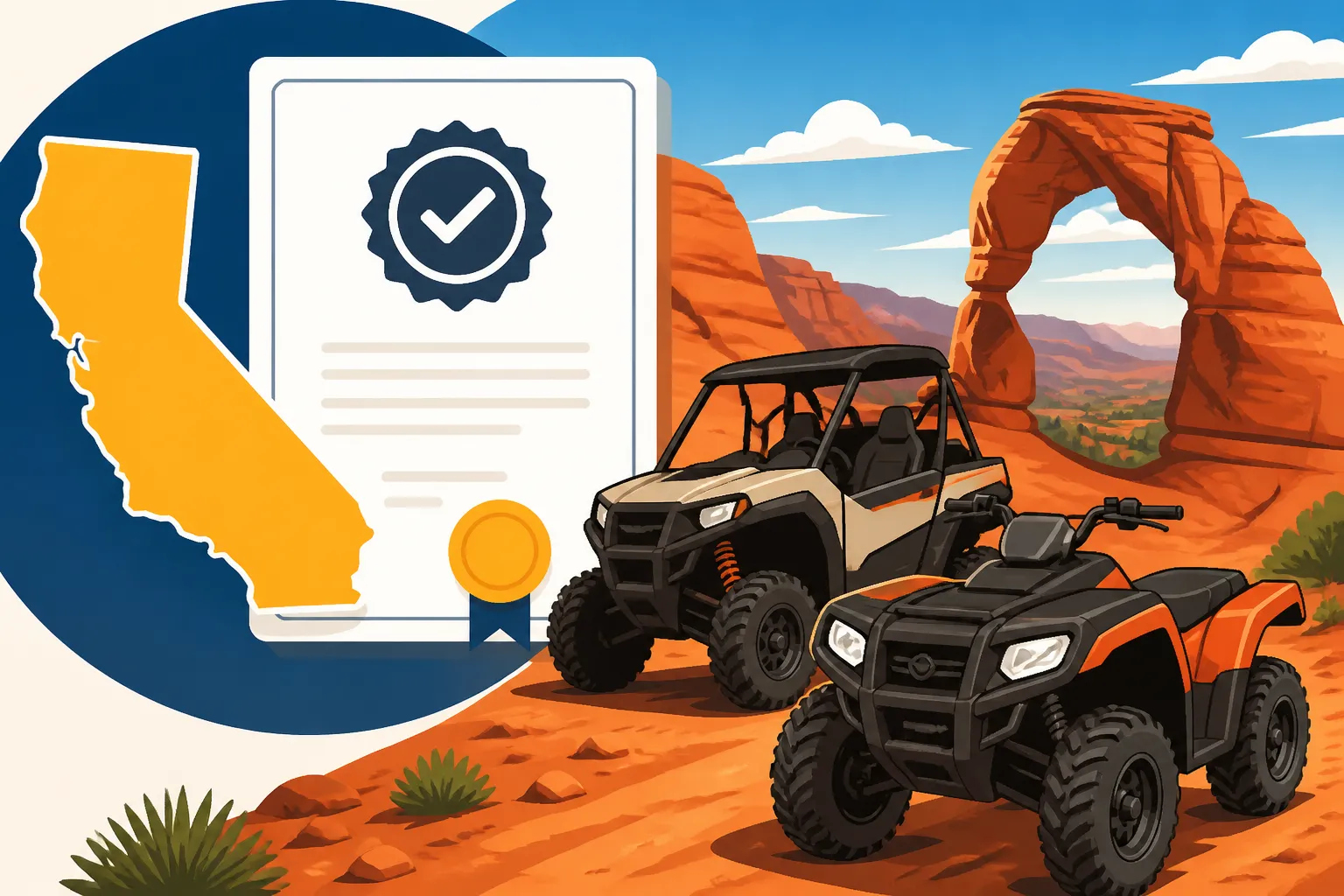
A California OHV safety certificate may help meet Utah’s rider-education requirement, but it does not register your machine or replace a Utah non-resident permit. The key is bringing proof that Utah can recognize and keeping the education, registration, and permit requirements separate before you unload.
Does Utah accept a California OHV certificate?
Generally, Utah recognizes qualifying OHV education certificates issued by other states. A California OHV safety certificate may satisfy Utah’s education requirement if it shows that the rider completed an accepted safety course. The important detail is the credential itself: a course receipt, informal training record, or California registration sticker is not automatically the same as an education certificate.
Utah’s education requirement applies to certain OHV operators, based on the state’s rules for age or birth date. It is not a requirement that every visitor necessarily has to meet. Check the current Utah rule for the rider’s age and circumstances, and confirm that the particular California certificate is accepted. If the certificate’s name or issuing body is unclear, ask Utah’s OHV program before relying on it.
The broader recognition rule is covered in Certificates From Other States Utah Accepts. For the Utah course and the kinds of riders it applies to, see The Utah OHV Education Certificate. Those rules concern rider education, not a machine’s registration or permission to use a trail.
A California credential is most useful when it is easy to verify. Bring the original card if you have one, or a clear copy that shows the rider’s name and the issuing organization. If your proof is digital, save it where you can open it without cell service. A screenshot may be handy, but it is sensible to carry a printed copy too.
| What you bring | What it may help prove | What it does not replace |
|---|---|---|
| California OHV safety certificate | Completion of rider education, if Utah recognizes that credential | Utah registration or a non-resident permit |
| California OHV registration or sticker | The machine’s registration status in California | Utah rider education or a Utah permit |
| Utah non-resident OHV permit | Permission for a qualifying out-of-state machine to ride in Utah | Rider education or the machine’s home-state registration |
| Driver license | Identity and, where relevant, permission to drive a street-legal vehicle | OHV education or off-highway permit requirements |
If you are unsure whether your certificate qualifies, do not wait until a trailhead check to find out. Share the certificate’s exact name and issuer with the relevant Utah OHV office or program contact, and ask whether it meets the education requirement for your rider. Keep the response with your trip documents.
The certificate is separate from Utah’s non-resident permit
A common source of confusion is treating education and access as one requirement. They are separate. A certificate is about the operator’s safety education. A non-resident permit is about an eligible out-of-state OHV being used in Utah. One does not stand in for the other.
Utah no longer relies on the former reciprocity arrangement that some visitors may remember. A California registration or sticker does not, by itself, settle whether a machine needs a Utah permit. Before riding, check Utah Ended OHV Reciprocity: What Visitors Do Now and Who Needs a Utah Non-Resident OHV Permit. The answer can depend on how the machine is registered and how it will be used.
In practical terms, think through three questions separately:
- Does this rider need to meet Utah’s OHV education rule? Check the current requirement for the rider’s age or birth date.
- Does the California certificate count? Confirm that the particular document and course are accepted by Utah.
- Does this machine need a Utah permit? Check the current rules for out-of-state machines, including any applicable exemptions.
A California resident may have a valid certificate and a properly registered ATV, yet still need to obtain a Utah non-resident permit for that machine. Conversely, a permit does not prove that the rider completed required safety education. This distinction applies whether you bring one quad for a day ride or several machines for a longer trip.
Use Machines Exempt From the Utah Permit if you think your vehicle falls into an exception. Don’t assume an exception applies simply because a machine is registered in California, used mainly on private property, or already has a sticker. Confirm the exact situation against Utah’s current requirements.
What to bring and check before leaving California
The easiest trip paperwork is organized by rider and machine. Keep education documents with the rider’s other identification and permits with the machine records. If several family members are riding, label each document clearly; one person’s certificate does not certify everyone in the group.
For each rider
- A California OHV safety certificate or other proof of course completion, if the rider is subject to Utah’s education requirement.
- A clear copy or photo of the certificate as backup, plus an offline copy if you depend on your phone.
- Any other proof Utah specifically requires for that rider or visit.
Check the name on the certificate. If it differs from the rider’s current name, carry documentation that explains the difference. If the card is damaged, hard to read, or missing, contact the California issuer about replacement proof and ask Utah whether the replacement format is acceptable. A note saying that a course was completed may not be enough if it does not identify the person and credential.
For each machine
- Current California registration documents and any required registration display.
- The Utah non-resident permit, if the machine needs one.
- Any additional documents required for the machine’s status or the riding area.
Use Buying the Non-Resident Permit Online to check the purchase process, and read Proof of Out-of-State Residency Utah Asks For if you need to document that the machine or owner qualifies as a non-resident. Make sure the permit information matches the machine and that you have proof available while riding. Keep any purchase confirmation with your other paperwork until you have the permit in the required form.
A street-legal vehicle can raise different questions from an off-highway-registered ATV or UTV. Don’t assume the vehicle’s road registration automatically answers every trail-access or permit question. Check the specific rules for the vehicle and route before relying on its plates.
A simple way to prepare for a Utah ride
Use this sequence before loading the trailer:
- Identify who is riding. Check which riders fall under Utah’s current education requirement. Do this for every operator, including teenagers and adults who may take a turn driving.
- Verify the California credential. Confirm that Utah recognizes the specific certificate, rather than assuming all safety courses or state cards count.
- Check each machine’s status. Note whether it is registered in California, street legal, or otherwise covered by a particular rule.
- Determine whether a Utah permit is required. Apply the rule to each machine, not just to the owner or the group as a whole.
- Save and pack proof. Keep readable copies of certificates, registrations, and permits where you can access them offline.
- Check the riding area’s rules. A valid certificate and permit do not guarantee that a route is open or that a particular machine can use it.
At a trailhead, a rider may be asked to show more than one kind of proof. Carrying Your Certificate and Permit on the Trail explains why it helps to keep education and permit documents accessible. If an officer, ranger, or riding-area operator asks about a certificate, a clear credential is easier to verify than a vague explanation that the rider completed a class.
Rules for visitors and OHV areas can change, so recheck them before each trip rather than relying on an old forum post or advice from a previous visit. That is especially important if you have a new machine, a replacement certificate, a different rider in the group, or a trip that crosses between public lands and a state park.
The practical takeaway is simple: bring the California certificate, but verify that Utah accepts that exact credential. Then handle the machine’s registration and any Utah non-resident permit as separate items. Keeping those requirements distinct is the best way to avoid arriving at a Utah trail with proof of education but missing the permission your machine needs.
Disclaimer
This article is for general informational purposes only and does not constitute professional advice. Laws, prices and regulations vary by location and change over time. Consult a qualified professional for guidance on your specific situation.