The Adult OHV Education Course in Utah
Utah’s adult OHV education course can be easy to confuse with machine registration, trail permits and riding-area fees. The key is to work out whether you need a certificate, complete the right course for your age and situation, and carry proof when required. Here’s how to approach the course and what it does—and does not—allow you to do.
Who Needs the Adult OHV Education Course
Utah’s OHV education requirement depends on the operator, not just the machine. A course certificate shows that a rider has completed the required safety education; it is not a registration document or a permit to ride a particular trail.
For adults, the requirement is generally tied to date of birth. Riders born after the applicable cutoff may need to complete Utah’s adult OHV course before operating on public land. Requirements can differ for younger riders, so an adult course should not be assumed to satisfy a youth rider’s education requirement. Check the current rules with the Utah Division of Wildlife Resources before riding, especially if the operator is close to an age threshold or is visiting from another state.
The phrase “adult course” describes the course pathway, not a general exemption from age rules or supervision requirements. A rider might be old enough to take the adult course yet still need to meet separate rules for age, supervision, passengers or the type of vehicle being operated.
The course is worth distinguishing from several other parts of Utah OHV compliance:
| Requirement | What it addresses | Does the course replace it? |
|---|---|---|
| OHV education certificate | Operator education and eligibility under the education rule | No |
| OHV registration | The machine’s registration status | No |
| Utah non-resident OHV permit | A visiting rider’s permit requirement, where applicable | No |
| Riding-area or day-use fee | Access to a particular recreation area | No |
| Street-legal requirements | Equipment, registration, insurance and road-use rules | No |
A certificate does not make an unregistered machine legal, authorize riding on a closed route, or provide permission to ride on private land. It also does not turn an off-highway machine into a street-legal vehicle. For a broader overview of operator requirements, see The Utah OHV Education Certificate.
Residents and visitors should check different requirements
Utah residents and out-of-state visitors can face overlapping but different requirements. A visitor may need to consider both the education rule and Utah’s non-resident permit rule. Utah no longer relies on the old reciprocity approach that many riders remember, so an out-of-state plate or registration should not be treated as proof that every Utah requirement is satisfied. Utah Ended OHV Reciprocity: What Visitors Do Now explains the permit issue separately.
If you are visiting, verify each item for your situation before loading the trailer:
- Whether the operator needs an education certificate based on age and applicable rules.
- Whether the machine needs a Utah non-resident permit.
- Whether the machine has valid registration for its home state.
- Whether the riding area charges a separate entrance or day-use fee.
- Whether the route has local restrictions, seasonal closures or land-manager rules.
That checklist matters because the requirements attach to different things: education applies to the operator, registration and permits concern the machine or its use, and area fees apply to access. One document rarely covers all of them.
The machine type does not settle the question
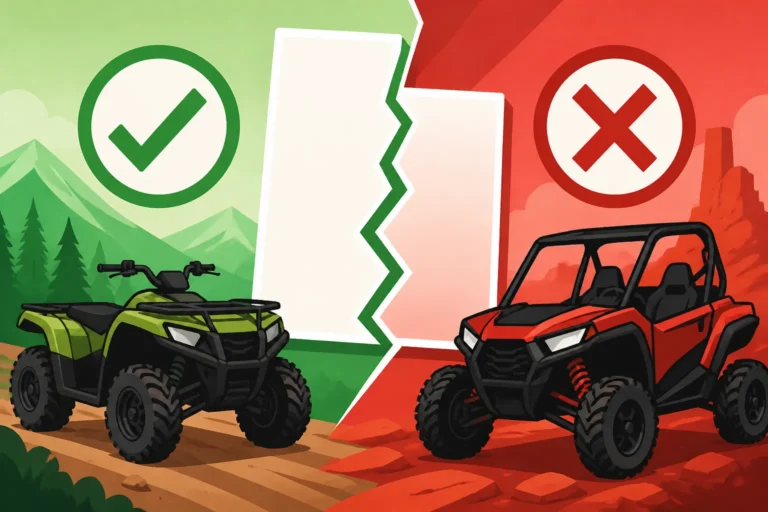
The education requirement is about operating an OHV, but the rules and exemptions can depend on the vehicle category and where it is being used. A quad, side-by-side, dirt bike or other off-highway machine may be treated differently for some purposes, and a vehicle’s street-legal status can create another set of obligations.
Do not assume that a machine is exempt just because it is small, electric, used on private land, or normally driven by someone else in the family. Check how Utah classifies the vehicle and whether the education rule applies to the operator’s intended use. Which Machines Utah Registers as Off-Highway Vehicles can help clarify vehicle classification, while Street-Legal Vehicles and the Permit Question addresses a separate issue for street-legal machines.
How to Complete the Course
The adult course is designed to provide basic safety and legal information for OHV operation. The course platform and steps can change, so use the official Utah course route and follow its current instructions rather than relying on an old saved link or an unofficial summary.
A practical way to complete it is:
- Confirm that the adult course is the correct one. Check the rider’s age and the current Utah education requirement. If the rider is under 18 or close to an age cutoff, check whether a youth course or other rule applies.
- Use the official course provider. Start through the Utah Division of Wildlife Resources’ OHV education information. Be cautious of third-party pages that look official but do not issue the certificate Utah recognizes.
- Set aside enough uninterrupted time. Course length and format can change. Review Free Online Adult Course Length for what to expect, then allow extra time for login steps, reading material and any required knowledge checks.
- Complete every required section. Do not assume that opening the course or watching some content is enough. Follow the instructions through completion and confirm that the course records a passing result if a test is included.
- Save the certificate details. Once the course is complete, keep the certificate or confirmation accessible. Make sure the name and any identifying information are accurate.
- Check what proof to carry. Find out whether a digital copy is accepted for your situation, and keep an offline copy or printed backup if you expect poor reception. Carrying Your Certificate and Permit on the Trail covers the practical document question.
The course can be completed on a phone or another internet-connected device if the official platform supports it. Still, a larger screen may make reading material and entering information easier. If you plan to use a phone, make sure it has a stable connection, sufficient battery and a way to save or retrieve your certificate afterward. See Taking the Utah OHV Course on a Phone for device-specific considerations.
Before you start
Gather the information the course requests, and use the rider’s own details rather than a parent’s or another family member’s account. A mismatch between the course record and the person carrying the certificate can create avoidable questions. If the course asks for an email address, use one the rider or responsible adult can access later.
It also helps to complete the course before the trip instead of waiting until arrival at a trailhead. Remote riding areas may have weak mobile service, and a course site may require a login, confirmation or additional step. Finishing ahead of time gives you a chance to resolve a missing certificate or incorrect record without delaying the ride.
If the website stalls or does not show a completion result, do not immediately repeat the course under a different identity. First check whether the account has a saved progress record, whether a confirmation message was sent, and whether the course has a support or contact option. Keep any completion confirmation until the official certificate is available.
Course completion is not a skills endorsement
The education course provides information; it does not certify that a rider can safely handle every machine or terrain type. A new operator still needs practical instruction and gradual experience. A rider who has completed a course may not yet be ready for steep slickrock, deep sand, narrow mountain routes or a passenger-loaded side-by-side.
Match the route to the least experienced operator in the group. Talk through controls, braking, safe following distance, hand signals and what to do if a machine stops or a rider becomes separated. For a first trip, choose a route with room to turn around and avoid committing to a difficult obstacle simply because the map looks short.
What to Do With Your Certificate
After completing the course, treat the certificate as a document you may need to show—not as something that automatically appears in every registration or permit record. Save the original digital record, take a clear screenshot if appropriate, and consider keeping a printed copy with the machine’s paperwork.
Before a ride, check that the certificate belongs to the person who will be operating the OHV. A family should not assume one adult’s certificate covers other riders. Each operator’s eligibility and documentation should be checked individually. A passenger may have different requirements from the driver, but do not assume the answer without confirming the current rule.
Keep a backup that works offline
Trailheads and remote routes can have little or no cell reception. A certificate stored only behind an account login may be difficult to retrieve if you cannot connect. Download or save the document when possible, and carry a backup in a place protected from dust and moisture. Do not rely on a photo alone unless current Utah guidance says that format is acceptable.
Also keep the course record separate from the machine documents. A small folder or waterproof pouch can hold the certificate, registration, permit and any relevant proof of residency. That makes it easier to respond to a document check without mixing up which paper proves what.
If the certificate is lost, check the course account or official provider’s process for retrieving or replacing it. Do not assume you must repeat the course, and do not rely on a self-made document as proof. Replacing a Lost OHV Education Certificate covers the lost-record issue.
Check whether a certificate has an expiration date
A certificate may remain valid unless Utah changes its rules or the course provider specifies otherwise, but riders should confirm the current policy rather than treating an old memory as definitive. The question is especially relevant if you completed a course many years ago, took a course in another state, or cannot find the original record. Does the OHV Certificate Ever Expire? focuses on validity and replacement questions.
Keep a copy even if you believe the certificate does not expire. A certificate that is valid but unavailable can still make a trail-side check inconvenient. If your name or other information has changed, ask the official provider how to correct the record before a trip.
An out-of-state course may need to be reviewed
A visitor who already completed OHV education elsewhere should not assume that every state’s course is automatically accepted in Utah. Utah has rules about certificates from other states, and acceptance can depend on the course and the official requirements. Review Certificates From Other States Utah Accepts and confirm the answer for the specific certificate you have.
Keep proof that identifies the course and the person who completed it. If you cannot establish whether the certificate qualifies, contact the relevant Utah office before traveling. Repeating an approved course may be a straightforward fallback in some cases, but confirm the requirement first rather than paying for or taking a course unnecessarily.
How the Course Fits With Permits and Registration
A common source of confusion is that people call every required document a “permit.” Utah’s adult education certificate is not the same thing as a non-resident OHV permit, and neither one replaces machine registration.
Think of a ride as a set of separate checks:
- Operator: Does the person need an education certificate, and do age or supervision rules apply?
- Machine: Is the OHV properly registered for its use and home jurisdiction?
- Visitor status: Does the rider or machine need Utah’s non-resident permit?
- Destination: Is there an entrance fee, day-use fee or other access requirement?
- Route: Is the trail open to that machine and permitted use?
- Road travel: If the machine will use public roads, does it meet street-legal requirements and have the required documentation?
The operator’s certificate answers only the education question. A registered Utah machine does not automatically prove that a visiting operator has the required certificate. Likewise, completing the course does not supply a missing permit or pay a park entrance fee.
For visitors, start with Who Needs a Utah Non-Resident OHV Permit and Buying the Non-Resident Permit Online. Then check whether the education certificate is also required for each operator. If you have already purchased a permit, keep proof of that purchase with the other documents; it does not function as proof of course completion. The article Carrying Your Certificate and Permit on the Trail can help you plan how to keep both accessible.
Education is different from an area fee
Some Utah riding areas charge a fee for entry or day use. Those charges are tied to the destination, not to completion of the education course. A rider may have a certificate and still need to pay the applicable fee, follow posted operating rules and use only open routes.
Likewise, a state or federal land pass may have a different purpose from an OHV permit. Before a trip, check the area’s managing agency and current access information. The fact that a machine is registered or a rider has completed the course does not guarantee access to every road, trail or recreation site.
Street-legal use adds another layer
If you plan to ride a street-legal ATV or UTV, the education course remains only one part of the broader picture. Street use can require appropriate equipment, insurance, registration and compliance with road rules. A certificate does not qualify a machine for road travel.
If the ride includes both trails and public roads, confirm both types of requirements. The route may be open to an off-highway machine for one section but not another. Do not infer that a road is legal for OHV use merely because it connects a trailhead to town. Start with Utah OHV Registration vs Street-Legal Registration and check local road access before leaving.
Common Problems and a Pre-Ride Checklist
Most course-related problems are avoidable: taking the wrong course, losing proof, assuming an out-of-state certificate qualifies, or believing the education certificate replaces a permit. A short check before the trip can catch these issues while there is still time to resolve them.
Use this checklist for every operator:
- Confirm the rider’s age and whether the adult or youth course applies.
- Verify the current Utah education requirement for the planned use.
- Finish the course through the official route and confirm completion.
- Save proof under the operator’s own name.
- Keep a usable copy available offline.
- Check whether an out-of-state certificate is accepted.
- Verify the machine’s registration and any Utah non-resident permit requirement.
- Check the destination’s fees, open routes and land-manager restrictions.
- Review separate road-use rules if the machine will travel on public roads.
If your information does not match
If the certificate shows an incorrect name or other detail, contact the course provider or responsible Utah office for correction instructions. Do not edit the document yourself. A manually changed certificate may not be accepted, even if the correction seems obvious.
If you completed the course but cannot locate the record, search the email account used at registration and check the official account or retrieval process. If you took the course through another state, gather the provider name and completion details before asking whether Utah accepts it. That gives officials something specific to review.
If the course site is unavailable, avoid relying on an unofficial version that promises a certificate. Keep a record of the problem and use the official contact channel. If the trip is imminent, confirm whether another approved option exists before assuming you can ride without the required documentation.
If the rider is young
A younger operator may need a youth-specific course, supervision or other safeguards. The adult course should not be used as a shortcut around rules that apply to minors. Check the youth requirement and make sure the machine is appropriate for the rider’s size and ability. A certificate also does not make a child ready to operate a full-size machine or ride an advanced trail.
Parents and trip organizers should plan for each rider separately. Confirm which person will operate each vehicle, who will supervise, and whether the route and machine are suitable for the least experienced operator. Education paperwork is one piece of preparation, not a substitute for direct adult judgment and instruction.
Frequently Asked Questions
Is the adult OHV course required for every adult in Utah?
Not necessarily. The requirement is generally tied to the operator’s date of birth and the current Utah rule. Check the Utah Division of Wildlife Resources’ guidance for your specific age and riding situation before heading out.
Does the course certificate count as a Utah non-resident permit?
No. The education certificate and non-resident permit serve different purposes. A visitor may need to address both, along with machine registration and any riding-area fees.
Can I take the adult course on my phone?
The official course may support mobile access, but the platform’s requirements can change. Use a reliable connection, save the certificate when finished, and keep a backup that you can open without cell service.
Will Utah accept an OHV course certificate from another state?
Acceptance depends on Utah’s current rules and the specific certificate. Check the official guidance for out-of-state certificates rather than assuming all courses transfer.
Does completing the course make my ATV or UTV street legal?
No. The course concerns operator education. Street-legal use has separate equipment, registration, insurance and road-use requirements.
Disclaimer
This article is for general informational purposes only and does not constitute professional advice. Laws, prices and regulations vary by location and change over time. Consult a qualified professional for guidance on your specific situation.