Arizona Certificates Used in Utah
An Arizona OHV education certificate may help meet Utah’s rider education requirement, but it does not replace a permit, machine registration or other trail rules. The practical question is whether Utah recognizes the specific certificate you have and whether each rider who needs one can show it. Here’s how to check before you leave Arizona.
Does Utah accept an Arizona OHV certificate?
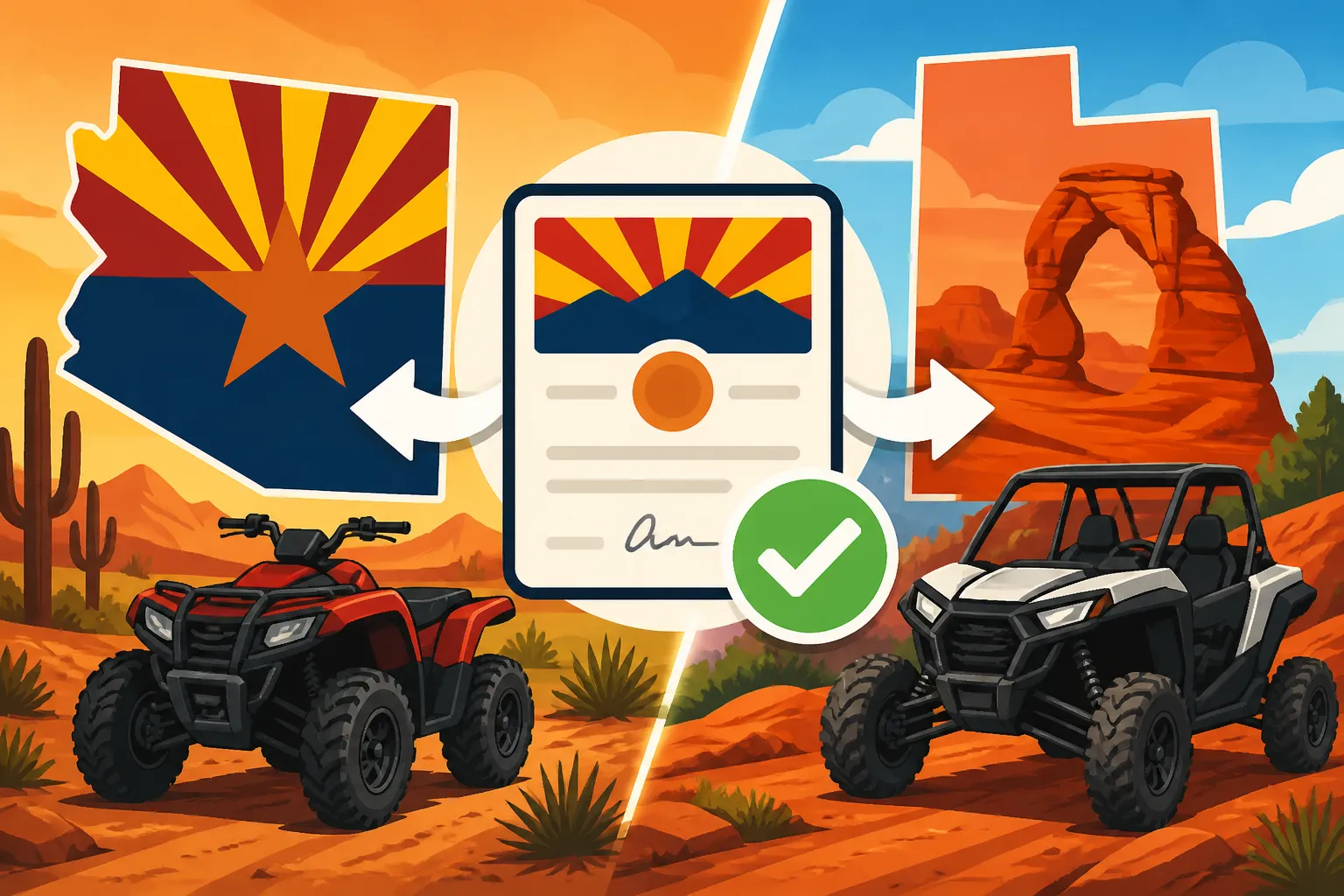
Utah accepts qualifying OHV education certificates from other states, including recognized Arizona OHV safety education certificates. The important word is qualifying: a course completion email, a general safety class or a card for a different activity may not count as an OHV education certificate Utah recognizes.
Check that the document is the official certificate issued after completing Arizona’s OHV education course, and that it identifies the rider. If you have an older card, a printout without a name, or only an email saying the course was completed, confirm with Utah’s current OHV education guidance before relying on it. Utah’s acceptance rules can depend on whether the other state’s course meets its standards. The broader rules for Certificates From Other States Utah Accepts are useful if your document is not clearly an Arizona OHV certificate.
The certificate is about rider education. It does not automatically authorize every person in your group to ride, and it does not make the machine legal to use on every Utah route. Think of it as one item in a trip checklist, not as a universal riding pass.
Utah’s education requirement is age-based, so check the current rule for each operator rather than assuming that a certificate is needed only for children—or that an adult never needs one. Birth date and the type of course completed can matter. Utah’s Age Limits in Utah OHV Education Law and The Utah OHV Education Certificate explain those requirements in more detail.
If a rider falls within a group required to hold a certificate, carry proof for that rider. A parent’s certificate does not cover a child, and one adult’s course record does not cover another operator. For families, it is simplest to match each certificate to the person who may take the controls.
What an Arizona certificate does and does not cover
A common mix-up is treating education, registration and visitor permits as interchangeable. They address different requirements. An education certificate shows that a rider completed an approved safety course; registration identifies the machine for legal use under the applicable rules; and a nonresident permit may be required for an out-of-state machine ridden in Utah.
| Item | What it shows or allows | What it does not replace |
|---|---|---|
| Arizona OHV education certificate | The named rider completed a qualifying safety course | Registration, a Utah nonresident permit, land-access rules or supervision requirements |
| Machine registration | The machine is registered under the applicable system | The operator’s education certificate or any Utah visitor permit that applies |
| Utah nonresident OHV permit | A visiting rider has the permit required for an eligible out-of-state machine | The education certificate, registration or recreation-area entry fee |
| Recreation-area fee or pass | Payment for access where a fee applies | Any education, registration or permit requirement |
Utah’s rules for visiting machines and riders changed after the state ended OHV reciprocity. An Arizona registration by itself should not be treated as proof that you can skip Utah’s nonresident permit requirements. Check Utah Ended OHV Reciprocity: What Visitors Do Now and Who Needs a Utah Non-Resident OHV Permit to see how the permit question applies to your machine and trip.
Likewise, an education certificate does not provide permission to ride a closed route, cross private land without permission or enter a fee area without paying its required charge. A route can have separate rules set by the land manager or recreation area. Check the relevant local conditions and access information before you unload.
A street-legal vehicle can raise a different permit question from an off-highway-only ATV or UTV. Do not assume that the same rule applies to both. If your vehicle is street legal, check the details in Street-Legal Vehicles and the Permit Question as well as the rules for the land or trail you plan to visit.
How to check your certificate before the trip
A short check now is easier than trying to sort out a document problem at a trailhead. Use this process for every rider who may operate an ATV, UTV or other covered OHV.
-
Find the certificate itself. Look for the official Arizona OHV education certificate, not just a registration document, a payment receipt or a course reminder. Make sure the rider’s name is readable.
-
Match the certificate to the person riding. Check spelling and identity details. If the certificate belongs to a parent or sibling, it does not establish that the operator completed the course.
-
Check Utah’s current recognition rules. Confirm that Utah accepts the specific Arizona course and certificate you hold. This is especially important if the record is old, digital-only, incomplete or issued by an organization other than the official state course provider. If the wording is unclear, ask the relevant Utah OHV authority before traveling.
-
Check the rider’s age and eligibility. Utah’s education rules depend on age. Confirm whether the operator needs a certificate and whether additional supervision or riding restrictions apply. An Arizona certificate does not necessarily waive those separate conditions.
-
Keep proof easy to show. Carry the physical certificate if you have one, or a clear saved copy that can be opened without cell service. Keep a second copy with your trip documents. A screenshot can be useful, but do not assume every form of digital proof will be accepted in every situation; confirm what Utah recognizes.
-
Check the machine’s paperwork separately. Verify registration and any Utah nonresident permit requirement for each machine. The rules may differ based on the machine’s status and how it will be used. Keep those documents with the corresponding vehicle.
-
Review rules for the actual riding area. Statewide permit rules do not replace local entry fees, closures, route limits or land-manager requirements. Check current access information before heading out, especially if weather, seasonal closures or a special event could affect your plan.
If you are bringing children or other less-experienced riders, don’t treat a certificate as a substitute for direct supervision or an appropriate machine. Review the family-specific guidance in Utah OHV Rules for Visiting Families and the requirements for Carrying Your Certificate and Permit on the Trail.
What to carry and what to do if there is a problem
For each rider and machine, organize the documents so you can show the right proof without searching through a phone gallery or a glove box. A practical set may include:
- Each required rider’s OHV education certificate
- The machine’s registration documents
- Any Utah nonresident OHV permit that applies
- Identification or residency proof if needed for the permit or transaction
- Recreation-area passes or proof of paid entry where applicable
Keep a readable digital backup as well as any physical card or printout. Save files to the phone itself rather than relying only on email or cloud storage, since reception can be unreliable in remote areas. If you prefer paper copies, store them in a waterproof sleeve. A basic clear sleeve from an outdoor retailer or Amazon can help keep documents legible through dust and splashes; it does not make an unaccepted document valid.
If you discover that a certificate is missing or unclear, do not count on explaining it at a checkpoint. Contact the Arizona course provider to ask about retrieving or replacing the record, and check with Utah whether the replacement format is acceptable. If a rider has not completed a qualifying course, resolve that before the trip if the rider is subject to Utah’s education requirement.
If you are already in Utah and cannot produce the certificate, stop and verify the rule before that person operates the machine. Another rider’s certificate is not a workaround. Do not rely on a verbal assurance from a seller, a friend or an online forum when official guidance is available.
The same approach applies if your permit or registration is uncertain. Confirm what applies to the specific machine rather than assuming an Arizona plate or card settles the question. For a broader pre-trip checklist, see Visiting Utah With an Out-of-State Machine. Checking education, registration, permits and local access separately is the safest way to avoid arriving at a trailhead with one document that is being asked to do four different jobs.
Disclaimer
This article is for general informational purposes only and does not constitute professional advice. Laws, prices and regulations vary by location and change over time. Consult a qualified professional for guidance on your specific situation.