Permits for a Guided Tour Customer
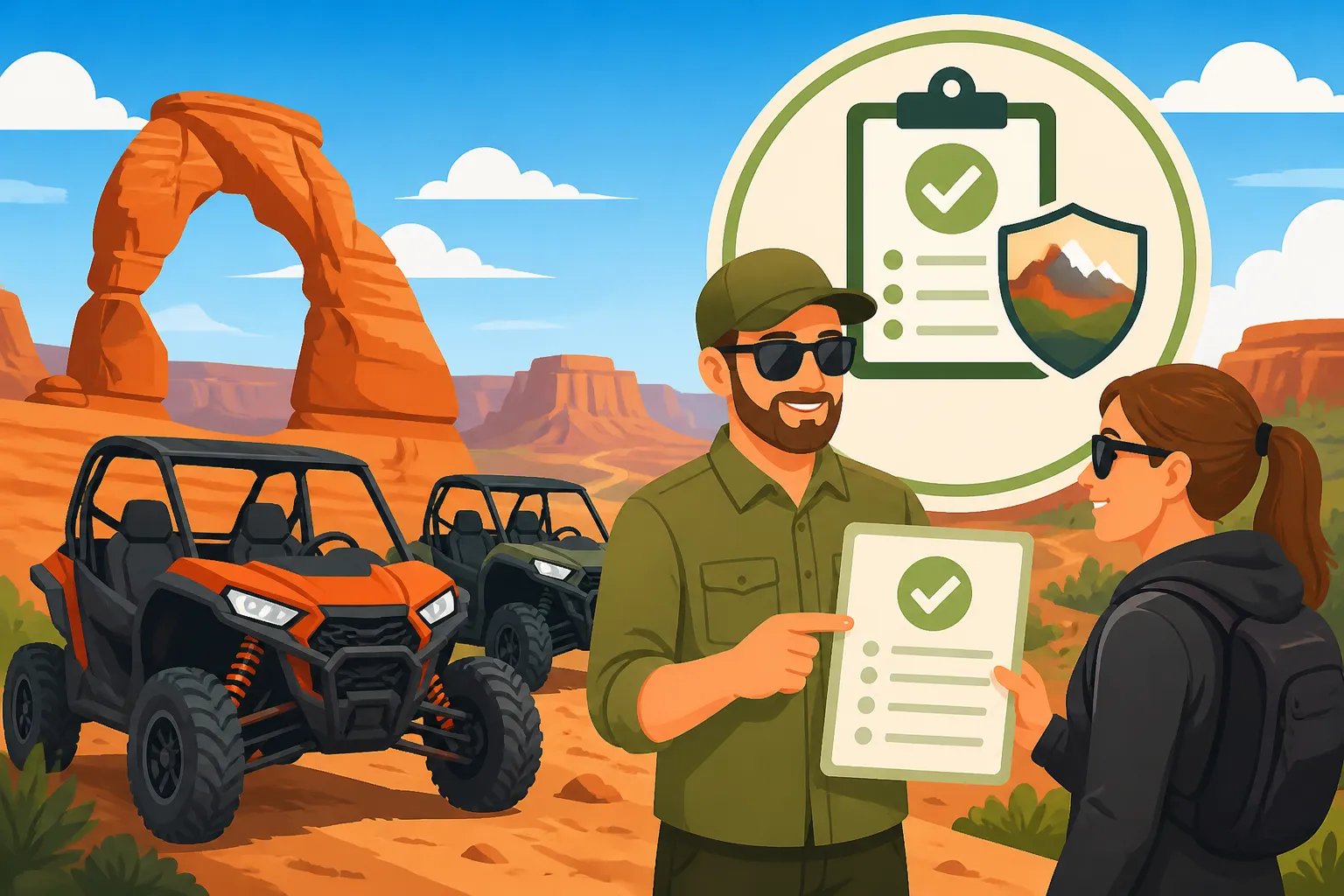
A guided ATV or UTV tour can make a Utah ride easier to plan, but it does not automatically settle the permit question. The key is whether your machine, residency, and trip qualify for an exemption—and whether the tour operator has arranged the paperwork you need. Confirm those details before booking or arriving at the trailhead.
Do guided tour customers need a Utah OHV permit?
Sometimes. A guide leading the ride does not, by itself, mean customers can skip Utah’s nonresident OHV permit. The requirement depends on who is operating the machine, where it will be ridden, and whether a specific exemption applies.
Utah’s nonresident permit rules are relevant to visitors operating off-highway vehicles on public land. They can apply whether you bring your own machine or ride a rental. Utah no longer relies on the older assumption that an out-of-state registration or home-state permit automatically satisfies its visitor requirements. Check Utah Ended OHV Reciprocity: What Visitors Do Now before your trip if you are relying on paperwork from another state.
A guided tour may take place on public land, private land, or a combination of routes. It may also involve a rental machine that the outfitter has already prepared for visitors. Those details affect what you need to carry, so ask the operator rather than assuming that “guided” means “permit included.”
The tour is not the same as your permit
A tour company may hold permits or authorizations that allow it to operate commercially in an area. Those permissions address the company’s use of land and its guided activity; they do not necessarily satisfy the individual customer’s OHV requirements. A land-use authorization and a rider’s nonresident OHV permit are different kinds of paperwork.
There may be exemptions for qualifying organized events, but a commercial tour should not be treated as exempt just because a guide leads a group. The exemption has specific conditions. Ask the operator whether the tour qualifies and what rule it relies on. If the answer is simply “we’re guided,” get clarification before riding.
This matters even if you are only on the machine for a short tour. A brief ride does not automatically make a permit unnecessary. The practical questions are whether the route is subject to Utah’s nonresident OHV rules and whether the specific machine and rider are covered.
Residents, visitors, and rental machines
If you are a Utah resident, your situation may differ from that of a visitor. If you are visiting from another state, ask whether the nonresident permit applies to you and the machine you will operate. If the outfitter supplies the vehicle, ask whether its permit is current and whether you are expected to obtain anything separately.
The requirement may also depend on the type of vehicle and how it is used. An OHV ridden on public trails is not necessarily treated the same as a street-legal vehicle being driven on a public road. If the tour crosses between roads and off-highway routes, ask how the operator handles each part. For background, see Street-Legal Vehicles and the Permit Question.
What to ask the tour operator before you book
A quick conversation can prevent a frustrating surprise at check-in. Ask direct questions and get a clear answer for your exact tour, not just the company’s general policy. If you are comparing outfitters, use the same questions with each one.
- Does this tour route require a Utah nonresident OHV permit? Ask whether the route uses public land and whether any part of the trip falls under an exemption.
- Who obtains the permit? Find out whether the operator purchases or arranges it, whether you must purchase it yourself, or whether it is not required for your circumstances.
- Which machine does the permit cover? If the operator provides a rental, confirm that the permit applies to the machine you will ride and ask where proof is kept or displayed.
- Does each rider need a separate permit? Requirements can depend on the permit and how it is issued. Do not assume that one person’s paperwork covers a group or that one machine’s permit transfers to another.
- Is there a separate education certificate requirement? A permit and an OHV education certificate are not interchangeable. Ask what applies to each driver, especially if a child or teen will operate a machine.
- What proof should I bring? Check whether the company wants a printed permit, a digital copy, identification, a course certificate, or other documents.
- What happens if we change machines or routes? A last-minute vehicle substitution or route change could affect what paperwork is needed.
The operator should be able to explain the arrangement in concrete terms. “We take care of everything” is reassuring only if the company can say what it takes care of and whether the paperwork covers each customer and machine. For a rental-specific checklist, see Questions to Ask a Rental About Permits. You can also compare what different outfits include in Comparing Utah Shops by What They Include.
If the operator says the tour is exempt, ask what makes it qualify. Organized-event exemptions are not a blanket exception for every guided ride. The company should be able to explain whether the tour meets the relevant criteria and whether customers need to do anything themselves. You can read more about the distinction in Organized Events That Waive the Permit.
When the operator supplies the ATV or UTV
If you are using a machine provided by the tour company, ask the company to confirm its status before the day of the ride. The vehicle may have a permit, registration, or other paperwork handled by the operator, but the fact that the company owns it does not answer every question about the customer’s obligations.
Ask whether the permit is already obtained for that machine, whether it covers the tour date and route, and whether you need to carry or display anything. If the operator says customers buy permits themselves, ask for the official purchase instructions and whether you should complete the purchase before arriving.
Do not buy a permit for a machine you may not use until you know how the operator handles substitutions or changes. If you purchase one yourself, confirm that the details match the machine and intended use. For more on purchasing, see Buying the Non-Resident Permit Online and Do You Need a Permit for Each Machine?.
When you bring your own machine
Bringing your own ATV or UTV adds another set of questions. Tell the tour company what you plan to ride, where it is registered, and whether it is street legal. Ask whether the route accepts customer-owned machines and what proof the guide expects to see.
A current home-state registration may establish that the vehicle is registered where you live, but it does not automatically resolve Utah’s separate visitor requirements. Confirm the Utah permit question directly. If your trip includes public roads as well as OHV routes, ask whether the machine must meet separate street-use requirements. A guided itinerary does not make an otherwise restricted road open to OHV traffic.
Permits, education certificates, and other paperwork
Customers sometimes use “permit” to mean any document needed for the ride. In practice, several requirements may be separate. Sorting them out helps you avoid arriving with one document and discovering that another is needed.
| Item | What it generally addresses | What to confirm with the operator |
|---|---|---|
| Utah nonresident OHV permit | A visitor’s operation of an OHV under Utah’s rules | Whether it applies to your route, who obtains it, and which machine it covers |
| OHV education certificate | The operator’s completion of applicable education requirements | Whether the driver’s age or status makes it necessary and what proof to bring |
| Vehicle registration | The vehicle’s registration status | Whether the supplied or customer-owned machine is properly documented |
| Commercial or land-use authorization | The outfitter’s authority to conduct business or use a particular area | Whether the operator has the required authorization for the tour |
| Trailhead or site fee | Access to a specific recreation area, where applicable | Whether it is included, paid separately, or not part of the tour |
A tour operator’s commercial authorization does not replace a customer’s education requirement. Likewise, a rider’s education certificate is not the same as an OHV permit, and neither one replaces vehicle registration. Ask about each item separately.
Check the education requirement for each driver
Utah has OHV education requirements that can apply to operators based on age and other details. Because the rule can differ by rider, do not assume that a parent’s certificate, a guide’s training, or the group’s booking covers everyone. Ask which drivers need a certificate, what proof is accepted, and whether a certificate from another state is recognized for your situation.
This is especially important when a minor will drive. A child may need to meet education and supervision requirements even when riding as part of a commercial tour. The tour company may also set stricter age or driving rules than the state minimum. Review The Utah OHV Education Certificate and Certificates From Other States Utah Accepts, then confirm the current requirements with the operator or the appropriate Utah authority.
Passengers who will not drive may have different requirements from operators, but they still need to follow the tour company’s age, passenger, and safety rules. Do not interpret a passenger’s exemption from an operator requirement as permission for that passenger to drive.
Keep the documents accessible
Before leaving for the tour, make sure you know what proof is expected and where to keep it. Follow the operator’s instructions about printed or digital documents. A phone screenshot can be useful, but it may not be enough if the company or an official needs to verify a document another way. Remote areas can also have unreliable cell service, so save any confirmation where you can access it offline or bring a printed copy if requested.
For a visitor using their own machine, review Carrying Your Certificate and Permit on the Trail and What Utah Riders Must Carry on Public Land. If your tour operator provides the machine, ask whether the required vehicle paperwork stays with the machine or is held by the guide.
Do not rely on a booking confirmation alone. It may show that you reserved a tour without proving that the required OHV documents have been obtained. Keep the permit confirmation, education certificate, and any other requested proof separate and easy to find.
A simple pre-tour checklist
Use this checklist a few days before the tour, then confirm anything that changes when you arrive.
- Identify the machine. Confirm whether you will use the outfitter’s vehicle or your own, and whether it will be operated as an OHV, a street-legal vehicle, or both during the trip.
- Describe your residency. Tell the operator whether you are a Utah resident or visitor and where your vehicle is registered.
- Ask about the route. Find out whether the ride uses public land and whether a particular exemption applies.
- Clarify who handles the permit. Ask whether it is required, who obtains it, and which rider or machine it covers.
- Check education rules. Confirm whether each person who will drive needs an OHV education certificate and what proof is accepted.
- Ask about site charges separately. A Utah OHV permit and an entrance or day-use fee are not necessarily the same thing. Ask whether the tour price includes any applicable site charge.
- Save proof before you travel. Keep confirmations accessible and follow the company’s instructions about printed or digital records.
- Reconfirm changes. If the vehicle, driver, route, or tour format changes, ask whether the paperwork still fits.
If you cannot get a clear answer from the tour company, check Utah’s official OHV information before riding. Do not assume the guide can resolve a missing permit or certificate at the trailhead, and do not rely on outdated advice about reciprocity. A small amount of preparation is easier than trying to sort out multiple requirements just before departure.
Disclaimer
This article is for general informational purposes only and does not constitute professional advice. Laws, prices and regulations vary by location and change over time. Consult a qualified professional for guidance on your specific situation.