Private-Land-Only Machines and Utah Registration
It's a common dilemma for ATV and UTV owners in Utah: you've got a fantastic machine, but you only ever ride it on your own property, a friend's ranch, or some private land you have permission to use. The thought of dealing with DMV paperwork and fees for something that never touches a public trail can feel like an unnecessary hassle. This guide is here to untangle that confusion, explaining when Utah actually requires registration for your off-highway vehicle (OHV) and when you might be exempt – and even when it's a good idea to register voluntarily.
The Core Question: Is Registration Truly Optional for Private-Land Use?
This is perhaps the biggest question on the minds of many private land owners or those who only ride on restricted access properties. The short answer in Utah is often "yes, for registration," but with some very important caveats that can easily lead to misunderstandings and potential legal headaches down the road. It's crucial to understand the state's specific definitions and where those lines are drawn.
Utah's Definition of an Off-Highway Vehicle OHV
First, let's make sure we're all on the same page about what Utah considers an "off-highway vehicle." In the simplest terms, an OHV is any motor vehicle designed for or capable of travel over unimproved terrain and that is not otherwise registered as a street-legal vehicle. This broadly includes ATVs (all-terrain vehicles), UTVs (utility task vehicles, often called side-by-sides), dirt bikes, and even snowmobiles. The key here is "unimproved terrain" and the lack of a standard street-legal registration.
So, whether you have a small youth quad for the kids to ride around the farm or a powerful side-by-side that only ever sees action on your sprawling hunting property, Utah generally categorizes it as an OHV. This initial classification is important because it sets the stage for whether state OHV laws, including registration rules, even apply to your machine in the first place. It doesn't matter how you use it; if it fits the physical description, it's an OHV.
The "Public Land" Distinction in Utah Law
Here's where the rubber meets the road (or rather, the knobby tire meets the dirt). Utah law specifically ties the requirement for OHV registration to operation on public lands, roads, or trails. If your OHV is exclusively operated on private property, and it never, ever ventures onto a public road, trail, or state-managed land, then the state generally does not require you to obtain an OHV registration sticker. This is the exemption that many private-land riders rely on.
However, "public land" in Utah is a vast and sometimes subtle concept. It includes not just obvious places like national forests, BLM land, or state parks, but also many county roads, undeveloped public access easements, and even shoulders of paved roads that might look like private property but are, in fact, public rights-of-way. It's not always as simple as "my land" versus "not my land." The moment a tire touches anything legally considered public, even for a short hop across a paved county road to get to another section of your property, the registration requirement typically kicks in. This distinction is absolutely paramount and often misunderstood.
Understanding Utah's OHV Registration Requirements
While the "private land only" exemption sounds straightforward, the practicalities of Utah's OHV laws mean that many owners who think they're exempt might actually need to register. It's about more than just where you ride; it's about the potential for your machine to interact with public spaces or official records.
Who Needs to Register and Why
Utah's OHV registration system is primarily designed to manage and fund the state's extensive network of public trails and riding areas. When you register your OHV, a portion of those fees goes directly back into maintaining trails, providing signage, and supporting educational and enforcement programs. This is why the requirement focuses on machines used on public land. So, who definitely needs to register? Any Utah resident operating an OHV on federal land, state parks, state forests, county OHV trails, or even dedicated city OHV routes. If you're using designated trails like those on the Paiute Trail system or riding at Sand Hollow State Park, your machine absolutely needs its current registration decal.
For out-of-state visitors, the rules are slightly different, as Utah no longer offers reciprocity for other states' registrations. If you're from out of state and planning to ride on Utah's public lands, you'll need to acquire a [Utah's Non-Resident OHV Permit Explained]. This permit serves the same purpose of contributing to trail maintenance and ensuring compliance with state regulations. Even if your machine is registered in your home state, the Utah permit is a must for public land use here.
When the Exemption Applies and When it Doesn't
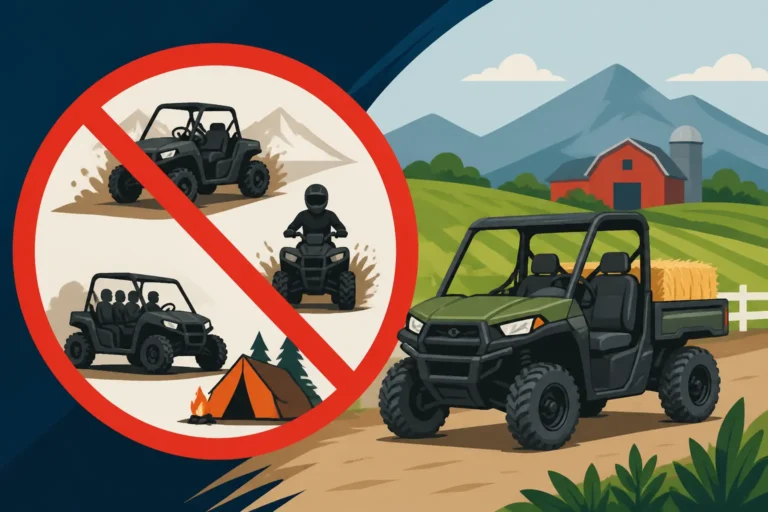
The private-land exemption truly applies only when your OHV never leaves private property. This means no trips down the gravel road that's technically a county right-of-way, no quick jaunts across a paved access road to reach another field, and certainly no recreational rides on public trails. If your OHV is confined to your farm, a completely fenced private ranch, or an industrial site, and it genuinely never interacts with any public thoroughfare or designated OHV trail, then you are generally exempt from the annual registration requirement.
However, the exemption immediately disappears if your machine ever enters public domain. Imagine you're riding your UTV on your own 100-acre property, but to get from the north end to the south end, you have to cross a small, unpaved road that the county maintains. Even if it's just a few yards, that's considered public use, and your machine would then need to be registered. This is where many owners get caught off guard. It's not just about spending hours on public trails; even fleeting contact can trigger the requirement. Keep in mind that while registration might be optional, machines built after a certain year will still require a title, even if only used on private land. You can learn more about this in [Utah ATV Title Requirements Explained].
The Titling Component for Private-Land Machines
This is a critical distinction that often confuses people. Even if your OHV is exclusively used on private land and doesn't require annual registration, Utah law still generally requires a title for any OHV manufactured in 1988 or later. A title is proof of ownership, like a deed for a house or a title for a car. It's a one-time document issued when the machine is new or first brought into the state. You can read more about this in [Utah's Title Rule for 1988 and Newer Machines].
So, while you might not need that yearly sticker, you absolutely need a title to legally prove you own the machine. This is crucial for several reasons:
- Proof of Ownership: If your machine is ever stolen, the title is essential for reporting it to the police and for any insurance claims. Without it, proving ownership can be incredibly difficult.
- Resale: When it comes time to sell your OHV, a clear title is vital. Most buyers, especially legitimate ones, will not purchase a machine without a title, as it's the primary document for transferring ownership. For private sales, you'll definitely need proper documentation like a bill of sale, and resources like LawDepot can help you draft a solid one to protect both buyer and seller.
- Lienholders: If you financed your OHV, the lender will hold the title until the loan is paid off, as it's their security for the loan.
The process for obtaining a title typically involves paperwork submitted to the Utah Division of Motor Vehicles (DMV). Even if you never intend to register, you should ensure your OHV has a clear title. You'll generally need a manufacturer's certificate of origin (MCO) for new machines or a properly signed-over title from the previous owner for used ones.
Practical Scenarios: When Private Land Use Gets Complicated
Life isn't always neatly contained within fence lines, and neither is OHV use. There are many real-world situations where a machine you thought was strictly "private-land-only" suddenly finds itself in a gray area, potentially triggering registration requirements you hadn't considered.
Crossing Public Roads to Access Private Land
This is perhaps the most common scenario where the private-land exemption breaks down. Let's say you own a large parcel of land, but it's split by a public county road or even a small town road. To get your ATV or UTV from one section of your property to the other, you have to drive it across this public thoroughfare. The instant your tires touch that public road, you are technically operating on public land, and your OHV must be registered with a current decal.
Many landowners mistakenly believe that a quick dash across a road doesn't count, or that if they own land on both sides, it's still "private use." Unfortunately, law enforcement sees it differently. A public road, regardless of how short a distance you're traveling on it, is considered public land for OHV registration purposes. If you're pulled over while doing this with an unregistered machine, you could face penalties for [Penalties for Riding Unregistered in Utah]. For situations like this, where you need to move a machine between parcels, a registered OHV or a street-legal conversion might be your only legal options. You can explore the latter in [Making a UTV Street Legal in Utah].
Lending Your Machine to a Friend for Public Land Use
Another situation that can get tricky is lending your unregistered, private-land-only OHV to a friend or family member. What if your friend wants to borrow your UTV for a weekend trip to a nearby trail system like Five Mile Pass? If they take your machine onto public land, your OHV must be properly registered. The fact that you only use it on private land doesn't exempt it when someone else uses it publicly.
The registration is tied to the machine itself, not solely to the primary operator's intent for its use. If your friend gets stopped on a public trail with your unregistered machine, it's still unregistered, and they could face consequences, and you, as the owner, might also be implicated. To avoid this, if there's any chance your OHV will be used on public land by anyone, even temporarily, it's always best to have it registered. This ensures compliance and peace of mind for both you and anyone you might loan it to.
Selling a Private-Land-Only Machine
Even if you've never registered your OHV because it lives entirely on your property, the moment you decide to sell it, you'll need to navigate some paperwork. As mentioned, if the machine is a 1988 model or newer, it must have a title. If you've somehow lost or never obtained a title for your private-land-only machine, you'll need to sort that out before a sale, as it will be very difficult to find a buyer without it. [Replacing a Lost ATV Title in Utah] covers the steps for that.
When selling, you'll also want a clear [Bill of Sale Requirements for a Utah ATV Sale]. Even though the machine hasn't been registered, a well-drafted bill of sale, perhaps using a template from a service like LawDepot, protects both you and the buyer. It outlines the terms of the sale, the purchase price, and confirms the transfer of ownership. This document becomes crucial for the new owner, especially if they do intend to register the machine for public land use, or if they need to obtain a new title in their name. Don't skip these steps just because you've kept it off the public radar; proper documentation is always smart.
Benefits of Voluntary Registration, Even for Private Use
Given the complexities and potential pitfalls of relying solely on the private-land exemption, many OHV owners in Utah find that voluntarily registering their machines, even if they mostly ride on private property, offers significant advantages and peace of mind. It's often a small investment for substantial benefits.
Proving Ownership and Theft Protection
One of the most compelling reasons to register your OHV, even if it stays on private land, is the added layer of security it provides regarding ownership. While a title is the primary document of ownership, having your machine registered in the state database further solidifies your claim. In the unfortunate event that your ATV or UTV is stolen from your property, having it registered makes it much easier for law enforcement to identify and recover it. Your registration information, along with the VIN, is linked in state records, creating a verifiable paper trail.
Without registration, if your title is lost or destroyed, proving unequivocally that the machine belongs to you can be a much more challenging process. The state database essentially acts as an additional, official record of your ownership. This might seem like an overabundance of caution, but when valuable equipment goes missing, every piece of verifiable documentation counts.
Easier Resale Value and Transferability
When the time comes to upgrade or simply sell your OHV, having it already registered can significantly streamline the process and even enhance its appeal to potential buyers. A machine that comes with current registration and a clean title indicates a responsible owner who has kept up with official requirements. Buyers, especially those who plan to ride on public lands, will appreciate that they don't have to jump through extra hoops to get the machine legal after purchase. This can make your OHV more marketable and potentially command a better resale price.
Furthermore, the transfer of ownership is smoother. If the machine is already in the state's system, updating the ownership records is generally easier than starting from scratch with a never-before-registered machine. You'll simply need to ensure you provide the buyer with a properly signed-over title and a detailed bill of sale. For this crucial paperwork, remember that resources like LawDepot can offer excellent templates to ensure everything is legally sound.
Access to Public Land in the Future
Perhaps the most practical reason for voluntary registration is the flexibility it offers. Even if you're currently a strict private-land rider, circumstances can change. You might discover a fantastic public trail system you want to explore, or friends might invite you on a ride to Moab or Sand Hollow. If your OHV is already registered, you can simply load it up and go, confident that you're legal to ride on public lands.
If you wait until you need to ride publicly, you might face delays. Getting your OHV registered typically requires a trip to the DMV or completing the process online, and waiting for decals to arrive. This can eat into your riding time. By keeping your machine registered, you're always ready for adventure, whether it's an impromptu trip to a state park or a planned excursion onto federal lands. It provides the ultimate flexibility, turning your "private-land-only" machine into an "anywhere-I-want-to-ride-legally" machine.
| Feature | Private-Land Only (Unregistered) | Voluntary Registration (Even for Private Use) |
|---|---|---|
| Legality | Permitted only if machine never touches public land/roads. | Legal for both private and public land use. |
| Cost | No annual registration fees. May still have title fees. | Annual registration fees and potential sales/uniform fees. |
| Proof of Ownership | Relies primarily on title; can be harder if title is lost. | Title plus state registration record; stronger theft protection. |
| Resale Value | May be harder to sell to buyers wanting public access; requires buyer to register. | More attractive to buyers; easier transfer, potentially higher value. |
| Public Land Access | Absolutely none without breaking the law. | Immediate legal access to all Utah public OHV trails. |
| Flexibility | Very limited; can't cross roads or lend for public use. | High flexibility; ready for any riding opportunity. |
| Donation of Funds | No direct contribution to Utah's OHV trail system. | Directly supports maintenance and development of OHV trails. |
How to Register a Private-Land Machine (If You Choose To)
If you've weighed the pros and cons and decided that voluntary registration is the right path for your private-land-only OHV, the good news is that the process is the same as for any other OHV in Utah. It's relatively straightforward, though it does require gathering some specific documents.
The Standard Registration Process
Whether your OHV has never been registered or its registration has lapsed for years, the basic steps are the same. You'll primarily interact with the Utah Division of Motor Vehicles (DMV). You can often begin the process online for renewals, but for a first-time registration or if your machine has never had a Utah title, an in-person visit to a [Which Utah DMV Offices Handle OHV Paperwork] is usually necessary.
When you go to the DMV, you'll fill out the necessary application forms. The key is to have all your documentation in order (more on that in the next section) to ensure a smooth transaction. Once everything is processed and fees are paid, you'll receive your registration card and the all-important OHV decal, which must be affixed to your machine in the proper location. You can find details on this in [Utah OHV Decals and Where They Go]. The registration is typically valid for one year, and you'll receive a renewal notice when it's time to update it.
What Paperwork You'll Need
Gathering the correct paperwork beforehand is key to avoiding multiple trips to the DMV. Here’s a rundown of what you’ll typically need:
- Proof of Ownership: This is usually the vehicle's title. If you're the original owner and it's a brand new machine, you'll need the Manufacturer's Certificate of Origin (MCO or MSO). If you bought it used, you'll need the properly signed-over title from the previous owner. If you don't have a title for an older machine, or it was lost, you'll need to work with the DMV on how to establish ownership, which might involve a [Bill of Sale Requirements for a Utah ATV Sale] or other supporting documents.
- Bill of Sale: While the title transfers ownership, a bill of sale is crucial for detailing the transaction, especially if purchased from a private party. Even if your state doesn't require notarization, having a formal agreement can be incredibly helpful. You can utilize platforms like LawDepot to generate a comprehensive bill of sale that protects your interests.
- Identification: Your valid driver's license or other government-issued ID.
- Proof of Residency: If you're a new resident, documents showing your Utah address.
- Payment for Fees: Be prepared for the various fees, which include the registration fee, a uniform fee based on the machine's value, and potentially sales tax if it hasn't been paid. While we can't state specific amounts, know that these costs vary.
Having physical copies of all these documents in hand, neatly organized, will make your DMV visit much more efficient.
Costs Involved and What They Cover
When you register your OHV in Utah, there are a few components to the total cost. These typically include:
- Registration Fee: This is the core fee for the annual registration. A portion of this goes directly to fund the Utah State Parks OHV program, supporting trail maintenance, enforcement, and education. It ensures that the trails you ride on are well-maintained and accessible.
- Uniform Fee: This is a property tax on the OHV, similar to what you'd pay on a car, assessed by the county where the machine is garaged. It's based on the machine's year and value, so older, less valuable machines generally pay less. This fee helps fund local county services.
- Sales Tax (if applicable): If you just purchased the machine and haven't paid sales tax yet (e.g., from a private seller), you'll pay it at the time of registration. The amount is a percentage of the purchase price or the fair market value, whichever is higher.
- Optional Fees: Depending on your situation, there might be small fees for a duplicate title, lien recording, or other administrative tasks.
While the exact figures change, understanding what each fee covers can help you budget and appreciate where your money is going. Essentially, your registration dollars are directly contributing to keeping Utah's incredible OHV opportunities open and well-maintained for all riders, whether you're riding private land today or hitting the trails tomorrow.
Disclaimer
This article is for general informational purposes only and does not constitute professional advice. Laws, prices and regulations vary by location and change over time. Consult a qualified professional for guidance on your specific situation.