Supervision Rules for Young Utah Riders
A family ride can go sideways before the machines even leave the trailer if no one knows who must supervise a young rider. Utah’s age limits, education-certificate rules and helmet requirements are separate obligations, not substitutes for one another. Here’s how to understand the basics, prepare for public-land riding and make supervision practical rather than merely nominal.
Utah’s age and supervision rules
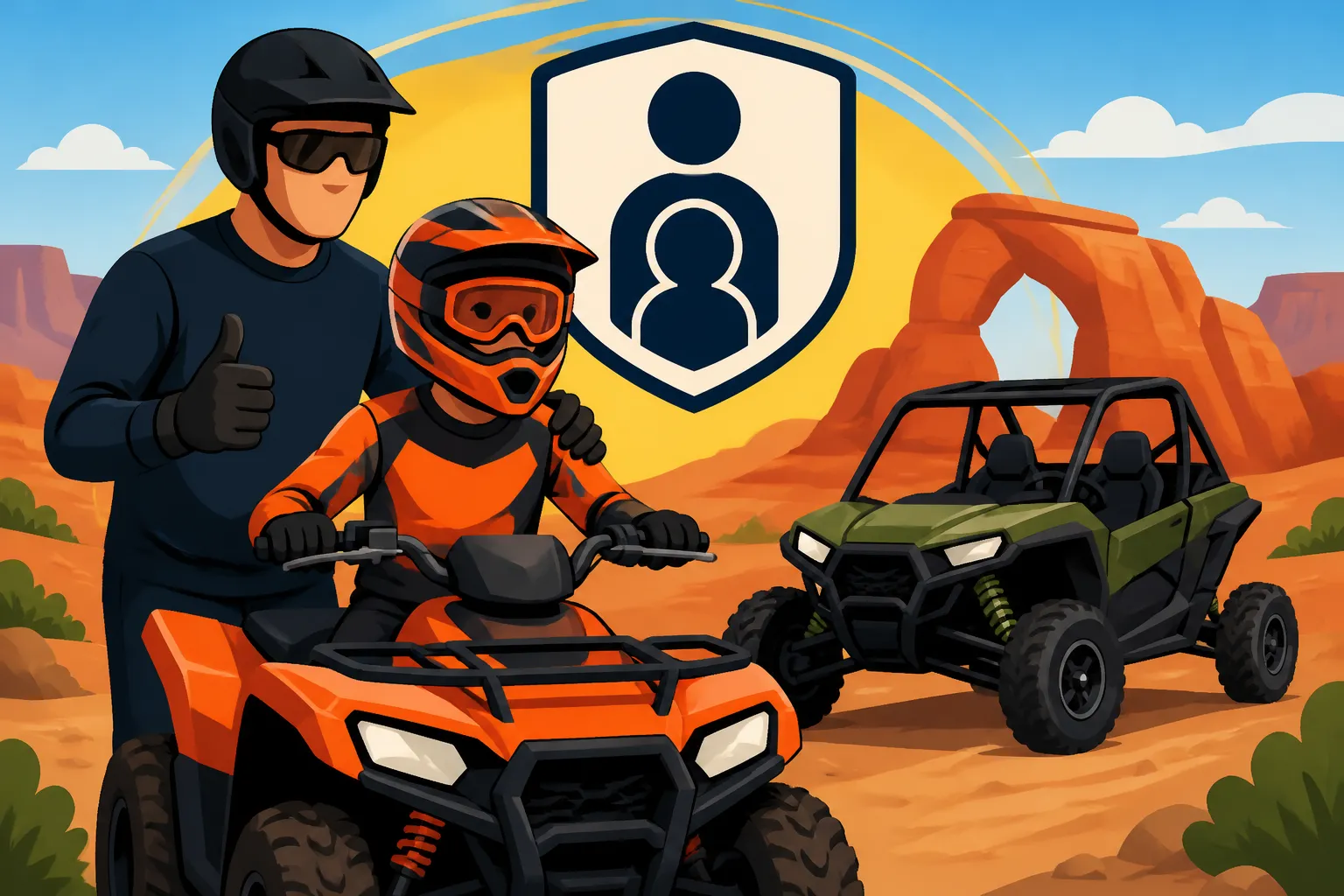
On Utah public land, a child younger than 8 may not operate an off-highway vehicle. Riders ages 8 through 15 must meet the youth education requirement, and anyone under 16 must be under the direct supervision of an adult who is at least 18. These requirements work together: an adult’s presence does not replace a child’s certificate, and a certificate does not remove the supervision requirement.
“Direct supervision” should mean the adult is actively watching and close enough to respond—not simply somewhere in the riding group, back at camp or reachable by phone. The adult needs a clear view of the young rider’s location and enough control over the ride to stop it or provide help. When terrain, dust, trees or distance block that view, the supervision may no longer be meaningful.
| Rider’s age | Public-land riding requirement | Practical takeaway |
|---|---|---|
| Under 8 | May not operate an OHV on public land | An adult riding nearby does not make operation permissible |
| 8 through 15 | Must meet the youth education requirement and ride under direct adult supervision | Carry the certificate and keep the rider within effective supervision |
| 16 or 17 | The under-16 supervision requirement no longer applies, but other age-related rules still do | Check education, helmet, machine and route requirements |
| 18 and older | Youth supervision requirements do not apply | Other registration, permit and land-use rules still apply |
The age limits are about operating the machine. They do not automatically answer whether a child can ride as a passenger. Passenger rules depend on the machine’s design, seating and applicable requirements. A child should not ride in a position the manufacturer did not intend for a passenger, and a passenger should be able to sit securely and use the available restraints. The distinction between operating and riding as a passenger is covered in Does a Passenger Need a Certificate?.
These youth rules are especially relevant on public trails and other public riding areas. They should not be treated as permission to ride anywhere else: private property, roads, state recreation areas and federal lands can each have additional restrictions. A parent or guardian’s permission does not override an age limit or a land manager’s closure.
It also matters what kind of vehicle is being driven and where. A machine used on a public road may be subject to driver, equipment and registration requirements that go beyond ordinary off-highway riding rules. Supervision alone does not authorize a young person to drive a street-legal ATV or UTV on a road. Check the rules for the particular vehicle and route before assuming the off-highway age rules settle the question.
For a broader view of age-related education requirements, see Age Limits in Utah OHV Education Law and Riding Age Minimums on Utah Public Land. Rules can be updated, so verify the current requirements with Utah’s official OHV information before a trip, especially when a young rider is close to an age cutoff.
Certificates, permits and helmets are separate checks
A youth education certificate, a nonresident permit and a helmet each address a different requirement. One does not stand in for another. Before riding, check each one that applies to the rider, machine and location.
Education certificate
Young operators who are required to complete Utah’s OHV education course should finish it before the ride and have their certificate available while riding. Parents should not assume that completing a course at home means the certificate is automatically in the machine or accessible offline. Save or print the proof in a form that can be shown at a trailhead, and check that the rider’s name and certificate information are correct.
The education course is meant to prepare riders for safe operation, but passing it does not show that a child is ready for every machine or trail. It also does not eliminate direct supervision for a rider under 16. See The Utah OHV Education Certificate for the certificate requirement and Course Rules for a Ten-Year-Old Rider for an age-specific example.
If a young visitor has completed an OHV course in another state, do not assume that every certificate is accepted automatically. Check Utah’s recognition rules before traveling; Certificates From Other States Utah Accepts explains what to confirm. Visitors may also have to meet Utah’s nonresident permit requirements for their machine. That permit is separate from a rider’s education certificate and is not a replacement for supervision.
Nonresident permits and machine paperwork
A family visiting from outside Utah should check permit requirements for each OHV and the type of riding planned. A permit for a machine does not certify the young operator, and a rider’s course certificate does not register the machine or satisfy a permit requirement. Review Who Needs a Utah Non-Resident OHV Permit and Carrying Your Certificate and Permit on the Trail before setting out.
For Utah residents, registration and other machine paperwork still matter. A parent who is carefully supervising a child does not make an unregistered machine legal to use where registration is required. Keep paperwork organized so the adult can check the machine’s status without taking attention away from the group.
Helmets and protective gear
Riders under 18 must wear a helmet when operating an OHV in Utah. Treat this as a separate safety check, not as something covered by the education certificate or adult supervision. A helmet should fit the rider properly, be secured as intended and be in suitable condition. A helmet that is too large, loose or difficult for a child to keep in place is not a useful substitute for a correct fit.
The helmet rule is not the entire equipment plan. Eye protection, gloves, sturdy footwear and clothing suited to the weather help address dust, debris, heat and scrapes. UTV occupants should use the machine’s belts and other restraints as designed. For more detail on the youth helmet requirement, see Utah Helmet Rules for Riders Under 18.
What effective supervision looks like on a ride
Supervision is more than having an adult in the same group. The adult needs to be able to see what the young rider is doing, communicate with them and respond quickly if something goes wrong. A dusty trail, a blind rise or a split in the route can break that connection even when everyone started together.
A practical plan includes a few simple controls:
- Choose a ride that fits the youngest operator. Consider the rider’s experience, machine size, terrain and the group’s ability to stay together. A certificate is not a trail rating, and a child who can manage a machine in an open practice area may not be ready for steep, narrow or crowded routes.
- Agree on boundaries before moving. Explain where the young rider may go, when to stop and what to do if the group becomes separated. Set a rule that the child does not ride ahead around a blind corner or continue past a junction without the adult.
- Keep visual contact. Space the group so the supervising adult can see the young rider or promptly regain sight if terrain blocks the view. If dust or distance makes that impossible, slow down, regroup or change the route.
- Use clear stop signals. Make sure everyone knows how to signal a stop, a problem or a change in direction. Do not rely on phone service in remote areas.
- Stop before conditions exceed the rider’s ability. Fatigue, heat, cold, fear and mechanical trouble can quickly change a child’s judgment. The adult should be prepared to turn back even if the rest of the group wants to continue.
The supervising adult should be able to focus on the young rider. If one adult is also leading several machines, managing navigation and helping another rider, it may be difficult to provide effective supervision. For a larger group, designate one adult to stay with the youth rider and make sure the route plan gives that adult room to stop without putting others at risk.
Machine choice is part of supervision, too. A young rider should use an OHV appropriate to their size and ability, with controls they can reach and operate correctly. Adult-sized machines can be heavy and powerful, and a child may not be able to handle the throttle, brakes or steering under pressure. Do not rely on a limiter or a parent’s confidence in a child as a substitute for choosing a suitable vehicle and confirming that its use is permitted.
Passengers need a separate plan. A child passenger should be seated in a proper passenger position, use available restraints and be able to hold on safely. The driver should not carry a passenger if the machine is not designed for one or if the passenger’s size makes secure seating impossible. A young passenger may also need close adult attention, even when the driver is old enough to ride without youth supervision.
Before you take a young rider to public land
A quick pre-ride check helps prevent the common mistake of treating one completed task as proof that everything is covered. Confirm the rider’s age, certificate, helmet, machine and route independently.
Use this checklist before leaving:
- Confirm that the rider is old enough to operate the OHV on the land you plan to use.
- If the rider is within the required youth age range, confirm the education course is complete and keep proof accessible.
- If the operator is under 16, assign an adult who can provide direct, continuous supervision.
- Check the helmet fit and the machine’s passenger or restraint setup, as applicable.
- Confirm machine registration and any nonresident permit requirements.
- Check that the route is open to the machine and appropriate for the rider’s skills.
- Agree on stopping points, regroup locations and what the child should do if separated.
- Carry water, basic first-aid supplies and a way to communicate that does not depend solely on cell coverage.
Parents should also consider how the group will handle a breakdown or injury. If the adult supervising the child has to leave to get help, another capable adult should be designated to stay with the young rider. For remote riding, share the route and expected return time with someone who is not on the trip. Carry suitable recovery and communication equipment for the area, but do not let gear create a false sense that an unsuitable route is safe.
Land status deserves attention before the ride. A route may cross public, private or restricted land, and the rules can change along the way. Check maps and current closures rather than following tire tracks or assuming that a route is open because it appears on an old map. For help confirming what paperwork and proof to carry, see What Utah Riders Must Carry on Public Land.
If the group plans to ride on a public road or use a street-legal machine, stop and check the separate road-use rules first. Public-road operation can involve driver licensing and equipment requirements that ordinary trail supervision does not satisfy. Do not assume a young person who may operate an OHV on a trail may also drive it through town or across a road.
The safest approach is to make the adult’s role explicit: choose the route, stay close, watch the young rider, and be ready to end the ride early. Utah’s age and certificate rules establish minimum requirements. Good supervision adds the judgment needed to match the ride to the child in front of you.
Disclaimer
This article is for general informational purposes only and does not constitute professional advice. Laws, prices and regulations vary by location and change over time. Consult a qualified professional for guidance on your specific situation.