Right of Way When Meeting a Truck
There's nothing quite like the thrill of exploring Utah's incredible backcountry on your ATV or UTV, but that sense of adventure can quickly turn to a knot in your stomach when you round a blind corner and suddenly find yourself face-to-face with a massive pickup truck or even a work vehicle. It's a common, often nerve-wracking situation for riders, and knowing how to navigate these encounters safely and respectfully is key to a stress-free experience. This guide will walk you through the unwritten (and sometimes written) rules of the road when you meet a larger vehicle, helping you understand the right of way and ensuring everyone stays safe out there.
The Golden Rule: Yielding to Larger Vehicles on Utah Trails and Roads
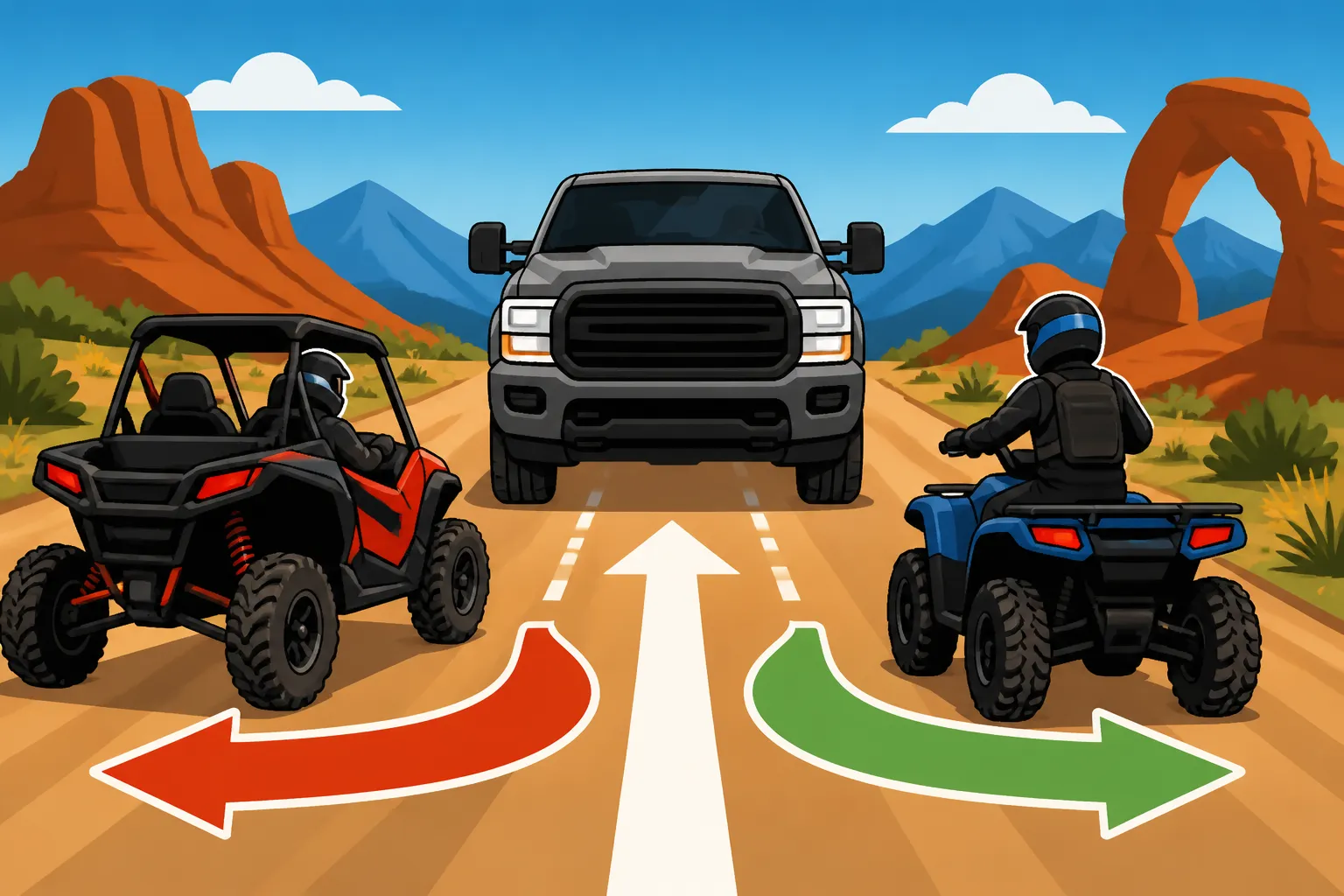
When you're out on Utah's scenic byways, forest roads, or designated OHV routes, you're sharing the space with all sorts of other users – from fellow OHV enthusiasts to hikers, mountain bikers, and yes, full-sized trucks. The fundamental principle for safe interaction, especially with larger vehicles, boils down to a simple, practical truth: the smaller, more agile vehicle generally yields to the larger, less maneuverable one. This isn't just about politeness; it's a matter of physics, safety, and sometimes, the law.
Think about it from the truck driver's perspective. Their vehicle has significantly more weight and momentum, a longer stopping distance, and often much less visibility, especially over the hood or around tight turns. Attempting to stop quickly or maneuver sharply to avoid a smaller OHV can be dangerous for them and could lead to losing control of their vehicle, especially on unpaved or steep terrain. Your ATV or UTV, by contrast, can usually slow down, stop, and pull over with much greater ease and in a tighter space. Prioritizing the safety and ease of maneuverability of the larger vehicle helps prevent accidents and keeps the flow of traffic smooth, even on remote dirt roads.
This yielding principle also extends to considerations like dust and road damage. A large truck kicking up a cloud of dust can completely obscure your vision, so allowing them to pass or waiting for the dust to settle is a smart move. Similarly, pulling over in a way that minimizes impact on the road surface, such as finding a wider shoulder or a solid section, shows respect for the trail and other users. It's all part of being a responsible rider in the vast playground that is Utah.
Understanding the "Right of Way" in Practice
While official "right of way" rules might seem more applicable to paved highways, there are common practices that have emerged on off-highway roads to keep everyone safe. Generally, if you're on a narrow, single-lane road or trail, and you encounter a larger vehicle, your job is to find the safest place to pull over and allow them to pass. This isn't a sign of weakness; it's a display of good judgment and trail etiquette.
Consider a scenario where you're cruising down a gravel forest road in the Fishlake National Forest, enjoying the scenery. Suddenly, around a bend, you see a full-size pickup truck loaded with camping gear heading your way. Your immediate reaction should be to slow down, assess the road conditions, and look for a safe spot to pull over. This might be a wider shoulder, a small turnout, or even a section of the road where the terrain is stable enough for you to get your OHV safely off the main path. The truck driver will appreciate your foresight and cooperation, often slowing down themselves as they approach to give you ample time and space.
Conversely, if you're the larger vehicle, the same courtesy should be extended in reverse to smaller, more vulnerable users like hikers or mountain bikers. It's a two-way street of respect and safety, ensuring that every user can enjoy Utah's incredible outdoor spaces without unnecessary conflict or danger. For specific rules regarding street-legal OHVs, check out [Utah Traffic Rules for Street-Legal Side-by-Sides].
The Importance of Communication on Shared Routes
Clear and early communication can make all the difference when encountering a truck or other large vehicle on shared routes. While you might not have a CB radio in your ATV or UTV like many truck drivers do, there are still effective ways to signal your presence and intentions. Visual cues are paramount.
As soon as you spot an approaching vehicle, make eye contact if possible. A simple nod or a wave can acknowledge their presence and signal your intention to yield. If it's dusty or at dusk, turning on your headlights early can make your OHV more visible, especially if you have aftermarket lights from a brand like SuperATV that offer excellent illumination. Even during the day, your lights make you more conspicuous. You might also consider a hand signal to indicate you're pulling over or to slow down. If you're riding in a group, have the lead rider signal, and ensure everyone in the group follows suit. This prevents confusion and allows the truck driver to anticipate your actions.
Some riders, especially those exploring very remote areas with frequent truck traffic, do equip their UTVs with small CB radios or walkie-talkies. This can be incredibly useful for communicating ahead on blind turns or steep climbs, but for most recreational riders, clear visual signals are often sufficient. The key is to be predictable and make your intentions clear as early as possible.
Common Scenarios and How to Handle Them Safely
Riding in Utah means encountering a huge variety of terrain and road conditions, and each can present its own challenges when meeting a larger vehicle. Understanding how to react in specific common scenarios will help you maintain control and avoid stress.
Blind Corners and Limited Visibility
Utah's trails and unpaved roads are famous for their twists and turns, often with steep rock walls or thick brush that completely obscure your view around a bend. Meeting a truck on a blind corner is perhaps the most unnerving scenario, as there's little time to react. The best defense here is a good offense: ride defensively. Always assume there's something coming around that blind corner, whether it's another OHV, a hiker, or a full-size truck.
This means approaching blind corners at a reduced speed, staying to the far right of the road, and being ready to stop or pull over at a moment's notice. If you hear an engine sound before you see the vehicle, it's wise to slow down dramatically or even stop before the corner. A quick, short tap of your horn, if your OHV has one, can also alert oncoming traffic to your presence. Many experienced riders will even shout "Vehicle!" or "Coming around!" if they are in a group to make their presence known. When you finally see the truck, immediately look for the widest, most stable spot to pull over, even if it's just a few feet before the corner itself.
Steep Grades: Uphill vs. Downhill Implications
Encountering a truck on a steep uphill or downhill grade adds another layer of complexity. The general rule on steep, narrow roads, whether paved or unpaved, is that the vehicle traveling uphill usually has the right of way. This is because it's often more difficult and sometimes dangerous for an uphill vehicle to stop and restart on a steep incline, especially if it's heavily loaded. Downhill vehicles have gravity on their side and can typically stop and yield more safely.
So, if you're descending a steep, narrow trail in the Manti-La Sal National Forest and you see a truck climbing towards you, it's generally your responsibility to pull over. Find a stable, relatively flat spot if possible, or a section where you can safely get one side of your OHV off the main track. Conversely, if you're the one grinding uphill and you spot a truck coming down, they should be the ones to yield. However, safety always trumps "right of way." If the truck driver doesn't seem to be yielding, or if your position is more precarious, be prepared to yield yourself. Better safe than sorry!
Dusty or Narrow Roads: When to Pull Over
Dust is an inevitable part of riding Utah's unpaved roads, and it can significantly reduce visibility for everyone. When you meet a truck on a dusty road, the best practice is to slow down, pull over as far as safely possible, and let the dust settle after they pass. Trying to push through a massive dust cloud created by a truck is incredibly dangerous, as it can completely blind you to road hazards, other vehicles, or even your riding buddies.
Similarly, many of Utah's backcountry routes are genuinely narrow, sometimes barely wider than a single vehicle, with steep drop-offs or sheer rock walls. There might not be a designated "turnout" for miles. In these situations, both parties need to exercise extreme caution. If you're on your OHV, be proactive in scanning ahead for any wider sections of the road. Even a few extra feet can make all the difference. Sometimes, it might even mean slowly backing up to a slightly wider spot if there's no room to pass safely ahead. Communication with hand signals, as discussed earlier, becomes even more critical in these tight spots.
What to Do When You Encounter a Truck: A Step-by-Step Guide
So, you've spotted an approaching truck. What exactly should you do? Here's a practical, step-by-step approach to ensure a safe and smooth encounter.
Slow Down and Create Space
The moment you spot an approaching truck, the very first thing to do is slow down. This gives you more time to react, better control over your OHV, and reduces the risk of kicking up a lot of dust yourself. Take your foot off the throttle and gently apply the brakes. As you slow, start actively scanning the immediate roadside for a safe place to pull over. Look for wider sections, solid ground, or a natural turnout. Avoid pulling over onto soft shoulders, loose gravel, or areas with unseen hazards like sharp rocks or deep ruts, which could cause your OHV to tip or get stuck.
The goal is to create as much space as possible between your machine and the approaching truck. If the road allows, hug the far right side, even if you don't immediately pull off. This signals to the truck driver that you're aware of their presence and are preparing to yield. Remember, a truck needs a lot more room to pass safely than you might realize, especially if they are pulling a trailer or carrying a wide load.
Signaling and Making Eye Contact
Once you've started slowing down and are looking for a spot to yield, focus on communication. Make eye contact with the driver as they approach. A friendly nod and a wave can go a long way in establishing goodwill and confirming that you've seen them and are yielding. If you're wearing a full-face helmet, a clear hand signal, like pointing to the side of the road where you plan to pull over, can be very effective.
Your vehicle's lighting can also play a role. If it's a bit dim, dusty, or approaching dusk, make sure your headlights are on. Some riders even install additional amber or white accent lights (available from companies like SuperATV) specifically for increased visibility in dusty conditions or low light. The more visible you are, and the clearer your intentions are, the safer the encounter will be for everyone. This proactive signaling prevents confusion and allows the truck driver to adjust their speed and trajectory accordingly.
Safely Pulling Over and Waiting
Once you've identified a safe spot, execute a smooth, controlled pull-over. Get your OHV as far off the main travel lane as is safely possible without putting yourself in a precarious position. Ideally, all four wheels of your ATV or UTV should be off the primary road surface. If the shoulder is narrow, try to get at least two wheels off. Turn your wheels slightly away from the road to prevent your machine from rolling back into traffic on an incline.
Once you're stopped, relax, and wait for the truck to pass. Do not rush back onto the road immediately after they've gone by. Wait for the dust to settle, and ensure you have a clear view of the road both ahead and behind you before rejoining the flow of traffic. Take a moment to check your mirrors, if you have them, and give the truck ample time and space before you move again. This patience is crucial, especially on those really dusty roads where visibility can remain poor for a minute or two after a large vehicle passes.
| Action Step | Why It Matters | When to Do It |
|---|---|---|
| Slow Down Immediately | More control, increased reaction time, reduced dust. | As soon as you see or hear an approaching truck. |
| Scan for Safe Pull-Over Spot | Avoids hazards, ensures stable footing for your OHV. | While slowing down and approaching the truck. |
| Signal Intentions | Clear communication, reduces confusion, shows courtesy. | Eye contact, hand waves, turn on headlights as the truck gets closer. |
| Pull Over Safely | Creates maximum space, minimizes risk of collision. | In the identified safe spot, as the truck is about to pass. |
| Wait for Dust to Settle | Ensures clear visibility before rejoining the road. | After the truck has passed. |
Equipment and Preparation for Safer Encounters
Being prepared before you even leave home can significantly improve your safety and confidence when encountering larger vehicles on the trail. It's not just about what you do in the moment, but how you set yourself and your machine up for success.
Communication Devices for Group Riding
While a CB radio might be overkill for a solo rider or a small family outing, they can be incredibly beneficial for larger groups, especially those exploring very remote or technical trails. Having a way to communicate between machines allows you to alert riders behind you about oncoming traffic, blind spots, or safe pull-over locations. Beyond CBs, two-way radios or even helmet-mounted comms systems (like those designed for motorcycle riders) can work wonders for intra-group communication, making it easier to coordinate actions when a truck approaches.
For the truly remote, off-grid adventures, a satellite messenger or a personal locator beacon (PLB) should always be part of your kit. While not directly for communicating with trucks, these devices are crucial for calling for help in an emergency, which could arise from an unexpected incident involving a larger vehicle. For information on what documentation you should have on hand, consider checking out [What Paperwork Utah Riders Must Carry].
Lighting and Visibility
Making your OHV as visible as possible is a no-brainer. While stock headlights are usually adequate, upgrading your lighting system can be a game-changer, especially for riding at dawn, dusk, or in dusty conditions. Many riders add LED light bars or auxiliary spotlights to their UTVs and ATVs, not just for seeing the trail better, but for being seen by others. Look for options that project a wide beam, making your presence known from a distance.
Beyond forward-facing lights, ensuring your taillights are bright and clean is equally important, especially if a truck is approaching from behind or if you need to pull over quickly. Some UTVs even benefit from rock lights or underglow kits, not just for aesthetics, but because they illuminate the ground around your machine, making it easier to see where you're pulling over, especially if it's uneven terrain. Brands like SuperATV offer a wide range of lighting solutions that can significantly enhance your visibility on the trail.
Mirrors and Awareness
It sounds basic, but having properly adjusted mirrors on your UTV or ATV is critical for situational awareness. Many stock ATVs don't come with mirrors, but they are a fantastic aftermarket addition for seeing what's coming up behind you, or for monitoring your fellow riders. UTVs typically come with a rearview mirror, but adding side mirrors can dramatically improve your field of vision, helping you spot an approaching truck much sooner.
Regularly checking your mirrors, just like you would in a car, becomes second nature over time. This allows you to anticipate traffic, plan your maneuvers, and identify safe spots to pull over long before a truck is right on your tail. Think of mirrors as your eyes in the back of your head – essential for knowing what's going on around you at all times, not just when you're turning or changing lanes on a paved road. Ensuring your mirrors are clean and free of dust before each ride will ensure they're effective.
Disclaimer
This article is for general informational purposes only and does not constitute professional advice. Laws, prices and regulations vary by location and change over time. Consult a qualified professional for guidance on your specific situation.