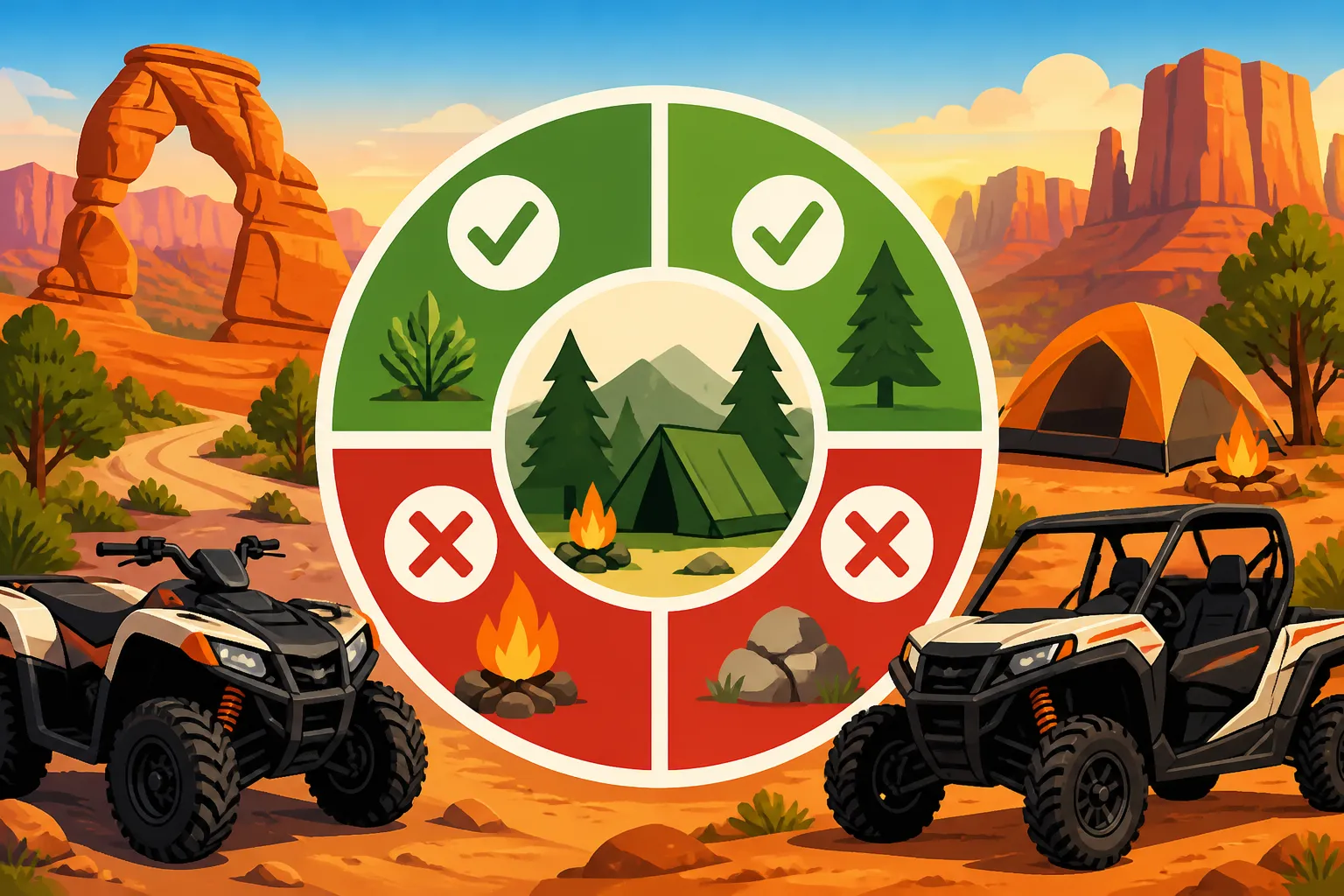
Dispersed Camping Rules Near Utah Trails
Finding a legal place to camp near a Utah ATV or UTV trail can be harder than picking the trail itself. A tempting flat spot may be private land, a closed area, or outside the route you’re allowed to drive. This guide explains how to check land status, choose a suitable campsite, follow vehicle rules, and avoid common camping mistakes.
Start by identifying who manages the land
Public land does not mean camp anywhere
Utah riding areas can cross a patchwork of federal, state, tribal, and private land. A route that looks continuous on a map may pass through land with different access and camping rules. The Bureau of Land Management and U.S. Forest Service both manage extensive public lands, but their local rules can differ. State parks, wildlife areas, and other lands may have their own designated camping options or restrictions.
Before you set out, identify the manager for the exact area where you plan to camp. Near Moab, for example, the rules can depend on the specific parcel or recreation area, not simply on being outside town. The same caution applies around the San Rafael Swell, the Paiute Trail near Marysvale, and routes near Fishlake National Forest. Don’t assume that a spot beside a trail is open to overnight camping just because it appears undeveloped.
A land-status map is a helpful starting point, but it is not the final word. Check the responsible agency’s local recreation information for closures, camping limits, designated sites, fire restrictions, and vehicle rules. If a boundary or access point is unclear, contact the relevant office before your trip rather than trying to settle the question after you arrive.
Check whether the campsite is actually accessible
A campsite can be on public land and still be inaccessible to your ATV or UTV. The road or trail leading to it may be closed to motor vehicles, restricted to certain vehicle types, or open only for specific uses. In forested areas, a route may appear on a general map but be closed to motorized travel under the applicable travel plan. In desert country, an informal tire track does not automatically count as an authorized route.
Use the area’s official travel map to check which routes are open to your vehicle. A Motor Vehicle Use Map, or MVUM, is particularly useful for understanding designated motorized routes on National Forest System lands. [Reading a Motor Vehicle Use Map] and [Telling Open Routes From Closed on a Forest Map] can help you make sense of route markings before you tow. For a broader trip plan, also check [Trail Closures Utah Riders Should Check First].
Mapping tools such as onX Offroad can help you plan a route and notice possible land boundaries, but treat them as a planning aid rather than permission to travel or camp. Compare the map with official agency information, especially near property boundaries, closed roads, and trail junctions. Download maps for offline use before leaving service; a phone map that cannot load in a remote area is not much help at a confusing turn.
Choose a campsite that fits the rules and the terrain
Look for established sites and avoid expanding the footprint
When dispersed camping is allowed, use an existing campsite where possible. A spot with signs of prior use, such as a defined parking area or a previously disturbed tent area, may reduce the temptation to flatten vegetation or create a new access track. However, signs of past use do not prove that camping is allowed there today. Confirm both the land status and current local rules.
Keep vehicles on designated or otherwise authorized routes, and park only where permitted. Driving a short distance off a trail to reach a prettier view can still cause damage or violate travel restrictions. Utah’s dry soils, desert crusts, and fragile vegetation can take a long time to recover from repeated vehicle traffic. Avoid widening a campsite by moving rocks, cutting vegetation, or driving around obstacles.
Think about the campsite’s surroundings, too. Avoid blocking a trail, gate, road, or access to a stock tank or other facility. Where the managing agency gives a required distance from water, follow that direction; don’t rely on a rule of thumb from another state or recreation area. If you are unsure whether a site is appropriate, choose a clearly established location or use a designated campground instead. [Camping Beside Utah's OHV Trails] offers more planning context for riders who want to combine a trail trip with an overnight stay.
Treat stay limits and group rules as local requirements
Many public-land areas limit how long visitors can remain in one place, but the details are not universal. A limit may apply to a campground, a recreation area, or a broader zone, and the rules may specify whether moving to a nearby site counts as relocating. Group size, number of vehicles, and seasonal access can also vary. Read the rules for the specific location rather than assuming that a stay limit you followed elsewhere applies here.
If your trip involves several nights, plan the route around the rules before you unload. For example, a group riding near Green River might camp in one area, ride a loop, and then move to a different authorized camping area if the local limit requires it. Moving only a short distance within the same restricted area may not satisfy the rule. When the wording is unclear, ask the local land manager how it applies.
Keep the group’s footprint modest. Several trailers, multiple side-by-sides, and a large camp can affect other visitors and may exceed local limits even if each person believes they are following the rules. Confirm group-size requirements in advance, and do not assume a site can accommodate a long trailer simply because it looks spacious in a photo. For trailer access and unloading considerations, see [Utah Trailhead Parking That Fits a Trailer].
| Before you camp | What to verify | Why it matters |
|---|---|---|
| Land status | Which agency or owner manages the site | Different owners may have different camping rules |
| Route access | Whether the road or trail is open to your vehicle | A legal campsite may still be unreachable by motor vehicle |
| Camping designation | Whether dispersed camping is allowed at that location | Public land is not automatically open for overnight use |
| Stay and group limits | Length of stay, group size, and vehicle limits | Rules may vary by area or season |
| Fire conditions | Current restrictions and permitted fire methods | Conditions can change and local orders may prohibit fires |
| Sanitation | Waste, trash, and water-protection requirements | Poor disposal can damage the site and create health hazards |
Keep riding, fire, and sanitation rules separate
Camping permission does not give you permission to ride anywhere
A common mistake is treating access to a campsite as permission to ride every nearby track. Camping rules and off-highway vehicle rules are separate. You may be allowed to camp in a particular area but still be required to keep your ATV or UTV on designated routes. Likewise, a route open to OHVs does not necessarily mean overnight camping is allowed beside it.
Plan a route from the campsite using official maps, and avoid creating shortcuts between trails. If a gate is closed, a route is marked closed, or a sign limits vehicle use, do not go around it because another track appears to continue. Pay attention to seasonal closures and temporary restrictions, which may be in place for safety, restoration, fire danger, or wildlife protection. [Private Land Crossings on Utah Routes] is worth reviewing when a planned ride may pass near property boundaries.
For a multi-day trip, check each riding area you expect to enter. A base camp near one part of the Paiute Trail, for instance, does not settle the rules for every connecting route or nearby parcel. Keep the official maps available, follow posted signs, and be prepared to turn around if route status is uncertain. That is less frustrating than discovering after the ride that a shortcut crossed a closed or private area.
Fire restrictions can change your whole camp plan
Do not assume that a campfire is allowed because there is an existing fire ring. Restrictions can change with dry conditions, wind, and local fire danger, and they may cover campfires, charcoal, stoves, or other equipment differently. Check the current restrictions from the land manager and follow posted signs. If fires are prohibited, use only an allowed alternative—or go without a flame if the rules say that is what the conditions require.
When fires are allowed, use an established fire ring where available, keep the fire small, and never leave it unattended. Have a way to extinguish it, and make sure it is fully out before you leave or go to sleep. Sparks, dry grass, and gusty desert winds can turn a small fire into a serious problem quickly. [Campfire Rules During a Utah Fire Season] explains why checking local restrictions should be part of trip planning, not an afterthought.
Also think about cooking and heating equipment. A device that seems harmless at home may be restricted under a particular order or condition. Read the actual restriction rather than relying on what another camper says at the trailhead. If the rule is unclear, contact the agency or choose a no-flame setup until you can confirm what is permitted.
Pack out waste and protect water sources
Bring a plan for trash and human waste before you leave town. Dispersed sites may not have bins, restrooms, or potable water, and burying waste is not automatically acceptable everywhere. Follow the land manager’s requirements for human waste, including any rules for portable toilets or waste bags. Pack out food scraps and small items such as bottle caps, wipes, and pieces of packaging; those are easy to overlook when camp is busy.
Store food and scented items securely, especially if you are camping in a forested or wildlife-sensitive area. Do not wash dishes, use soap, or dump gray water in a stream or other water source. Check local guidance for required distances from water and for any special sanitation rules. If you are unsure, use a contained system and carry waste out to an appropriate disposal point.
A clean camp is easier to leave quickly if weather or a closure changes your plans. Before departing, walk the area and check under vehicles, around the fire ring, and near the spot where the group ate. The goal is to leave the campsite looking as undisturbed as possible, not just to make it tidy enough for the next person.
Plan the trip before you tow
Use a practical pre-trip checklist
A little preparation can prevent a long, stressful search for a campsite after a full day of riding. Choose a backup location in case your first choice is full, closed, or unsuitable for your trailer. Check the approach road for vehicle restrictions and surface conditions, then confirm that the campsite and route are both permitted for your setup.
Before leaving, make sure you have:
- The name of the land manager and its local camping guidance.
- Official route information for the roads and trails you plan to use.
- Offline maps, plus a way to identify your location without cell service.
- A backup campsite or designated campground.
- A plan for trash, human waste, water, and food storage.
- Information about current fire restrictions and any temporary closures.
- A trailer and vehicle setup that can safely reach the chosen area.
onX Offroad can be useful for organizing waypoints and reviewing a planned route, but keep the official agency map available as well. Check the route again before the trip; an old screenshot or saved line may not reflect a closure or a change in access. A local office, ranger station, or recreation-area page can help resolve questions that a map cannot answer.
If you are heading to a popular area during a holiday or busy riding period, arrive with a realistic backup plan. A spot that appears open on a map may already be occupied, and turning a trailer around on a narrow road can be difficult. Do not create a new campsite simply because the first choice is taken. Move to another authorized location, use a developed campground, or adjust the trip.
Be ready to change plans on the ground
Conditions in Utah can shift between the map and the trailhead. A road may be muddy after a storm, a seasonal route may be closed, or fire restrictions may have changed. If a route is signed closed or the campsite is not clearly allowed, choose another option. Do not rely on the fact that other campers have used the spot before.
For remote rides, tell someone where you expect to camp and when you plan to return. Bring enough water and supplies to handle delays, and avoid planning a route that depends on a single questionable access road. [What to Carry on a Utah Day Ride] can help you think through ride-day essentials, while [Checking Utah Trail Conditions Before You Tow] is useful when weather or trail access could affect the trip.
Finally, keep the campsite and the ride connected in your planning without confusing their rules. Confirm where you may sleep, where you may park, and which routes you may ride as separate questions. That simple habit helps protect Utah’s public lands and makes it much less likely that a relaxing overnight trip ends with a warning, a damaged campsite, or an unexpected detour.
Disclaimer
This article is for general informational purposes only and does not constitute professional advice. Laws, prices and regulations vary by location and change over time. Consult a qualified professional for guidance on your specific situation.