Hell’s Revenge, Utah’s Signature Slickrock
Hell’s Revenge can look deceptively simple on a map, then feel very different when your UTV points down a steep slickrock descent with little room to second-guess the line. This guide explains what makes the Moab trail challenging, how to judge whether your machine and group are ready, and how to plan a safer ride without treating every obstacle as a must-do.
What to Expect on Hell’s Revenge
A slickrock route with real exposure
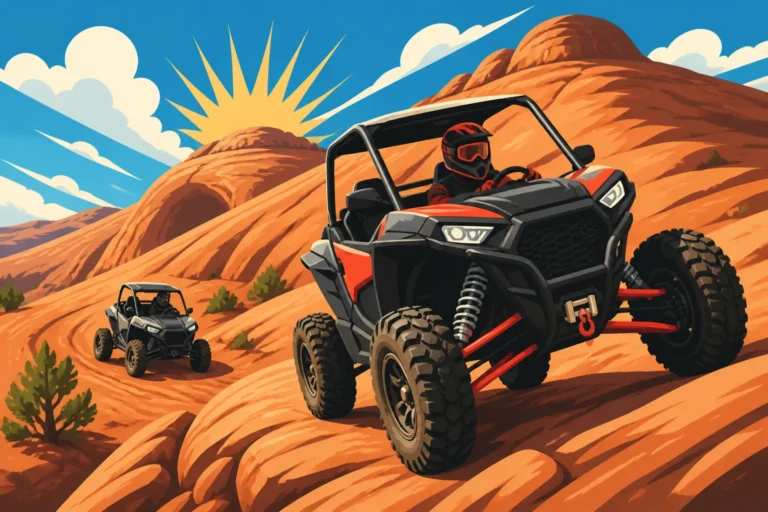
Hell’s Revenge is a well-known off-highway route in the Sand Flats area near Moab. It crosses broad expanses of sandstone, but “slickrock” does not mean the surface is always slippery. The rough, grippy rock gives tires traction in many conditions; the challenge comes from steep pitches, uneven ledges, abrupt transitions, and routes that can feel exposed when you are sitting behind the wheel.
The trail is not simply a smooth scenic loop. Some sections require you to pick a careful line, maintain a controlled speed, and accept that the ground may fall away beside the route. A climb that looks manageable from the bottom can feel much steeper from the driver’s seat. If you are new to slickrock, it is normal to feel cautious at first. Taking time to assess the route is good judgment, not a sign that you do not belong there.
Hell’s Revenge is often described as a loop, but the ride can vary depending on your route choices and which obstacles you include or bypass. Do not assume every line you see in a video or on a map is part of the necessary route. For a broader sense of Moab riding options, [Riding Moab, Utah on a Side-by-Side] can help put this trail in context.
Marked routes and optional obstacles
A key planning distinction is the difference between the main route and the more demanding obstacle lines. Hell’s Revenge has named features and side challenges that attract experienced drivers, but reaching the trail does not mean you need to attempt every one. A group can enjoy the ride while choosing to bypass a feature that feels beyond its skill, vehicle setup, or comfort level.
That choice is especially important when the line is steep, narrow, or difficult to reverse out of. Before committing, stop in a safe place, look at the approach and exit, and talk through what the driver will do if the machine loses momentum or the line feels wrong. Do not let a queue of riders, a camera, or a passenger’s encouragement make the decision for you.
Maps and trail apps can help with orientation, but they do not replace careful route-finding on the ground. If you use onX Offroad, prepare your map before leaving reliable service and compare it with official area information and posted signs. A mapped line can show where a route goes without communicating how steep, exposed, or intimidating it may feel in person.
Decide Whether Your Machine and Group Are Ready
Match the route to the machine
A capable machine is only one part of a successful ride. Ground clearance, tire condition, drivetrain, braking, steering, and the vehicle’s overall mechanical health all matter on steep rock. A machine that is well suited to moderate trails may still feel uncomfortable on a technical obstacle, especially if it is heavily loaded, has worn tires, or has a passenger who is uneasy with steep angles.
Before the trip, inspect tires for damage and adequate tread, check fluid levels and brakes, and confirm that steering and suspension components are in good condition. Secure loose gear so it cannot shift on a descent. If you are renting, ask the provider which routes the machine is permitted to use and whether any obstacles are off-limits under the rental agreement. A stock vehicle can be appropriate for some riders and lines, but “stock” alone does not tell you whether a particular machine, driver, or route choice is a good match. The related guide [Is Hell's Revenge Too Hard for a Stock UTV?] explores that question in more detail.
Width also deserves attention. A larger side-by-side may offer a comfortable cabin, but it can feel different on narrow approaches and tight turns than a smaller machine. Check the route information and your vehicle’s dimensions before committing, and do not rely on a general trail description to confirm that every machine will fit every line. For a wider look at choosing routes around vehicle size, see [Picking a Moab Trail by Machine Width].
Be honest about experience and comfort
Drivers who have handled steep terrain before may still find Hell’s Revenge demanding. Slickrock driving involves reading the surface, selecting a controlled line, and responding calmly when a tire climbs or drops over a change in grade. If your experience is mostly on dirt roads or gentle forest trails, consider whether a less technical outing would be a better first day in Moab.
Passengers matter too. A rider who is frightened by a steep descent may distract the driver or feel pressured to keep going when they would rather turn around. Talk about expectations before the ride: whether you will skip optional obstacles, how the group will handle a stop, and what anyone can say if they want to pause. A low-pressure conversation at the trailhead is much easier than negotiating after everyone is strapped in and facing a difficult section.
If you are uncertain, compare Hell’s Revenge with a less demanding slickrock option before deciding. [Fins and Things for First-Time Slickrock] offers a useful point of comparison for riders who want to build experience. You can also read [Driving Hell's Revenge for the First Time] for a more focused look at first-time preparation and decision-making.
| Consideration | Why it matters | A sensible preparation |
|---|---|---|
| Driver experience | Steep rock requires calm line choice and controlled inputs | Choose a route that matches experience, not just ambition |
| Vehicle condition | Mechanical problems are harder to manage on exposed terrain | Inspect tires, brakes, steering, fluids, and secured cargo |
| Vehicle width | Tight approaches can feel different in a wide machine | Check dimensions and route guidance before the trip |
| Passenger comfort | Anxiety can affect communication and concentration | Agree in advance that skipping obstacles is acceptable |
| Navigation | Service and visibility may be limited in places | Prepare maps ahead of time and follow posted signs |
| Weather and surface | Conditions can affect traction, visibility, and comfort | Check local guidance and reconsider if conditions are poor |
Ride With a Plan, Not a Stopwatch
Prepare before leaving the staging area
Before unloading, make sure everyone knows the basic plan: which route you intend to follow, where you will regroup, and what the group will do if a vehicle has a problem. Share the route with someone who is not riding with you, especially if you are traveling in a small group. A simple check-in plan can help others know when to expect you back.
Carry water, sun protection, food, and basic safety and recovery supplies appropriate to your group and machine. The red-rock landscape can be hot and exposed, and the effort of concentrating on technical terrain can make a ride feel more tiring than expected. A small day pack should not become a pile of loose items inside the vehicle; secure what you bring and keep important items easy to reach. For a practical packing checklist, see [What to Carry on a Utah Day Ride].
Get oriented before you start. Review the route, identify junctions and marked signs, and agree on how riders will communicate if they become separated. If you are using onX Offroad or another navigation tool, make sure the map is ready before you leave areas with dependable reception. Use navigation as a backup and reference, not as a reason to ignore signs, closures, or the terrain directly in front of you.
Use steady, deliberate driving
On steep slickrock, abrupt inputs can make a difficult moment harder. Drive at a controlled pace, keep your attention on the chosen line, and avoid sudden steering or throttle changes unless a specific situation calls for them. The right approach depends on the machine and the terrain, so follow the vehicle manufacturer’s guidance and any instructions provided by a qualified guide or rental operator.
Give the vehicle ahead space. If you follow too closely, you may not have room to stop if the driver pauses, changes lines, or needs to back away from an obstacle. Wait until the route is clear before moving into a challenging section. In a group, the lead driver should choose a pace that lets the least experienced rider travel without feeling rushed, while the last driver helps make sure nobody is left behind.
A pause is often the smartest move. If you cannot see the exit of a feature, do not understand the line, or feel unsure about the machine’s position, stop in a safe place and reassess. If the terrain allows, walk the line from a safe viewpoint. Turn around or choose a bypass when that is the safer option. The point is not to prove the machine can climb something; it is to complete the ride with your group and equipment in good shape.
Handle Obstacles and Exposure Carefully
Choose lines based on conditions, not crowd pressure
Hell’s Revenge is famous in part because riders talk about particular obstacles and challenging lines. That attention can make them seem like required checkpoints. They are not. A feature that looks manageable to an experienced driver may be unsuitable for a newer driver, a passenger who is uncomfortable, or a vehicle that is not prepared for that line.
Before approaching a difficult feature, look for the bypass or continuation route and decide whether you are willing to take it. If you are unsure whether a line is part of the route or an optional challenge, do not guess based on the riders ahead of you. Confirm with a reliable map, posted information, or a knowledgeable local operator. onX Offroad can be one way to review route orientation, but a screen cannot assess your vehicle’s traction, your comfort, or the specific surface in front of you.
Avoid stopping where another rider’s line could bring them close to your vehicle. If you need to observe, choose a safe place well away from the route and keep passengers clear of moving machines. A crowd gathering around an obstacle can create pressure and reduce the space people need to maneuver. Good trail manners include letting others decide for themselves and not blocking a route while taking photos.
Know when to turn around
Turning back is a valid outcome, not a failed ride. If the approach is more exposed than expected, the surface is changing, or your group is no longer communicating well, stop and reassess before proceeding. The same applies if a vehicle develops a warning light, unusual sound, steering issue, or tire problem. Continuing just because you have already driven a long way can turn a manageable concern into a more serious one.
Be especially careful about backing on a steep or uneven slope. A driver who feels uncertain should not be rushed into reversing while trying to manage passengers, spotters, and a waiting line. If the group cannot safely resolve the situation, seek help through the appropriate local or emergency channels rather than improvising a risky recovery. Recovery equipment should only be used by people who understand how to use it safely and have the right equipment for the machine and terrain.
Conditions and access can change, so check current area notices before you leave and again when you arrive. Do not assume that an old post, a familiar route, or a track saved on a phone reflects today’s access. [Trail Closures Utah Riders Should Check First] explains why checking closures belongs in the planning routine, even for a route you have ridden before.
Plan a Moab Ride That Fits Your Day
Account for time, heat, and logistics
Do not plan the ride around the shortest estimate you can find. Time can vary with route choices, group size, stops, traffic at obstacles, weather, and how often you pause to check the line. A small group of experienced drivers moving at a steady pace may have a different day from a family group that stops often or chooses to bypass challenging features.
Start with enough daylight and avoid treating the trail as a race against sunset. Leave room for a slower-than-expected section, a mechanical check, or a navigation pause. In hot weather, consider the comfort and energy of every person in the vehicle, not only the driver. Take breaks before anyone is exhausted, and make sure water is available throughout the ride.
Hell’s Revenge is accessed from the Sand Flats area, where local access requirements and conditions can change. Check current information for entry, parking, and camping before you go rather than assuming that an old trip plan still applies. The guide [Sand Flats Recreation Area Fees and Camping] can help you identify the kinds of logistics to confirm. For an itinerary that fits a shorter outing, [Moab Trails That Fit a Half Day] can help you compare alternatives.
Leave room for a different trail choice
A good Moab trip does not have to revolve around one famous route. If your group arrives and decides Hell’s Revenge is not the right fit, there are other trails and riding areas to consider. That flexibility is particularly useful when you have mixed experience levels, a wide machine, nervous passengers, or a day when conditions are not inviting.
Think about the kind of ride your group actually wants. Some riders enjoy steep, technical driving; others would rather have a scenic route with fewer stressful decisions. Those are both legitimate ways to spend a day outdoors. Choosing an easier option can give a new driver a chance to learn how the machine responds on varied terrain before tackling a more demanding route later.
For any route, check land access, posted restrictions, and navigation details before setting out. Download or prepare your maps in advance, and remember that digital maps are tools rather than permission to travel anywhere. If you use onX Offroad, treat it as one part of your planning process alongside official information, signs, and conditions on the ground. A flexible plan makes it easier to enjoy Moab without turning a trail choice into a test of nerve.
Disclaimer
This article is for general informational purposes only and does not constitute professional advice. Laws, prices and regulations vary by location and change over time. Consult a qualified professional for guidance on your specific situation.