Utah Trailhead Parking That Fits a Trailer
A trailhead that looks roomy on a phone screen can feel very different when you arrive with a long truck, a loaded trailer, and nowhere to turn around. In Utah, parking conditions vary from paved staging areas to narrow dirt pullouts, and a busy weekend can change the picture completely. This guide helps you check access, judge trailer fit, and make a practical backup plan before you tow.
Check the parking before you leave home
Start with the whole rig, not just the UTV
A parking spot has to fit more than the machine you plan to ride. Think about the tow vehicle, trailer, hitch, and the space needed to maneuver. A spot that appears long enough for a pickup may still be difficult to use if the trailer needs room to swing wide or if other vehicles are parked close by.
Measure your complete setup from the front of the tow vehicle to the back of the trailer. Then consider the width of the truck and trailer, including mirrors and any gear that sticks out. If you are hauling more than one machine, account for the time and space needed to unload safely without blocking traffic.
A simple sketch can help. Mark the rig’s approximate length and width, then compare those measurements with the parking area you can see on a map or in recent photos. Keep in mind that a satellite image may not show a newly installed gate, a seasonal closure, a muddy approach, or vehicles already occupying the space.
Read maps as clues, not guarantees
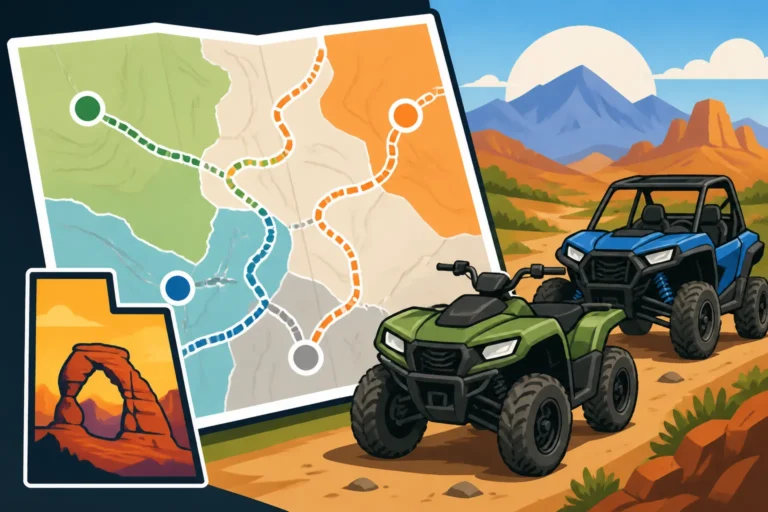
Use several sources when you are deciding whether a Utah trailhead can handle a trailer. Look for the access road, the visible parking area, nearby turnarounds, and any narrow sections where passing another vehicle might be difficult. A map can show the shape of a lot, but it usually cannot tell you how crowded it will be or whether the surface is suitable for a heavy truck and trailer.
[Utah OHV Trail Maps and How to Read Them] is a useful starting point for understanding the difference between a mapped route and the conditions you will encounter on the ground. For navigation, [Downloading Utah Trail Maps for Offline Use] can help you prepare for areas where cell service is limited. Mapping tools such as onX Offroad may also help you review routes and access points before departure, but treat map information as one part of your planning rather than a promise that a parking area will fit.
When you use onX Offroad or another mapping app, zoom in far enough to inspect the final approach. A route that looks straightforward at a broad scale may include a narrow road, a sharp turn, or a limited shoulder near the trailhead. Save the area for offline use before leaving reliable service, and keep a second source of directions available.
Look for recent, local information
Parking conditions can change with weather, construction, closures, events, and seasonal demand. Recent trip reports, land-manager notices, and calls to a local visitor center or recreation office can fill in details a map cannot. Ask specific questions: Is there room for a long trailer? Is the approach paved or maintained dirt? Is overnight parking allowed? Are there designated turnaround areas?
For trips near Moab, distinguish between a staging area, a campground, and a trailhead. They may all appear close together on a map, but they serve different purposes and can have different rules. [Where to Stage a Trailer in Moab] offers a helpful companion topic when you are planning around that busy riding destination.
Before heading out, check [Checking Utah Trail Conditions Before You Tow]. A passable road for a passenger car does not automatically mean a comfortable or safe approach for a loaded trailer, especially after rain or snow.
Judge whether the site is workable for a trailer
Check the approach and turning space
The last stretch of road often matters more than the parking space itself. Look for tight bends, steep grades, loose gravel, washboards, soft sand, narrow bridges, gates, and places where oncoming traffic could force you to stop. A long trailer can track inside the tow vehicle’s path on a turn, so a road that seems wide enough from the driver’s seat may still leave little clearance.
Think through how you would enter and leave. Can you pull through, or would you need to back out? Is there a safe place to turn around if the lot is full? Is the entrance wide enough to make the turn without crossing into a ditch or damaging the shoulder? If those questions do not have comfortable answers, choose a different staging point rather than hoping the maneuver works when you arrive.
A short reconnaissance trip can be worthwhile if the trailhead is unfamiliar and close enough to inspect without the trailer. If that is not practical, ask someone familiar with the area about the exact final approach, not merely whether “trailers can get there.” Trailer length, ground clearance, and driving experience can change the answer.
Consider surface, slope, and weather
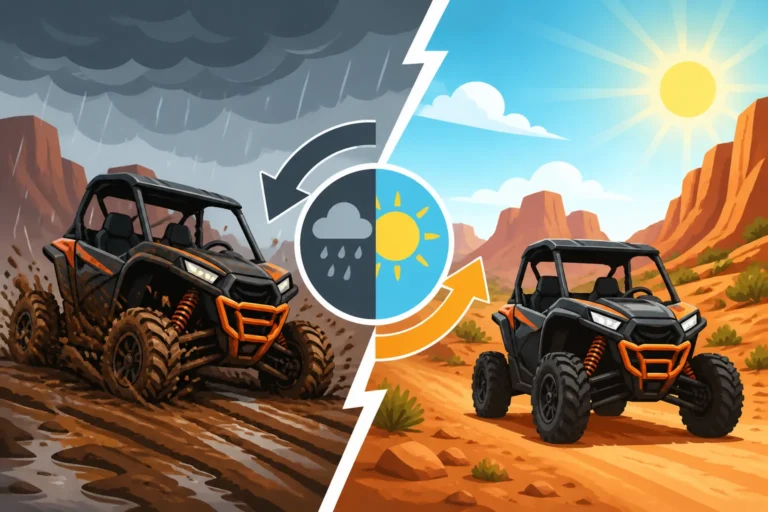
A flat-looking dirt lot may have a soft edge or a slope that makes unloading awkward. After rain, clay can become slick, while sandy areas can make it difficult to move a heavy rig from a stop. In winter or spring, snow, mud, and runoff can narrow access or leave the parking area rutted.
Before unloading, choose a spot where the trailer is stable and the ramp can be lowered without blocking moving vehicles. Avoid parking on a steep cross-slope if you can help it. Chock the trailer wheels when appropriate, keep people clear of the ramp, and unload where dust, traffic, and other riders will not create unnecessary risk.
Weather deserves special attention in the desert. A dry dirt road may become difficult after a storm, and a wash crossing that looks harmless can change quickly with runoff. For a broader packing checklist, see [What to Carry on a Utah Day Ride], and plan your route with enough flexibility to turn around if conditions are worse than expected.
Match the parking plan to the destination
Different Utah riding areas call for different expectations. Around Moab, popular trail systems and recreation sites can draw heavy traffic, particularly during busy travel periods. At Sand Hollow near Hurricane and St. George, plan around the designated access points and the possibility of crowded staging areas. At Little Sahara, sand and dune traffic make the exact location of the unloading area important. Around Marysvale and the Paiute Trail, a trip may involve town-based staging or access from a trail corridor rather than one simple parking lot.
Do not assume that a place shown near a riding area is open for trailer parking. It may be private property, a day-use site with restrictions, a narrow road shoulder, or a spot intended for smaller vehicles. For sites managed by a state park or another agency, check that agency’s current rules for vehicle access, day use, camping, and overnight parking.
| Parking feature | Why it matters with a trailer | What to confirm |
|---|---|---|
| Entrance width | A narrow entrance can make turning difficult | Whether the full rig can enter without crossing obstacles |
| Turning room | You may need space to pull through or turn around | Whether there is a safe exit if the lot is full |
| Surface and slope | Loose or uneven ground can affect traction and unloading | Whether recent weather has changed the approach |
| Space to unload | Ramps and machines need room outside the traffic lane | Whether unloading blocks other users |
| Parking rules | A convenient spot may not allow staging or overnight use | Which agency or property owner manages the site |
Make a backup plan before towing
Identify a second staging option
A backup is not just another pin on your map. It should be a place you are permitted to use, with an approach suitable for your rig and a realistic route to the riding area. If the first lot is full, you do not want to discover that the alternative is a narrow roadside pullout or a long drive in the wrong direction.
Choose a primary and secondary staging point before the trip. Note the distance between them, the route connecting them, and whether the trailer can travel that route comfortably. If your ride plan depends on a particular trailhead, decide in advance what you will do if it is unavailable: wait for a space, switch to a nearby route, or postpone unloading.
For longer trips, keep lodging or a campground separate from your day-ride parking plan. A place to sleep may not allow you to leave a trailer there all day, and a trailhead may not allow overnight parking. Near central Utah, [Trailering to Marysvale From Salt Lake City] can help with the broader logistics of reaching a riding base.
Have a safe response if the lot is full
If you arrive and the parking area is full, do not stop in the travel lane while deciding what to do. Move to a safe, legal location where you are not blocking a gate, road, driveway, emergency access, or other trailers. If the road is narrow, avoid turning around in a blind spot or on unstable ground.
A spot that looks like an obvious overflow area may still be off-limits or unsafe. Do not park on vegetation, private land, a fire access route, or an unmarked shoulder just because other vehicles have done so. Follow posted signs and instructions from land managers. When in doubt, leave and use your planned alternative.
This is where a downloaded map can be useful, but it should support—not replace—good judgment. Before you travel, mark your backup location, check the route on more than one map source, and keep enough fuel and time to reach it. A map app such as onX Offroad can be part of that preparation; verify access and restrictions with the relevant land manager when the details matter.
Keep parking courteous and efficient
At a crowded trailhead, small choices make a noticeable difference. Park within marked spaces when they exist, leave room for other trailers to maneuver, and avoid spreading gear across the lot. Load and unload efficiently without rushing. Keep children and pets away from moving vehicles, ramps, and machines.
Do not block the entrance while airing down, adjusting tie-downs, or waiting for your group. If you need extra time, move to an appropriate area first. Secure ramps and loose equipment before driving, and check that no one is behind the trailer before backing up.
When your ride is over, leave the site as you found it. Pack out trash, avoid spinning tires on the way out, and respect quiet hours or posted restrictions. Thoughtful parking helps keep access workable for the next group—and reduces tension when several trailers arrive at once.
Use this pre-trip checklist
Before you tow
- Measure the full tow vehicle and trailer combination, and note your trailer’s turning needs.
- Choose a primary staging area and a legitimate backup.
- Review the final approach for tight turns, steep grades, gates, soft surfaces, and narrow roads.
- Check current access information with the responsible land manager or local office.
- Download maps for offline use and save the parking locations.
- Confirm whether the site allows day-use staging, overnight parking, or both.
- Review weather and trail conditions, especially if the route includes dirt roads or washes.
When you arrive
- Check signs and posted instructions before entering or unloading.
- Make sure there is room to turn around or exit safely.
- Park on a stable surface without blocking traffic or access.
- Unload in a way that leaves space for other riders.
- Switch to the backup plan if the site is full or the approach feels unsafe.
If you are planning several stops or comparing areas, [Utah Trailhead Parking That Fits a Trailer] is a useful topic to keep in mind as you build the wider itinerary, while [The Best ATV and UTV Trails in Utah] can help you consider riding destinations beyond a single trailhead. The key is to plan the trailer logistics alongside the ride itself. A little checking before departure can spare you the stressful moment of discovering that the final turn is tighter, the lot is smaller, or the ground is softer than you expected.
Disclaimer
This article is for general informational purposes only and does not constitute professional advice. Laws, prices and regulations vary by location and change over time. Consult a qualified professional for guidance on your specific situation.