Reserving a Utah OHV Campsite
A campsite near a Utah riding area can make a trip easier, but a reservation does not guarantee that your trailer will fit, your machine can use nearby routes, or your OHV paperwork is complete. The key is to choose a site around your riding plans, check who manages it, and confirm what the booking actually covers before you pay.
Find the right campground and understand who manages it
Utah OHV camping is spread across places managed by different agencies and operators. A site near a trail could be in a state park, on Bureau of Land Management or Forest Service land, at a private campground, or in another managed recreation area. Each may use a different reservation system, cancellation policy, and set of camping rules.
Start with the riding area you want to visit, then identify campgrounds that are actually open for your dates. A campground that looks close on a map might be separated from the riding area by a closed route, a public road where your machine cannot travel, or a long tow. The agency responsible for the land is a useful starting point: look for its current campsite information and follow its booking instructions rather than relying only on an old map listing or a third-party summary.
The booking method depends on the campground. Some sites are reservable through an official online system; others are first come, first served, or offer a mix of reservable and walk-up sites. A private campground may take bookings directly. Before making plans around an unreserved site, check whether it is still operating and what “first come, first served” means there. Availability can be especially uncertain on busy weekends and holiday periods.
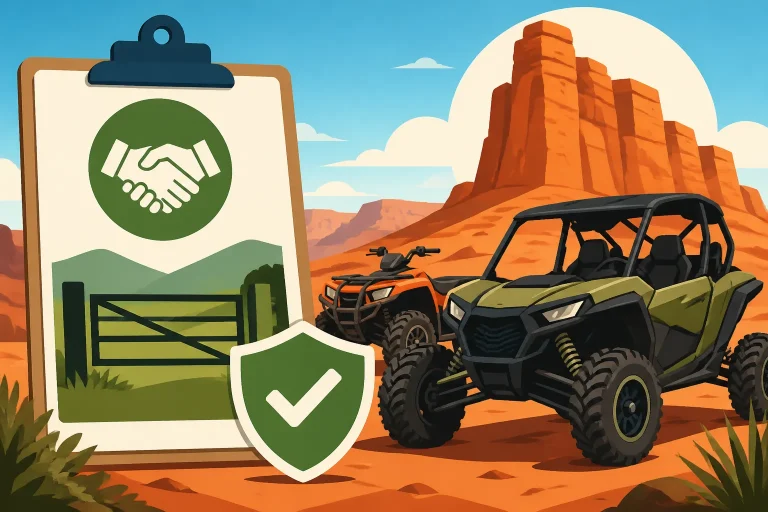
A campground reservation is different from access to the riding area. It may reserve a campsite without paying a separate day-use or entrance fee, and it does not necessarily include an OHV permit. Check the campground’s details and the riding area’s own rules. Camping Fees Beside Utah Riding Areas explains why camping charges and riding-area fees should be checked separately, while Permits and Fees for Utah’s Riding Areas can help you identify other costs to verify.
| Question | What to verify before booking |
|---|---|
| Who manages the campground? | Find the managing agency or operator and use its current booking instructions. |
| Is the site reservable? | Confirm whether it is bookable, first come, first served, or a mix. |
| Does the reservation include riding access? | Check separately for day-use, entrance, or other area fees. |
| Can your machine use nearby routes? | Confirm access rules, legal connections, and any restrictions for OHVs. |
| Will your rig fit? | Check the site’s length, width, parking, and surface details. |
| What are the cancellation rules? | Review the policy and deadlines shown during booking. |
If you are traveling from outside Utah, handle your machine’s requirements separately from the campsite booking. A campsite confirmation is not an OHV permit, and it does not establish that your out-of-state registration or other documents meet Utah rules. Start with Utah’s Non-Resident OHV Permit Explained and Utah Ended OHV Reciprocity: What Visitors Do Now, then confirm current requirements for your situation before riding.
Check site details before you reserve
A campsite that is available on your dates is not automatically a practical fit. Read the listing carefully, especially if you are towing a long trailer, bringing more than one machine, or camping with a group. Site details can be brief, so check the campground map, photos, access notes, and any measurements the managing agency provides.
Look for the maximum vehicle or trailer length, the number of parking spaces, and whether the site has a suitable place to unload. Do not assume that a campsite’s advertised capacity means it can accommodate several tow vehicles and trailers. If the listing does not clearly describe your setup, contact the campground or managing agency before booking. Utah Trailhead Parking That Fits a Trailer offers a related checklist for thinking through space and access when towing.
Also consider the route into the campground. A site can be reachable by a paved road but still have a narrow entrance, a tight turn, a steep approach, or a small parking pad. Those details matter when towing a large trailer or maneuvering a wider UTV. A map’s distance estimate may not reflect the time it takes to tow over rough or slow roads.
Check the practical facilities, not only the view. Listings may describe water, toilets, electrical hookups, dump stations, shade, or other amenities, but availability varies by location. Verify which features are actually offered at the specific site and whether they are seasonal or subject to closure. If you need power for medical equipment or other essential gear, do not rely on an unclear listing; get confirmation before you book.
Consider how the campground handles OHVs. Some locations may allow machines to be unloaded or parked at a campsite but restrict riding within the campground. Others may have designated access routes or require machines to be transported to a trailhead. Do not assume that a nearby track is open to OHVs simply because it appears on a map. Check current land-manager route information and campground rules. For broader route-planning guidance, see Reading a Motor Vehicle Use Map and Trail Closures Utah Riders Should Check First.
A few questions worth answering before payment:
- Is the campsite close enough to your intended riding area to avoid a long daily tow?
- Can your trailer and tow vehicle fit at the same time?
- Is there a safe and permitted place to unload?
- Are OHVs allowed to travel between the campsite and the trails?
- Are water, restrooms, power, and waste facilities available on your dates?
- Are quiet hours, generator restrictions, or machine-use rules posted?
- Does the site permit the number of people, vehicles, and tents in your group?
The reservation details should match your actual group and equipment. If the listing limits the number of vehicles or people, do not treat that as a loose suggestion. Ask the operator how extra vehicles are handled before booking. A second vehicle parked outside the campsite may not be allowed, even if the site itself has room for your tent.
Make the reservation and plan around the rules
Once you have chosen a campground, use the booking method identified by its manager. Enter your dates and party details carefully, then compare the campsite description with your trailer, vehicle, and group size before confirming. If you are booking multiple sites, check that each reservation is for the intended dates and that the sites are close enough for your group if that matters.
Read the cancellation and change policy before completing the reservation. Policies vary, and the amount you may recover can depend on when you cancel and the provider’s terms. Weather, road conditions, a mechanical problem, or a change in trail access can affect a trip, but they do not automatically change a campground’s refund policy. Keep the confirmation and note any deadlines that matter to your booking.
When a listing is unclear, contact the campground before payment rather than guessing. Useful details to confirm include:
- Whether your trailer length and vehicle combination fit the site.
- Whether OHVs may be unloaded and parked there.
- Whether a route from the campground to the riding area is open and legal for your machine.
- Whether the listed facilities will be available during your stay.
- Whether another entrance fee, camping charge, or permit is required.
Keep the answer with your reservation confirmation. If a campground is managed by a public agency, confirm information using the agency’s current listing or contact channel. Conditions and access can change, so a saved screenshot from a previous season is not a substitute for checking close to departure. For a broader look at the different kinds of camping near riding areas, see Camping Beside Utah’s OHV Trails.
Remember that a campsite booking handles only the campsite. It does not replace vehicle registration, a required Utah non-resident permit, an OHV education certificate, or any land-use permission that applies to your ride. Requirements can depend on the rider, machine, location, and type of trip. Check the applicable rules before leaving, and carry any required documents. What Utah Riders Must Carry on Public Land is a useful companion when assembling riding paperwork.
The same separation applies to day-use access. If a campground sits within or beside a state park or recreation area, the campsite reservation might not cover entry for every person or vehicle. Ask what is included and check the official information for the riding area. See Day-Use Fees at Utah OHV Destinations for more on keeping those charges distinct from a campsite booking.
Prepare for arrival and have a backup plan
Save your confirmation where you can reach it without a strong mobile signal. Download maps and directions in advance, and write down the campground’s check-in instructions, contact details, and any gate or access information it provides. Cell coverage can be limited in remote areas, so do not rely on being able to look up every detail at the entrance.
Plan the tow and riding portions as separate legs. Check road conditions before departure, especially after storms or during seasonal closures. A campground may be open while a nearby OHV route is closed, or a road to the campground may be difficult for a trailer. Confirm both the road access and the riding routes. Checking Utah Trail Conditions Before You Tow can help you build that check into your trip planning.
Bring the equipment and supplies your specific site requires. A developed campground may have basic facilities, while a more primitive site may require you to bring water, lighting, and a way to manage waste. Do not assume a fire ring means a campfire is allowed: restrictions can change with conditions. Check current fire rules and use only permitted areas.
On arrival, follow posted instructions for parking, unloading, waste, fires, quiet hours, and OHV use. Keep your machine within allowed areas and use designated routes. If the site is occupied, inaccessible, or materially different from its listing, contact the campground operator or managing agency rather than setting up somewhere else without permission.
It is sensible to have a second option, especially for a busy period or an area with limited campsites. That might mean a confirmed backup reservation, a different campground, or a plan to stay elsewhere and tow to the riding area. Do not assume you can camp on nearby public land just because a developed campground is full; dispersed camping rules and land boundaries still apply. Dispersed Camping Rules Near Utah Trails explains why an open-looking spot is not automatically available for camping.
A practical final check before leaving:
- Confirm the campsite dates, address or directions, and arrival instructions.
- Recheck trailer fit and parking plans.
- Verify the campground’s current status and access conditions.
- Check whether riding-area access charges or permits are separate.
- Confirm registration, permit, education, and document requirements for your riders and machines.
- Download maps and save the reservation confirmation offline.
- Review current fire restrictions and campground rules.
- Keep a backup plan in case access or trail conditions change.
Reserving early can help secure a site that fits your setup, but the reservation is only one part of an OHV trip. Matching the campsite to your trailer, confirming legal riding access, and keeping camping charges separate from machine permits will prevent many avoidable surprises.
Disclaimer
This article is for general informational purposes only and does not constitute professional advice. Laws, prices and regulations vary by location and change over time. Consult a qualified professional for guidance on your specific situation.