Utah Residents Riding in Arizona
Utah registration does not automatically answer every question when you take an ATV or UTV into Arizona. You may need to confirm how Arizona treats your machine, what proof to carry, and whether your destination has separate access rules. The key is to treat vehicle registration, rider requirements, and land access as three different checks before you leave.
Does Utah Registration Work in Arizona?
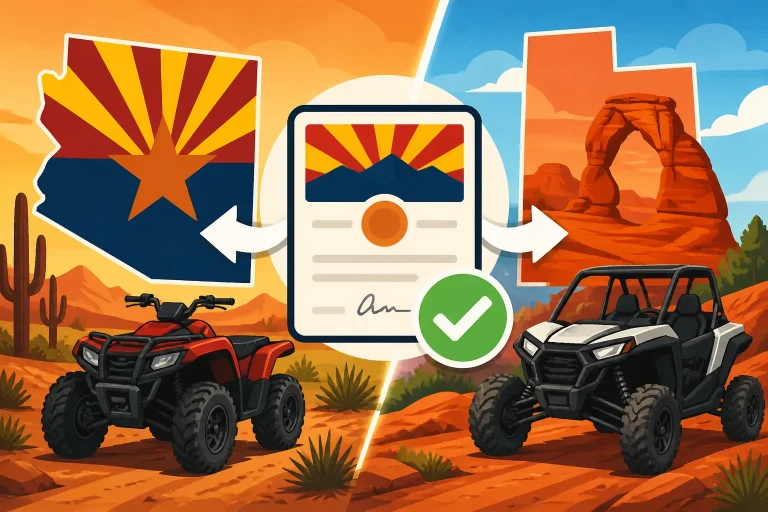
For a Utah resident bringing a properly registered off-highway vehicle into Arizona, the main starting point is the machine’s valid Utah registration. Arizona generally recognizes valid out-of-state registration for nonresident vehicles, but requirements can depend on the vehicle and how it is being used. Check Arizona’s current rules before the trip, especially if the machine has no plate or registration, or its paperwork is unusual.
Carry current proof that connects the vehicle to its Utah registration. Keep the registration document with the machine, and make sure the registration decal is current and displayed as required. If your machine is street-legal, carry its road-registration documents as well. A street-legal plate and an off-highway registration are not interchangeable in every situation; the classification and paperwork matter.
| What you are checking | What to confirm before riding in Arizona |
|---|---|
| Utah OHV registration | It is current, belongs to the machine, and is displayed as required |
| Street-legal status | The machine’s road registration and equipment meet the rules for the roads you plan to use |
| Arizona decal or registration requirement | Whether your out-of-state documents qualify for the machine and use in question |
| Rider rules | Age, supervision, helmet, and other requirements that apply in Arizona |
| Land access | Whether the specific trail or recreation area requires a fee, permit, or reservation |
A Utah nonresident permit is for a qualifying out-of-state rider operating in Utah. It is not an Arizona permit and does not replace Arizona requirements. Likewise, Utah registration is not a pass for every road, trail, or recreation area in Arizona. For the broader state-to-state picture, see Utah Riders Crossing Into Neighboring States and Arizona’s Rules for Utah Riders.
If you are unsure how Utah classifies your machine, start with Which Machines Utah Registers as Off-Highway Vehicles. This can help you understand what your Utah documents represent, but Arizona’s treatment of the vehicle is determined by Arizona rules. A machine that is registered for off-highway use in Utah should not be assumed to have road privileges in Arizona.
The safest approach is to verify the Arizona rule for your exact situation with the relevant state agency before traveling. Be especially careful if the machine is newly purchased, has incomplete paperwork, has been modified, or is registered in a category that does not clearly match its use.
Rider Rules and Documents to Carry
Vehicle paperwork is only part of the preparation. Riders also need to follow Arizona’s rules for age, supervision, protective equipment, and operating on public land. Requirements may vary by age, vehicle, and setting, so do not rely on Utah’s rules as a substitute. Check the current Arizona requirements for every person who will drive or ride as a passenger.
A Utah OHV education certificate may be useful evidence of training, but it is not a general authorization to ride everywhere in Arizona. Nor does carrying the certificate establish that a rider meets all Arizona requirements. Review The Utah OHV Education Certificate and Carrying Your Certificate and Permit on the Trail for what those documents mean in Utah, then separately check what Arizona expects.
Before loading up, gather a document set for each machine and rider:
- Current Utah registration paperwork and any required decal
- Road-registration documents for a street-legal vehicle
- Identification and any required driver documentation
- Required rider certificates or proof of age, if applicable
- Land-use permits, passes, reservations, or fee confirmations for the destination
- Emergency contacts and a trip plan for remote routes
Carry paper proof where practical, even if you also keep a digital copy. Cell service can be weak or absent at trailheads and in remote riding areas. A phone image can be a useful backup, but it may not be accepted in every situation, and a device can lose power or break.
Riders sometimes confuse a state’s vehicle registration with a land manager’s permit. They serve different purposes. Registration identifies the vehicle and confirms its required status; it does not, by itself, authorize access to private land or waive a recreation-area fee. What Utah Riders Must Carry on Public Land explains the similar distinction for Utah riding, but check Arizona requirements for your chosen route.
If you are taking children, check the rules that apply to their ages and roles before departure. A passenger who is permitted on one machine may not be permitted on another, and age-related restrictions can differ between states. Confirm that the vehicle is designed for the number of occupants, that passengers have appropriate protective equipment, and that the route is suitable for their experience.
Check the Destination, Not Just the State
Arizona riding areas can involve different land managers and access conditions. A route may cross public land, state trust land, a state recreation area, or private property. Each can have its own rules. A valid Utah registration does not grant permission to cross private land, and it does not automatically cover access fees or permits set by a land manager.
Before choosing a destination, identify who manages the land and check its current route map, closures, and entry requirements. Look for details on:
- Whether the route is open to the type and width of your machine
- Whether an access fee, permit, or reservation is required
- Whether the route has seasonal or temporary closures
- Whether roads are open to OHVs or only to properly road-registered vehicles
- Where staging and parking are allowed
- Any limits on camping, fires, noise, or group size
A route shown on an online map is not necessarily open to motorized travel. Maps can be out of date, and boundaries between land managers are not always obvious on the ground. Use current official maps and obey signs and gates. If a route crosses private property, get permission rather than assuming public access.
Do not assume that a trailhead fee, state park pass, or other recreation pass covers every nearby riding area. Fees can apply to a specific site, vehicle, or activity, and may be collected separately from registration. Ask the managing agency what the payment covers and whether it applies to your machine and planned use.
Street-legal status also needs a separate check. A Utah-plated UTV may be allowed on some Arizona roads, but that does not mean it can use every public road or trail. Confirm that the vehicle meets applicable road requirements and that the road is open to the type of vehicle. Off-highway routes may have their own equipment, speed, and access restrictions. For the distinction between vehicle categories, see Utah OHV Registration vs Street-Legal Registration.
Plan around the route’s actual conditions, not just its distance. Desert rides can involve heat, loose sand, limited water, and long gaps between services. Mountain routes can bring changing weather and difficult terrain. Carry sufficient water, basic recovery equipment, communication options, and a map that works offline. Tell someone where you are going and when you expect to return.
A Practical Before-You-Go Checklist
A short check before departure can prevent a paperwork problem from turning into a wasted trip. Work through the following steps for each vehicle and rider.
- Confirm the machine’s status in Utah. Check that its registration is current and that the decal and documents match the machine. If it is street legal, confirm that its road-registration paperwork is also current.
- Check Arizona’s requirements for a nonresident vehicle. Confirm whether your Utah registration satisfies Arizona’s current OHV decal or registration rules for your specific vehicle and use. Do not assume that a missing decal is acceptable without confirming the exemption.
- Review rider requirements. Check Arizona’s current age, supervision, helmet, and other safety rules for both drivers and passengers. Treat Utah certificates as supporting documents, not as a replacement for Arizona requirements.
- Choose the route and identify its land manager. Check current maps, closures, vehicle limits, and access rules. Get permission for private land crossings.
- Confirm fees and permits. Ask whether your destination requires a separate pass, permit, entry fee, or reservation. Keep proof of payment with your trip documents.
- Prepare for the route. Pack water, protective gear, navigation tools, and recovery supplies appropriate to the terrain. Plan for limited service and changing conditions.
- Keep proof accessible. Carry registration and access documents in a protected place, with a backup copy stored separately or on a device.
If any part of the machine’s paperwork is uncertain, resolve it before the trip rather than trying to explain it at a trailhead or during a stop. For help understanding Utah paperwork before leaving, What Paperwork Utah Riders Must Carry is a useful companion. For a wider overview of nonresident requirements in the other direction, see Visiting Utah With an Out-of-State Machine.
The practical takeaway is simple: use your valid Utah registration as the starting point, but verify Arizona’s current rules and the requirements of the specific riding area. Vehicle status, rider rules, and land access are separate questions. Checking all three helps you arrive prepared and avoid treating one document as permission for everything.
Disclaimer
This article is for general informational purposes only and does not constitute professional advice. Laws, prices and regulations vary by location and change over time. Consult a qualified professional for guidance on your specific situation.