Do Dirt Bikes Need the Same Utah Permit?
A dirt bike may look different from a quad or side-by-side, but Utah’s visitor permit rules can apply to it too. The answer depends mainly on whether you are a Utah resident, where you plan to ride, and whether the bike is an off-highway machine or a street-legal motorcycle. Here’s how to sort out the permit question before you unload.
The short answer for dirt-bike riders
If you are visiting Utah and plan to ride an off-highway dirt bike on public land, you will generally need a Utah non-resident OHV permit for that bike. A dirt bike is an off-highway vehicle for this purpose; having an out-of-state registration, plate or sticker does not automatically mean you can ride Utah trails without checking the visitor permit rules.
That permit is separate from the bike’s registration and from any rider education requirement. Think of them as different checks:
- Registration identifies the machine and shows it meets the rules that apply where it is registered.
- The non-resident permit covers an eligible visiting machine’s use on Utah public land.
- Rider education concerns the person operating the bike, not the machine.
Utah residents generally deal with Utah OHV registration rather than the visitor permit. If you are unsure which category applies to you, start with Who Needs a Utah Non-Resident OHV Permit and Utah Ended OHV Reciprocity: What Visitors Do Now. The key practical point is not to assume another state’s registration or trail decal substitutes for Utah’s permit.
The public-land detail matters. A private riding area may have its own access conditions, and private-land use is not the same as riding a public trail. Likewise, having permission to ride one property does not authorize you to continue onto an adjacent public route. Check the rules for the specific place you plan to ride, including any land-manager requirements that apply on top of the state permit.
A street-legal dirt bike can raise a different question. A plated motorcycle used on roads may not be treated the same way as an off-highway dirt bike on a trail, but a plate alone is not a universal pass for every OHV route. Check Street-Legal Vehicles and the Permit Question if your bike has road registration or you plan to ride a mix of streets and trails.
What kind of dirt bike are you bringing?
Start by identifying how the bike is registered and how you intend to use it. A bike with an off-highway registration or trail sticker is not necessarily equivalent to a street-legal motorcycle. And a machine that can be made street legal may still need the appropriate documentation and equipment before it can be used on public roads.
| Your situation | What to check before riding in Utah |
|---|---|
| You are a Utah resident with a dirt bike used off highway | Check that the bike’s Utah OHV registration is current and follow the applicable trail rules. |
| You are visiting with an off-highway dirt bike registered elsewhere | Check the Utah non-resident permit requirement and obtain a permit if required for your planned public-land riding. |
| Your dirt bike has a street-legal plate from another state | Confirm whether the route and your intended use are covered by the street-legal vehicle rules or require an OHV permit. |
| You are riding only on private land | Confirm that you have permission and check whether any additional local or property rules apply. |
| You are joining an organized event | Ask the organizer whether an exemption applies and what proof, if any, you need to carry. |
For the typical visiting rider, the most important distinction is off-highway use on public land. A dirt bike that is trail-registered in another state should not be assumed exempt just because it has a registration sticker. Utah’s change away from broad reciprocity is why older advice from riders or online forums can be misleading. Read Old Advice About Utah Reciprocity to Ignore only as a reminder to verify current rules; use the official Utah information for the final answer.
If the bike has a road plate, think about the route as well as the machine. Riding a plated bike on a public road and riding it on an OHV trail can involve different requirements. The same bike may need to meet road rules for one part of a trip and OHV rules for another. Confirm the permit question before you plan a route that moves between pavement, public trails and areas managed by different agencies.
Private land deserves the same careful distinction. If you have permission to ride on a ranch or other private property, do not assume that permission covers a public trail nearby, a county road, or a crossing over another parcel. Ask the property owner where you may ride, and check the status of any route that leaves the property. For more on the limits of private-property use, see Private-Land-Only Machines and Utah Registration.
How to check and get the right permit
Before buying anything, confirm the requirement for your machine and trip. Utah’s rules and permit procedures can change, and individual riding areas may have additional fees or restrictions. Use current official Utah OHV information rather than relying on an old permit, a friend’s experience from a previous season, or a sticker from another state.
A sensible preparation process is:
- Confirm the bike’s status. Check whether it is registered as an OHV, registered as a street-legal motorcycle, or not currently registered. Keep the registration details available while you check the visitor rules.
- Confirm where you will ride. Identify whether your route is on public land, private land, or a mixture. Check the rules for each area and any state park or other managed recreation site on your itinerary.
- Check whether an exemption applies. Some situations may be treated differently, such as certain street-legal vehicles or qualifying organized events. Do not assume an exemption applies simply because the bike is plated or you are riding with a group.
- Buy the permit through an accepted channel if required. Check Buying the Non-Resident Permit Online for the online process, and confirm the current permit instructions before your trip.
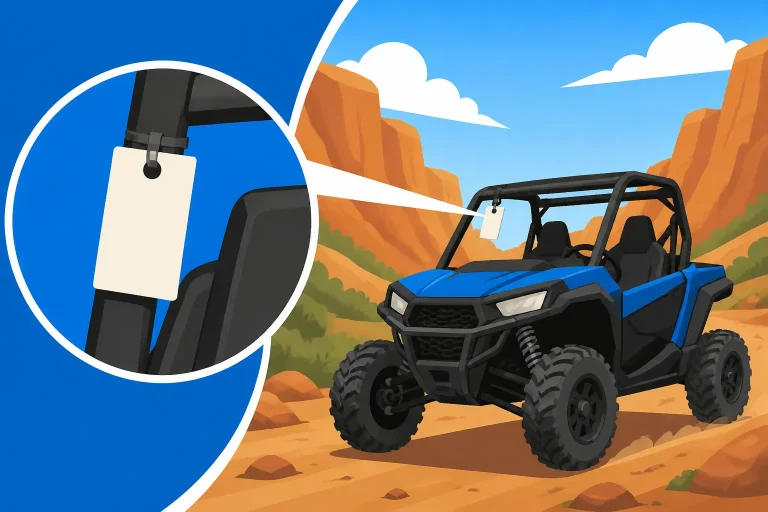
- Follow the display and proof requirements. Read Where to Display a Non-Resident Permit so you know how the permit must be attached or carried. Keep any required proof accessible while riding.
- Check education rules for each rider. A permit for the machine does not replace a rider’s education certificate if one is required. See The Utah OHV Education Certificate and confirm whether a certificate from your home state is accepted.
The permit is generally tied to the machine, not shared across an entire group. If several people bring several dirt bikes, check the requirement for each bike rather than assuming one permit covers the whole trailer. The post Do You Need a Permit for Each Machine? is useful if you are transporting multiple machines or swapping riders during a trip.
Do not confuse the Utah non-resident OHV permit with an entrance fee. A riding area or state park may charge an additional access or day-use fee. Paying that fee does not necessarily satisfy the permit requirement, and having a permit does not automatically include parking, camping or site entry. Confirm each charge separately with the relevant land manager. Utah Permit Versus State Park Entry Fee explains that distinction.
If you are buying permits close to your departure, leave time to review the instructions and save the confirmation. A phone screenshot can be useful for your records, but it is not a substitute for displaying the permit in the way Utah requires. Also plan for limited cell service: download or print the relevant confirmation and rule information before entering remote areas.
Other requirements that can catch dirt-bike riders out
A valid permit is only one part of being ready to ride. Dirt-bike riders should also check registration status, rider education, access rules, and the conditions of the trail itself.
Rider education is separate from the bike permit
Utah’s OHV education requirements apply to riders who meet the applicable criteria, and the rules can depend on the rider’s age or other circumstances. A non-resident permit does not satisfy that requirement. Before traveling with a younger rider, confirm the current Utah education rules and whether a certificate earned elsewhere is recognized. The state’s requirements may differ from what your home state asks of riders.
Carry the education proof required for the rider, rather than assuming a parent’s paperwork or the bike’s registration is enough. If you are riding as a group, check each operator individually. A passenger or spectator does not need an operator credential merely for being present, but anyone who takes control of a bike should meet the rules for operating it.
Registration is not the same as a permit
A permit does not fix an expired or missing registration, and registration does not necessarily remove a visiting rider’s permit obligation. Keep the bike’s registration documents with you and make sure the machine’s identification information is legible. If the bike is newly purchased or its paperwork is incomplete, resolve that issue before the trip. A bill of sale alone may not establish that the machine is properly registered for the type of riding you plan to do.
Trail access can change from one route to another
A permit does not give blanket permission to ride anywhere in Utah. Routes may be closed, restricted to certain vehicle types, or subject to seasonal limits. Some trails may not be suitable for a dirt bike because of width, terrain, traffic or local restrictions. Check Trail Closures Utah Riders Should Check First and review the relevant land manager’s current maps before you tow.
Also pay attention to trail signs and boundaries. A route shown on an old map may have changed, and a legal road or trail can end at a gate, private boundary or closed area. Stay on designated routes, follow posted instructions and do not ride around a closure. For a broader checklist of what enforcement officers may ask to see, read What Rangers Check at Utah Trailheads.
Keep the essentials together
Before leaving home, make a simple document set for each bike and rider. Depending on the situation, that can include registration, permit confirmation, proof of rider education and identification. Keep it in a secure, dust-protected place, and make sure everyone in the group knows who has which documents.
Check the permit’s current display instructions rather than improvising a location. Dirt bikes get covered in mud and dust, and a poorly placed permit may be hard to see or may not stay attached. A protective sleeve can help keep paperwork clean, but it should not obscure required information or conflict with the official display directions.
Finally, check rules again shortly before riding. The permit answer may be straightforward, but access conditions, closures, event exemptions and fees can vary. A few minutes of checking can prevent a frustrating trip back to the trailer—or a ride on a route where your bike is not allowed.
Disclaimer
This article is for general informational purposes only and does not constitute professional advice. Laws, prices and regulations vary by location and change over time. Consult a qualified professional for guidance on your specific situation.