What Rangers Check at Utah Trailheads
A trailhead check can turn an easy Utah ride into a delay if your paperwork is buried, a permit is missing, or your route is closed. Rangers may check different things depending on who manages the land and what you’re riding. Here’s what to have ready, what rules can vary, and how to avoid preventable problems before unloading.
Paperwork Rangers May Ask to See
A check may start with your machine’s registration and any permit required for your situation. The exact documents depend on whether you’re a Utah resident, what kind of machine you have, and whether you’re riding on public land, in a state park, or somewhere with its own access requirements.
Keep documents easy to reach. A glove box or secured pouch is more useful than papers packed under camping gear. Don’t assume a photo on your phone will be accepted in every situation or that it will load where cell service is weak. Check the current rules for the document you’re carrying, and bring a printed copy when practical.
| What may be checked | Why it matters | What to do before the ride |
|---|---|---|
| Registration or other proof of status | Shows the machine is properly registered or otherwise authorized for use | Confirm the documents match the machine and are current |
| OHV decal or permit display | Helps show that a required registration or permit is in place | Attach it where required and keep it visible |
| Nonresident OHV permit | May be required for visitors riding eligible out-of-state machines | Check whether your machine and trip require one, and buy it before riding |
| OHV education certificate | May be required based on the rider’s age or other applicable rules | Confirm who needs a certificate and carry proof |
| Area entry or camping authorization | Some destinations have access fees, permits, or site rules separate from vehicle paperwork | Check the land manager’s rules for your exact destination |
| Route and closure information | A road or trail may be closed even if the machine and rider are otherwise compliant | Review current maps, signs, and closure notices |
If you’re riding an out-of-state machine, don’t rely on old advice about states accepting one another’s registrations. Utah ended OHV reciprocity, and visitors may need to take additional steps. Start with Utah Ended OHV Reciprocity: What Visitors Do Now and Who Needs a Utah Non-Resident OHV Permit to determine which rules apply to your situation. The details can depend on the machine and how it is registered, so confirm the current requirement before you travel.
If a nonresident permit applies, check how it must be displayed and what proof you should carry. A permit purchase confirmation may be useful, but don’t assume it replaces the permit or its required display. Where to Display a Non-Resident Permit explains the display question, while Buying the Non-Resident Permit Online covers the purchase process.
Residents should also make sure the machine’s registration and decal are in order. A current registration record does not necessarily mean a decal is attached correctly. If you’re unsure about placement, see Utah OHV Decals and Where They Go. For a broader list of paperwork, What Utah Riders Must Carry on Public Land is a useful companion.
Rider Qualifications and Machine Safety
A ranger may ask who is operating the machine and whether the rider meets the applicable education, age, supervision, or equipment rules. These requirements can differ by age, residency, vehicle type, and location. A family ride deserves a little extra planning: don’t assume that an adult’s paperwork covers a child, or that a passenger is subject to exactly the same requirements as an operator.
Utah has OHV education requirements for some riders. Confirm whether each operator in your group needs a certificate, and make sure they can show proof if asked. For the details, see The Utah OHV Education Certificate. Youth rules deserve particular attention; Age Limits in Utah OHV Education Law and Supervision Rules for Young Utah Riders can help you work out what to check before leaving home.
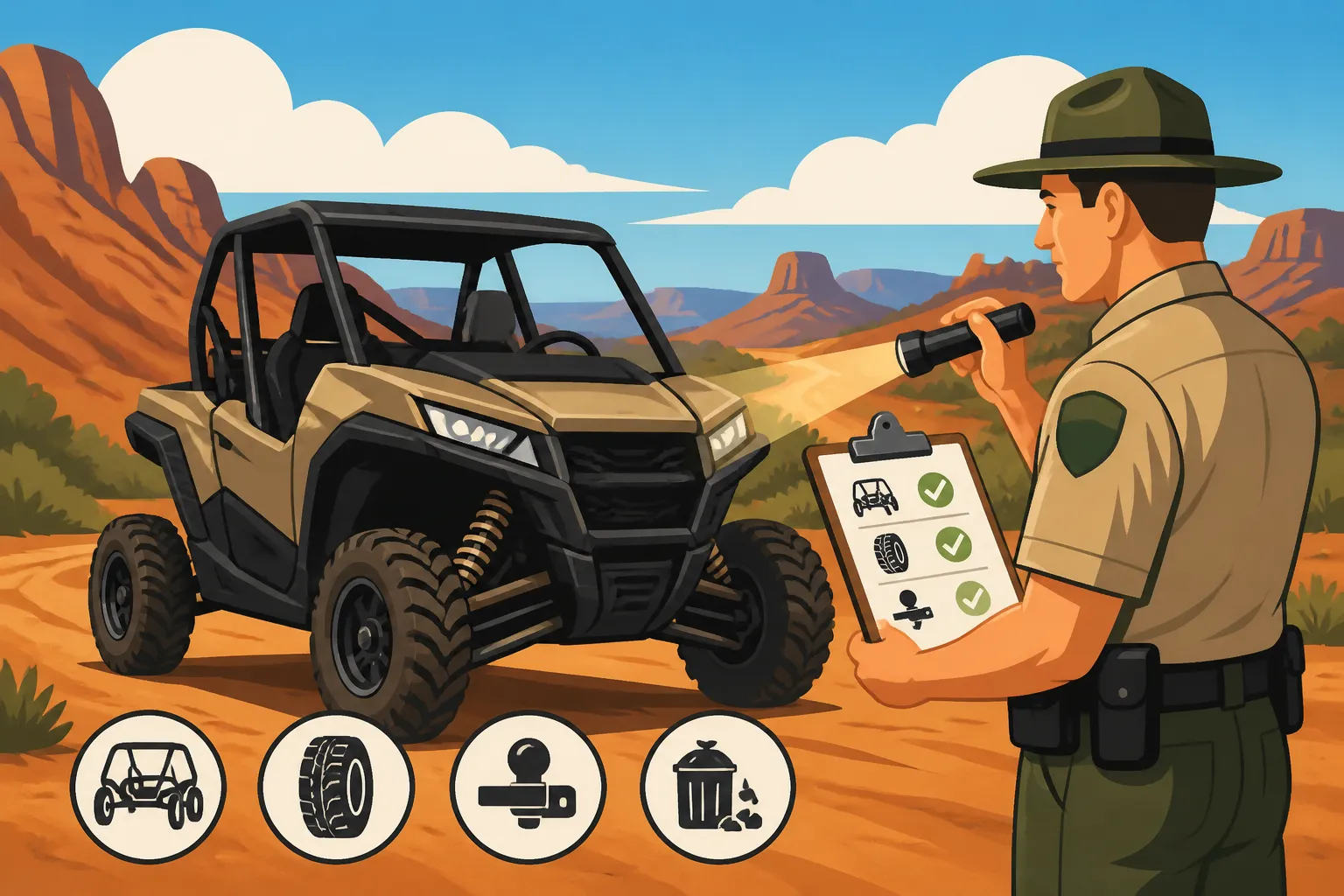
A ranger may also look at basic safety and equipment matters, particularly if something appears out of order or the area has specific restrictions. That does not mean every trailhead check includes a full mechanical inspection. But a machine that is loud, leaking, missing required safety equipment, or being operated in a way that creates an immediate hazard can draw attention.
Before riding, check that:
- The machine is in sound operating condition, with brakes and controls working properly.
- Any required lights, muffler, or spark-arresting equipment are present and functioning.
- Everyone has suitable protective gear and follows the applicable helmet rules.
- Children are using machines appropriate to their size, ability, and the rules for the area.
- Passengers are seated in positions intended for passengers, with required restraints used where applicable.
- Your group understands any local rules about flags, speed, noise, or designated riding areas.
Some details depend on the type of machine and where you ride. A dune area, a state park, and a forest route may not have identical requirements. Use the official information for the specific destination, and take signs at the trailhead seriously. A general checklist is not a substitute for an area’s posted rules.
Access, Routes, and Area-Specific Rules
Vehicle paperwork does not give you permission to ride every route. Rangers and other land managers may check whether you are on an open route, within an authorized riding area, and following the rules for that property. A trail can be closed for maintenance, seasonal protection, weather damage, or another management reason. The closure may apply even if the route appears passable.
Before heading out, identify who manages the land you plan to ride. Utah rides can involve state, federal, local, or private land, and each may have separate restrictions. A Utah OHV permit does not automatically replace an area entrance fee, camping authorization, or other land-manager requirement. Likewise, a state park entry payment does not necessarily satisfy vehicle registration or rider education rules.
Check current information close to your departure, especially after storms or during seasonal closures. Use the route map and follow signs at junctions rather than relying on a remembered track or an old online route. Trail Closures Utah Riders Should Check First and Reading a Motor Vehicle Use Map can help you understand why route status matters. For a destination-specific trip, also check the relevant land manager’s current notices.
A trailhead encounter may include questions about:
- Where you entered and which route you plan to ride.
- Whether the route is open to your vehicle type.
- Whether you are staying on designated routes rather than creating a new track.
- Whether you have authorization to cross private land or use a restricted area.
- Whether your group is following posted speed, noise, parking, or camping rules.
- Whether a separate destination fee or permit applies.
If you see a closed gate, barrier, or sign, don’t treat it as a suggestion or assume the route is open because other tire tracks pass through. What a Closed Gate Means on Public Land explains why access boundaries matter. When a route status is unclear, stop and verify it with the managing agency rather than guessing.
Rangers may also check behavior that affects other visitors and the land. Stay on the route, give other trail users space, and avoid disturbing wildlife or damaging vegetation. Follow instructions from authorized staff, and ask politely if you need clarification about a boundary or rule. A calm conversation is more likely to resolve uncertainty than continuing past a sign and sorting it out later.
Get Ready Before You Unload
The simplest way to reduce hassle is to check your documents and your destination before the machines come off the trailer. A short preparation routine also helps if your group includes visitors, young riders, or machines registered in different states.
- Confirm the land manager and destination rules. Identify whether the ride is on state, federal, local, or private land. Check for entry requirements, route closures, and any separate fees or permits.
- Check registration and display requirements. Make sure each machine’s paperwork is current and the decal or permit is displayed as required. If you recently bought the machine, verify that you have the documents needed for its status rather than assuming the seller’s paperwork is enough.
- Review visitor rules. If a machine is registered outside Utah, confirm whether a nonresident OHV permit applies. Do this before the trip, not after reaching a trailhead with limited service.
- Check rider qualifications. Work out whether each operator needs an OHV education certificate and whether age or supervision rules affect anyone in the group.
- Inspect the machine and safety gear. Check the brakes, controls, tires, lights, muffler, and other equipment relevant to the machine and destination. Bring protective gear that fits each rider.
- Pack documents where you can reach them. Keep required proof together in a dry, secure place. If relying on digital documents, save them for offline access and confirm whether digital proof is accepted for that requirement.
- Read signs when you arrive. Check the trailhead board for closures and local restrictions, and compare it with the route information you reviewed earlier.
If a ranger says something is missing, ask which requirement applies and what you need to do before riding. Don’t continue onto a route while trying to resolve a required permit or an unclear closure. If you believe you have the correct documents, show them and ask whether the ranger needs a specific document, display, or proof of purchase.
For a family or group, assign one person to check the paperwork for every machine and rider. It’s easy to focus on the driver’s registration and overlook a visitor permit, a youth certificate, or an area entry requirement. A quick final check at home is usually easier than trying to resolve the issue at a remote trailhead.
Disclaimer
This article is for general informational purposes only and does not constitute professional advice. Laws, prices and regulations vary by location and change over time. Consult a qualified professional for guidance on your specific situation.