Street-Legal Out-of-State UTVs on Utah Trails
A UTV with an out-of-state plate may look ready for Utah, but street-legal registration does not automatically answer every trail-access question. The key is to separate the machine’s registration status from the rules for the route you want to ride. Here’s how to think through Utah’s nonresident permit, paperwork, and trail access before unloading.
Does a street-legal out-of-state UTV need a Utah OHV permit?
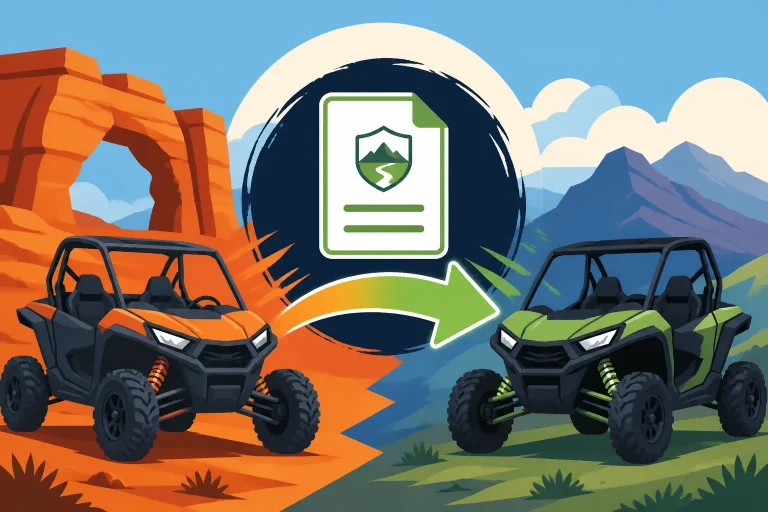
Utah’s nonresident OHV permit rules distinguish between an off-highway vehicle and a motor vehicle registered for street use. In general, a UTV that is validly registered as street legal in its home state may not need Utah’s nonresident OHV permit. A machine that is registered only as an OHV is a different case and may need the permit before it is operated on Utah public lands.
The important detail is the vehicle’s legal registration status, not simply whether it has a license plate. A plate, a seller’s claim that a vehicle is “street legal,” or equipment such as mirrors and turn signals does not by itself prove that the state where it is registered recognizes it as a street-legal motor vehicle. Keep the current registration document available, and check how the issuing state classifies the machine.
Utah ended OHV registration reciprocity with other states, so an out-of-state OHV registration should not be treated as a substitute for Utah’s nonresident permit. That change matters most to visitors whose UTV is registered for off-highway use only. If your machine is registered as an OHV rather than as a street-legal vehicle, review Who Needs a Utah Non-Resident OHV Permit and Utah Ended OHV Reciprocity: What Visitors Do Now before traveling.
| How the UTV is registered | What to check before riding in Utah |
|---|---|
| Street-legal motor vehicle in another state | Confirm that the registration is current and that Utah’s rules recognize the machine as street legal. Check route access separately. |
| OHV-only registration in another state | Check whether you need a Utah nonresident OHV permit. An out-of-state OHV registration alone may not meet Utah’s requirements. |
| Registration status is unclear | Ask the issuing state or Utah’s OHV program how the vehicle is classified. Do not rely only on the plate or the seller’s description. |
| Rental or borrowed UTV | Ask the owner or rental company for the registration classification and confirm who is responsible for permits and required documents. |
This distinction does not mean every street-legal UTV can ride every trail. Registration and permit requirements address whether the vehicle is properly documented for a type of use. They do not establish that a particular trail is open to that vehicle. A route may be limited by land manager rules, vehicle width, seasonal closures, local restrictions, or other posted conditions.
When there is uncertainty about your machine’s classification, resolve it before the trip rather than trying to settle the question at a trailhead. Utah’s guidance on Street-Legal Vehicles and the Permit Question can help frame the issue, but confirm current requirements with the appropriate Utah agency before riding.
What street-legal registration does and does not allow
Street-legal registration generally means the vehicle is authorized for road use under the rules of the state where it is registered. It does not turn every road, trail, or public-land route into an approved UTV route. In Utah, you still need to confirm that the route is open to motorized use and permits a vehicle of your UTV’s type and dimensions.
This distinction can be easy to miss when a route connects a town with a riding area. A vehicle may be legal on certain public roads but not on a nearby trail, or it may be allowed on one trail segment and restricted on another. Signs, maps, closures, and land manager instructions matter even when the UTV has a valid plate.
A practical way to think about it is to check three separate questions:
- Is the vehicle correctly registered? Confirm that the registration is current and identifies the UTV as street legal in its home state.
- Is the operator allowed to drive it? Check licensing, age, insurance, and any applicable OHV education requirements.
- Is the specific route open to this vehicle? Check the route’s designation, current closures, vehicle restrictions, and local rules.
Those questions are related, but one answer does not automatically settle the others. For example, a valid plate does not waive a trail closure. Likewise, being exempt from a Utah nonresident OHV permit does not necessarily remove an operator education requirement that applies to the vehicle or rider. Because rules may depend on the machine and the person operating it, confirm the applicable requirements rather than assuming the street plate covers everything.
If you plan to travel on public roads as well as trails, review Utah Traffic Rules for Street-Legal Side-by-Sides and Driver License Rules on Utah Roads. Road-use rules can include requirements for equipment, insurance, passengers, and where the vehicle may be driven. A UTV’s street-legal status does not give it access to roads that are closed to that class of vehicle.
Route research is especially important on public lands, where the route network can include roads, OHV trails, and non-motorized paths close together. Use current maps and look for restrictions that apply to your exact vehicle. A trail shown as open to motor vehicles may still have limits that affect a wide side-by-side. For help reading land-use maps, see Utah OHV Trail Maps and How to Read Them and Trail Closures Utah Riders Should Check First.
Paperwork and checks to make before you ride
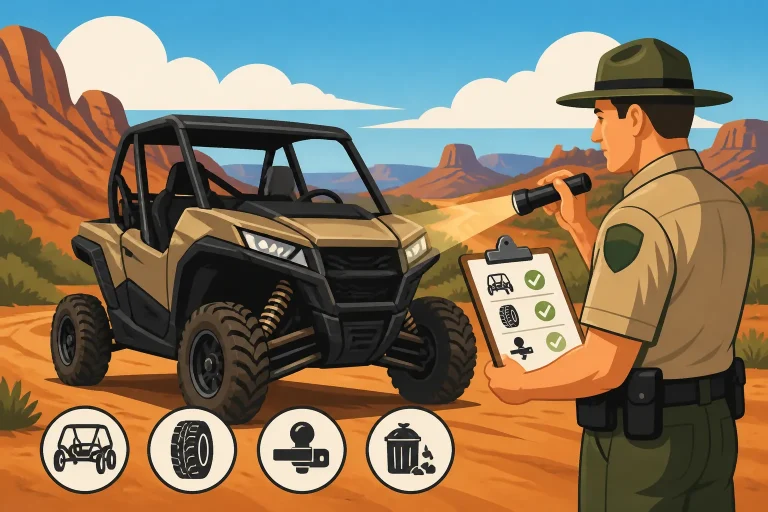
Carry enough documentation to explain both who owns the machine and how it is registered. Requirements can vary by situation, but preparing a simple paperwork set can save time if a ranger or officer asks questions.
Before leaving home, gather:
- Current registration showing the vehicle’s street-legal classification in its home state.
- Proof of insurance that meets the requirements for the planned road use.
- A driver’s license for anyone who may operate the UTV on public roads.
- Any required OHV education certificate or other rider documentation that applies to the operator.
- Rental or borrowing paperwork if the UTV is not yours.
- Information about any permit or recreation-area fee required for the destination.
Keep the registration and insurance documents accessible, whether in paper form or another format accepted for the situation. Do not assume a phone photo will be accepted everywhere or that service will be available when you need to retrieve an online record. For broader advice on documentation, see What Utah Riders Must Carry on Public Land.
If your UTV is OHV-only, treat the permit question as a separate task from trail-area fees. A Utah nonresident OHV permit and an entrance or day-use fee are not interchangeable. A permit may address the vehicle’s status for operation in Utah, while an area fee may apply to using a particular recreation site. Check both when planning a destination. Utah Permit Versus State Park Entry Fee explains the difference in more detail.
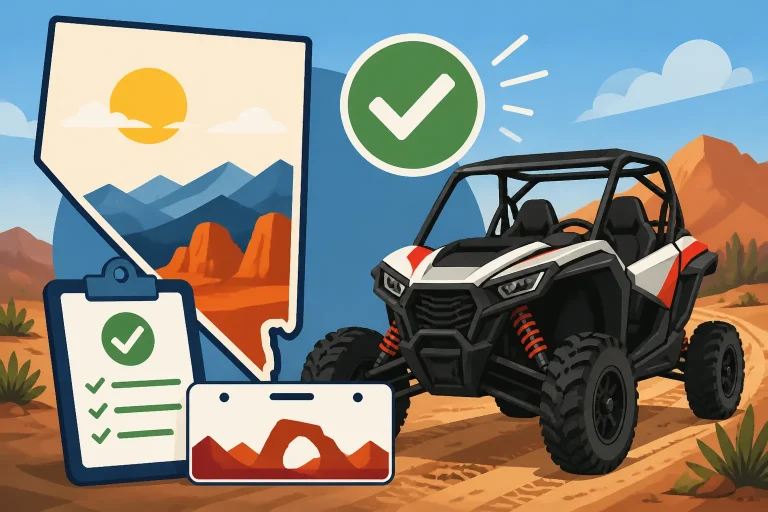
Before loading up, make a route-specific checklist:
- Confirm the registration category. Read the registration document, not just the license plate. If it does not clearly show street-legal status, ask the issuing state or Utah’s OHV program.
- Check the permit requirement. If the vehicle is registered as an OHV, confirm whether a nonresident permit is needed and how to obtain it. Review Buying the Non-Resident Permit Online if a permit applies.
- Check the operator requirements. Confirm licensing and any education rules that apply to the rider’s age and vehicle.
- Check the route and land manager. Verify that the trail is open, appropriate for your UTV, and not subject to a temporary closure or local restriction.
- Check destination fees. Find out whether the riding area charges a separate entrance, day-use, or camping fee.
- Recheck close to departure. Conditions and closures can change. Confirm the route and requirements again before towing to the trailhead.
This process is useful even for experienced riders. A registration decision made in one state may not answer a separate question about a Utah trail or recreation area.
Common assumptions that cause trouble
The most frequent mistake is treating a street plate as a universal trail pass. It is better understood as evidence of the vehicle’s road registration, not blanket permission to ride any route. Trail access depends on where you are going and what the land manager allows.
Another common mistake is assuming that any out-of-state registration qualifies as street legal. Some states register UTVs for off-highway use, while others may allow certain machines to be registered for road use under specific conditions. If your papers say OHV, off-highway, or a similar classification, do not assume the machine is exempt from Utah’s nonresident permit rules just because it has a plate.
Visitors also sometimes mix up permits and recreation fees. A nonresident OHV permit, when required, is not automatically a pass for a state park or riding area. Conversely, paying an entrance fee at a destination does not necessarily satisfy a vehicle-registration or permit requirement. Check each requirement on its own.
Finally, do not rely on old advice from another rider or an outdated discussion online. Utah’s reciprocity rules changed, and requirements can depend on how a particular vehicle is registered. When a detail affects whether you can legally ride, check the current official instructions rather than guessing.
The simplest plan is to bring clear registration and insurance documents, verify whether the UTV is street legal in its home state, and confirm the destination’s route rules before arrival. If the UTV is registered only as an OHV, check Utah’s nonresident permit requirements separately. That approach helps prevent a paperwork issue from turning into a wasted trip, and it keeps vehicle registration separate from the question that matters on the ground: whether your chosen route is open to your UTV.
Disclaimer
This article is for general informational purposes only and does not constitute professional advice. Laws, prices and regulations vary by location and change over time. Consult a qualified professional for guidance on your specific situation.