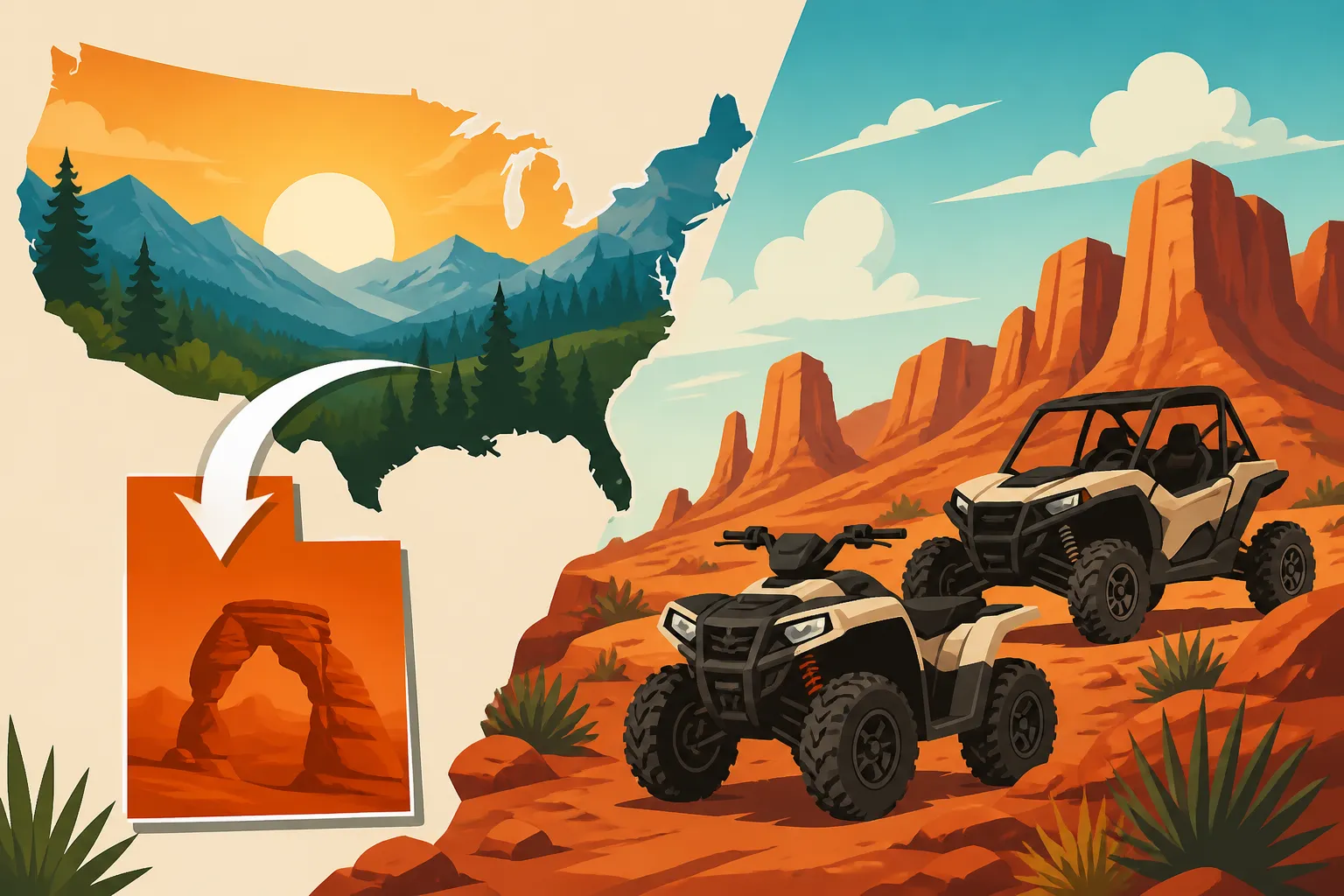
America the Beautiful Passes on Utah Land
The America the Beautiful pass can reduce some recreation fees on federal land, but it is not an ATV or UTV permit and it does not open every Utah trail for riding. The key is to separate entrance and day-use fees from vehicle permits, registration, and site-specific rules before you head out.
What an America the Beautiful pass covers
The America the Beautiful pass is a federal recreation pass. At participating federal sites, it can cover or reduce certain entrance fees and standard amenity day-use fees. Whether it applies depends on the site, the type of fee, and the pass’s terms.
That distinction matters for ATV and UTV riders because “federal land” does not automatically mean “free with the pass.” A riding area may have no entrance charge, may collect a separate recreation fee, or may charge for facilities such as camping. The pass does not turn every fee into a covered fee.
A useful way to think about it is that the pass may help with access to a participating federal recreation site. It does not give permission to ride a particular route or replace paperwork required for the machine or rider.
| Cost or requirement | Does the pass replace it? | What to check |
|---|---|---|
| Entrance fee at a participating federal recreation site | Sometimes covered, depending on the site and fee | Whether that location accepts the pass for its entrance fee |
| Standard amenity day-use fee | Sometimes covered, depending on the site | Whether the fee is a covered day-use fee or a separate charge |
| Utah non-resident OHV permit | No | Whether the rider and machine need a Utah permit |
| OHV registration or decal | No | Registration rules for the machine and its home state |
| Rider education certificate | No | Utah education requirements and any applicable exceptions |
| Camping, reservations, or other site charges | Not automatically | The site’s specific fee and pass rules |
| State park entrance or use fee | No | The state park’s own fees and passes |
| Trail access and route legality | No | Current land-manager maps, closures, and vehicle restrictions |
Before relying on the pass, look at what the fee is actually called. A fee collected at a federal site might be an entrance fee, a day-use fee, a camping charge, a reservation fee, or a special recreation fee. Those categories do not necessarily receive the same treatment.
A pass also does not override closures or restrictions. If a route is closed to motorized use, limited to certain vehicle types, or subject to a seasonal restriction, the pass does not change that. Riders still need to use routes open to their machine and follow the rules of the agency managing the land.
The pass is separate from Utah OHV requirements
A common planning mistake is to treat a federal recreation pass as a substitute for Utah OHV paperwork. It is not. The pass concerns eligible federal recreation fees; Utah’s OHV rules and land-use rules are separate.
Visitors should first determine whether their machine and riding plans require a Utah non-resident OHV permit. Utah’s permit rules are not the same as an entrance fee at a federal site, and buying one does not necessarily pay fees charged by a recreation area. For a starting point, see Who Needs a Utah Non-Resident OHV Permit and Utah’s Non-Resident OHV Permit Explained.
The same separation applies to registration. A machine’s registration or decal is its own requirement, distinct from a federal pass. A rider might need valid registration and a Utah permit while also paying an entrance or day-use fee. Conversely, a pass may be useful at a federal recreation site even when a particular ride does not require a separate entrance fee.
Education requirements are separate as well. If a rider needs a Utah OHV education certificate, a recreation pass does not satisfy that requirement. The pass is not a rider credential, vehicle document, or authorization to use a motorized route.
Even after sorting out permits and registration, check the land manager’s rules. A Utah OHV permit does not grant blanket access to every federal route. BLM and Forest Service areas can have their own route designations, closures, and operating restrictions. The distinction is explained further in Does a Utah Permit Cover Federal Land?, BLM Rules That Sit on Top of Utah Permits, and Forest Service Rules Riders Overlook.
Keep these questions separate when planning:
- Is the machine properly registered, and does the rider need a Utah permit or certificate?
- Is the planned route open to that kind of machine?
- Does the recreation site charge an entrance or day-use fee?
- Does that site accept the America the Beautiful pass for that specific fee?
- Are there additional costs for camping, reservations, or other services?
Answering each question avoids the assumption that one pass or sticker handles every part of the trip. It also makes it easier to identify what you need to carry and what you may need to pay at the entrance.
How the pass applies across Utah land
Utah riding trips can cross different kinds of land and fee systems in a short distance. A route may involve federal public land, a developed recreation site, a state park, or local facilities. The America the Beautiful pass is not a universal Utah recreation pass: it applies only under its terms at participating federal sites.
Federal recreation sites
At a participating federal site, the pass may cover an eligible entrance or standard amenity day-use fee. The site’s own fee information is the practical authority on whether the pass applies. Do not assume it covers every charge just because the site is on federal land.
The distinction can be especially important at popular riding destinations with developed facilities or designated fee areas. The fee may be collected for a particular recreation area or service rather than for general entry to federal land. Check the location’s official information before the trip, and ask the site operator if the fee category is unclear.
State parks
The federal pass does not replace a Utah state park fee or state parks pass. If a ride includes a state park, check that park’s entry rules separately. Park entry, riding access, and the legal status of routes are different questions; permission to enter a park does not necessarily mean every road or trail is open to your OHV.
For instance, a rider heading to an OHV destination near a state park should not assume that a federal pass covers the park’s fee, or that a park entry payment acts as a Utah OHV permit. The relevant fees and riding rules need to be checked independently.
Public land without an entrance station
Some public-land rides do not involve a staffed entrance or a site entrance fee. That does not mean every route is open, nor does it cancel permit or registration requirements. It simply means the fee question may be different from the route-access question.
Use current maps and agency information to identify routes open to motorized travel. A trail visible on a general recreation map may be closed, limited to a particular vehicle width, or not designated for motorized use. Check for temporary closures as well as permanent route designations.
Privately operated or locally managed areas
A riding area may be operated or managed through a local arrangement, or it may charge for services that are not covered by the federal pass. Ask the site which pass, if any, it accepts and what the charge includes. A federal pass should not be treated as a discount card for unrelated private, county, or municipal fees.
For destination-specific fees, Day-Use Fees at Utah OHV Destinations and Permits and Fees for Utah’s Riding Areas can help separate land access charges from permit requirements. If your route includes a Utah state park, Utah Permit Versus State Park Entry Fee addresses why those costs should be checked separately.
Common riding scenarios and what to verify
The right answer depends on where you ride and what fee is being collected. These examples show how to apply the distinction without assuming the pass will cover a charge.
A day ride on federal land
Start with the route map and confirm that the route is open to your machine. Then check whether the staging area or recreation site charges an entrance or day-use fee. If there is a fee, confirm whether it is eligible for the pass. Separately, verify Utah permit, registration, and education requirements.
If there is no entrance fee, carrying an America the Beautiful pass may not change the cost of that ride. It still does not replace the documents or permits that apply to the rider and machine.
A visit to a developed federal recreation site
A developed site may collect an entrance fee or a standard amenity day-use fee, but it may also have additional charges. Check whether the pass is accepted for the specific fee you expect to pay. Do not assume it covers camping, reservations, rentals, special recreation fees, or other services.
Also check whether the riding route begins inside the fee area or merely passes near it. Paying or showing a pass at one entrance does not necessarily settle fees at a separate site farther along the trip.
A trip that includes a state park
Treat the state park fee and the OHV permit as separate from the federal pass. Verify the park’s entrance and riding rules, then check Utah OHV requirements and any fees associated with the rest of the route. A federal pass does not automatically apply to the state park portion of the trip.
A group traveling in several machines
Do not assume that one pass covers every vehicle or every rider in a group. Pass admission rules can depend on how a site charges, such as by vehicle or by person, and the terms vary by pass and location. Check the site’s current instructions for how the pass holder must be present and which occupants or vehicles are included.
The pass also does not cover each machine’s Utah permit, registration, or other required paperwork. If multiple out-of-state machines are coming to Utah, review Do You Need a Permit for Each Machine? and the permit information for visitors before leaving home.
A ride combining several land managers
A long route can move between areas governed by different agencies. A pass accepted at one entrance does not necessarily apply to another area along the route. Confirm the land manager for each segment, the route’s status, and any entrance or recreation fees at each location.
When in doubt, plan around the most restrictive rule for each segment rather than assuming the first pass or permit handles the rest. A recreation pass, OHV permit, and route authorization each answer a different question.
How to check before you travel
Pass rules and site fees can differ by location and change over time. A quick check before departure is more reliable than relying on an old trip report, an unofficial map, or a general statement that a destination is “on federal land.”
- Identify the land manager. Check whether the staging area and planned route are managed by a federal agency, Utah, a local government, a private operator, or more than one entity.
- Confirm the route is open. Use current agency route maps and closure notices. Check vehicle limits, seasonal restrictions, and any local rules that apply.
- Identify the fee category. Find out whether the charge is for entrance, standard amenity day use, camping, a special recreation permit, a reservation, or another service.
- Ask whether the pass applies to that specific charge. Read the site’s current fee information or contact the site operator. Avoid interpreting “federal fee” as meaning every charge is pass-covered.
- Check OHV requirements independently. Confirm registration, Utah permit, and rider education requirements. The federal pass does not meet these obligations.
- Check state and local fees separately. If the trip includes a state park or local recreation area, confirm its own fee and pass rules.
- Carry proof and keep a backup plan. Follow the site’s instructions for displaying or presenting the pass. In remote areas, do not depend on being able to look up rules at the entrance.
A helpful trip budget separates costs into three categories: machine and rider requirements, land access or entrance fees, and optional services such as camping or reservations. This makes it easier to see what the America the Beautiful pass might reduce and what it cannot replace.
If you already own the pass, carry it when visiting participating federal sites, but still verify acceptance before treating it as payment. If you do not own one, compare the eligible fees on your itinerary with the pass terms and current purchase information. A pass only makes financial sense when it applies to the places and fee types you will actually use; it is not required simply to ride a Utah trail.
Frequently Asked Questions
Does an America the Beautiful pass let me ride OHV trails in Utah?
No. It may cover eligible fees at participating federal recreation sites, but it does not authorize motorized travel on a route. Confirm that the route is open and meet Utah’s separate OHV requirements.
Does the pass cover a Utah non-resident OHV permit?
No. A federal recreation pass and a Utah OHV permit serve different purposes. Check whether the rider and machine need the Utah permit, even if the pass covers an eligible fee at a recreation site.
Does the pass work at Utah state parks?
No. It is a federal pass, not a Utah state park pass. Check the state park’s entry fees and riding rules separately.
Will the pass cover camping at a Utah riding area?
Not automatically. Camping and other site charges can be separate from entrance or standard amenity day-use fees. Check the location’s current fee rules before booking or arriving.
Disclaimer
This article is for general informational purposes only and does not constitute professional advice. Laws, prices and regulations vary by location and change over time. Consult a qualified professional for guidance on your specific situation.