Registering a UTV You Only Use on Your Own Land
It's incredibly frustrating when you own a side-by-side, maybe just for puttering around your own property or helping with chores, and then wonder if you still need to jump through the hoops of registration. You might think, "It's my land, my machine, why does the state care?" And honestly, it’s a fair question. This guide is going to peel back the layers of Utah's OHV laws to show you exactly when your private-land-only UTV needs to be registered, and when you might actually be in the clear.
The "Private Land Only" Assumption and Utah's Reality
Many UTV owners, especially those who never plan to hit a public trail, naturally assume that their machine is exempt from state registration. It feels like a logical conclusion: if you're not using public resources or contributing to trail wear, why should you pay a registration fee? However, Utah's Off-Highway Vehicle (OHV) laws are a little more nuanced than this common-sense approach might suggest, often catching private-land riders off guard.
Why Riders Assume They're Exempt
The assumption usually stems from a simple, understandable logic. You bought your UTV for specific tasks on your property—hauling feed, checking irrigation lines, moving firewood, or perhaps just enjoying a spin on your acreage. Since it never leaves your boundaries, you don't see how it impacts public lands or services. You figure the state's registration requirements are for the folks out on the Paiute Trail or tearing up the dunes at Sand Hollow, not for someone working their farm or just enjoying their backyard. This line of thinking is perfectly valid from a personal perspective, and it's something many of us in the OHV community have pondered.
However, state laws often operate on broader definitions and objectives than an individual's specific use case. The state isn't just trying to collect fees for trail maintenance (though that is a big part of it); they're also tracking ownership, aiding in theft recovery, and maintaining a general registry of motor vehicles within their borders. It's easy to feel like the government is overreaching when your UTV never leaves your private spread, but understanding the legal framework helps clarify why these rules exist, even if they sometimes feel cumbersome.
Utah's Broad Definition of an Off-Highway Vehicle
Utah's definition of an Off-Highway Vehicle (OHV) is quite encompassing, and it often doesn't depend on where you intend to ride it. Instead, it focuses on the vehicle's design and capability. Generally, an OHV is defined as any motor vehicle that is designed for or capable of travel over unimproved terrain and that is not a street-legal motor vehicle. This includes ATVs, UTVs (side-by-sides), dirt bikes, and even some snowmobiles. The key here is the design, not necessarily the current use.
What this means in practice is that if your UTV fits the description of an OHV, it’s often subject to state regulations, including titling and registration, unless a very specific exemption applies. The state views these vehicles as needing to be part of the official record for various reasons, including establishing clear ownership, ensuring that if it ever does venture onto public land (even accidentally or briefly), it's compliant, and contributing to the overall OHV program that benefits all riders, even if indirectly. While you might only ride it on your vast ranch, the moment it could potentially be ridden elsewhere is what the law often considers. You can find more details on [Which Machines Utah Registers as Off-Highway Vehicles].
Specific Scenarios Where Private-Land UTVs Still Need Registration
So, you’re thinking, "Okay, but my UTV is only on my property." Unfortunately, there are several situations where Utah law still expects your machine to be registered, even if it rarely or never sees a public trail. These scenarios often hinge on the letter of the law rather than the spirit of your intended private-land use.
The Title-Registration Link
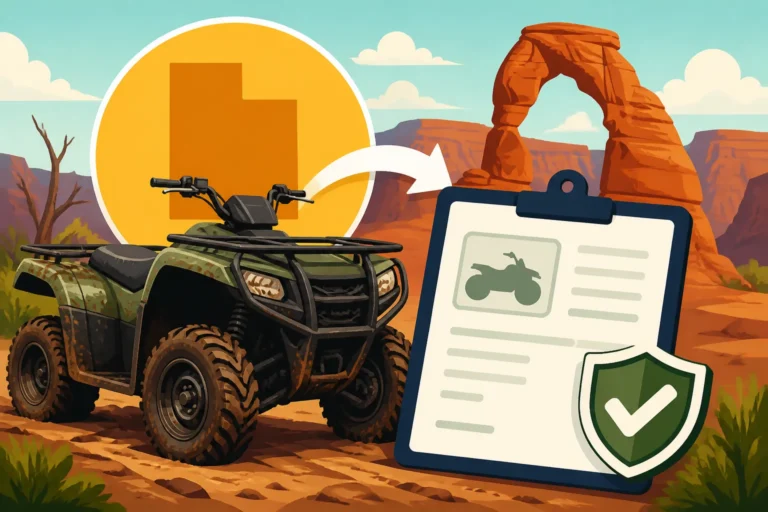
For many UTVs, especially those manufactured after 1988, Utah law requires them to be titled. This title is the official proof of legal ownership. Here’s where things get interesting: often, if a machine is required to have a title, it's also generally expected to be registered. The registration acts as an ongoing validation of that title and helps the state maintain a current record of the vehicle and its owner. Even if your UTV simply sits in your barn or just travels across your fields, if it has a title, the state anticipates it will also have a current registration. You can learn more about this by looking into [Utah ATV Title Requirements Explained].
While registration isn't a direct replacement for a title, it can certainly help establish a clear ownership chain, especially if the original title documents are ever lost or damaged. Think of it this way: a registered vehicle is much harder to "disappear" or be involved in illicit activities without a trace. It provides an official paper trail that can be invaluable in cases of theft recovery, insurance claims, or even just confirming ownership to potential buyers down the line. If you're ever in a situation where you need to create documents like an affidavit of ownership or a robust bill of sale, even for an informally purchased private-use machine, resources like LawDepot can assist you in generating professionally formatted legal forms to help solidify your claim.
Crossing Public Roads or Land
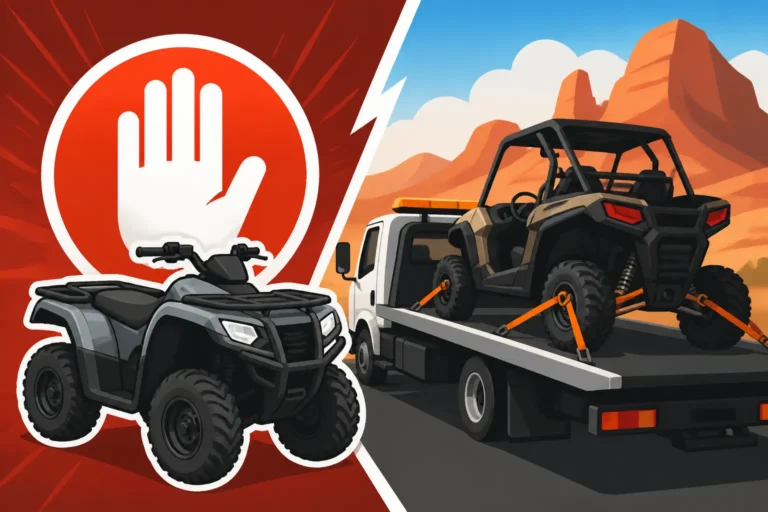
This is perhaps the most common trap for private-land UTV owners. You might live on a large property that's bisected by a county road, or your neighbor’s property is just across a small public easement. You think nothing of driving your UTV across that road or easement for a few seconds to get from one part of your land to another, or to visit a friend’s property. The instant your tires touch any public thoroughfare or land, even for the briefest moment, your UTV is considered to be operating on public land.
Imagine this: You're driving your UTV from your house to your back pasture, a route you've taken countless times. There's a small dirt road, maintained by the county, that runs between the two sections of your property. If a local law enforcement officer sees you cross that road without current registration, you could face a citation. It doesn't matter that you only went 50 feet; that public road negates your "private-land-only" exemption. The penalties for riding unregistered can be quite steep, and it's simply not worth the risk. Understanding these nuances is crucial, especially when considering [Penalties for Riding Unregistered in Utah].
Planned Future Sale or Trade
Even if your current intention is to keep your UTV strictly on your private property forever, life has a way of changing plans. You might eventually decide to upgrade, downsize, or move. When that day comes, having a UTV that has always been properly registered, even if only for private use, makes the sale or trade process significantly smoother. Buyers are naturally wary of machines that have never been registered, as it can raise questions about the machine's history, whether taxes were ever paid, or even its legitimacy.
A registered machine with a clear ownership history (and a title, if applicable) provides peace of mind for both seller and buyer. It shows you've been a responsible owner and helps ensure a clean transfer of ownership. If you're documenting the sale of a UTV that has been private-use only, and therefore might have an unusual paper trail, using a service like LawDepot to create a clear and comprehensive bill of sale can protect both parties. A well-documented transaction helps avoid headaches down the road. You can find out more about what needs to be included in [Bill of Sale Requirements for a Utah ATV Sale].
Legitimate Exemptions for Private-Land UTVs in Utah
While Utah's registration rules are broad, there are indeed a few specific situations where your UTV might genuinely be exempt from registration, even if it operates on private land. These exemptions are typically quite narrowly defined and require specific conditions to be met, so it's essential to understand them fully before assuming you're in the clear.
Farm and Ranch Exemptions
One of the most clear-cut exemptions for private-land OHVs in Utah is for machines used primarily for agricultural purposes. If your UTV is integral to the operations of a farm or ranch, like hauling feed, checking livestock, repairing fences, or moving equipment on private agricultural land, it may be exempt from registration. The key word here is "primarily." This exemption is designed for working machines, not for recreational joyrides on a large property that happens to have some agricultural activity.
The state and law enforcement take this "primarily agricultural" clause very seriously. If your UTV is used on weekends for family fun rides, even if it also helps with chores during the week, it might not meet the strict criteria for exemption. It's not enough to simply have a farm; the UTV's main purpose must be directly related to that agricultural operation. It’s always best to be absolutely clear on these details to avoid any misunderstandings. For more in-depth information, check out [Farm and Ranch Exemptions in Utah OHV Law].
Older Machines Without Titles
Some older ATVs and UTVs, particularly those manufactured before 1988, may never have been issued a title in the first place. In these specific cases, the lack of an original title can sometimes simplify the ownership process. However, this doesn't automatically mean they are exempt from registration if they are used on public lands or meet the criteria discussed earlier for private-land machines. The absence of a title simply changes how you prove ownership and register the machine, not necessarily if you need to.
If you own an older machine that never had a title, the process for registering it might involve alternative proofs of ownership, such as a bill of sale, affidavits, or a sworn statement. The DMV has specific procedures for handling these situations. It's a common misconception that "no title equals no registration," but that's rarely true for any machine intended for public use or newer models. Understanding the nuances for machines like these can be critical, so you might want to read up on [Registering a 1987 ATV in Utah] or [Title Rules for a 1990s Four-Wheeler in Utah].
Machines Strictly Confined to Private, Uncrossed Land
This is the narrowest and perhaps most difficult exemption to truly meet in practice. If your UTV genuinely never leaves your private property, never crosses any public road or easement, and is never used in any way that could be interpreted as accessing or impacting public land, then it likely does not need to be registered. This means no driving across a county road to get to another section of your land, no quick trips down a public access road, and certainly no taking it to the local store (even if the store is just across the street).
For many large landowners, even this seemingly straightforward exemption can be challenging to maintain. Property boundaries can be complex, and public easements for utilities or access might exist without you realizing it. Any deviation from strictly private, uncrossed land negates this exemption. It requires absolute diligence and a thorough understanding of your property lines and any public access points. It’s important to research specific guidelines for [Private-Land-Only Machines and Utah Registration] to ensure you meet all criteria. Unless you're absolutely certain your UTV meets these strict conditions, it's generally safer and simpler to proceed with registration.
The Process of Registering a Private-Land UTV (If Required)
If, after considering all the nuances, you realize your private-land UTV does need to be registered in Utah, the good news is that the process itself isn't fundamentally different from registering a UTV intended for public trails. The state's system is designed to handle all eligible OHVs consistently, regardless of their primary operating environment.
Necessary Documentation
When you head to the DMV to register your UTV, you'll need to gather a few key pieces of paperwork. Think of it as proving ownership and verifying the machine's identity. This typically includes the vehicle's title (if it has one), a bill of sale or other proof of purchase, and your personal identification. If the machine is new to you or has been out of the system for a while, you might also need a Vehicle Identification Number (VIN) inspection to confirm that the numbers match your documents and haven't been tampered with. This inspection is a crucial step in preventing fraud and ensuring the machine is legitimate.
Even if you purchased the UTV informally, having a clear paper trail is vital. A detailed bill of sale, even one you generate yourself (LawDepot can provide templates for this), can be the foundation of your ownership proof. Remember, the DMV agents are simply following established procedures, so having all your ducks in a row will make your visit much smoother. For a complete list and breakdown, consult [Documents to Bring to the Utah DMV for an ATV] and [VIN Inspections for Utah ATV Paperwork].
Fees and Where to Go
The costs associated with registering your UTV include the basic registration fee, a uniform fee (which is based on the machine's age and value), and potentially other small administrative charges. These fees are standardized across the state and apply whether you ride your UTV on public trails or exclusively on private land. The state doesn't differentiate the fee structure based on your intended use once it's determined that registration is required.
Once you have your documentation in order, you'll generally complete the registration process at a Utah Division of Motor Vehicles (DMV) office. While some aspects of OHV registration can be handled online (like renewals), initial registration usually requires an in-person visit to ensure all documents are verified correctly. Be prepared for potential wait times, especially during peak hours, and consider going during off-peak days or times. Getting to know the full cost breakdown can be helpful; you can find more information at [Utah OHV Registration Fees, Start to Finish]. You can also find out which locations are best for this process by checking [Which Utah DMV Offices Handle OHV Paperwork].
Here's a quick overview of typical scenarios:
| Scenario | Utah Registration Required? | Title Implications | Key Considerations |
|---|---|---|---|
| UTV (post-1988) on private land only | Likely Yes | Usually titled; registration helps track ownership and deters theft | Any crossing of public land/road negates strict private use; easier resale |
| UTV (pre-1988) on private land only | Potentially, depending on other factors | May not have a title; proof of ownership crucial for future actions | Lack of title doesn't automatically mean no registration needed if not exempt |
| UTV primarily used for agriculture on private land | No (if meets strict exemption criteria) | Title often still exists and is good practice to keep current | Must be primarily agricultural, not recreational; strict interpretation by state |
| UTV strictly confined to private, uncrossed land | No (very narrow exception) | Title usually exists | Requires absolute diligence; any public encroachment triggers requirement |
Disclaimer
This article is for general informational purposes only and does not constitute professional advice. Laws, prices and regulations vary by location and change over time. Consult a qualified professional for guidance on your specific situation.