Five Mile Pass on a Weekday Evening
A weekday evening can be a great time to ride Five Mile Pass: you may avoid the bustle of a weekend and fit in a loop without turning it into a full-day trip. The catch is that daylight, changing desert conditions, and route choices can make a quick outing feel rushed. This guide helps you plan a safer, more enjoyable ride.
What to expect at Five Mile Pass
Five Mile Pass is a popular off-highway riding area in Utah’s west desert, west of the Utah Lake area. Its open terrain and network of routes can suit different kinds of outings, from a short ride after work to a longer loop. The landscape is exposed and dry, so riders should plan for dust, uneven ground, limited shade, and quickly changing light near sunset.
Why a weekday evening can work well
An evening ride has a particular appeal: you can get out on the trail without committing your entire Saturday, and the cooler part of the day can be more comfortable than riding through the heat of the afternoon. A short ride can also give you a chance to test a machine, get familiar with the area, or enjoy a quick outing with a friend.
The tradeoff is that weekday evenings leave less room for delays. A slow-moving group, a navigation mistake, or a flat tire can use up daylight faster than expected. Set a firm turnaround time before you unload, rather than deciding to head back only when you feel ready. If your planned ride is short, leave enough margin for the return trip and loading the trailer.
Weekday does not mean empty or risk-free. You may still meet other riders, and dust can make it harder to see around bends or over rises. Keep your speed controlled where visibility is limited, leave space between machines, and pause somewhere safe if dust from another group obscures the route ahead.
The riding experience and terrain
Expect a mix of open ground and defined routes rather than one single, uniform trail. Conditions can vary across the area, and what looks like an easy line from a distance may hide loose material, ruts, rocks, or a steep change in slope. Choose a route that fits the least experienced rider and the least capable machine in your group.
If you are new to the area, start conservatively. Take a short loop, pay attention to how the surface changes, and save more challenging terrain for another visit when you have more daylight and a better sense of your group’s pace. For route ideas and a beginner-minded starting point, see [Five Mile Pass Trails for New Riders].
Open desert can make distances and terrain features look deceptively simple. A route that appears close on a screen may take longer than expected if it is rough, winding, or unfamiliar. Don’t treat a straight-line distance as an estimate of ride time; think in terms of the actual route and the pace your group can comfortably maintain.
Plan the ride around daylight and conditions
For a weekday outing, the best plan is usually a modest one. Decide where you intend to ride, how long you expect to be out, and when you will turn back. That small amount of planning can prevent the common “one more trail” decision from pushing your group into darkness.
Choose a realistic route before unloading
Start by checking a current map and identifying your likely access point, the route you want to ride, and an obvious way back. Make sure everyone in the group understands the plan. If riders are on separate machines, agree on what to do if someone loses sight of the group or needs to stop.
A mapping app such as onX Offroad can help you review routes and orient yourself before setting out. Download or save what you need for offline use before leaving reliable service, and carry a backup plan rather than depending on a phone signal in the riding area. Apps are useful, but they don’t replace posted closures, signs, or local restrictions.
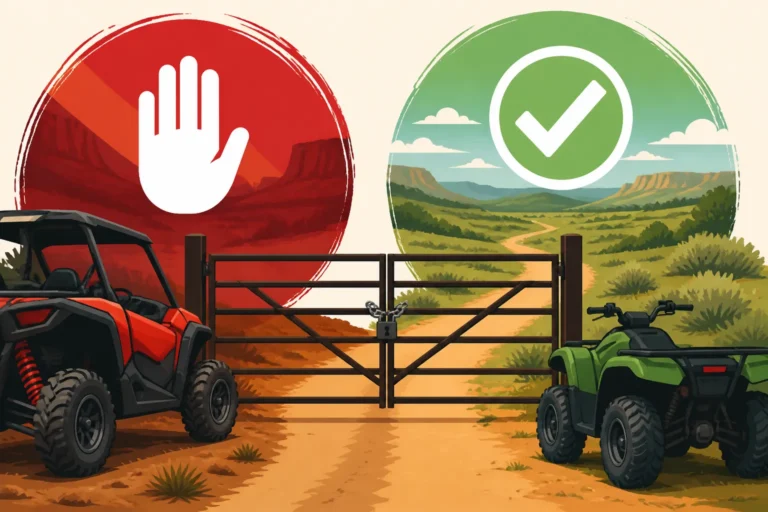
Use a map that helps distinguish open routes from closed or restricted areas. A line on a screen is not automatically permission to ride it. The guide [Utah OHV Trail Maps and How to Read Them] explains why it matters to understand route information, while [Reading a Motor Vehicle Use Map] offers a useful reminder to check the map’s designations instead of assuming every visible track is available for riding.
Check trail conditions and weather
Before you tow out, look for recent weather and any notices that may affect access. Rain can make some routes muddy or rutted, while wind can push dust across open ground. A route that seems manageable in dry conditions may be unpleasant or unsafe after weather changes.
Check for closures before each trip, particularly if your plans depend on a specific route or access road. Conditions and restrictions can change, so don’t rely solely on an old saved map or a route someone rode months ago. [Trail Closures Utah Riders Should Check First] and [Checking Utah Trail Conditions Before You Tow] are useful starting points for building this check into your routine.
If the forecast suggests a storm, strong wind, or other uncomfortable conditions, consider shortening the ride or choosing another day. A weekday evening is already time-limited; there is little benefit in forcing a ride when visibility or footing is poor. Keep the plan flexible enough to turn around early without feeling that the trip has failed.
Make the sunset cutoff part of the plan
Set your return time based on the route, not on how much daylight remains when you begin to feel tired. The last part of an evening ride can be harder than expected: shadows deepen, dips and rocks become less obvious, and dust can linger in the air. A return route that felt straightforward in full light may be more demanding at dusk.
Before leaving the staging area, check that your lights work and that everyone knows how to use them. Lighting does not make every route suitable after dark, and riders should not treat it as a reason to extend the outing beyond their comfort or ability. If you are uncertain about the return, turn around sooner.
| Planning question | A safer weekday-evening approach |
|---|---|
| How far should we ride? | Choose a short route that leaves time to return, regroup, and load before dark. |
| When should we turn around? | Set a specific cutoff before unloading and stick to it. |
| What if the route looks closed or unclear? | Don’t guess; check current route information and obey posted signs. |
| What if conditions worsen? | Shorten the ride or head back rather than trying to complete the original plan. |
| What if the group gets separated? | Agree on a regrouping point and communication plan before starting. |
Prepare your machine and group
A short ride still deserves a basic preparation routine. The biggest frustrations often come from small oversights: a phone with no offline map, a machine that wasn’t checked before towing, or a group that never agreed on what to do if someone falls behind.
Do a quick pre-ride check
Before you leave home, check the machine’s tires, controls, fuel, and general condition. Make sure the load is secure and that the trailer is ready for the trip. At the riding area, take a moment to confirm that each machine is operating properly before setting off. A quick inspection is easier at the staging area than on an isolated route near sunset.
Bring water even if you expect to be out for only a short time. Desert air, dust, and exertion can catch people off guard, and a minor delay can turn a brief ride into a longer one. A basic tool kit, a first-aid kit, and a way to contact someone can also be valuable. For a fuller packing checklist, see [What to Carry on a Utah Day Ride].
Make sure the group’s paperwork and required equipment are in order before riding. Requirements can depend on the machine, how it is registered, where it is being operated, and who is riding. If you are bringing younger riders or visitors, review the relevant rules in advance rather than trying to sort them out after you arrive. [Utah OHV Rules for Visiting Families] is a helpful place to start for family outings.
Agree on simple group rules
Before starting, decide who will lead and who will ride at the back. Keep the group together at a pace that works for everyone, and stop at safe places where riders can regroup without blocking a route. If someone needs to stop, make sure the rest of the group knows and waits in a visible, safe location.
Talk through what happens if machines become separated. Choose a clear regrouping point, make sure everyone can navigate back to it, and agree not to leave the area alone if someone is missing. A quick discussion at the start is much less stressful than trying to solve the problem after dark.
If riders have different experience levels, let the least experienced person set the pace. Avoid pressuring someone to follow a faster rider through terrain they don’t feel comfortable with. It is completely reasonable to turn around, skip a section, or take a simpler route. A good evening ride is one where everyone gets back feeling confident, not one where the group manages to cover the most ground.
Ride responsibly and finish the outing smoothly
Five Mile Pass may feel spacious, but good riding habits still matter. Stay on routes that are open to your machine, respect signs and closures, and assume that other people may be nearby even when you cannot see them. Responsible choices protect both your group and future access to the riding area.
Stay on open routes and ride with visibility in mind
Avoid creating new tracks across unmarked ground or using a closed route because it seems like a convenient shortcut. Route markings and access rules matter even when the terrain looks open. If you are unsure whether a route is available, stop and check rather than continuing on a guess.
When approaching a rise, blind turn, or dusty section, slow down enough to react to another rider or an unexpected change in the ground. Give other machines room, and don’t follow so closely that you can’t see clearly through their dust. If visibility drops, wait in a safe spot until you can see the route again.
Using onX Offroad or another mapping tool as a reference can help you keep track of your position, but compare the map with signs and conditions on the ground. Save the relevant map area before the ride and make sure you know how to read it without cellular service. Navigation tools are most useful when they support good judgment rather than replace it.
Leave the area ready for your next visit
Before loading, make sure everyone is accounted for and check that you have all your gear. Secure the machines and trailer carefully, especially if you are packing up in low light. A headlamp or other hands-free light can make it easier to check straps, retrieve small items, and avoid leaving equipment behind.
Take all rubbish with you, and avoid leaving food scraps or other debris at the staging area. Treat other riders courteously, keep noise under control, and be patient if people are loading or unloading nearby. A quick evening ride can be a welcome break from the week, but it is still a shared public-land experience.
If you want to make this a regular after-work outing, keep a simple trip routine: check conditions, confirm your route, tell someone where you are going, set a turnaround time, and inspect the machine before you head out. That routine makes it easier to enjoy a spontaneous ride without relying on luck or rushing through the details.
Disclaimer
This article is for general informational purposes only and does not constitute professional advice. Laws, prices and regulations vary by location and change over time. Consult a qualified professional for guidance on your specific situation.