Altitude Sickness on High Utah Trails
A ride that starts in Moab’s warm desert air can climb into thin, cold mountain air faster than your body can adjust. Headache, nausea, unusual fatigue, or dizziness may be easy to mistake for dehydration or a rough trail day. This guide explains how to recognize altitude sickness on Utah ATV and UTV routes, reduce your risk, and decide when to stop or descend.
Why altitude sickness can affect Utah trail riders
High-elevation routes can catch you off guard
Many Utah rides begin at a comfortable elevation and climb into mountain terrain where the air contains less available oxygen with each breath. Routes in the La Sal Mountains above Moab, the Fishlake area, and parts of the Paiute Trail can reach elevations where some visitors begin to feel the effects. The change can be especially surprising if you have spent the previous day in a lower desert town.
Altitude sickness, often called acute mountain sickness, is a reaction to gaining elevation faster than your body can adjust. It is not the same thing as being out of shape, and fitness does not guarantee protection. A strong rider who has traveled from sea level may feel unwell, while someone less athletic who has been at elevation for several days may feel fine.
The risk depends on more than a single elevation number. How quickly you climb, how high you sleep, how long you stay, and how your body responds all matter. Symptoms can occur at elevations lower than people expect, particularly after a rapid ascent. For route-specific elevation context, see [Elevation on the Paiute Trail and What It Does] and [La Sal Loops Above Moab, Utah].
Heat, exertion, and altitude can feel similar
Utah’s riding conditions can make early altitude symptoms difficult to spot. A headache or nausea might come from heat, missed meals, dehydration, motion sickness, or a combination of factors. Fatigue may also seem normal after a long day of bouncing over rocks or sand. The important clue is a new symptom that appears after gaining elevation, particularly when it worsens with continued climbing or activity.
A rider may feel completely normal at the trailhead, then develop a headache and lose their appetite after hours of climbing. A passenger might become unusually quiet, dizzy, or nauseated. Because UTV cabins can be noisy and dusty, riders may not notice these changes until they stop. Make a habit of checking in with everyone at breaks rather than assuming silence means everyone is doing well.
Water is important for safe riding, but drinking extra water does not prevent altitude sickness by itself. Overdrinking can also be dangerous. Pack enough water for the route and conditions, eat regular meals or snacks, and take breaks, but treat symptoms as symptoms—not as proof that someone simply needs another bottle. [Water to Pack for a Summer Utah Ride] can help with planning water needs for a hot-weather outing.
Recognize symptoms and know when to act
Early symptoms are a reason to pause
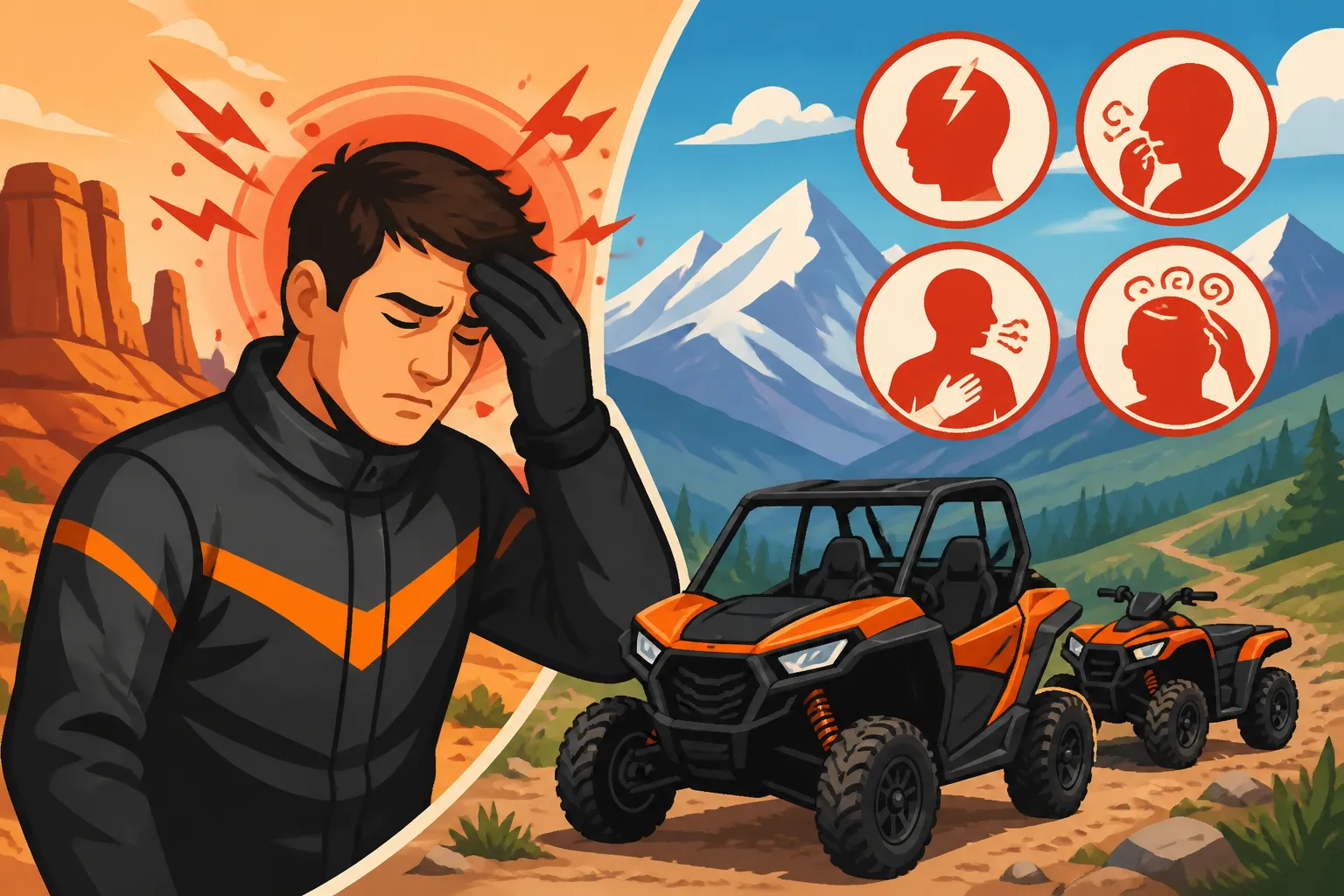
Mild altitude sickness often includes a headache, nausea, reduced appetite, dizziness, unusual tiredness, or trouble sleeping. Some people also feel light-headed or have difficulty keeping up with their usual pace. A single symptom does not prove altitude sickness, but symptoms that begin after a rapid climb deserve attention.
If someone develops symptoms, stop the ascent and take a calm break somewhere safe. Reduce exertion, keep the person warm and comfortable, and check whether the symptoms improve. Do not send the rider ahead alone, and do not pressure them to “push through” because the group is close to a destination. If symptoms persist, worsen, or return when activity resumes, descend to a lower elevation rather than continuing higher.
A practical way to think about symptoms is to compare how the person feels with their normal self. Are they unusually confused about a simple plan? Are they stumbling when they usually walk steadily? Are they getting more breathless than expected while resting? Those changes matter more than a rider’s insistence that they are fine.
| What you notice | What to do |
|---|---|
| Mild headache, nausea, dizziness, or unusual fatigue after climbing | Stop going higher, rest, and monitor the person |
| Symptoms that persist, worsen, or return with activity | Descend to a lower elevation and reassess |
| Confusion, poor coordination, difficulty walking, severe breathlessness at rest, or a worsening cough | Treat it as an emergency, begin descent if safe, and seek urgent help |
| A person becomes unresponsive or cannot be moved safely | Call emergency services and use available communication or rescue resources |
Severe symptoms require urgent help
Severe altitude illness can affect the brain or lungs and can become life-threatening. Warning signs include confusion, unusual behavior, loss of coordination, difficulty walking in a straight line, extreme drowsiness, or difficulty breathing while resting. A worsening cough, chest tightness, or a person who appears seriously unwell should also be treated as an emergency.
Do not wait for every warning sign to appear. If a rider has severe symptoms, get emergency help and move toward lower elevation if it is safe to do so. Do not leave the affected person alone to search for help. If the group has cell service, call 911 and give a clear location. In remote areas, a satellite messenger or other emergency communication device may be essential; [Cell Service Along the Paiute Trail] and [Satellite Messengers for Remote Utah Rides] are useful planning topics.
Symptoms can overlap with heat illness, injury, or another medical problem. If you are unsure, err on the side of stopping the ride and seeking help. A trail plan is never more important than a person’s ability to breathe, think clearly, and move safely.
Reduce risk before and during the ride
Give your body time to adjust
The most reliable prevention is to avoid gaining elevation too quickly, especially if you are arriving from a low-elevation home or traveling straight from a long drive. If your schedule allows, spend time at a moderate elevation before attempting a high route. Keep the first day’s ride easier, and avoid planning your most demanding high-elevation route immediately after arriving.
Sleeping altitude matters, too. You may tolerate a short ride at elevation better than spending the night high up before your body has adjusted. When planning several days of riding, build in a gradual start rather than stacking the highest and longest routes back-to-back. [Best Month to Ride the Paiute Trail] offers seasonal context, but weather and route conditions can change; elevation planning is a separate part of deciding whether a ride is suitable for your group.
Avoid alcohol and sedatives when you are adjusting to altitude, since they can complicate sleep and make it harder to judge how you feel. If you have a medical condition or a history of altitude-related problems, talk with a qualified health professional before a high-elevation trip. Medication decisions should be made with a clinician who knows your health history, not based on a riding-group tip.
Plan the route around the least-adjusted rider
Before setting out, identify high points, likely turnaround options, and routes back to lower ground. Let everyone in the group know that speaking up about a headache or nausea is expected, not embarrassing. A simple check-in at trail junctions can catch problems before someone becomes too tired or disoriented to communicate clearly.
For navigation, download maps before leaving reliable service. A tool such as onX Offroad can help you review route options and keep offline mapping available, but it should not replace a paper backup, a charged phone, or a communication plan. Confirm that the route you choose has practical exit options; an attractive loop may be a poor choice if turning around would be difficult for a symptomatic rider.
Pack for both the lower trailhead and the high point. Mountain weather can be much colder than the desert start, and wind or rain can make a tired rider feel worse. Carry warm layers, food, water, a first-aid kit, and a reliable way to contact help. [What to Carry on a Utah Day Ride] is a useful checklist to review before loading the machines.
Make a safer call on the trail
Use a simple stop-and-reassess routine
If a rider develops possible altitude symptoms, pause the group and make a deliberate decision rather than debating while continuing uphill. First, move out of the travel path and make sure the machine is parked safely. Ask what the person is feeling, when it started, and whether it is getting worse. Check for confusion, unusual coordination problems, or breathlessness while resting.
If symptoms are mild, do not climb higher. Rest and monitor the person, then decide whether a gradual descent is the safest next step. Keep the group together and assign someone to stay with the affected rider. A person who feels unwell should not be expected to drive a technical descent alone, especially if dizziness or poor coordination is present.
If symptoms worsen or any severe warning sign appears, treat the situation as urgent. Contact emergency services or use your emergency communication device, and follow their directions. Do not try to solve a serious problem by pushing the person to finish the loop, giving them someone else’s prescription medication, or splitting the group without a clear plan.
Let conditions and people—not the itinerary—set the pace
A route can be open and still be a poor choice for a particular group on a particular day. Consider recent travel, sleep, weather, elevation gain, the experience of the least-experienced rider, and how far the group is from help. A flexible plan might mean choosing a lower route near Moab instead of climbing into the La Sals, or shortening a high section of the Paiute Trail if someone develops symptoms.
Tools such as onX Offroad can help you compare route options and keep track of where you are, especially when cell reception is unreliable. Save maps before departure, share the planned route with someone who is not riding, and agree on a turnaround point before the group starts. Navigation can support a good decision, but it cannot tell you whether a rider’s symptoms are safe to ignore.
After a high-elevation ride, pay attention to how everyone feels rather than assuming symptoms will disappear as soon as the machines are loaded. If someone remains unwell, becomes worse, or develops severe symptoms, seek medical help. A shorter ride or an early descent may be disappointing in the moment, but it is far better than turning a fun Utah trip into a preventable emergency.
Disclaimer
This article is for general informational purposes only and does not constitute professional advice. Laws, prices and regulations vary by location and change over time. Consult a qualified professional for guidance on your specific situation.