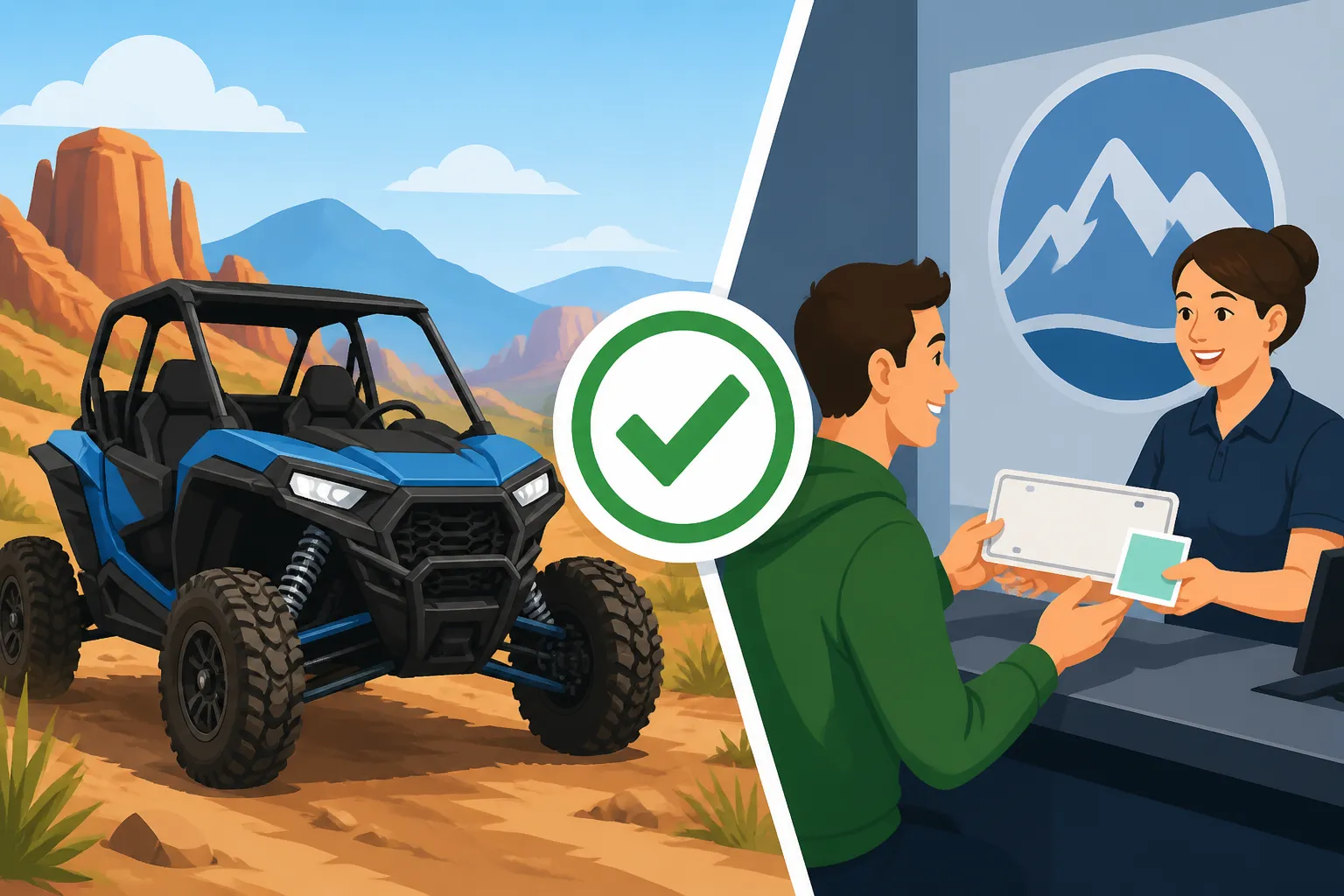
Getting a Plate and Sticker in One Visit
It can feel like you need a secret decoder ring and a dozen trips to the DMV just to get your off-highway vehicle (OHV) legal for both the trails and the pavement here in Utah. Many riders get frustrated, thinking they'll have to go through two completely separate processes, involving endless forms and appointments. This guide is here to untangle that knot, showing you how to streamline the process and, yes, often get both your off-highway vehicle registration sticker and your street-legal license plate in one efficient visit.
The Initial Hurdles: Why It Feels Like Two Processes
The Utah system, with its incredible opportunities for riding both off-road and on designated city streets, sometimes feels like it has a built-in complexity. You’re not alone if you've scratched your head trying to figure out if you need to register your machine twice, or if there’s a magical sequence of events that prevents multiple trips to the dreaded DMV. It's easy to assume the worst, especially when you're just eager to get out and ride.
Understanding Utah's Dual System for OHVs
First, let's clear up some common misconceptions. Utah does indeed have what you could consider a dual legal status for off-highway vehicles, but it's more about layers of legality rather than completely separate machines. You have the standard OHV registration, which is essential for hitting the vast network of trails we have throughout the state. This registration gets you that little decal that says "Utah OHV" on it, signifying you've paid your dues for trail access and maintenance.
Then, there's the street-legal conversion. This is where you modify your ATV or UTV to meet specific state requirements, allowing you to legally drive it on public roads with a standard license plate. Think of it as upgrading your machine's capabilities to expand its operating territory. The confusion often stems from the fact that both require documentation and fees, and it's not always clear how they interact. Many riders mistakenly believe these are completely separate administrative tracks, like trying to register a car and a boat at the same time, when in reality, it's more like adding a special permit to an already registered vehicle.
The paperwork for each can feel distinct, creating the impression that you’re dealing with two entirely separate entities. You've got your certificate of origin or title for the OHV side, and then you've got an inspection form and proof of insurance for the street-legal part. It's enough to make anyone feel like they're trying to put together a puzzle with two different instruction manuals. But take a deep breath; the good news is that with a bit of planning, these paths converge nicely at the DMV counter.
The Inspection Factor: What Comes First?
Before you even think about showing up at the Utah DMV for your street-legal plate, there’s a crucial step that needs to happen: the street-legal inspection. This isn't something the DMV itself does; it's performed by a certified inspection station, typically a mechanic's shop or a dealership. This inspection ensures your OHV has all the required safety equipment to be deemed roadworthy, things like working headlights, tail lights, turn signals, mirrors, and a horn. Many riders look to aftermarket suppliers like SuperATV for compliant parts that help them pass this critical step.
This inspection is non-negotiable for getting a street-legal plate. It's the gatekeeper, ensuring your machine meets the safety standards for sharing the road with regular traffic. Once your OHV passes, the inspection station will provide you with a Motor Vehicle Inspection Certificate. This piece of paper is absolutely vital. Without it, the DMV cannot issue you a street-legal license plate. So, while it's a step before the DMV, it's intrinsically linked to the street-legal registration process. Think of it as the prerequisite course you have to pass before you can enroll in the advanced class. You can learn more about what this entails by checking out [Utah's Street-Legal ATV Inspection, Step by Step].
It's common for riders to forget this step, or to assume it happens at the DMV, leading to wasted trips and frustration. The inspection verifies that your machine has the proper equipment to operate safely on public roads, such as a speedometer, proper braking, and a windshield or eye protection. Getting this done efficiently and correctly, often with quality parts, sets you up for success at the DMV. This certificate, once issued, becomes one of the most important documents in your packet when you finally walk up to that counter.
Consolidating Your Trip: The Dream of One-Stop Shopping
The good news, the shining light at the end of the bureaucratic tunnel, is that achieving one-stop shopping at the DMV for both your OHV decal and your street-legal license plate is often entirely possible. It's not a myth, nor does it require a special appointment. The key, as with most things involving government agencies, is impeccable preparation and understanding the sequence.
The Ideal Scenario: One DMV Visit for Both
Yes, you heard that right! You can absolutely walk into a Utah DMV office and, with all your ducks in a row, leave with both the necessary off-highway registration documentation and the application for your street-legal license plate completed. The trick is to present everything in a coherent manner, allowing the DMV clerk to process both aspects of your machine's legality. This is the core answer to that nagging question: "Can I really do this all at once?" The answer is a resounding "yes," provided you arrive fully equipped.
The Utah Department of Motor Vehicles offices are set up to handle multiple transactions for a single vehicle, especially when those transactions are related, such as an initial registration and then a street-legal application. What this means for you, the rider, is that you can avoid making two separate appointments or waiting in line twice. Imagine getting all the required stamps and papers in one go, freeing you up to plan your next ride rather than dreading another DMV visit. The efficiency gained by preparing everything upfront is invaluable, saving you time, gas, and a good deal of stress.
However, this ideal scenario hinges on one critical factor: preparation. You cannot simply show up with a partial understanding of what's needed. Every single piece of documentation, every form, and every fee must be ready to go. The DMV staff can only process what you provide, and any missing component will break the chain, potentially forcing you to come back another day. So, while the system allows for this seamless experience, the responsibility falls squarely on the rider to gather everything beforehand. This isn't just about saving time; it's about minimizing frustration and ensuring you get legal without unnecessary hurdles.
Essential Documents to Gather Before You Go
To make that single DMV visit a success, you need a comprehensive arsenal of documents. Think of it as your "full kit" for legalizing your ride. Missing even one item can derail your entire plan for a one-stop visit. This is where meticulous organization pays off huge dividends. Before you even get in your car to drive to the DMV, double-check and triple-check this list. For a more general overview, you might want to look at [Documents to Bring to the Utah DMV for an ATV] or [A First-Time Buyer's OHV Paperwork Checklist in Utah].
Here's a breakdown of what you'll need:
| Document Category | Specific Items Required | Purpose |
|---|---|---|
| Proof of Ownership | Original Certificate of Title or Manufacturer's Statement of Origin (MSO) | Establishes you as the legal owner for registration. |
| Bill of Sale (if recently purchased, especially privately) | Details the transaction and purchase price. | |
| Proof of Identity | Valid Driver's License or State ID Card | Verifies your identity as the applicant. |
| Street-Legal Proof | Motor Vehicle Inspection Certificate (MVIC) | Confirms your OHV passed the required safety inspection. |
| Proof of Current Insurance (for road use) | Mandatory liability insurance for street-legal vehicles in Utah. | |
| Payment for Fees | Payment Method (card, cash, check – check DMV for accepted types) | Covers OHV registration fees, uniform fees, and license plate fees. |
| Other (Situational) | Lien Release (if vehicle had a loan) | Shows clear title if a previous loan existed. |
| Odometer Disclosure Statement | May be required for newer machines or specific transfers. |
It's crucial to have the original title or MSO. Copies are generally not accepted for initial registration or title transfer. If you bought your machine from a dealer, they might handle some of this paperwork, but if it was a private sale, the burden is entirely on you. Ensure your bill of sale is complete and accurate, including the purchase price for tax calculations. Without the official Motor Vehicle Inspection Certificate, which confirms your machine meets all the street-legal equipment requirements (like having functional turn signals and mirrors, perhaps aftermarket ones from SuperATV), you simply won't get that road plate.
Furthermore, ensure your proof of insurance is current and clearly shows your OHV listed with the required liability coverage for road use. A printed insurance card or a digital copy on your phone should suffice, but it must be active. Finally, be prepared to pay the various fees, which can include the OHV registration fee, the uniform fee based on the machine's value, and the specific license plate fee. Having all these physical documents in hand, organized and ready to present, is the single biggest factor in successfully getting both your plate and sticker in one visit.
The DMV Visit Itself: Navigating the Paperwork Maze
You’ve got your meticulously organized stack of papers, you’ve double-checked every line, and you’re feeling confident. Now, it's time for the actual DMV visit. Even with everything prepared, navigating the counter process can sometimes feel like a test of patience. Knowing what to expect and how the transactions typically unfold can help you stay calm and ensure a smooth experience.
The Order of Operations at the Counter
When you approach the DMV counter with your goal of getting both your OHV decal and your street-legal plate, it's generally best to lead with the foundational paperwork: the OHV registration. Think of it as establishing the vehicle's identity in the Utah system first. You'll present your proof of ownership (title or MSO), your identity, and any bill of sale if applicable. The clerk will process the initial registration, which includes calculating and collecting the standard OHV registration fee and the uniform fee. This step is what gets your machine into the state's OHV database and allows for the issuance of your off-highway decal.
Once the OHV registration is in progress or completed, you can then smoothly transition to the street-legal portion of your visit. This is where you'll present that all-important Motor Vehicle Inspection Certificate, along with your proof of insurance. At this point, the clerk will already have your machine's basic information in their system from the OHV registration. They can then add the "street-legal" designation, process the application for a license plate, and collect any additional fees associated with the plate itself. It really is a sequential process, usually handled by the same clerk in one sitting.
It’s important to communicate clearly to the clerk that you intend to do both. Saying something like, "I'm here to register my UTV for off-highway use, and I also want to get the street-legal license plate today," sets the expectation. They are accustomed to these multi-faceted transactions. While the computer system integrates these statuses, the human element at the counter will guide you through the two distinct sets of requirements. Many components, such as a sturdy bumper or compliant lights from a company like SuperATV, are often essential for meeting the inspection requirements that lead to this part of the process.
Common Pitfalls and How to Avoid Delays
Even with a well-prepared stack of documents, minor oversights can turn your one-stop dream into a two-trip nightmare. Being aware of the most common pitfalls can help you sidestep them entirely and ensure your DMV visit is as quick and painless as possible. The goal is to avoid any reason for the clerk to say, "I'm sorry, but…"
One of the most frequent issues is an incomplete or incorrect Motor Vehicle Inspection Certificate. Double-check that all sections are filled out by the inspection station, that it's signed, and that the VIN matches your machine exactly. Any discrepancies here will halt the street-legal process immediately. Similarly, a missing original title or Manufacturer's Statement of Origin (MSO) is a showstopper for initial registration. Make sure you have the physical, unblemished original document. If it's a new machine, the MSO is critical, as detailed in [Utah ATV Title Requirements Explained].
Another common delay arises from incorrectly filled out bills of sale, especially for private party purchases. Ensure the bill of sale includes the full names and addresses of both buyer and seller, the date of sale, the purchase price, and a clear description of the vehicle, including the VIN. If you're unsure, you might want to review [Utah Bill of Sale: What It Must Say]. If a lien existed on the machine, make sure you have the official lien release from the bank or financial institution. Without it, the DMV cannot transfer a clear title to you.
Finally, inadequate proof of insurance for street-legal status can cause a snag. While your OHV might not require insurance for trail riding in all circumstances, it absolutely does for road use. Ensure your policy is active, shows your OHV, and meets Utah's minimum liability requirements. Having the policy details ready, either digitally or on a physical card, is key. And, of course, having sufficient funds to cover all fees is crucial. While it might seem obvious, miscalculating the total costs, including the various fees mentioned in [Utah OHV Registration Fees, Start to Finish], can lead to an unexpected delay if your payment method isn't sufficient.
After Your Successful Visit: What to Expect Next
Congratulations! You’ve navigated the DMV, presented your paperwork, and the clerk has processed everything. You should leave with a sense of accomplishment, knowing your machine is on its way to being fully street-legal and trail-ready. But what happens immediately after, and what should you keep an eye out for in the coming days and weeks?
Receiving Your Plate and Decal
Immediately after your successful DMV visit, you’ll typically receive some form of temporary documentation. For the OHV registration, if your machine is already in the system, the clerk might be able to hand you the physical OHV decal on the spot. If it's a brand-new registration, or if they need to order one, it will be mailed to you, along with your official registration card. This decal is essential for displaying on your machine when you're on the trails, as described in [Utah OHV Decals and Where They Go].
For your street-legal license plate, it's common for the DMV to issue you a temporary paper plate to display on your OHV until your permanent metal plate arrives in the mail. The actual metal license plate is almost always mailed to the address on your registration, usually within a few weeks. It's important to properly mount this plate once it arrives, ensuring it's clearly visible and illuminated by a [License Plate Lights and Mounting in Utah]. During this waiting period, your temporary plate serves as legal proof of your street-legal status.
It’s a good practice to carry both your temporary street-legal registration and your OHV registration card with you when riding, especially until your permanent plate and decal arrive. This ensures that whether you're on a public road or a designated trail, you have proof that your machine is legally compliant. The waiting period for the physical plate and decal can vary, but generally, it's a few weeks. If you haven't received them within that timeframe, you can always contact the Utah DMV to check on the status.
Keeping Everything Current and Legal
Getting your OHV registered and street-legal is just the first step; maintaining that legal status requires ongoing attention. The good news is that once you've gone through the initial process of getting both your OHV registration and your street-legal plate, future renewals are typically much simpler and can often be done together, reinforcing that "one-stop" convenience.
Both your OHV registration and your street-legal license plate will have expiration dates. In Utah, these generally align, meaning you'll usually renew them at the same time. The DMV will send you a renewal notice in the mail well in advance of the expiration date. This notice will detail the fees for both the OHV registration and the street-legal plate. You can typically renew online, by mail, or in person, making it quite convenient. For more details on this, you can look up [Renewing Your Utah OHV Registration].
Beyond renewals, it's important to ensure your street-legal machine continues to meet all the equipment requirements. Over time, parts can wear out, or you might make modifications. Regularly check your lights, horn, mirrors, and other safety equipment to ensure they are still fully functional and compliant with Utah law. Components from aftermarket providers like SuperATV, if installed, also need to be maintained to ensure they continue to meet the necessary standards. Keeping your insurance current is also non-negotiable for street-legal operation. Allowing your registration or insurance to lapse can lead to fines and legal issues, so staying proactive is key to enjoying your adventures without worry.
Disclaimer
This article is for general informational purposes only and does not constitute professional advice. Laws, prices and regulations vary by location and change over time. Consult a qualified professional for guidance on your specific situation.