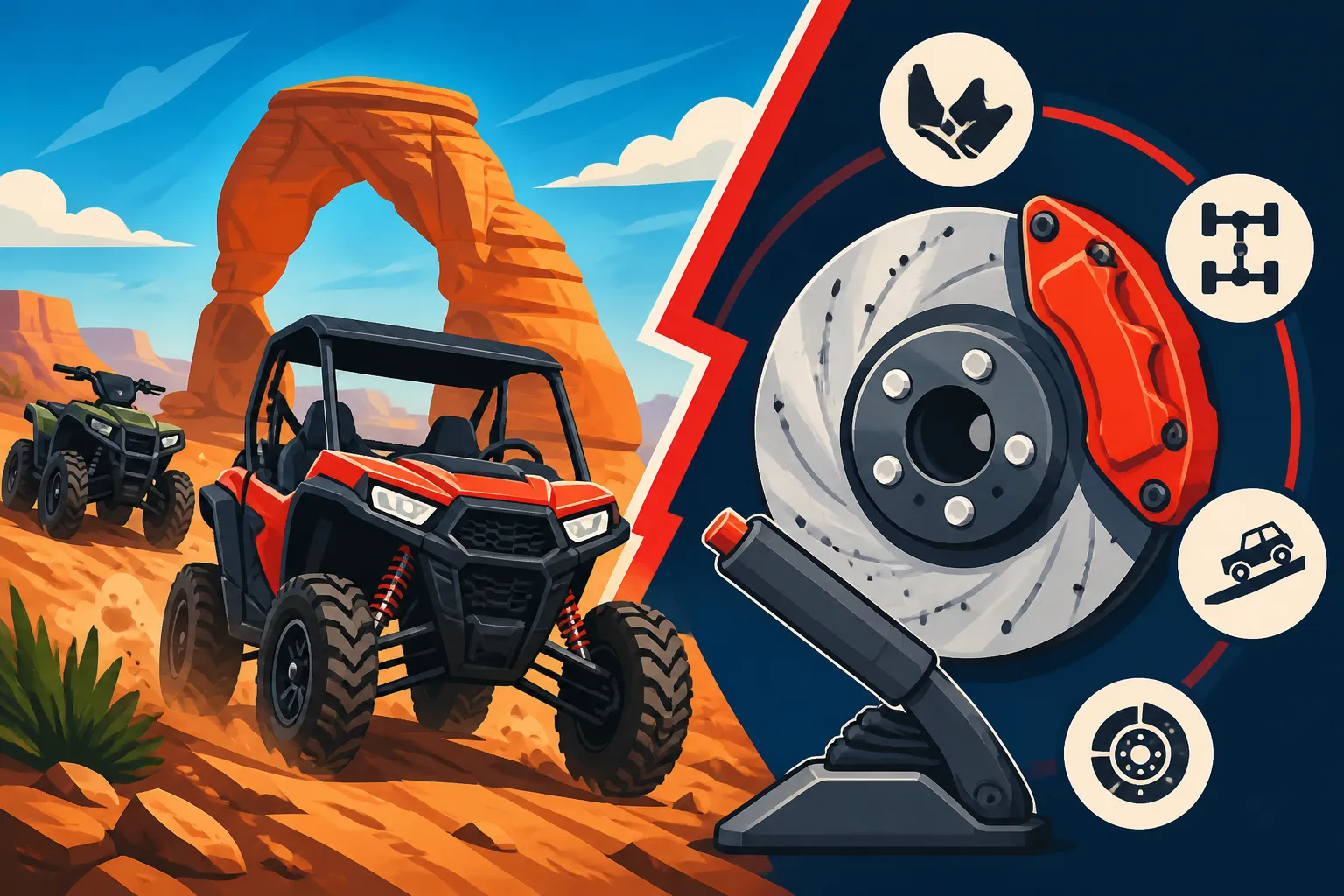
Utah Brake Rules Beyond the Parking Brake
One of the biggest headaches for any side-by-side or ATV owner looking to take their machine onto Utah's public roads is navigating the often-confusing world of street-legal requirements. It's not just about adding blinkers and a horn; the brakes, those critical components that keep you from becoming intimately familiar with the back bumper of a minivan, have specific rules. This guide is here to cut through the noise, helping you understand Utah's brake requirements for street-legal OHVs, going far beyond just making sure your parking brake works, so you can ride confidently and legally.
Understanding Utah's Basic Brake Requirements for Street-Legal OHVs
When you're tearing through the red rock trails of Moab or cruising the dusty routes of the Paiute Trail, your braking needs are a bit different than when you're navigating Main Street in Hurricane. This fundamental shift in environment is precisely why Utah has specific rules for street-legal OHV brakes. It's not just about slowing down; it's about predictable, reliable stopping power when it truly counts.
The Fundamental Difference: Off-Road vs. On-Road Braking
Think about it this way: off-road, you're often feathering the brakes, using engine braking, and relying on the terrain to help scrub speed. You might slide a bit, lock up a wheel to pivot, or even roll gently to a stop. The pace is often slower, and the risks, while present, involve hitting a tree or a rock, not rear-ending a family sedan at 45 mph. Your focus is on control, traction, and modulating your speed through unpredictable surfaces like sand, mud, or slick rock. The braking technique is dynamic, adapting to every dip and climb.
On the other hand, when you're on paved roads, especially with other vehicles around, your brakes need to be absolute workhorses. They need to bring your machine to a complete, controlled stop, quickly and in a straight line, regardless of whether you're at 25 mph in a small town or cruising at 50 mph on a designated OHV route. The expectation is that your brakes will perform consistently, allowing for predictable stopping distances and minimal drama. You can't rely on sliding or engine braking as your primary means of stopping when a deer jumps out in front of you on a paved county road. The margin for error is significantly smaller, and the consequences of brake failure are much, much higher. This distinction is critical to understanding why the state cares so much about your stopping power once you hit the asphalt.
What Utah Law Actually Says About Brakes
Utah's regulations for street-legal vehicles, which now encompass OHVs, don't necessarily reinvent the wheel (or the brake caliper) for our machines. Instead, they apply general motor vehicle standards to them. What this means in practice is that your OHV must have a reliable, functional braking system that can stop the vehicle effectively under varying conditions. Generally speaking, the law mandates that every vehicle must be equipped with service brakes, which are your primary foot-operated brakes, and a parking brake, which acts independently.
The service brakes are required to operate on all wheels. Now, before you panic and start counting axles on your three-wheeler, remember this typically applies to all wheels that are designed to have brakes. Most modern ATVs and UTVs already come from the factory with hydraulic disc brakes on all four wheels, so this isn't usually an upgrade you have to worry about. The crucial part is that these brakes must be capable of stopping the vehicle safely and within a reasonable distance. They must also be maintained in good working order, free of excessive wear or defects. This isn't just a suggestion; it's a legal requirement that directly impacts your safety and the safety of everyone else on the road.
The Parking Brake: A Non-Negotiable Component
While you might rarely use your parking brake when you're parked on a flat section of the desert trail, it transforms into an absolutely critical component once your OHV becomes street legal. Utah law, like most states, requires a parking brake that is completely independent of the service brake system. This independence is a crucial safety feature, ensuring that even if your primary hydraulic brakes fail (say, a ruptured line or a master cylinder issue), you still have a way to bring your vehicle to a controlled stop, albeit an emergency one, and certainly to keep it from rolling away when parked.
The parking brake isn't just for emergency stopping; its primary day-to-day function on the road is to hold your vehicle stationary on any grade. Imagine pulling over on a steep incline along a scenic byway in the Manti-La Sal National Forest to take a photo. Without a functioning parking brake, your machine could easily roll, causing a dangerous situation for you, your passengers, and anyone else on the road. The street-legal inspection will specifically test this capability, ensuring that once engaged, your parking brake can reliably prevent your OHV from moving. For many off-road machines, the parking brake is often an afterthought or barely used, but for street-legal use, it has to be robust and dependable. This is why you need to ensure your cables are adjusted, the mechanism isn't seized, and it can hold its own when you need it most.
Essential Brake System Components for Utah Street-Legal Compliance
Beyond the general legal requirements, let's break down the actual components that make up your OHV's braking system and why each one is vital for street-legal operation in Utah. It's a complex dance of hydraulics, friction, and mechanics, all working in concert to keep you safe.
Service Brakes: The Primary Stopping Power
Your service brakes are the real heroes of your street-legal OHV. These are the brakes you operate with your foot pedal, and they're responsible for the vast majority of your stopping power. Most modern ATVs and UTVs utilize hydraulic disc brake systems, much like what you'd find in a car. This system consists of a master cylinder, which converts your foot pressure into hydraulic pressure, brake lines that transmit this pressure, and calipers that squeeze brake pads against rotating rotors on each wheel. Some older or utility-focused machines might still have drum brakes, where shoes press against the inside of a drum.
For street-legal compliance, these components must be in pristine condition. This means your brake pads need to have sufficient material – no metal-on-metal grinding! Your rotors shouldn't be excessively grooved, warped, or rusted, as these issues severely reduce braking efficiency and can cause dangerous pulsation or pulling. Brake lines must be free of leaks, cracks, or damage, as any compromise here means a loss of hydraulic pressure and, consequently, braking power. The brake fluid itself needs to be at the correct level and free of contamination. A spongy brake pedal is a huge red flag, indicating air in the lines or a master cylinder issue, and it will absolutely fail an inspection. These are not areas where you can cut corners; your life, and the lives of others, depend on these components functioning perfectly. [What Happens If You Never Register a Quad] is a good read, but ignoring brake issues is even riskier than riding unregistered.
Emergency/Parking Brake System Specifics
As we touched on, the parking brake needs to be truly independent. What does "independent" really mean in practical terms? It means it shouldn't rely on the same hydraulic lines or master cylinder as your service brakes. Most OHVs achieve this through a mechanical cable system. When you engage the parking brake lever or pedal, it pulls a cable that physically activates a braking mechanism, often at the rear wheels. This mechanism might be a small drum brake integrated into the rear caliper, or a separate caliper and rotor assembly specifically for the parking brake.
The key here is its ability to operate even if your main brake system fails. For inspection, the parking brake must engage positively and hold the vehicle securely. This includes being able to hold the machine on a significant incline. A common frustration for riders is a parking brake that barely holds, or one that requires excessive force to engage. This often points to stretched cables, worn shoes or pads in the parking brake mechanism, or a need for adjustment. Ensuring this system is robust and reliable is a critical part of your street-legal conversion. If you're encountering issues, many aftermarket suppliers, including SuperATV, offer replacement parking brake cables and components designed to restore this vital function.
Brake Lights: A Critical Visual Signal
While brake lights don't stop your vehicle, they are an integral part of the overall braking safety system when you're on public roads. Think of them as the crucial communication link between your OHV and other drivers. Utah law requires that your street-legal OHV have working brake lights that illuminate brightly whenever you apply your service brakes. These lights must be visible from a specified distance (typically hundreds of feet) and provide a clear signal to vehicles behind you that you are slowing down or stopping.
Often, off-road machines only come with basic tail lights. Converting to street legal almost always involves adding dedicated brake light functionality, which might mean replacing your tail light assembly with one that has brighter brake light LEDs or adding a separate set of lights. Crucially, these lights need to be activated by a pressure switch in your hydraulic brake system, or a mechanical switch on your brake pedal, ensuring they come on automatically whenever you hit the brakes. Without functioning brake lights, you're a significant hazard on the road, leaving other drivers guessing about your intentions. This is an immediate failure point for any street-legal inspection. [Utah Street-Legal ATV Equipment Requirements] covers other lighting you'll need.
What a Utah Street-Legal Inspection Checks on Your Brakes
So, you’ve put in the work, you’ve adjusted and potentially even upgraded your brake system. Now comes the moment of truth: the street-legal inspection. It’s not just a quick glance; the inspector is looking for specific things to ensure your OHV is truly safe for public roads. Understanding what they’re checking can save you a frustrating trip back to the shop.
The Visual Inspection: Pads, Rotors, and Lines
One of the first things an inspector will do is get down and dirty, visually examining your brake components. They're looking for clear signs of wear, damage, or neglect. They'll check your brake pads for thickness – if they’re worn down to the backing plate, you’re looking at an automatic failure. Rotors will be inspected for deep grooves, scoring, or warpage, which can indicate excessive wear or overheating. They’ll also check your calipers for any signs of leaks around the piston seals.
Your brake lines are another critical point. The inspector will trace them, looking for any frays, cracks, bulges, or indications of fluid leaks, especially at the fittings. They want to see secure lines, properly routed and clamped, not dangling or rubbing against moving parts. The master cylinder will be checked for leaks and proper fluid level. Even the condition of your parking brake cable will be scrutinized for excessive rust, fraying, or improper routing. It's a comprehensive check because these components are directly responsible for your ability to stop safely. Taking the time to do a thorough pre-inspection check yourself can save you time and money. Consider cleaning off accumulated trail dust and mud so the inspector can clearly see everything.
The Performance Test: Stopping Power and Balance
Beyond just looking at the parts, the inspector will often perform a functional test of your service brakes. This isn't usually a high-speed panic stop, but rather a check of pedal feel and stopping characteristics. They'll likely press the brake pedal, checking for excessive travel before engagement (a "low" pedal) or a "spongy" feel, which indicates air in the lines or a master cylinder issue. They'll also ensure that the brakes engage smoothly and consistently.
During a slow drive, the inspector will look for the vehicle to stop in a straight line without pulling sharply to one side. A pull suggests an imbalance in braking force between sides, perhaps due to a seized caliper, unevenly worn pads, or a hydraulic problem. This pulling can be incredibly dangerous on the road, potentially causing you to swerve into another lane or off the road entirely in an emergency stop. They're looking for a firm, responsive pedal that inspires confidence. If your machine shudders, pulls, or takes an excessive distance to stop at a low speed, it won't pass. [Cost to Make a UTV Street Legal in Utah] includes the inspection fee, so make sure you're ready!
Parking Brake Functionality: Holding the Line
The parking brake gets its own special attention during the inspection. The inspector will typically engage the parking brake and attempt to move the vehicle, often by trying to drive forward gently, or even on a slight incline if the inspection station has one. The goal is to confirm that the parking brake can completely hold the vehicle stationary, preventing any movement.
They might also check the number of "clicks" on a lever-style parking brake or the firmness of a foot pedal, looking for a positive engagement without excessive slack. If the parking brake slips, allows the vehicle to creep, or requires extreme force to engage, it will result in a failed inspection. This is a common issue for many OHV owners, as the parking brake may not be heavily used in off-road environments and can often become neglected or maladjusted. Before your inspection, ensure your parking brake holds firm on a steep driveway or hill. Don't be shy about testing it; you want it to perform perfectly when the inspector asks.
Common Brake Issues That Will Fail a Street-Legal Inspection
Even with the best intentions, it's easy to overlook common brake problems that will send you right back to the garage after a street-legal inspection. Off-road riding is tough on components, and brakes are no exception. Knowing these pitfalls ahead of time can help you prepare and pass on your first try.
Worn-Out Components: Pads, Rotors, and Drums
This is probably the most frequent reason for failing a brake inspection. Our off-road machines are exposed to grit, mud, water, and extreme heat cycles. Brake pads, designed to wear down, often do so rapidly in these conditions. If your pads are too thin – usually below a certain specified minimum thickness – they'll be flagged. Running on thin pads not only dramatically reduces your stopping power but also risks damaging your rotors or drums, leading to far more expensive repairs.
Similarly, rotors and drums can become severely worn, grooved, or warped. Grooves happen when dirt and debris get trapped between the pad and rotor, essentially acting like sandpaper. Warpage can occur from excessive heat, leading to a pulsating brake pedal and inconsistent braking. An inspector will easily spot these issues. What might feel "good enough" on the trail, where speeds are lower and stops more gradual, simply isn't acceptable for the demands of public road use. Always prioritize replacing worn brake components before your inspection. Remember, these parts are friction-based, and friction means they will wear out.
Fluid Leaks and Spongy Pedals
Any leak in your hydraulic brake system is an immediate safety hazard and an automatic inspection failure. Even a tiny drip from a brake line fitting, a caliper seal, or the master cylinder reservoir means that brake fluid is escaping, reducing the pressure that’s critical for stopping. Such leaks can quickly escalate, leading to partial or complete brake failure – a terrifying prospect on a busy road.
A "spongy" or "mushy" brake pedal is another major red flag. This sensation usually indicates air trapped within the hydraulic lines. Air compresses, unlike brake fluid, so a spongy pedal means you're losing braking power to compressing air instead of squeezing calipers. It can also point to a failing master cylinder, where internal seals are no longer holding pressure effectively. These aren't minor inconveniences; they are serious defects that compromise your ability to stop your OHV reliably. Before your inspection, bleed your brakes thoroughly if you suspect air, and meticulously check all lines and components for any signs of leakage. If you need replacement lines or a master cylinder, you'll find options that fit your machine.
Malfunctioning Parking Brake or Brake Lights
We’ve already emphasized the importance of the parking brake, and a failure here is just as critical as problems with your service brakes. If your parking brake won't engage positively, or if it slips and fails to hold the machine stationary on a slight incline, it's a guaranteed failure. Common culprits include stretched cables, seized mechanisms (often from rust or dirt accumulation), or worn out shoes/pads within the parking brake itself. This isn't a part to be ignored.
Similarly, non-functional brake lights are a common and easily avoidable failure point. If your brake lights don't illuminate when you press the pedal, or if they are dim, inconsistent, or only one side works, you won't pass. This could be due to a faulty pressure switch, a bad bulb or LED, a broken wire, or corrosion in the electrical connectors. For street-legal conversions, ensuring the brake light switch is correctly integrated into your hydraulic system and that your lights are bright and visible is paramount. Companies like SuperATV offer wiring harnesses and complete brake light kits designed to integrate seamlessly into most OHVs, ensuring you meet these visual communication requirements. Don't forget, these simple fixes can prevent a re-inspection.
Maintaining Your OHV's Brakes for On-Road Safety and Compliance
Once your OHV is street legal, brake maintenance takes on a whole new level of importance. It's not just about keeping your machine running; it's about public safety and avoiding hefty fines. Regular care and knowing when to seek professional help are key to keeping your brakes reliable.
Regular Inspections and Preventative Maintenance
Think of your brake check as part of your pre-ride ritual, especially if you're mixing trail and road riding. The dirt, dust, and grime from off-road adventures can quickly degrade brake components. After every few serious rides, or at least every oil change interval, take the time to do a thorough visual inspection. This means checking your brake fluid level and condition in the reservoir. Look for any discoloration, which can indicate moisture contamination, or a low level, which could mean a leak or severely worn pads.
Then, visually inspect your pads, rotors, and calipers. Look for uneven wear on pads, deep grooves on rotors, or any signs of fluid weeping from the calipers or master cylinder. Give your brake lines a once-over for any cracks, chafing, or bulges, especially where they flex. Don't forget your parking brake cable – check for rust, fraying, or anything that might hinder its smooth operation. Keeping your brake components clean from mud and debris can also significantly extend their life and maintain performance. A simple blast with a hose and a quick wipe-down can make a big difference. This proactive approach ensures that minor issues don't escalate into major, expensive, and dangerous problems. [A First-Time Buyer's OHV Paperwork Checklist in Utah] might not list brake checks specifically, but it's part of the ownership experience.
Upgrading for Enhanced Performance
While your factory brakes might meet the minimum requirements for street-legal conversion, for some riders, especially those who frequently push their machines hard or carry heavy loads, upgrading components can be a wise investment. Aftermarket brake kits are designed to offer superior heat dissipation, better stopping power, and enhanced durability compared to stock parts. This can be particularly beneficial if you often find yourself making quick stops at higher speeds on paved roads, or if your machine is heavier due to accessories and passengers.
Consider options like braided stainless steel brake lines, which offer a firmer pedal feel by preventing expansion under pressure, or performance brake pads that are designed for better bite and fade resistance. Some riders even opt for larger rotors and multi-piston calipers for maximum stopping force. While these upgrades aren't explicitly required for street-legal status, they contribute significantly to your confidence and safety on the road. For example, if you're frequently hitting roads around Sand Hollow or the city streets of Moab, having that extra stopping power can be incredibly reassuring. SuperATV and other specialized brands offer a wide array of performance brake parts, from heavy-duty pads to complete caliper and rotor upgrades, that can make a noticeable difference in your OHV's on-road performance.
Professional Help vs. DIY Brake Work
Many routine brake maintenance tasks, such as inspecting pads, checking fluid levels, and even replacing pads, can be done by a mechanically inclined owner. There are plenty of online resources and service manuals to guide you through these processes. However, when it comes to more complex brake issues, especially for a street-legal machine, knowing when to call in a professional is crucial.
If you're dealing with a spongy pedal that won't firm up after bleeding, suspecting a master cylinder issue, or tracking down an elusive fluid leak, it might be best to leave it to a certified technician. Brake systems are critical safety components, and a mistake can have dire consequences. Professionals have the specialized tools, diagnostic equipment, and expertise to accurately identify and fix problems, ensuring your brakes are repaired to factory specifications or better. For street-legal conversions, where your machine will interact with public traffic, compromising on brake safety is simply not an option. Don't hesitate to seek expert help if you're unsure, or if a problem seems beyond your comfort level. Your peace of mind and safety are worth the investment. [What a Utah Officer Looks for on a Street-Legal ATV] includes proper brake function, so make sure yours are dialed in.
| Brake System Aspect | Off-Road Expectation | Street-Legal Expectation |
|---|---|---|
| Service Brakes | Good enough to slow/stop; some sliding/skidding acceptable | Reliable, firm pedal; quick, straight, controlled stops |
| Parking Brake | Holds on moderate incline; often optional for trail use | Holds vehicle stationary on any legal grade; independent |
| Brake Lights | Often not present or basic tail/brake combo | Bright, visible, activates instantly with service brakes |
| Wear & Tear | More tolerance for worn pads/rotors, minor leaks | Components must be within safe operating limits |
| Maintenance Focus | Functional for trail hazards | Functional for public road safety and traffic laws |
| Inspection Result | Rider's discretion (unless commercial use) | Strict state inspection, will fail for deficiencies |
Disclaimer
This article is for general informational purposes only and does not constitute professional advice. Laws, prices and regulations vary by location and change over time. Consult a qualified professional for guidance on your specific situation.