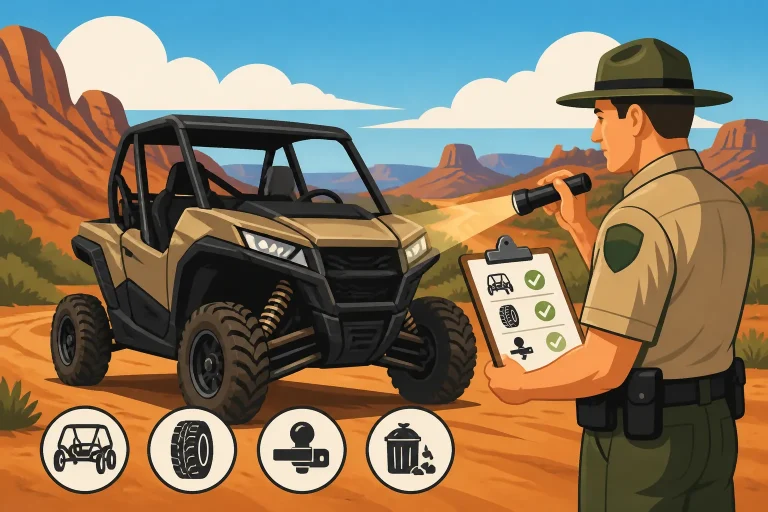
Wyoming and Montana for Utah Riders
Wyoming and Montana for Utah Riders
A Utah registration sticker does not automatically give an ATV or UTV permission to ride every trail across the state line. Wyoming and Montana have their own rules for out-of-state machines, public-land use and road access. The practical approach is to check each state’s current permit requirements before loading up, then verify the rules for the specific trail system or land manager.
What Utah Registration Does and Does Not Do
Utah registration is important proof that a machine is registered in Utah, but it is not a universal trail pass. When you travel to Wyoming or Montana, the destination state’s laws and the rules of the land manager still apply. A permit issued for use in Utah does not automatically cover an out-of-state trip.
This is a separate question from Utah’s own nonresident permit policy. Utah ended OHV reciprocity in 2020, so visitors to Utah may need to meet Utah’s permit requirements even if their machines are registered elsewhere. That change concerns riding in Utah; it does not set Wyoming or Montana’s rules for Utah residents. For background, see Utah Ended OHV Reciprocity: What Visitors Do Now and Utah’s Non-Resident OHV Permit Explained.
A useful starting assumption is that you need to check three things for each destination:
- Vehicle registration or permit: Does the state require an out-of-state OHV to display a state-specific permit or registration?
- Land access: Is the route open to your type of machine, and does the land manager require an additional pass or fee?
- Road use: Is the route a public road open to the vehicle, or an OHV trail with separate requirements?
Those questions are related, but they are not interchangeable. A machine can be legally registered and still be prohibited from a particular trail. It can also be permitted for OHV use but not allowed on a road that is open only to street-legal vehicles.
Registration, permits and reciprocity are different
Registration generally identifies the machine and confirms it meets the applicable state registration requirements. A nonresident OHV permit, where required, gives an out-of-state rider permission to use qualifying public routes under that state’s rules. A recreation-area pass or day-use fee may cover access to a managed destination, but it does not necessarily replace the state’s OHV permit.
That is why “my Utah sticker is current” is not a complete answer when planning an out-of-state ride. The important question is whether Wyoming or Montana recognizes the Utah registration for the kind of use you intend, or requires another credential in addition to it.
Requirements can also differ between an ATV, a side-by-side, a dirt bike and a street-legal vehicle. Do not assume that a permit rule for one category applies to every machine. If you ride a road-legal UTV, check both the motor vehicle requirements and the OHV rules for the trail or route you plan to use. A license plate does not, by itself, guarantee access to an OHV trail.
Start with the route, not just the state
“Riding in Wyoming” or “riding in Montana” is too broad to plan from. The rules can depend on whether you will be on state-managed trails, federal land, a county road, a private route or a recreation area with its own access system.
Before leaving Utah, identify the trailhead and the managing agency or landowner. Then check the state’s current guidance for nonresident riders and the route manager’s current notices. For a broader checklist of documents and on-trail obligations, see What Utah Riders Must Carry on Public Land.
Riding a Utah ATV or UTV in Wyoming
For a Utah rider, the key Wyoming question is whether the machine needs a Wyoming nonresident OHV permit or another state-specific credential for the intended public-land use. Do not rely on the Utah registration alone until you have confirmed Wyoming’s current requirements for your machine type and route.
Wyoming’s rules can treat an off-highway machine differently from a street-legal motor vehicle. If the machine is being used as an OHV on trails or other designated routes, look for the applicable nonresident requirements. If it is fully street legal and you plan to use public roads, confirm that the vehicle’s equipment, registration and insurance satisfy road-use rules. If your trip includes both roads and trails, check both categories rather than assuming one status covers the whole ride.
Confirm the permit requirement before travel
When checking Wyoming requirements, use the details of your actual machine and trip:
- Is it an ATV, UTV, dirt bike or another off-highway vehicle?
- Is it registered in Utah, and can you show current proof?
- Will you ride on public land, a designated OHV trail or a managed recreation area?
- Does the route cross between land managed by different agencies?
- Are you planning to use public roads, or only OHV routes?
- Does the land manager require an additional pass, fee or registration?
If Wyoming requires a nonresident permit for your situation, obtain it through an authorized method before riding and follow the display instructions. If the rule is unclear, ask the responsible state office or land manager directly. A sales receipt or an application in progress may not be accepted in place of the required permit.
Do not wait until you reach a remote trailhead to resolve the question. You may find that the permitted sales outlet is elsewhere, that a required document needs to be displayed on the machine, or that the route has a separate access charge. Check how the state wants proof carried or displayed, and keep the confirmation with your registration documents.
Check local routes and closures separately
A state permit does not make every Wyoming route open to every vehicle. Trail designations, seasonal closures, width limits and land-management restrictions can still apply. A route shown on an old map may have been changed, closed or limited to particular vehicle classes.
Use the current route information from the managing agency, and compare it with the vehicle’s width and equipment. This is particularly important for wide side-by-sides, machines towing trailers and groups combining different vehicle types. A trail that suits a narrow ATV may not be appropriate or legal for a wider UTV.
Also verify whether a route is open to OHVs or only to licensed street vehicles. A road shown on a general map may not be an authorized riding route. Conversely, a designated OHV trail may not allow ordinary highway travel to connect distant sections. Keep road and trail permissions distinct when building a route.
Carry proof that matches the machine
For Wyoming, bring current Utah registration information and any required Wyoming permit or access pass. Carry a driver license if you will operate on public roads, and have any required insurance documentation for road use. If a machine has more than one registration or permit because it is used in different ways, bring proof of each rather than relying on a single sticker.
Before departure, compare the machine’s VIN and identifying details on the paperwork with the actual vehicle. Make sure the name and address information are current, and keep a digital copy as a backup while carrying whatever physical proof the relevant rules require. Digital copies are useful if documents are lost, but do not assume a phone image replaces a required decal, permit or paper document.
For related distinctions between off-highway and road registration in Utah, see Utah OHV Registration vs Street-Legal Registration. The categories are not necessarily identical across state lines, so use that comparison as a prompt to verify Wyoming’s own definitions rather than as a substitute for them.
Riding a Utah ATV or UTV in Montana
Montana has its own rules for nonresident OHV use, and a Utah registration should not be treated as automatic permission to ride every Montana trail. Confirm whether your machine needs a Montana nonresident permit for the public-land use you have planned, and check for additional requirements imposed by the land manager or recreation area.
As in Wyoming, the answer may depend on whether the machine is an OHV or a street-legal vehicle, where it is registered and where you intend to ride. A road-legal Utah UTV may have a different set of obligations from an ATV used solely on designated trails. And a Montana permit, if required, does not override trail closures or local restrictions.
Separate state requirements from site fees
A Montana OHV permit and an entrance or day-use fee serve different purposes. One may address state authorization for nonresident OHV use, while the other may be charged by a particular park or recreation site. A pass for one managed area should not be assumed to cover a different trail system or the state’s broader requirements.
Before the trip, identify the exact riding area and check:
- Whether nonresident Utah machines need a Montana OHV permit
- Which types of machine the permit rule applies to
- How the permit must be obtained and displayed
- Whether a separate day-use, parking or recreation fee applies
- Which trails are open to your machine’s size and type
- Whether there are current seasonal, weather or wildlife-related closures
The correct permit and access information can depend on where you ride, so use current state and land-manager instructions. If an online source describes a rule but does not make clear whether it applies to your specific machine, contact the agency or recreation area before traveling.
Do not assume a plate settles trail access
Some Utah riders may travel with a plated UTV, especially when their route involves public roads between staging areas and trails. Street legality can be useful, but it does not automatically mean the vehicle is authorized on every OHV trail or that it is exempt from every nonresident requirement.
Check the route designation and the machine’s eligibility for it. Public roads, county roads, forest roads and OHV trails may have different rules. The correct route may depend on road signage, local restrictions and the land manager’s current information. Do not use a road merely because it appears passable or because another rider has taken it.
The same caution applies to equipment. A street-legal setup that meets Utah requirements may not satisfy every requirement where you are traveling. Review Montana’s road-use requirements if you plan to drive on public roads, and check trail rules separately if you will leave the road network. For Utah-focused guidance on visitors and plated machines, see Street-Legal Out-of-State UTVs on Utah Trails.
Recheck the land manager’s current information
Montana riding opportunities can involve state, federal and local land rules. A state credential is only one part of planning. Current maps, signs and agency notices matter, especially where routes cross management boundaries or seasonal restrictions apply.
Use the route’s current official map or travel information and pay attention to vehicle-class designations. Confirm that your intended route is open to motorized use, and check whether there are limits on width, group size or operating conditions. If the posted sign at the trailhead differs from an older map or downloaded track, follow the current on-site restriction and seek clarification before proceeding.
For a broader discussion of rules that sit alongside state permits, see BLM Rules That Sit on Top of Utah Permits and Forest Service Rules Riders Overlook. Those articles focus on Utah, but the underlying planning point applies elsewhere: state authorization and land-manager access are separate checks.
A Practical Checklist Before You Cross the State Line
The easiest way to avoid a last-minute permit problem is to plan around the exact machine and destination, not just the state name. A short check before departure can prevent wasted travel, an unusable trail plan or a citation for riding without the required document.
Before loading the machine
- Identify each vehicle. Note whether each one is an ATV, UTV, dirt bike or street-legal vehicle. Check that the Utah registration is current and that the documents match the machine.
- Choose the specific riding area. Record the trailhead, route and land manager. If the plan includes more than one area, check each separately.
- Check Wyoming or Montana’s current nonresident rules. Confirm whether a state permit is required for your machine and intended use, and find out how to obtain and display it.
- Check the land manager’s access rules. Verify that your machine type and size are allowed, and look for closures, seasonal limits or separate fees.
- Check road use separately. If you will ride on public roads, verify the required registration, equipment, insurance and operator qualifications for that state.
- Save the proof and instructions. Keep permit confirmations, registration documents, maps and contact information somewhere accessible, including an offline copy where cell service may be unreliable.
- Recheck close to departure. Closures, weather conditions, fire restrictions and access arrangements can change. Confirm the route remains open before towing to the trailhead.
At the trailhead
Read posted signs before unloading or entering the route. Confirm that the permit or pass is displayed as required, and keep the relevant paperwork available. If the signs show a restriction that conflicts with your planned route, stop and resolve it rather than assuming your permit overrides the restriction.
For groups, check every machine individually. One rider’s permit does not necessarily cover other vehicles, and one machine’s street-legal status does not transfer to the rest of the group. Make sure each operator knows which routes are approved and where the group is expected to turn around.
If you are unsure
When official information is ambiguous, ask the state office, permit seller or land manager responsible for the exact area. Describe the vehicle, where it is registered, whether it is street legal and the route you plan to use. Those details make it easier to get an answer that applies to your trip.
Avoid relying solely on a friend’s past experience, a forum post or an old map. Rules, permit systems and access conditions can change. The article Checking Utah Rules Before Every Season covers the same habit for Utah riders; checking current official information is just as useful before an out-of-state trip.
Frequently Asked Questions
Does Utah registration automatically cover an ATV or UTV in Wyoming?
Do not assume that it does. Check Wyoming’s current rules for nonresident OHVs and the specific route you plan to ride. A state permit or land-use requirement may apply in addition to Utah registration.
Does Utah registration automatically cover an ATV or UTV in Montana?
Not necessarily. Verify Montana’s current nonresident OHV requirements for your vehicle type and intended public-land use. Also check whether the riding area charges a separate fee or has additional access rules.
Does a street-legal Utah UTV need an OHV permit in either state?
That depends on the state’s rules, the machine’s legal status and where you plan to operate it. Check road-use requirements and OHV trail requirements separately; a license plate does not guarantee trail access.
Can a recreation-area pass replace a state OHV permit?
Not unless the relevant state and land manager explicitly say that it does. A site pass may cover access or day use at one destination while a state permit addresses nonresident OHV operation.
Disclaimer
This article is for general informational purposes only and does not constitute professional advice. Laws, prices and regulations vary by location and change over time. Consult a qualified professional for guidance on your specific situation.