Utah State Park Annual Passes for Riders
Utah’s state parks can be excellent bases for ATV and UTV trips, but an annual park pass does not automatically cover every cost a rider may face. The key is separating park entry from riding-area fees, machine permits and camping charges. Here’s how to assess whether a pass fits your plans and what to check before you tow.
What a Utah State Parks Annual Pass Does for Riders
A Utah State Parks annual pass is primarily an admission product. It may make sense if your riding trips involve repeated visits to state parks that charge day-use entry, including parks where off-highway riding is available. The important catch is that park entry and permission to ride are separate questions.
A pass should not be treated as a universal OHV permit. It does not, by itself, establish that your ATV or UTV is registered, that you have any required education certificate, or that an out-of-state machine meets Utah’s permit requirements. It also may not cover every riding-area charge, campsite, special activity or extra vehicle. The current pass terms and the rules for the specific park control.
For riders, it helps to think of a trip as several possible cost layers:
- State park admission: The charge to enter or use a park, where applicable.
- OHV-area or riding fee: A separate fee that may apply to access or use a designated riding area.
- Machine paperwork: Utah registration or any required visitor permit for an out-of-state OHV.
- Camping and other services: Campsites, reservations, rentals and special activities may be charged separately.
- Non-park recreation access: Federal, county or other recreation areas have their own rules and fees.
A pass could reduce the first layer without changing the others. That is why comparing the pass price with the admission charges you would otherwise pay is only one part of the decision. You also need to confirm whether the park charges an additional OHV fee and whether that fee is included in the pass.
This distinction matters at popular riding destinations such as Sand Hollow State Park and Coral Pink Sand Dunes State Park. Both are state parks associated with OHV recreation, but you should not assume their fee arrangements or pass coverage are identical. Review the current park information for the activity you plan to do, not just the general annual-pass description. For a closer look at one destination’s charges, see Entrance Fees at Utah’s Sand Hollow and Day-Use Fees at Utah’s Coral Pink Dunes.
Also separate a state park pass from the paperwork for the machine itself. Utah residents generally need to follow Utah registration and education requirements when using an OHV where those rules apply. Visitors may have additional permit requirements based on the machine and where they plan to ride. Utah’s Non-Resident OHV Permit Explained covers that separate question; the park pass does not replace it.
| What you are paying for | Could a state park annual pass help? | What to verify |
|---|---|---|
| Day-use admission at a participating state park | Potentially, if the park and pass terms include the visit | Which parks and vehicles the pass covers |
| OHV use within a state park | Not safe to assume | Whether a separate OHV or riding-area charge applies |
| Utah OHV registration | No | Registration rules for the machine |
| A non-resident OHV permit | No | Visitor permit requirements and exemptions |
| Camping or a reservation | Not safe to assume | Site-specific fees and passholder benefits |
| Riding on federal or county land | No, not by itself | The managing agency’s access and fee rules |
How to Decide Whether the Pass Is Worth It
The most reliable way to judge the pass is to compare the cost of the pass with the charges you would actually pay for your planned visits. Avoid using a broad estimate based on “how often you ride in Utah.” Instead, list the parks you expect to visit and identify which charges the pass would replace at each one.
Start with the destinations. A rider who visits the same fee-charging state park several times may get more value from an annual pass than someone whose trips are mostly on public land outside state parks. If your plans mix parks, federal areas, trail systems and private destinations, count only the park charges that the pass actually covers.
Then check the pass conditions for each park. Does it apply to the admission method used there? Does it cover a vehicle and its occupants, or is admission handled differently? Are there exceptions for particular facilities, events, activities or additional vehicles? If the policy is unclear, ask the park before buying; a general annual-pass page may not spell out every activity-specific fee.
A simple comparison can help:
- List likely visits. Write down the parks you expect to use during the pass period, including possible repeat visits.
- Identify the admission charge at each park. Use the current official park information and note whether it is charged per vehicle, visitor or another basis.
- Separate riding charges. Record any OHV access, staging, area-use or other charge that is not included in general admission.
- Check pass coverage. Confirm that the pass applies to the park and the kind of visit you have planned.
- Compare the covered admission total with the pass cost. Do not count fees the pass will not replace.
- Add flexibility as a practical benefit, not a guaranteed saving. A pass may make spontaneous park visits simpler, but only if its rules fit your usual trips.
For example, suppose a family plans several visits to one state park and a single visit to another. If the annual pass covers the relevant entry charges at both, repeated use could make it attractive. If the family must still pay a separate OHV fee on every visit, the pass may save less than expected. The same calculation changes for a solo rider, a group arriving in multiple vehicles, or a traveler who plans to camp rather than make day trips.
The purchase window also matters. A pass is useful only during the period and under the conditions stated by the park system. Check when its validity begins and ends, how it must be displayed or presented, whether it is transferable, and what happens if you change vehicles. Do not rely on an old pass, a photograph of someone else’s pass or a previous season’s policy without confirming acceptance.
If your trip is mainly to an OHV area rather than a state park, compare that destination’s own fee structure instead. Permits and Fees for Utah’s Riding Areas is a useful starting point for understanding that riding destinations do not all use the same system. Sand Flats above Moab, for example, has its own access and camping arrangements; it is not made free by a Utah State Parks annual pass. See Sand Flats Fees Above Moab, Utah for that destination’s separate considerations.
How Park Passes Fit With OHV Permits and Registration
The most common planning mistake is treating every sticker, permit and pass as interchangeable. They serve different purposes, may come from different authorities and can be required at the same time.
A park pass addresses park admission under its terms. OHV registration or a visitor permit addresses whether the machine is properly authorized for the relevant use. Education certificates may apply to riders depending on age and other circumstances. A riding-area fee can be another, separate requirement. Paying one does not automatically satisfy the others.
If you are a Utah resident, check the machine’s registration status and the rider education rules before leaving home. An annual state park pass does not legalize an unregistered ATV or UTV. The details can depend on the machine, the rider and where it will be operated, so review the current requirements in What Utah Riders Must Carry on Public Land.
If you are visiting Utah with a machine registered elsewhere, do not assume your home-state registration alone is enough for every Utah riding area. Utah has a non-resident OHV permit system, with requirements and exceptions that depend on the circumstances. A state park pass does not satisfy that requirement. Check Who Needs a Utah Non-Resident OHV Permit and Machines Exempt From the Utah Permit before traveling, especially if you plan to ride more than one type of machine or visit both state and federal land.
Street-legal status can also affect which rules apply, but it does not make the annual pass an OHV permit. A plated machine may still be subject to park entry charges, road rules and land-manager restrictions. Similarly, a machine that is exempt from one OHV permit requirement may still need to follow park-specific access rules. Check both the machine rules and the destination rules rather than assuming one settles the other.
An organized event can have its own permit arrangements, but that does not make a general park pass a substitute for the event’s instructions. Confirm with the organizer what is included, which machines and participants are covered, and whether the arrangement applies to your independent riding before or after the event. If you add a separate park visit or stay beyond the event area, the regular park and OHV rules may apply.
There is also a land-management boundary to keep in mind. Utah’s riding opportunities span state parks, federal lands, county areas and other properties. A pass issued by Utah State Parks does not automatically cover entry to a nearby federal recreation site, a county trailhead or a separate riding area. A single weekend itinerary may involve several agencies and several fee systems. Day-Use Fees at Utah OHV Destinations can help you sort out which charges are destination-specific.
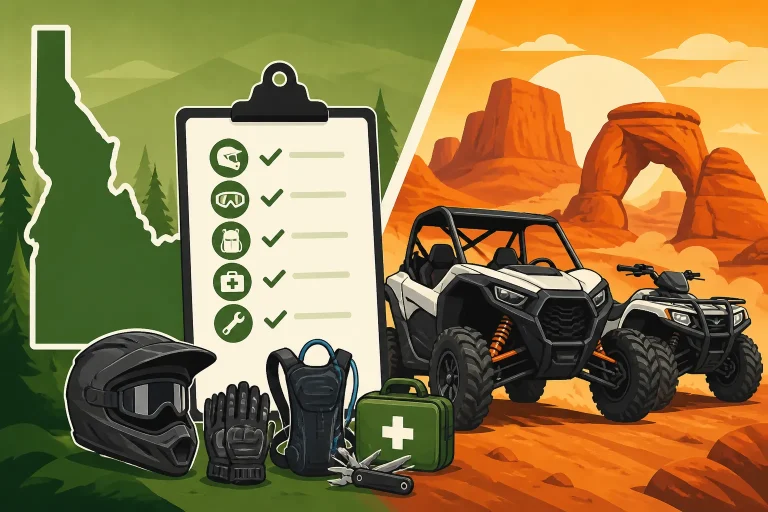
Before the trip, make a checklist with one line for each requirement:
- Machine registration or visitor permit
- Rider education certificate, if required
- State park pass or day-use admission
- OHV-area fee, if applicable
- Camping reservation or camping charge
- Any separate permit for land outside the state park
This may feel like administrative overkill for a quick ride, but it is easier than reaching a gate and discovering that the pass you bought covers entry but not the riding activity you planned.
Planning Visits to Utah State Parks With Riding Areas
A state park visit is not automatically an OHV ride. Parks can have different zones, operating rules, routes, staging areas and closures. Before setting out, confirm that riding is allowed at the specific location and that the route is open to your kind of machine. Do not assume every road inside a park is an OHV route or that a pass allows access to every part of the property.
For a park that offers riding, check the practical details that affect the day:
- Where OHVs may be unloaded and staged
- Which routes are open to the machine’s type, width and use
- Whether a flag, helmet, spark arrester or other equipment is required
- Whether the park has separate rules for passengers, children or groups
- Where riding is prohibited, including sensitive areas and closed routes
- Whether the current conditions or seasonal restrictions affect access
- Whether day-use admission, OHV use and parking are charged separately
These details can change, so use current park information shortly before departure. A map from a prior visit or an old social-media post is not enough to establish that a route remains open. If an official notice identifies a closure, follow it even if a pass is valid.
Sand Hollow illustrates why checking destination details matters: a visit can involve the state park, designated OHV terrain and other facilities, each with its own practical rules. Verify what your annual pass covers and whether the specific riding activity has an additional charge. For trail planning and conditions, Sand Hollow and Sand Mountain: A Rider’s Guide can help you think through the riding side of the trip.
Coral Pink Sand Dunes is another destination where a rider should check both the park admission terms and the OHV rules. Dunes bring additional considerations such as riding boundaries, staging, equipment and conditions. A pass that addresses park entry does not answer those questions. Review the current site information and the riding guidance in Coral Pink Dune Hours and Unloading Areas before loading up.
Some riders build a longer itinerary that combines state parks with nearby riding areas. In that case, plan each stop separately. A Utah State Parks pass does not replace fees at a different recreation area, even if it is close to a state park or commonly included in the same trip. Little Sahara, for instance, has its own fee and access details; check Fees at Utah’s Little Sahara rather than assuming that a state park pass covers it.
Think about the vehicle carrying the machines, too. An annual park pass may have terms tied to a vehicle or a particular method of entry. A group arriving in a truck with a trailer and a second support vehicle should verify how the pass applies to each vehicle. The ATV or UTV’s own registration and permit status remains a separate matter from the tow vehicle’s park access.
The same care applies to camping. A pass may provide a benefit related to park entry, but that does not guarantee a campsite or include every overnight charge. Reservations, site availability, occupancy limits and camping rules are distinct from admission. If you plan to camp, check the park’s current reservation process and fees before treating the pass as a complete trip budget.
Finally, keep proof accessible. Have the pass available in the form the park accepts and carry the OHV paperwork required for the machine and rider. Cell service can be unreliable in remote areas, so save or print official confirmations and maps when appropriate. Do not assume a screenshot will be accepted unless the park or permit issuer says that form of proof is valid.
A Practical Buying and Trip-Planning Checklist
Before purchasing a pass, answer a few specific questions rather than relying on the word “annual” to mean broad coverage.
Which parks will you visit? Make a realistic list, not a wish list. Include only destinations where the pass applies, and distinguish day-use visits from camping or other activities.
What is the pass valid for? Read the current official terms for eligible parks, vehicles, visitors, display requirements, validity dates and exclusions. If you travel with more than one vehicle, ask how the pass applies to the group.
What costs remain? Confirm whether OHV use, camping, reservations, parking or special activities carry separate charges. The official fee information for each destination is more useful than a general statement that the pass covers park admission.
What does your machine need? Check Utah registration or non-resident permit requirements, plus any applicable rider education rules. Verify whether your machine’s category changes the requirements.
Where else will you ride? Identify whether each stop is a state park, federal site, county area or another destination. Every land manager can have distinct access rules.
Are routes open and suitable? Check current closures, route maps and machine restrictions. A valid pass is not permission to ride in a closed area.
A compact trip worksheet can keep the costs straight:
| Trip item | Information to confirm | Where to verify |
|---|---|---|
| State park entry | Whether the pass applies to this visit | Current park and pass terms |
| OHV access | Separate fee, permit or route restriction | Park or riding-area information |
| Machine authorization | Registration or visitor permit | Current Utah OHV requirements |
| Rider requirements | Education certificate or age rules | Utah OHV rules |
| Camping | Reservation, availability and charge | Park reservation information |
| Other destinations | Land manager and fee system | The destination’s official information |
If the annual pass appears to save money, consider convenience as well as the arithmetic. A pass can be worthwhile for someone who regularly returns to participating state parks, even if the savings are modest, because it may simplify admission. But convenience is not a reason to skip checking the exclusions. A pass that does not cover the riding charge you expected it to cover can make a trip more expensive than planned.
If the math is close, wait until your itinerary is clearer or ask the park system directly about the precise use case. Tell them which park, what kind of vehicle you are arriving in, whether you are bringing an OHV, and whether you plan to camp. Broad questions such as “Does the pass cover riding?” may get an answer that is too general to rely on.
For visitors coming from another state, the order of operations is simple: confirm machine eligibility and permit needs first, choose riding areas second, and then decide whether a park pass is useful for the parks on that route. Buying the pass first can lead to confusing its purpose with the permit required for the machine. For a broader overview of visitor obligations, see Visiting Utah With an Out-of-State Machine.
The safest budget assumes separate line items until an official source confirms that one charge includes another. That approach may not be the most exciting part of planning a ride, but it prevents a park pass from being mistaken for a riding permit, a camping reservation or universal admission to every Utah OHV destination.
Frequently Asked Questions
Does a Utah State Parks annual pass cover OHV riding?
Not automatically. The pass may apply to park admission, but a separate OHV-area fee or machine permit may still be required. Check the current terms for the exact park and activity.
Does the pass replace a Utah non-resident OHV permit?
No. A state park pass and a non-resident OHV permit serve different purposes. Visitors should confirm whether their machine needs a permit before riding.
Will the pass cover camping at a state park?
Do not assume so. Camping, reservations and other services can have separate rules and charges. Check the park’s current camping information.
Is the pass useful if most of my riding is outside state parks?
It may offer little value if you rarely pay admission at participating state parks. Compare the pass with only the entry charges it actually covers, and review fees for your other destinations separately.
Disclaimer
This article is for general informational purposes only and does not constitute professional advice. Laws, prices and regulations vary by location and change over time. Consult a qualified professional for guidance on your specific situation.