What Utah Charges a Resident Who Registers Elsewhere
It's a common scenario, and frankly, I totally get why folks try to navigate it this way. You've just found your dream ATV or UTV, maybe it's a sweet deal from an out-of-state seller or you've heard whispers about easier registration processes elsewhere. The idea of saving a few bucks on sales tax or avoiding what seems like a mountain of paperwork in Utah can be mighty tempting. But here's the kicker: for Utah residents, trying to register your off-highway vehicle (OHV) in another state usually creates more headaches and costs in the long run than it solves. This guide is here to lay out exactly what Utah expects, what potential charges you could face, and how to make sure your machine is legal and ready for the trail, right here in the Beehive State.
Why Utah Residents Might Look to Register an OHV Elsewhere
Let's be real, no one enjoys paying more than they have to, or jumping through hoops of bureaucracy. The thought process behind a Utah resident looking to register an OHV out-of-state often stems from a few understandable, but often misguided, assumptions.
The Myth of Cheaper Sales Tax
One of the biggest drivers is often the perceived saving on sales tax. Perhaps you've found a fantastic deal on a side-by-side from a private seller in a neighboring state, or you're considering buying from a dealer across the border. You might think, "If I register it there, I'll pay their sales tax, which could be lower, or maybe even none if it's a private sale." While some states might have different sales tax structures, the reality for a Utah resident is that sales tax is generally due to Utah when the machine is brought into the state for use. It doesn't matter where you bought it or where you initially tried to register it. Utah wants its share for the privilege of using that machine on its trails and roads.
Avoiding Utah's Uniform Fees and Registration
Another common reason is the desire to avoid Utah's annual uniform fee and registration costs. These fees can vary based on the age and value of your machine, and they do add up. The allure of a state with seemingly simpler, cheaper, or less frequent registration requirements can be strong. Some individuals even explore complex arrangements like setting up an out-of-state Limited Liability Company (LLC) to "own" the vehicle, hoping to bypass Utah's requirements entirely. However, as many have found, the state of Utah has provisions to address these situations, particularly when the primary operator and storage location of the OHV are demonstrably within Utah. For more on this, check out [The Montana LLC Question Utah Owners Keep Asking]. The system is designed to capture these fees from residents who use the state's resources.
Perceived Simplicity of Other States' Processes
Sometimes, it's not even about money, but about convenience. Some states might seem to have a less complicated process for titling or registering an OHV. Maybe you heard a friend of a friend had an easy time in Arizona or Idaho. While every state has its own system, assuming it will be simpler for a Utah resident to register there and then use the machine here is a leap. You're often adding layers of complexity, not removing them, because you'll eventually need to satisfy Utah's requirements anyway if you're a resident planning to use your OHV here.
The Legal and Financial Repercussions of Out-of-State Registration for Utah Residents
So, what happens when Utah catches wind that you, a bona fide resident, are operating an OHV within its borders that's registered somewhere else? This is where those perceived savings can quickly turn into significant costs and potential legal trouble. Utah has a vested interest in ensuring its residents contribute to the maintenance and management of the OHV trail system, which is largely funded by these very fees.
Unpaid Sales Tax: It Catches Up With You
This is often the biggest financial hit. If you're a Utah resident and you purchase an OHV, sales tax is generally owed to Utah, regardless of where the purchase took place. If you tried to register it in another state to avoid this, Utah can assess the sales tax, plus interest, and potentially penalties, once they identify you as a Utah resident operating the machine here. This isn't a minor oversight; it can be a substantial amount, especially on a newer, higher-value machine. You'll likely need to provide proof of purchase, and the State Tax Commission will calculate what's due.
Accumulating Uniform Fees and Registration Penalties
Beyond sales tax, Utah has its annual uniform fee and registration fee. If you've been operating your OHV with out-of-state plates for a period while being a Utah resident, you've likely skipped paying these. When you eventually register the machine correctly in Utah, you could be required to pay back all outstanding uniform fees and registration fees for the period you've owned and operated the machine as a Utah resident. On top of that, penalties can be levied for operating an unregistered vehicle. These fines are designed to deter non-compliance and fund the resources needed to manage our fantastic riding areas. To understand the potential financial impact of penalties, it's worth reviewing [Penalties for Riding Unregistered in Utah].
The Dreaded "Unregistered" Status on Utah Trails
Even if your OHV technically has a registration from another state, if you're a Utah resident, the state generally considers it unregistered if it hasn't met Utah's specific requirements. This means you could be pulled over by a game warden or law enforcement officer on the trail, facing fines for operating an unregistered OHV. Your machine could even be impounded in certain circumstances. It's a risk that frankly isn't worth taking when you're out trying to enjoy our beautiful scenery. Having your machine legally registered in Utah is not just a formality; it's a necessity for peaceful riding.
Licensing and Insurance Complications
While not always a direct charge from the state for out-of-state registration, operating an improperly registered OHV can lead to complications with insurance and driver's licenses. If you're involved in an accident and your machine isn't legally registered in Utah as required for residents, your insurance company might dispute coverage or claims, leaving you financially vulnerable. Furthermore, an officer might inquire about your driver's license status and OHV education certificate, adding more layers to an already complex situation.
Here's a quick look at the reality versus the perception:
| Item/Factor | Perceived Outcome by Registering Elsewhere (for Utah Resident) | Actual Outcome/Charge When Identified as Utah Resident |
|---|---|---|
| Utah Sales Tax | Avoided or paid at a lower rate | Due upon first use in Utah, plus interest/penalties |
| Utah Uniform Fee | Not paid | Due upon first use in Utah, plus interest/penalties |
| Utah Registration Fee | Not paid | Due upon first use in Utah, plus penalties |
| Proof of Residency | Irrelevant | State determines residency based on multiple factors |
| Penalties & Interest | Not applicable | Applied to unpaid taxes/fees, can be significant |
| Legal Status on Utah Trails | Machine is "registered" | Illegal to operate on Utah public lands without proper Utah registration/fees for residents |
| Potential Impoundment | Unlikely | Real risk for unregistered operation |
How Utah Defines Residency and What That Means for Your OHV
Understanding what constitutes "residency" in Utah is absolutely crucial, because it's the trigger for many of these obligations. Utah doesn't just look at where your driver's license is from. The state considers a combination of factors to determine if you're a resident for tax and registration purposes.
Key Factors for Determining Utah Residency
The Utah State Tax Commission and the DMV typically consider several indicators to establish residency. These can include:
- Your primary dwelling: Where do you primarily live? If you own or rent a home in Utah and spend most of your time there, that's a strong indicator.
- Utah Driver's License or State ID: If you hold a Utah driver's license or state identification card, you are presumed to be a resident.
- Voter Registration: Being registered to vote in Utah is another strong sign.
- Property Ownership: Owning property (especially residential property) in Utah.
- Employment: Working in Utah.
- Children's School Enrollment: If your children attend school in Utah.
- Utilities and Bank Accounts: Having utility accounts or bank accounts primarily in Utah.
- Vehicle Registration (Other Vehicles): If your cars and trucks are registered in Utah.
It's not usually one single factor, but the overall picture that indicates your primary place of abode and where you conduct your main affairs. The state is pretty savvy about identifying actual residents versus those attempting to maintain a tenuous connection elsewhere purely for financial reasons.
The "New Resident" Timeline
Even if you've recently moved to Utah and brought your OHV with you, there's a grace period before you absolutely must register it here. Typically, new residents are required to register their vehicles, including OHVs, within a specific timeframe after establishing residency. This often means you have a certain number of days to get your paperwork in order. If you're new to the state, definitely look into [How Soon New Residents Must Register a UTV] to ensure you're compliant right from the start. Ignoring this deadline can lead to similar penalties as trying to bypass registration as a long-term resident. For more general advice, also see [Moving to Utah With an ATV You Already Own].
Getting Back on Track: Registering Your OHV Correctly in Utah
If you've been operating your OHV in Utah with out-of-state registration as a resident, or you're planning a purchase and want to do it right from the get-go, getting your machine properly registered in Utah is the smart move. It provides peace of mind and ensures you're contributing to the trails you love.
Step 1: Gather Your Documents
The first thing you'll need is all your existing paperwork. This includes:
- Proof of Ownership: The most crucial document is your vehicle's title. If it's an out-of-state title, make sure it's properly signed over to you.
- Bill of Sale: A detailed bill of sale is essential, especially for private party purchases. It should include the purchase price, date of sale, seller's and buyer's information, and the vehicle's VIN. If your original bill of sale from an out-of-state purchase is lacking, or you've misplaced it, consider using resources like LawDepot to create a comprehensive, Utah-compliant bill of sale to document the transaction accurately. This can help smooth the process at the DMV.
- Photo ID: Your current Utah driver's license or state ID.
- Proof of Residency: While your ID helps, having other supporting documents like a utility bill can't hurt, especially if you're dealing with a situation where residency is questioned.
For a complete checklist of what to bring, refer to [What Paperwork Utah Riders Must Carry].
Step 2: Address Unpaid Sales Tax and Fees
This is where the "charges" for registering elsewhere come into play. You'll likely need to contact the Utah State Tax Commission or the DMV directly to discuss any outstanding sales tax, uniform fees, and registration fees you owe, along with any applicable interest or penalties. Be prepared to be upfront about the situation. The goal is to get square with the state, and they often have processes in place to help you do that. Sometimes, using a template from LawDepot for a letter explaining your situation or creating an affidavit of ownership can be helpful in compiling all necessary details.
Step 3: VIN Inspection (If Required)
For vehicles coming from out-of-state, a VIN inspection might be necessary to verify the vehicle's identification number. This is usually done by a certified inspector or law enforcement officer. It's a straightforward process, but it's a required step before final registration for some machines. Get the details by checking out [VIN Inspections for Utah ATV Paperwork].
Step 4: Visit the Utah DMV or County Assessor's Office
Once you have all your documents, and you've initiated the process to address any outstanding taxes or fees, you'll visit your local Utah DMV or county assessor's office. They will process your title transfer (if applicable), collect the necessary sales tax, uniform fees, and registration fees (including any back fees or penalties), and issue your Utah OHV registration and decals. Remember, these fees contribute directly to the upkeep of the state's amazing trail system, so while it might sting to pay back fees, you're investing in your own riding future. For a step-by-step guide, see [How to Register an ATV or UTV in Utah] and [Utah OHV Registration Fees, Start to Finish]. Understanding the breakdown of costs, including [Utah ATV Sales Tax and Uniform Fees], will also prepare you for the transaction.
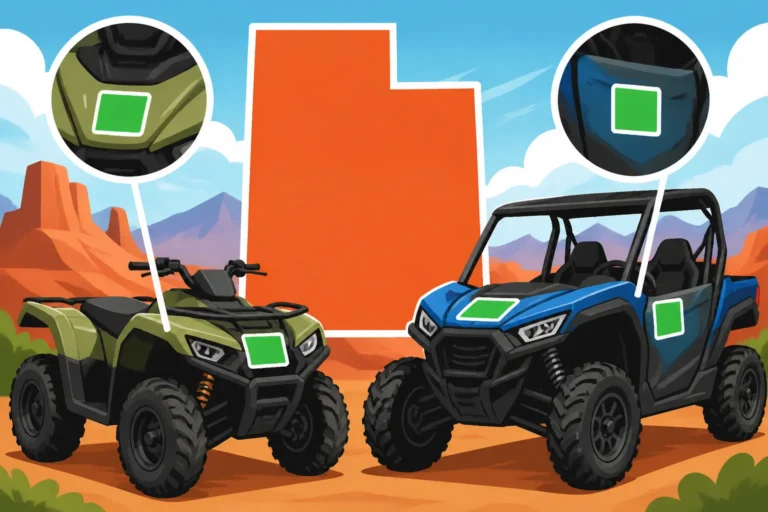
Step 5: Display Your Decal
Once you have your Utah registration decal, make sure to display it correctly on your OHV. This visible proof of registration will save you hassle on the trails. You're now officially legal to ride Utah's incredible network of OHV trails!
It might seem like a lot to untangle, especially if you've been putting it off. But getting your OHV properly registered as a Utah resident means you can ride without a worry, knowing you're fully compliant and supporting the trails we all love. Don't let the thought of bureaucracy scare you. Whether you're getting your paperwork in order or ensuring you have a solid bill of sale, resources like LawDepot can provide helpful tools for navigating the documentation. It's an investment in stress-free riding for years to come.
Disclaimer
This article is for general informational purposes only and does not constitute professional advice. Laws, prices and regulations vary by location and change over time. Consult a qualified professional for guidance on your specific situation.