The Order to Do Utah OHV Paperwork In
Trying to figure out the right order for all the paperwork when you're getting a new or used ATV or UTV registered in Utah can feel like trying to solve a puzzle with half the pieces missing, often leading to frustrating extra trips to the DMV or county assessor's office. This guide is here to walk you through the most efficient and pain-free sequence for handling your Utah OHV paperwork, ensuring you get your machine on the trail without unnecessary delays.
Why the Right Paperwork Order is Crucial for Utah OHV Owners
Let's be real, no one enjoys spending more time at the DMV or county assessor's office than absolutely necessary. It's not exactly the most exciting part of owning an ATV or UTV, but it's a vital step to legally hit Utah's incredible trails. The frustration of arriving with what you think is everything, only to be told you're missing a key document or that you needed to do something else first, is a common experience. This isn't just about avoiding a minor annoyance; getting the order wrong can lead to serious delays, unnecessary fees, or even the inability to register your machine at all until you sort things out.
Think about it: if you don't have a proper bill of sale or title transfer, the state won't even know you own the machine. If you skip a VIN inspection when it's required, you'll hit a roadblock. If you try to pay registration fees before the title is properly in your name, you're just spinning your wheels. Each step builds on the last, and understanding this sequence can save you hours of headache and help you avoid a repeat visit. We want you out on the dunes of Sand Hollow or exploring the Paiute Trail, not stuck in a waiting room!
The Ideal Paperwork Flow for a Newly Acquired OHV in Utah
Whether you've just picked up a shiny new side-by-side from a dealership or scored a sweet deal on a used quad from a private seller, there's a specific dance you need to do with the paperwork in Utah. Knowing these steps upfront will make the process much smoother.
Buying from a Licensed Utah Dealership
When you buy from a reputable dealership in Utah, they often handle a significant chunk of the initial paperwork for you, which is a huge relief for many riders. They're typically equipped to manage the sales tax, title application, and even the initial registration process.
First, your dealer will collect all the necessary information for the purchase, including your identification and payment details. They'll issue you a purchase agreement and a temporary operating permit, which often allows you to ride your new machine home legally. Crucially, they should prepare the application for a new title in your name and ensure all sales tax is collected and remitted to the state. They will also collect the initial registration fees and the uniform fee based on the machine's value. You'll sign off on these documents, and the dealer will typically submit them electronically or physically to the Utah Division of Motor Vehicles (DMV) or county assessor's office. This streamlined process means you often just need to wait for your official title, registration card, and decal to arrive in the mail. Before you drive off, always double-check [What a Utah Dealer Hands You at Delivery] to ensure you have all the immediate necessary proofs.
Purchasing from a Private Seller
Buying from a private party is where the paperwork burden shifts almost entirely to you, the buyer. This is also where most people encounter snags if they don't know the proper order.
-
Secure a Proper Bill of Sale: This is your absolute first line of defense and proof of purchase. Even if the seller has a title, you need a clear, comprehensive bill of sale. It should include the buyer's name and address, the seller's name and address, the date of sale, the purchase price, a full description of the OHV (make, model, year, VIN), and signatures from both parties. If you need a robust template, services like LawDepot can provide customizable forms that ensure you don't miss any critical details. This document is essential for proving ownership and calculating sales tax. For a deeper dive, check out [Bill of Sale Requirements for a Utah ATV Sale].
-
Obtain the Signed-Over Title: This is arguably the most critical piece of paper. The seller must provide you with the original title certificate, properly signed over to you. Ensure all sections related to the transfer of ownership are completed accurately by the seller, including their signature, the date of sale, and the odometer reading if applicable. Verify the VIN on the title matches the machine itself. Without a properly signed title, you'll face significant hurdles getting the machine registered in your name. Learn more about [Utah ATV Title Requirements Explained]. If the seller can't produce a title for a machine that should have one, you'll want to read up on [No Title From the Seller: What Utah Requires].
-
Complete a VIN Inspection (If Required): For certain circumstances, especially if you're buying a machine from out of state, if it has a rebuilt or salvage title, or if there's any discrepancy, Utah might require a Vehicle Identification Number (VIN) inspection. This typically needs to be done by an authorized law enforcement officer or DMV inspector. This step often happens before you can fully register the machine. Don't assume you can skip it; if you're unsure, it's best to verify with the DMV. More details can be found in [VIN Inspections for Utah ATV Paperwork].
-
Visit the Utah DMV or County Assessor's Office: With your bill of sale and properly signed title in hand (and a VIN inspection if needed), you're ready to head to the county assessor's office. This is where you'll formally apply for a new title in your name and register the OHV. You'll pay the applicable sales tax (if it wasn't collected by a dealer), the uniform fee, and the registration fee. Make sure you bring valid identification and payment for all fees. It's often a good idea to bring a completed title application form, which you can usually download from the DMV website beforehand, to speed things up. To make sure you have everything, consult [Documents to Bring to the Utah DMV for an ATV].
This table summarizes the key steps and documents for purchasing an OHV in Utah:
| Step | Private Sale | Dealer Purchase | Key Documents/Actions |
|---|---|---|---|
| 1. Proof of Purchase | Secure a detailed bill of sale with all required info. | Dealer provides purchase agreement. | Bill of Sale (private), Purchase Agreement (dealer) |
| 2. Title Transfer | Obtain original title, signed over by seller. | Dealer handles title application to DMV. | Original Title (private), Title Application (dealer) |
| 3. VIN Inspection (if applicable) | Get VIN inspection by law enforcement/DMV. | Dealer usually handles or advises if needed. | VIN Inspection Certificate (if required) |
| 4. Tax, Title, & Registration | Visit County Assessor/DMV to pay sales tax, apply for title, and register. | Dealer collects sales tax and registration fees, submits applications. | Sales Tax Payment, Title Application, Registration Application, Fees |
| 5. Receive Documents & Decal | Wait for title, registration card, and decal in mail. | Wait for title, registration card, and decal in mail. | New Title, Registration Card, OHV Decal |
Registering an OHV Without a Title
There are situations where an OHV might not have a title, particularly older machines (often those manufactured before 1988) or those from states that didn't require titles for OHVs. Utah has specific provisions for these cases, but it adds another layer to the paperwork process.
If you're dealing with a machine that falls into this category, your first step is still to get a rock-solid bill of sale. This document is your primary proof of ownership, so make sure it's comprehensive and signed by both parties. Services like LawDepot can be incredibly helpful for creating a legally sound bill of sale in these situations. Without a title, the bill of sale takes on even greater importance. Next, you will almost certainly need a VIN inspection. This is crucial for the state to verify the machine's identity and ensure it isn't stolen. Once you have your bill of sale and a positive VIN inspection, you'll visit the DMV or county assessor's office. You'll explain the situation, present your bill of sale and VIN inspection, and fill out any additional affidavits or forms the state requires for registering a machine without a traditional title. This might include a form affirming you've attempted to locate a title or that the machine never had one. It's a bit more involved, but definitely doable with the right documentation. If this applies to you, researching [Registering a UTV in Utah Without a Title] will be very beneficial.
Common Paperwork Hiccups and How to Avoid Them
Even with the best intentions, paperwork can throw a wrench in your plans. Being aware of common issues can help you navigate them smoothly.
Missing or Incorrectly Filled Out Titles
This is probably the most frequent frustration. A seller might forget to sign the title, or they might write something in the wrong box, accidentally voiding the transfer. Sometimes, a title might be reported as lost or stolen.
Always inspect the title carefully before you finalize the purchase and exchange money. Ensure the seller's name matches the name on the title, and that they sign in the correct seller's signature block. Never let them use correction fluid or cross out information; this can invalidate the title. If there's a mistake, the seller might need to apply for a duplicate title before the sale can proceed. If the title is missing, it's the seller's responsibility to obtain a duplicate. Trying to register an OHV with a flawed title will only lead to rejection at the DMV and a wasted trip. For machines from older eras, understanding [Utah's Title Rule for 1988 and Newer Machines] can save confusion.
Out-of-State Purchases
Buying an OHV from another state adds a few extra considerations. While the general order remains the same (bill of sale, signed title, VIN inspection, then registration), you need to be mindful of sales tax and VIN verification requirements.
Utah expects you to pay sales tax on an OHV purchased out-of-state if you intend to register it here, even if you paid sales tax in the other state (though you may get credit for what you paid there). Also, machines brought in from out of state almost always require a VIN inspection by Utah law enforcement or a certified inspector to verify the vehicle's identity. Don't skip this step, or you'll be sent away from the DMV. Be prepared to show your out-of-state bill of sale and title during this process. For detailed steps, consider reading [Buying an ATV Out of State and Registering It in Utah].
Gifting an OHV to a Family Member
Gifting an OHV, while a generous act, still requires proper documentation to transfer ownership. Even if no money changes hands, the process is similar to a sale.
You'll still need a signed-over title from the giver to the recipient. While a bill of sale isn't for a monetary transaction, a "Gift Affidavit" or formal gift agreement is highly recommended. This document explicitly states that the OHV is a gift, clarifies the giver and recipient, details the machine's VIN, and ideally specifies the date of transfer. This helps the DMV understand it's not a sale and that sales tax (which is based on purchase price) should not apply. Resources like LawDepot can help you generate a professional-looking gift agreement to ensure clarity and avoid future questions. This makes the title transfer process much smoother at the DMV. Furthermore, be aware of [Taxes on an ATV Gifted Between Relatives] as there might be other financial implications.
Preparing for Your DMV/Assessor Visit and Final Steps
Once you've gathered all your documents in the correct order, it's time for the final leg of the journey to get your OHV fully legal. A little preparation can make this visit quick and successful.
The Paperwork Checklist for Registration Day
Before you even leave your driveway, make a physical checklist and double-check you have everything you need. This might seem basic, but it's the simplest way to avoid a frustrating second trip.
Here's a general list of items you should have ready, particularly for a private purchase:
- Your Valid Photo ID: Driver's license or state ID.
- Original Title Certificate: Properly signed over by the previous owner, with no errors or alterations.
- Detailed Bill of Sale: With all buyer/seller/vehicle information and signatures. If it's a gift, have your gift affidavit or agreement.
- Proof of VIN Inspection: If required for your specific situation.
- Proof of Utah Residency: Utility bill, mail, etc., if your ID doesn't show your current Utah address.
- Payment for Fees: Be ready for sales tax (if applicable), the uniform fee, and registration fees. Check the DMV website for accepted payment methods, but having a debit card, credit card, or checkbook usually covers it.
- Completed Title and Registration Application Forms: Often available online for you to fill out beforehand.
Having these documents neatly organized will not only make your life easier but will also make the DMV staff's job smoother, potentially speeding up your transaction. For new residents, understanding [How Soon New Residents Must Register a UTV] is key.
What Happens After You Register?
After you've successfully completed the registration process at the county assessor's office or DMV, you won't immediately walk out with everything. You'll typically be given a temporary registration slip or receipt as proof that you've completed the transaction.
Your official Utah OHV registration card, new title certificate, and the all-important OHV decal will usually be mailed to you. This can take a few weeks, so be patient. Once the decal arrives, you'll need to affix it correctly to your machine. For ATVs, this typically means on the left-rear fender or a prominent location. For UTVs, it's often on the rear. Make sure you understand [Utah OHV Decals and Where They Go] so you place it correctly. Until your permanent documents and decal arrive, keep that temporary receipt or registration proof with you when you ride. It’s your legal proof that you’ve done your due diligence.
The Value of Preparing for a Single Trip
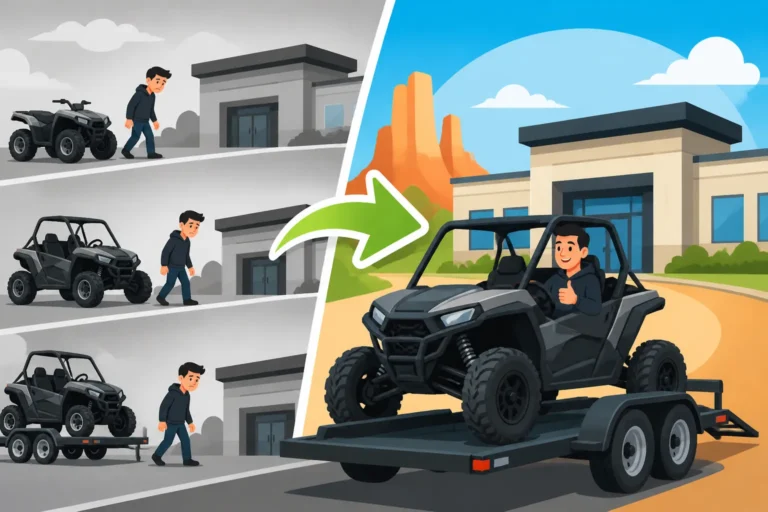
The entire goal of understanding this paperwork order is to achieve the mythical "one trip to the DMV." While not always possible, especially with unforeseen circumstances, proper preparation drastically increases your chances.
By understanding what's needed at each stage—from verifying the title details with a seller to having all your forms and identification ready for the DMV—you streamline the process. Knowing which questions to ask a private seller about their title, or proactively getting a VIN inspection if your machine fits the criteria, saves you from being turned away. It's about empowering yourself with knowledge so you can spend less time on bureaucratic tasks and more time enjoying Utah's incredible backcountry on your legally registered OHV. Don't underestimate the satisfaction of walking out knowing you've handled everything correctly on your first try! You might also find [One Trip to the DMV Instead of Three] helpful for general strategy.
Disclaimer
This article is for general informational purposes only and does not constitute professional advice. Laws, prices and regulations vary by location and change over time. Consult a qualified professional for guidance on your specific situation.