Getting to Sand Mountain From St. George
Leaving St. George for Sand Mountain sounds straightforward until you are towing a trailer, navigating unfamiliar desert roads, or trying to find the right place to unload. This guide explains the usual drive toward Sand Hollow and Sand Mountain, how to plan your final approach, and what to check before you head out so you arrive ready to ride rather than searching for a staging area.
The usual route from St. George to Sand Mountain
Follow the route toward Hurricane and Sand Hollow
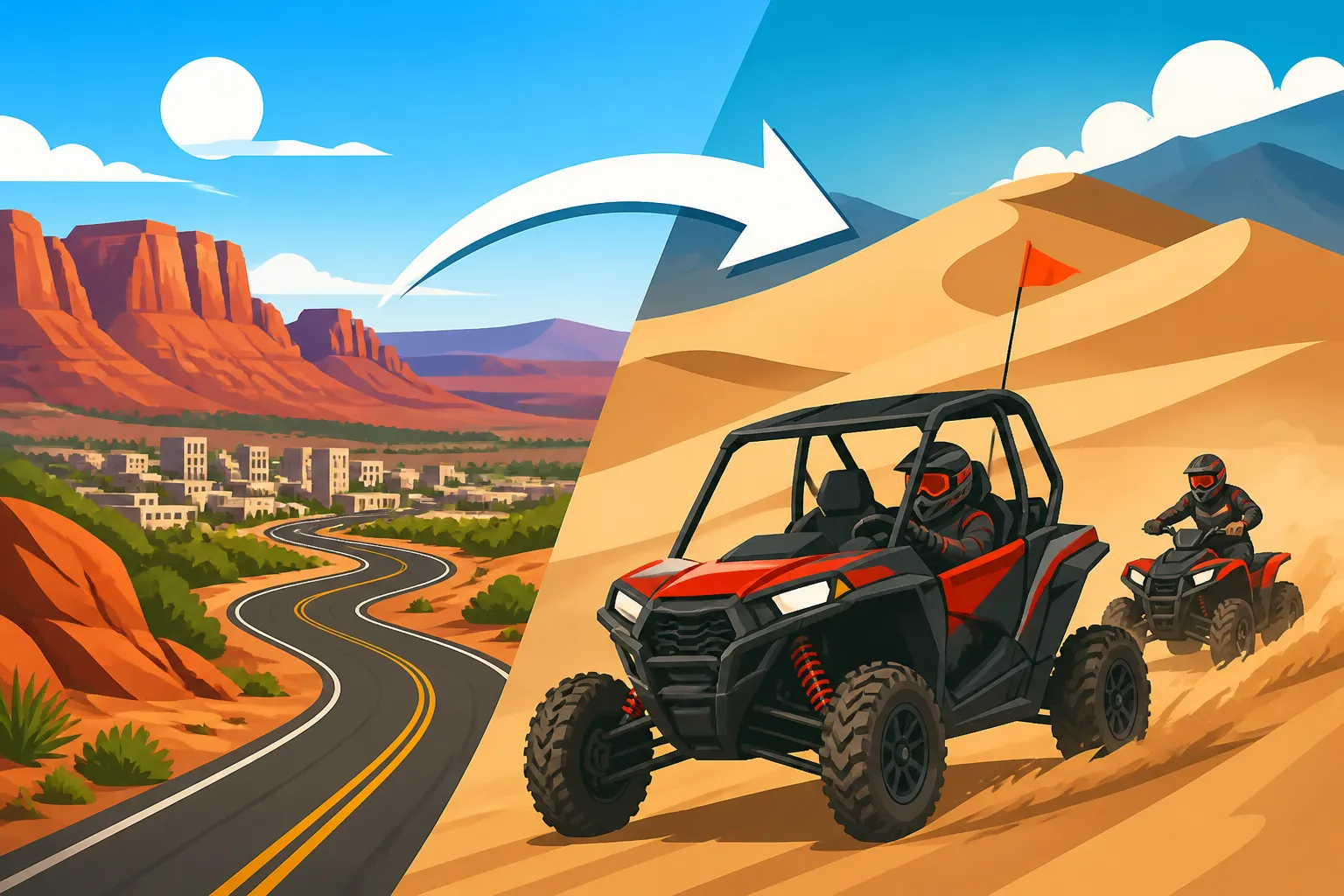
Sand Mountain is near Sand Hollow State Park, east of Hurricane. From St. George, the common approach is to head toward Washington and Hurricane, then continue east on State Route 9. Depending on where you start in St. George and traffic conditions, a navigation app may direct you onto Interstate 15 North before connecting with State Route 9.
Once you are on State Route 9, look for the signed turn toward Sand Hollow and follow directions to the specific access point or staging area you plan to use. Sand Mountain and Sand Hollow are closely associated, but a search result for the park entrance is not necessarily the same thing as directions to every OHV staging area. Confirm your intended destination before you leave town.
For a broader overview of the riding area, including how Sand Mountain fits alongside the reservoir and state park, see [Sand Hollow and Sand Mountain: A Rider's Guide]. The distinction matters when you are towing: arriving at a park entrance, a day-use area, or an OHV staging lot can put you in different places, even though all may appear on a map under Sand Hollow.
Treat the last part of the drive as a separate navigation task
The highway portion is generally the easy part. The final approach is where riders can lose time: a phone map may route to a park gate when you need a staging lot, a pin may be on the wrong side of the dunes, or a road may look like a shortcut without being suitable for your trailer.
Before driving out of St. George, enter the exact destination you intend to use—not just “Sand Mountain.” Check the route against the access information for the area, and look closely at the final turns. If you are meeting friends, agree on one staging location and share the same pin. “We’re at Sand Hollow” is not always specific enough when people are arriving from different directions.
A tool such as onX Offroad can help you review mapped roads and riding routes before you go, especially if you want to understand how the access roads connect to nearby trails. Use it as a planning aid rather than a substitute for posted signs or land-manager directions. Download the information you need before leaving reliable cell coverage, and compare your route with [Utah OHV Trail Maps and How to Read Them] if you are unfamiliar with the area.
Choose the right place to unload
Confirm whether you need a park entrance or an OHV staging area
Sand Hollow State Park and the Sand Mountain riding area are near one another, but the exact access point you need depends on your plans. If you are visiting the reservoir, using park facilities, or following a route that begins inside the state park, the park entrance may be appropriate. If your main goal is unloading an OHV and riding the dunes, verify the designated staging access for your trip.
Do not assume that a map pin labeled “Sand Mountain” leads to a roomy, legal place to park a truck and trailer. Pins can be approximate, and different apps may use different names for nearby access points. Check for signs as you approach, and do not take an unmarked two-track simply because it appears to lead toward the dunes.
It also helps to think through your whole arrival: where you will park, where you will unload, where your group will meet, and how you will return to the vehicle. A passenger who gets dropped at the wrong entrance or a trailer left in a tight turn can turn a simple outing into a frustrating one. For the particular connection between the park and the dunes, read [Sand Hollow State Park's Tunnel to the Dunes].
Make trailer access part of the route decision
A route that works for a car may be awkward with a long trailer. Before setting out, check whether the final approach includes narrow roads, tight turns, steep grades, soft shoulders, or a small parking area. If you are towing a wide UTV or carrying several machines, consider whether you will have enough room to turn around and unload without blocking other visitors.
When you arrive, use the signed parking and staging areas, and avoid spreading out across access lanes. If a lot is busy, take a moment to assess the layout before backing in. It is much easier to choose a spot carefully than to maneuver a trailer while other vehicles are trying to get through. The practical tips in [Utah Trailhead Parking That Fits a Trailer] apply well to a busy desert riding area.
A useful pre-trip check is to confirm your vehicle’s fuel range, trailer lights, tie-downs, spare tire, and the condition of your tow vehicle’s tires. St. George is a convenient place to organize supplies before heading east, but it is still worth leaving with the equipment you need rather than counting on a quick fix at the trailhead.
Prepare for desert navigation and riding
Download maps before you leave town
Cell service can be inconsistent once you move away from developed areas or ride beyond the main access roads. Do not make your entire navigation plan depend on live directions. Save the destination, download an offline map where possible, and make sure the driver or navigator knows how to use it before the vehicle starts moving.
onX Offroad can be useful for checking mapped routes and keeping a general sense of where you are, but map layers do not override land closures, signs, or current restrictions. If an app shows a route that conflicts with a closed gate or posted notice, follow the posted direction. Build in time to stop safely and check your location rather than trying to study a screen while driving.
For a more reliable plan, save the staging location and the route back to it. If your group separates, a shared meeting point is more useful than vague instructions to “head back toward the highway.” The guide [Downloading Utah Trail Maps for Offline Use] covers practical ways to prepare for navigation gaps.
Check conditions and choose a sensible riding plan
Sand conditions, wind, heat, and recent weather can change what a day at Sand Mountain feels like. A route that looks manageable on a map may be tiring in high temperatures, and loose sand can be demanding for a new rider or a machine that is not set up for it. Check conditions before towing, then be willing to adjust your plans if the weather or access situation is not favorable.
If you are new to dunes, keep the first ride conservative. Stay with people who know the area, choose terrain that suits your experience and machine, and avoid following a fast group onto a line you have not assessed. A short, familiar loop is a better way to learn the terrain than committing early to a long ride far from your staging point.
Before leaving home, review [Checking Utah Trail Conditions Before You Tow] and [Sand Hollow's Busiest Days for Riders]. Busy weekends can affect parking, unloading, and how comfortable it feels to ride in a group. For a detailed packing checklist, [What to Carry on a Utah Day Ride] is a useful companion.
| Before you leave St. George | Why it matters |
|---|---|
| Confirm the exact staging or park access point | “Sand Hollow” can refer to several nearby destinations |
| Save the destination and an offline map | Cell service may be unreliable away from developed areas |
| Check current access and trail conditions | Closures or weather can affect your plan |
| Inspect your tow vehicle and trailer | A breakdown or trailer issue is harder to handle at the riding area |
| Agree on a meeting point | Groups can arrive at different entrances or staging areas |
| Carry required paperwork and permits | Registration and visitor requirements depend on your machine and residency |
Bring the paperwork and equipment that apply to your group
If you are visiting from outside Utah with an OHV, review the state’s visitor requirements before your trip. Do not assume that a registration sticker from another state automatically settles every permit or education requirement. Start with [Utah's Non-Resident OHV Permit Explained], then check [The Utah OHV Education Certificate] to understand whether the riders in your group need to complete the required course.
Carry the documents and proof that apply to your machine and riders, and keep them accessible. If your paperwork is stored in a truck glove box while you are riding, make sure someone in the group knows where it is. Check your machine’s registration status before the trip rather than discovering a problem at the staging area.
Prepare for the ride itself, too. Bring water, eye protection, sun protection, basic tools, and a first-aid kit suited to your group. A whip flag may be required or strongly expected in particular dune settings, so check the rules for the area and fit the right flag before unloading. [Whip Flag Rules at Sand Hollow] explains why this small piece of equipment deserves attention.
Make the drive and ride day easier
Plan around heat, crowds, and daylight
The drive from St. George is only one part of the day. Loading, unloading, gear checks, and regrouping all take time, so avoid planning a ride that only works if every step goes perfectly. Set a realistic departure time, especially if you are traveling with children, a large group, or several trailers.
In warm weather, getting organized early can make the day more comfortable. Keep drinking water easy to reach, protect gear from direct sun, and pause when someone needs a break. If a rider feels overheated, dizzy, or unusually tired, stop and address it rather than pushing on to complete a planned route. Desert conditions can make a short delay feel much more manageable than a preventable emergency.
Crowds can also change the experience. On a busy day, allow extra time to park and unload, stay alert around staging areas, and keep your group together before entering the riding area. If the lot is full or access is restricted, do not improvise by parking on a shoulder or blocking a road. Choose a legal alternative and revise the day’s plan.
Keep the return trip in mind
Before riding away from the staging area, check that everyone knows how to get back and where the vehicles are parked. Take a moment to note a landmark or save the location on your phone. If your group uses radios or another communication plan, confirm that it works before separating.
Set a return time that leaves room for loading and securing the machines. Rushing at the end of the day is when people are more likely to overlook loose straps, leave equipment behind, or make a poor decision because they are tired. Walk around the trailer before pulling out, check that the machines are secure, and make sure the lights and coupler are connected correctly.
The simplest successful trip is usually the one with a specific destination, a confirmed access route, an offline backup map, and a flexible riding plan. Sand Mountain is close enough to St. George for a day trip, but a little preparation can make the difference between an easy arrival and an avoidable scramble at the edge of the dunes.
Disclaimer
This article is for general informational purposes only and does not constitute professional advice. Laws, prices and regulations vary by location and change over time. Consult a qualified professional for guidance on your specific situation.