Certificates From Other States Utah Accepts
Utah visitors often arrive with an OHV safety card from home and are unsure whether it meets Utah’s education rules. The key is to separate a course certificate from a riding permit, then confirm that Utah recognizes the specific credential and know what proof to carry.
What Utah accepts and what it does not
An OHV education certificate is evidence that a rider completed a safety course. Utah may recognize a qualifying certificate issued outside the state, but having a card from another state does not by itself prove that it meets Utah’s current requirements. Recognition can depend on the course, the certificate and the rider’s circumstances.
That distinction matters because “certificate” can mean several different things. A rider may have completed an online course, received a wallet card, passed a state-run class or downloaded a completion record from a course provider. Those documents are not automatically interchangeable. A certificate should identify the rider and show that the rider successfully completed an OHV education course—not merely registered for one or viewed general safety material.
Utah’s education requirements are also separate from its non-resident OHV permit rules. A certificate is about education; a permit is permission to ride under Utah’s rules for visitors and their machines. A valid certificate does not replace a permit when one is required, and a permit does not necessarily satisfy an education requirement. Utah ended OHV registration reciprocity in 2020, but that change concerns reciprocity and visitor requirements, not whether an education course was completed. For the permit side of the question, see Utah Ended OHV Reciprocity: What Visitors Do Now and Who Needs a Utah Non-Resident OHV Permit.
The practical answer is to treat a certificate from another state as potentially acceptable, not automatically accepted. Before the trip, verify the exact certificate with Utah’s official OHV program. If the answer depends on a rider’s age or the kind of machine, provide those details when asking. A clear confirmation is more useful than a general statement that “out-of-state cards are accepted.”
It also helps to distinguish an education certificate from other documents that might look official:
- A registration card shows that a machine has been registered; it is not an education certificate.
- A non-resident permit addresses visitor access requirements; it is not proof of course completion.
- A driver’s license demonstrates driving credentials, but should not be assumed to replace an OHV education certificate.
- A rental agreement, guided-tour receipt or club membership card is not proof of OHV course completion unless it explicitly documents a qualifying course.
- A course enrollment email is not the same as a completion certificate.
For a broader explanation of the Utah credential itself, see The Utah OHV Education Certificate. Visitors should also check which separate documents they need to carry under What Utah Riders Must Carry on Public Land.
How to confirm an out-of-state certificate
The most reliable way to confirm a certificate is to identify exactly what it is and ask Utah about that credential, rather than asking only whether Utah “accepts other states’ cards.” Course names and card designs vary, and a front-desk answer based on a different state’s program may not address your situation.
Gather the details before contacting Utah
Find the certificate or course record and note:
- The rider’s name as it appears on the document.
- The course or program name.
- The state or organization that issued it.
- The completion date, if shown.
- Whether the rider passed a test or completed a course, rather than only registering.
- Whether the document is a physical card, a printable certificate or an electronic record.
- The rider’s age and the type of OHV they plan to operate.
You do not need to share personal information publicly. But when contacting an official office, these details help staff determine whether they are looking at the same credential you will present on the trail. If the certificate has a course identification number or verification feature, keep that information available too.
Ask a specific question
A useful question is: “Does Utah recognize this named OHV education course and certificate for a rider in these circumstances?” Include the issuing state and whether the rider is an adult or a minor. If there is more than one rider, ask about each person’s certificate; one rider’s course completion does not cover a passenger or another operator.
Also ask what form of proof Utah expects. A state may recognize the course but require the rider to produce a particular record. Find out whether a digital certificate is acceptable, whether a downloaded copy is enough, and whether the rider must be able to show it without an internet connection. Keep a record of the answer and the date you received it, but do not treat an informal response as a guarantee if the rules or official guidance have since changed.
If an official office cannot verify a certificate from the details you have, ask what information is missing and whether the course provider can supply it. A provider may be able to confirm successful completion or issue a replacement record. If Utah still cannot confirm the credential, taking a course approved for Utah may be the simplest way to avoid an argument about eligibility at the trailhead.
Check the certificate itself
Before relying on the document, make sure it is complete and readable. Check that:
- The rider’s name is correct and matches the rider’s identification closely enough to avoid confusion.
- The document says the course was completed, not just started.
- The issuing organization and course are identifiable.
- The certificate or record can be retrieved if the original card is lost.
- Any required signature, completion date or identification number is visible.
A certificate with a typo, a shortened name or a missing course title may still be verifiable, but it can slow down a check. Contact the issuer before traveling if the details are unclear. For youth riders, make sure the certificate belongs to the young operator, not only to a parent or supervising adult. Utah’s age-related education and supervision requirements are separate questions, so check them for the specific rider in Age Limits in Utah OHV Education Law and Supervision Rules for Young Utah Riders.
State-specific questions for visitors
A general statement about out-of-state certificates can be misleading because states use different course providers, card formats and rules. The right approach is to check the actual credential, not to assume that a neighboring state’s card is either accepted or rejected based only on where it was issued.
For example, a rider coming from California should verify the specific course or card rather than relying on a friend’s experience. Certificates for Visitors From California addresses that state-specific question. Riders coming from Arizona can use Arizona Certificates Used in Utah as a starting point, while Idaho visitors should also review What Idaho Riders Need Before Crossing. The same practical check applies to visitors planning a Moab trip from Colorado or a Uintas trip from Wyoming; see Colorado Riders Planning a Moab Week and Wyoming Riders Coming to the Uintas.
These state-specific topics are useful, but they should not be treated as substitutes for checking an unusual or recently issued credential. A state may offer multiple courses, and a rider might have completed a course designed for a different activity or received a document that is not an official completion record. When in doubt, match the exact course name and issuer to Utah’s current guidance.
Also avoid confusing education reciprocity with registration or permit reciprocity. A rider may have a valid education certificate and still need to meet Utah’s non-resident permit requirements. Conversely, a visitor who has handled the permit still needs to check whether the rider’s education status is sufficient. These are independent checks, so make a small list for each rider and each machine.
| Question | What the answer tells you | What it does not establish |
|---|---|---|
| Does Utah recognize this course certificate? | Whether the rider’s education credential may satisfy Utah’s education requirement | Whether the machine is registered or the visitor has a required permit |
| Does the machine have valid registration? | Whether registration requirements have been addressed | Whether the operator has completed required education |
| Does the visitor need a Utah non-resident permit? | Whether the visitor has handled the separate permit requirement | Whether a course certificate is valid |
| Is the rider old enough and properly supervised? | Whether age and supervision rules are met for that rider | Whether the certificate or machine paperwork is valid |
| Is the planned route open to this machine? | Whether the route permits the machine and type of use | Whether the rider’s paperwork is complete |
That last point is easy to overlook. A certificate does not grant access to every route, trail or recreation area. Land managers can have their own route restrictions, closures and access rules. Check the route before towing, particularly if the ride crosses different types of public land or includes a state park.
What to carry and how to avoid a trailhead problem
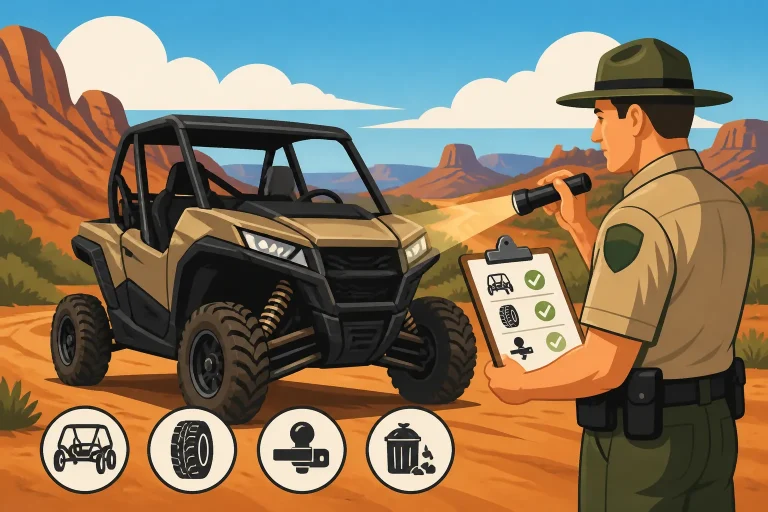
Once Utah confirms that a certificate qualifies, make the proof easy to show. A physical card is convenient, but a readable paper copy or saved electronic document may also be useful if that form is accepted. Do not rely on being able to log into a course account at the trailhead: cellular coverage may be limited, a password may be forgotten, or the provider’s site may be unavailable.
A sensible preparation routine is:
- Save a clear copy of the certificate to the rider’s phone.
- Store an additional copy offline so it can be opened without a data connection.
- Pack a paper copy if you have one, especially for a group or family trip.
- Keep the rider’s identification and certificate together, but protect both from water and dust.
- Carry any separate registration or visitor permit documents required for the machine and trip.
- Make sure each person can identify which documents belong to them.
If the certificate is digital, check its readability before leaving. A cropped screenshot, a low-resolution photo or a page that requires a live login may be difficult to verify. Keep the original file or a full-page copy when possible. Do not alter the document to hide a typo or change a name; ask the issuer to correct it.
For a family or group, create a separate document set for every operator who may need to show proof. A parent’s certificate does not transfer to a child. A shared phone may be useful, but each rider should know where their own record is saved and be able to retrieve it. If a group leader carries copies, each rider should still know how to show their credential independently.
If the certificate is missing or unclear
If you cannot find the card, start with the organization that issued the course. Ask whether it can confirm completion or provide a replacement certificate. Give the issuer the information it needs to locate the record, such as the name used during the course and an approximate completion date. Avoid waiting until the day of the ride, when office hours, account access or identity checks may delay a replacement.
If the course provider cannot locate the record, contact Utah’s official OHV program with the available course details. Ask whether another form of verification is acceptable or whether the rider should complete a Utah-approved course instead. Do not assume that a parent’s statement, a photograph of a damaged card or an unfinished online account will be sufficient.
If a certificate has a different name from the rider’s current identification, resolve that before travel if possible. A name change, a spelling error or a course account created under a nickname can make a valid record harder to match. Keep any supporting document the issuer provides, but confirm with Utah whether that resolves the issue.
If the answer is uncertain close to departure
There are two realistic choices: delay riding until the credential is confirmed, or complete a course that Utah recognizes before operating. Which is practical depends on the rider, timing and available course options. The important thing is not to gamble on an assumption simply because another visitor used a similar-looking card.
Do not confuse “I have a certificate” with “I have verified that Utah accepts this certificate.” That small distinction can prevent a wasted trip, a missed ride or a disagreement with an enforcement officer. It is also a good reason to check requirements well before a holiday weekend, when offices and course providers may be busy.
For a trip with several visitors, assign one person to verify the certificate rules and a different checklist item to each rider. Then check permits, registration, trail access and any area fees independently. For a wider checklist, see Carrying Your Certificate and Permit on the Trail and Visiting Utah With an Out-of-State Machine.
Frequently Asked Questions
Does Utah accept every OHV safety certificate from another state?
Do not assume so. Utah may recognize qualifying out-of-state course certificates, but acceptance depends on the specific course and current requirements. Confirm the exact certificate with Utah’s official OHV program before riding.
Does an out-of-state certificate replace Utah’s non-resident OHV permit?
No. Education and permit requirements are separate. A certificate documents course completion; it does not automatically satisfy a visitor permit requirement.
Is a photo of my certificate enough?
It may be useful, but whether a photo or digital copy is acceptable depends on Utah’s current proof requirements. Confirm the accepted format and keep an offline copy or paper backup if practical. See Proof on a Phone in a Dead Zone.
Does a parent’s certificate cover a child who operates an ATV?
No. An education certificate belongs to the person who completed the course. Check the requirements for the young rider, including any applicable age and supervision rules.
What should I do if I cannot prove that my certificate qualifies?
Ask the course provider for a verifiable completion record and check with Utah before traveling. If the credential remains uncertain, completing a course Utah recognizes may be the more dependable option.
Disclaimer
This article is for general informational purposes only and does not constitute professional advice. Laws, prices and regulations vary by location and change over time. Consult a qualified professional for guidance on your specific situation.