Age Limits in Utah OHV Education Law
Utah’s OHV education rules can be confusing because they involve more than one age threshold. A rider’s birth date may determine whether they need a certificate, while a young operator’s age affects whether they may ride on public land and whether an adult must accompany them. Here’s how to separate those rules and prepare before a trip.
Utah’s education rule is based on birth date, not just current age
Utah requires an OHV education certificate for people born after January 1, 1988, when they operate an OHV on public land. That means the rule does not apply only to children. Many adults need a certificate too, even if they have years of riding experience.
The date matters more than the rider’s age today. Someone who is now an adult may still fall under the certificate requirement because of when they were born. Conversely, a rider born before the cutoff may not need a certificate under this rule, though other operating, registration, permit, and safety requirements can still apply.
The certificate requirement is also separate from the minimum age for operating an OHV. Completing a course does not automatically mean a child of any age may ride, ride alone, or use any machine. Utah’s rules for young operators still matter.
| Question | What it concerns | What to check |
|---|---|---|
| Does the rider need an education certificate? | The rider’s birth date and where the OHV will be operated | Whether the rider was born after the date in Utah’s rule and whether the route is public land |
| Is the rider old enough to operate? | The operator’s age | Utah’s minimum-age restrictions for public land |
| Must an adult accompany the rider? | The operator’s age and riding setting | The supervision rule and how it applies to the planned route |
| Does the machine have the right paperwork? | Registration and, for some visitors, a permit | The machine’s status and the rider’s residency |
| Can the machine use a road? | Street-legal status and road rules | Whether the road is open to that kind of vehicle and whether the operator meets road requirements |
For the course options and the adult-specific process, see The Adult OHV Education Course in Utah. Young riders have a separate practical path described in How Utah Youth Riders Earn an OHV Certificate.
Public land is a key part of the rule
The education requirement is tied to operating on public land. That can include riding areas and routes managed by different public agencies, not only a marked trailhead or a state recreation area. A route may cross more than one kind of land during a ride, so don’t assume the requirement disappears because a short stretch looks remote or unstaffed.
Private property is a different setting, but that does not make every other legal or safety concern disappear. An owner may set conditions for riding, and machine suitability, supervision, protective equipment, and any applicable local rules still deserve attention. If a planned route moves between private and public land, prepare as though the public-land rules will apply once you enter public land.
Age limits and supervision are separate from the certificate
Utah’s public-land rules set a minimum age for operating an OHV. A child under eight may not operate an OHV on public land. Riders from eight through fifteen may operate only subject to Utah’s supervision requirements; an education certificate does not replace that requirement.
For young operators, the important question is not simply “Did the child pass the course?” It is also “Is the child old enough to operate here, and is the required adult accompanying them?” Check the current rule before setting out, especially if your ride includes several routes, a group of children, or a child riding on a separate machine.
The exact arrangement matters. An adult riding somewhere in the same area may not meet a requirement to accompany a young operator. Plan for the adult to remain close enough to supervise effectively and respond quickly. For a closer look at the age threshold itself, see Riding Age Minimums on Utah Public Land. The practical details are covered in Supervision Rules for Young Utah Riders.
A certificate does not make every machine appropriate
A course can teach rules and safety principles, but it does not establish that a child is physically ready for a particular ATV or UTV. A young rider must be able to reach and operate the controls, understand how the vehicle responds, and stop or steer when needed. The machine should suit the operator’s size, ability, and experience.
Use the manufacturer’s guidance when choosing a youth machine, and consider the riding surface and conditions. A small, inexperienced operator may struggle on steep, loose, rocky, or crowded routes even if they have completed the required education. A certificate is a legal education credential, not a guarantee that a rider or route is suitable.
Do not treat an adult-sized machine as a shortcut to carrying a child. A passenger must have a proper, designated seating position and be able to use the vehicle’s restraints as intended. A machine designed for one rider should not be treated as a two-person vehicle.
Helmets and other safety rules still apply
Education requirements are only one part of youth OHV rules. Utah has helmet requirements for young riders, and other rules may apply to the machine, its passengers, and where it is operated. Confirm the current requirements before a trip rather than relying on what a friend remembers or what was allowed in another state.
Even when a legal exception may apply, a properly fitted helmet and suitable protective gear are sensible precautions. For a child, fit matters: a helmet that shifts, blocks vision, or is too heavy can be a poor choice even if it looks like the right size. Eye protection, sturdy clothing, gloves, and footwear also help reduce common riding risks.
Getting the right certificate for a child or adult
The certificate process is designed to teach riders the basics of operating OHVs responsibly. Course options may differ for youth and adults, so choose the course intended for the rider’s age group. Don’t assume that an adult course automatically fits a child’s needs or that a child’s course is the right credential for an adult.
A ten-year-old, for example, should be checked against the youth course instructions, the public-land age rule, and the adult-supervision requirement. Passing a course does not change those separate rules. The specific questions for that age are discussed in Course Rules for a Ten-Year-Old Rider.
Use this process before a ride:
- Confirm the rider’s age and birth date. The birth-date cutoff determines whether the education certificate requirement applies; the rider’s current age affects the operating and supervision rules.
- Choose the course for the rider. Follow the official Utah instructions for the relevant youth or adult course.
- Complete the course and save proof. Keep the certificate or other accepted proof accessible during the trip. A phone copy can be useful, but remote areas may have poor service or a dead battery, so consider carrying a backup.
- Check whether another state’s certificate is accepted. Visitors should not assume that any course card from another state will count. Utah’s rules and acceptance conditions are addressed in Certificates From Other States Utah Accepts.
- Review the planned route and machine paperwork. A certificate does not register an OHV or grant access to a closed route.
If a rider has taken a course before, confirm that the document is still available and that it matches the requirement. A course completion record in an email account is less useful if the rider cannot access it at the trailhead. Save an offline copy or print it, and make sure the name and identifying information are readable.
For adults, prior riding experience is not a substitute for a required certificate. For youth, the certificate is not a substitute for adult supervision. Those are two of the most common misunderstandings because riders often hear “education card required” and assume it settles every age-related question.
Visitors, permits, and other paperwork
Utah’s education certificate and a non-resident OHV permit serve different purposes. A certificate shows that the rider has completed an accepted education requirement. A permit addresses a visitor’s ability to operate an out-of-state-registered OHV in Utah, where applicable. One does not replace the other.
Visitors should check both requirements before traveling. Start with Who Needs a Utah Non-Resident OHV Permit and Utah Ended OHV Reciprocity: What Visitors Do Now. The permit question generally turns on the machine’s registration and the rider’s circumstances; the education question turns on the rider and Utah’s course rules. A family may need to sort out paperwork for more than one machine and education proof for more than one operator.
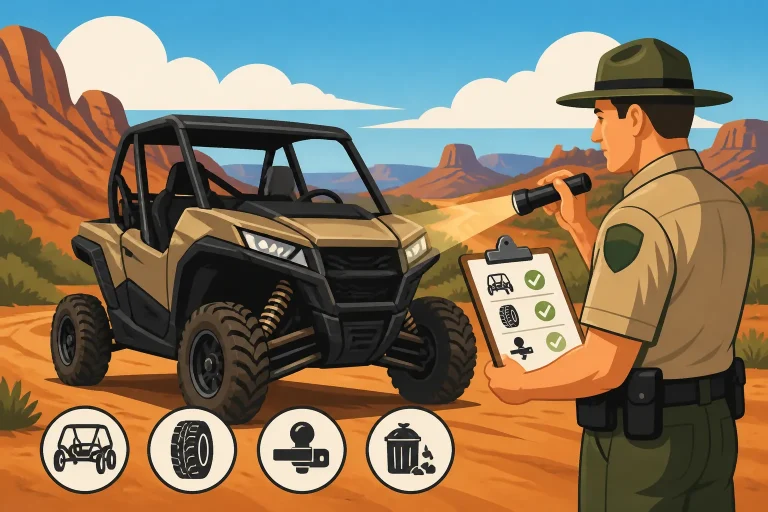
A practical pre-trip check looks like this:
- For each operator: confirm age, certificate requirement, accepted proof, and any supervision condition.
- For each machine: confirm registration, required decal or permit, and whether its type is covered by the paperwork.
- For each route: verify that OHV use is allowed and check closures or local restrictions.
- For each road segment: confirm that the vehicle is allowed on that road and that road-use requirements are met.
A street-legal registration does not necessarily remove every off-highway requirement or make every trail open to the vehicle. Likewise, a non-resident permit does not make an underage rider eligible to operate without required supervision. If a machine will be used both on roads and on trails, look at the requirements for each setting separately.
Keep proof usable in the field
Carry documents in a way that works where you are riding. A screenshot or downloaded file may be convenient, but it will not help if it is stored only in an account that requires mobile service to open. A printed copy can be a useful backup. Keep it protected from water, dust, and damage, and make sure every adult responsible for the group knows where it is.
Before departure, check that the names and details on documents are legible. If a certificate was issued under a different name, or a visitor has a certificate from another state, resolve any questions about acceptance before reaching the trailhead. Sorting out a documentation problem at home is easier than trying to do it in an area with limited reception.
Common mistakes when planning a youth ride
The rules become easier to follow when they are treated as separate checks rather than one general “legal to ride” question. These mistakes are worth avoiding:
- Using a course certificate as proof that a child may ride alone. The certificate and the supervision rule are different.
- Assuming the rules apply only to Utah residents. Visitors should check Utah’s requirements too, including whether their education credential is accepted.
- Confusing a permit with a certificate. A permit for an out-of-state machine does not satisfy a rider education requirement.
- Assuming public land means only a developed recreation area. Routes may cross public lands managed in different ways.
- Relying on another state’s age rules. Minimum ages, supervision, education, and helmet requirements can differ.
- Treating course completion as proof of riding readiness. A child still needs a suitable machine, skills, protective gear, and appropriate adult oversight.
- Waiting until the trailhead to find paperwork. Download or print proof and confirm acceptance before the trip.
- Assuming trail access means road access. Roads have their own restrictions, and an off-highway certificate does not grant road-driving privileges.
If an age, birth date, or supervision situation is unusual, contact the relevant Utah authority before riding. That includes a child close to an age threshold, a visitor with a certificate from another state, or a route that crosses different land jurisdictions. A few minutes of checking can prevent a ride from starting with the wrong assumption.
Frequently Asked Questions
Does every Utah OHV rider need an education certificate?
No. Utah’s certificate requirement is based on a birth-date cutoff and applies to operating on public land. Riders born after January 1, 1988 generally need the required certificate. Other rules, such as age and supervision requirements, can apply independently.
Can a child under eight ride an OHV on public land if they have a certificate?
No. A certificate does not override Utah’s minimum age rule for operating an OHV on public land. A child under eight may not operate one there.
Can a rider aged eight through fifteen operate alone after passing the course?
Passing the course does not remove the supervision requirement. Young operators must meet the applicable adult-accompaniment rule as well as the education requirement.
Does a Utah non-resident permit replace the education certificate?
No. The permit and certificate address different requirements. Visitors should check both the machine’s permit status and each operator’s education and age requirements.
Does an out-of-state OHV safety card count in Utah?
It may, depending on whether Utah accepts that credential. Visitors should confirm acceptance with Utah’s official OHV guidance before relying on an out-of-state card.
Disclaimer
This article is for general informational purposes only and does not constitute professional advice. Laws, prices and regulations vary by location and change over time. Consult a qualified professional for guidance on your specific situation.