Riding a Quad Across a Sidewalk Legally
It can be incredibly frustrating when you just want to get your quad or side-by-side from your driveway to the road, or from a parking lot to the trail access, and you're faced with a sidewalk. You know you can't just cruise down it, but is it even legal to cross it? The confusion about what's permissible often leaves riders worried about breaking the law or, worse, causing an accident. This guide is here to clear up the rules in Utah, explaining exactly how and when you can legally cross a sidewalk with your off-highway vehicle (OHV), whether it's street-legal or not.
Understanding Utah's Basic Rules for Sidewalks and OHVs
Let's get right to the heart of it: generally speaking, riding an ATV or UTV on a sidewalk in Utah is a big no-no. Sidewalks are designed for pedestrians, not powerful off-road machines, and mixing the two creates a serious safety hazard. The law is pretty clear on this for the safety of everyone. However, Utah law isn't designed to trap you on your own property. There are specific, limited circumstances where crossing a sidewalk is not only allowed but necessary, provided you follow the rules. It’s all about getting your machine to an authorized roadway or designated trail without endangering walkers or causing damage.
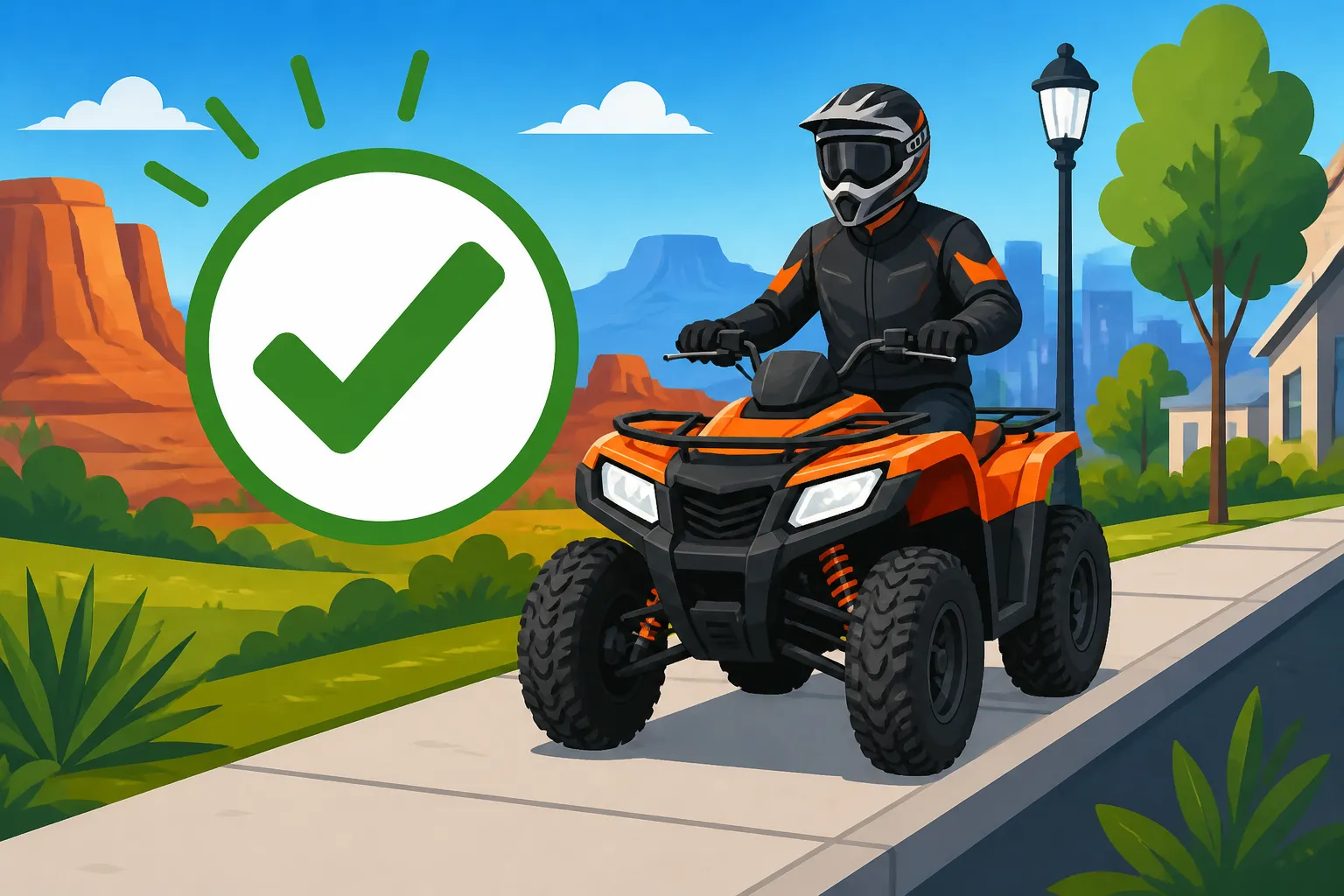
The distinction here is crucial: you can cross a sidewalk, but you cannot travel on it. Think of it like a brief, necessary bridge to get where you need to go. This typically applies when you're moving from a private driveway, parking lot, or garage directly onto a public street, or vice-versa. The state wants to facilitate responsible access for OHV owners, but not at the expense of pedestrian safety or the integrity of public infrastructure. It's a fine line, and misunderstanding it can lead to trouble.
Why Sidewalks Are Off-Limits for OHV Travel
The primary reason sidewalks are off-limits for continuous OHV travel is safety. Pedestrians, often children, seniors, or people with limited mobility, expect sidewalks to be safe zones, free from fast-moving vehicles. The noise, speed, and sheer size of an ATV or UTV can be startling and dangerous in such a confined space. Even at slow speeds, a side-by-side weighs hundreds or even thousands of pounds, and an encounter with a pedestrian could be catastrophic.
Beyond safety, there's also the matter of infrastructure. Sidewalks are not built to withstand the weight and tire action of OHVs. Repeated travel can cause cracks, uneven surfaces, and other damage, leading to costly repairs for local municipalities and potentially creating trip hazards for pedestrians. Furthermore, OHV tires, especially aggressive off-road treads, can be abrasive on concrete and asphalt, accelerating wear and tear. Respecting these boundaries helps keep our communities safe and our public spaces in good condition.
The Legal Definition of Crossing Versus Traveling
In Utah, "crossing" a sidewalk implies a brief, perpendicular movement across its width, directly from one property (like a driveway) to another (like the street). It's a straight shot, as direct as possible, with the sole purpose of transitioning between authorized areas. This is not to be confused with "traveling" on a sidewalk, which would mean driving parallel to the street for any distance, even a short one. Traveling on a sidewalk is almost universally prohibited and will likely land you a ticket.
Imagine you're pulling out of your garage. You drive your UTV down your driveway, and it intersects with the public sidewalk before reaching the street. Legally, you are permitted to traverse that sidewalk section to reach the street. However, if your driveway parallels the sidewalk for any length, you cannot use the sidewalk itself as an extension of your driveway to get to a better vantage point or to bypass a parked car. The moment you are moving along the sidewalk, rather than directly across it, you're usually in violation. This distinction is vital for every rider to understand to avoid unintended legal issues.
When Can You Cross? Specific Legal Scenarios for Utah OHVs
So, when is it okay to cross a sidewalk? Utah law provides specific guidelines, which are largely based on common sense and safety. These rules apply whether your machine is just a regular off-highway vehicle or has been fully converted to be street-legal. The goal is always to minimize risk and impact while enabling reasonable access. It's not about making it easy to hop on and off sidewalks, but about providing a clear path from private property to public roads or designated trail access points.
There are certain conditions that must be met for a legal crossing. These include the necessity of the crossing, the manner in which it's executed, and the responsibility of the OHV operator. Ignoring any of these conditions could transform an otherwise legal maneuver into a citation. Let's break down the most important aspects you need to remember every time you navigate that concrete strip.
Direct Access from Private Property to Public Road
The most common and permissible scenario for crossing a sidewalk is when you are moving your OHV directly from private property (such as your home's driveway, a business parking lot, or a private staging area) to an adjacent public street or highway. This is considered a necessary movement for legitimate ingress and egress. The law recognizes that OHV owners need a way to get their machines to the trailheads or designated street-legal routes. Without this provision, many riders would be effectively trapped on their own property.
However, this doesn't mean you can take a scenic route. The crossing must be the most direct path available, usually perpendicular to the sidewalk itself. You can't use the sidewalk as a shortcut to get to a different street or to bypass a neighbor's driveway. Your path should be straight across, exiting private property and immediately entering the public roadway. Any deviation or lingering on the sidewalk could be interpreted as illegal travel rather than a lawful crossing, and trust me, law enforcement officers are trained to spot the difference.
Yielding to Pedestrians and Maintaining Control
This is probably the single most important rule: when crossing a sidewalk, you must yield to all pedestrians. Period. This isn't just a suggestion; it's a legal requirement and a moral obligation. Pedestrians have the right of way on sidewalks, and as the operator of a much larger, heavier, and potentially dangerous machine, the responsibility for their safety rests entirely on your shoulders. This means slowing down, stopping if necessary, and making eye contact to ensure they know your intention and feel safe proceeding.
Maintaining control of your OHV is also paramount. This involves operating at a very slow speed, being attentive to your surroundings, and ensuring you can stop safely at a moment's notice. Loose gravel at the end of a driveway, a wet patch, or even an unexpected dip can cause a loss of traction or balance, especially for heavier UTVs. A sudden surge of acceleration or a missed brake pedal could lead to a collision. Always approach a sidewalk crossing with caution and a ready foot on the brake.
Perpendicular Crossing and Shortest Distance
When you cross a sidewalk, Utah law expects you to do it at a right angle (perpendicularly) and cover the shortest possible distance across the pedestrian path. This is a practical and safety-oriented rule. A perpendicular crossing minimizes the time your OHV is on the sidewalk, reduces the potential for a side-swipe accident with a pedestrian, and makes your intentions clear. It's a quick, direct pass-through, not a turn onto the sidewalk.
Trying to angle across the sidewalk or driving along it even for a few feet to adjust your approach to the road is generally not allowed. This increases the distance traveled on the sidewalk and the time your vehicle is in a pedestrian zone, thereby increasing risk. Always aim for a straight, direct path. If your driveway doesn't allow for a perfectly perpendicular approach to the street due to its angle, you should still aim for the most direct and shortest crossing of the sidewalk itself, immediately entering the roadway without traveling along the sidewalk at all.
Impact of Street-Legal Conversion on Sidewalk Crossing
If you've gone through the effort of making your ATV or UTV street-legal in Utah, congratulations! This opens up a lot of possibilities for getting to the trails and even riding on certain public roads. However, the street-legal status does not change the rules about riding on sidewalks. A street-legal OHV is still an OHV, and sidewalks are still for pedestrians. The same rules about crossing apply: direct, perpendicular, shortest distance, and yielding to pedestrians.
The benefit of a street-legal machine, when it comes to sidewalks, is that once you've crossed the sidewalk and are on the public road, you can legally travel on that road (where permitted). For a non-street-legal OHV, once you cross the sidewalk and hit the street, you typically need to be on your way to a legal loading point or directly entering a designated trail system that has legal road access, and often only for very short distances, or you must be trailered. The street-legal conversion primarily affects what you can do after you've safely crossed the sidewalk and are on the roadway, not what you can do on the sidewalk itself. Making sure your machine is properly equipped for street use, with elements like clear turn signals and appropriate mirrors, perhaps from a brand like SuperATV, will help ensure you meet visibility standards when you do enter the roadway. [Making a UTV Street Legal in Utah] covers all the requirements for this transformation.
| Behavior | Legality in Utah | Key Considerations |
|---|---|---|
| Riding on a sidewalk for any distance | Illegal | Designed for pedestrians, high risk of accident, property damage. |
| Crossing perpendicularly from driveway to road | Legal (with conditions) | Must be shortest path, yield to pedestrians, maintain control. |
| Crossing to access a trail directly from private land | Legal (with conditions) | Same as above; direct access to a designated trail or public road leading to a trail. |
| Using the sidewalk as a shortcut to another street | Illegal | Considered "traveling" on the sidewalk, not a crossing. |
| Driving slowly along the sidewalk to turn | Illegal | Still considered "traveling" on the sidewalk. |
| Pausing on the sidewalk to check for traffic | Illegal | You should stop before the sidewalk if possible, or cross quickly and yield. |
Safety and Etiquette: Making the Crossing Safely
Beyond just the letter of the law, there's the spirit of it: safety and common courtesy. Crossing a sidewalk, even legally, puts your large, noisy machine into an area typically reserved for quiet pedestrian movement. This requires a heightened sense of awareness and responsibility. It’s not just about avoiding a ticket; it's about being a good neighbor and ensuring everyone, including you, stays safe. A brief moment of inattention can have serious consequences, especially when pedestrians are involved.
This section isn't just about what you can't do, but what you should do to ensure every sidewalk crossing is as safe and smooth as possible. It involves preparation, awareness, and a commitment to cautious operation. Think of it as leaving a good impression of the OHV community.
Pre-Crossing Checks and Visibility
Before you even begin to move towards the sidewalk, take a moment for a quick mental checklist. Is your path clear? Are there any hidden obstacles or blind spots? For example, tall bushes or fences near your driveway can obscure your view of the sidewalk. If you have a UTV, make sure your side mirrors are properly adjusted. Aftermarket mirrors, like those you might find from a brand like SuperATV, can offer a wider field of view, significantly enhancing your ability to spot an approaching pedestrian or cyclist.
Always look both ways—multiple times, if necessary—for pedestrians, joggers, cyclists, or even children playing. Your machine is much quieter than a car at slow speeds, and a pedestrian might not hear you approaching. Make sure your headlights are on, even during the day, to increase your visibility. Many riders install auxiliary lights for better trail visibility; these can also serve as a great safety feature during sidewalk crossings, making your presence known. [Headlights and Tail Lamps Utah Requires] provides more detail on lighting.
Operating at Minimal Speed and High Alertness
When approaching and crossing a sidewalk, your speed should be barely above idle. Think "walking pace" at most. This gives you maximum time to react to an unexpected pedestrian, a child darting out, or even a pet. Rapid acceleration or braking can be jarring and unsafe. Smooth, controlled movements are key. Your hands should be firmly on the steering wheel or handlebars, and your foot ready on the brake.
Maintaining high alertness means more than just looking. It means listening, too. Are there sounds of children playing nearby? Is there a dog walker with headphones on who might not hear you? It means anticipating potential hazards. A ball rolling into the street could mean a child is close behind. The moment you are on or near a sidewalk, your focus should be entirely on the immediate surroundings, prioritizing pedestrian safety above all else. This isn't the time to check your phone or admire the scenery.
Avoiding Damage to Sidewalks and Landscaping
While the primary concern is pedestrian safety, also be mindful of the physical environment. Stick to the paved surface of the sidewalk. Avoid driving over grass verges, planter strips, or any other landscaping. Not only can this damage public or private property, but it can also lead to citations for property damage or trespassing. The tires of an OHV, especially those designed for aggressive off-road traction, can easily tear up turf or compact soil, harming trees and plants.
If your driveway ends in a way that creates a drop-off to the street, and you find yourself frequently scraping or bottoming out when crossing the sidewalk, consider a gradual ramp or curb cut if permissible by your municipality, rather than stressing the sidewalk itself. Some riders might also consider adjusting their suspension or tire pressure slightly for the brief transition, though usually, slow and steady is all that's needed to prevent damage. [Tire Rules for Street-Legal Machines] touches on tire considerations for road use.
Communication and Courtesy with Pedestrians
Even if you have the legal right to cross, a little courtesy goes a long way. If you see pedestrians approaching, stop before the sidewalk and wave them through. A simple hand gesture can avoid confusion and potential conflict. If you're on a street-legal machine and need to cross, consider a quick, light tap on your horn (if equipped, and many street-legal conversions include one, like those from SuperATV) to gently announce your presence, but only if absolutely necessary and never in a way that would startle someone.
Remember, most pedestrians aren't expecting an OHV on or near their sidewalk. They might not be familiar with the rules for [Riding a UTV in a Utah Neighborhood] or how [City and County OHV Rules Across Utah] apply. Your polite, cautious demeanor helps build positive relationships between the riding community and the general public. It reinforces the idea that OHV enthusiasts are responsible and respectful citizens, not just thrill-seekers.
What Happens If You Don't Follow the Rules
Ignoring Utah's rules for sidewalk crossings can lead to a range of unpleasant consequences, from a friendly warning to significant fines and even impoundment of your machine. Law enforcement officers take pedestrian safety seriously, and any infraction involving sidewalks is likely to draw their attention. It’s far better to understand and follow the rules than to face the penalties.
It’s not just about what an officer sees; it’s about the impact on others and your own reputation as a responsible rider. Getting a ticket for something preventable is frustrating, especially when the information to avoid it is readily available.
Potential Fines and Citations for Improper Crossing
If you're caught riding on a sidewalk for any distance, or crossing improperly (e.g., failing to yield, not crossing perpendicularly), you could face a traffic citation. The specific fine amount can vary by municipality and the severity of the offense, but it's rarely cheap. Expect a financial hit that could easily outweigh the perceived convenience of taking a shortcut. These violations are often treated similarly to other traffic infractions and can accumulate on your driving record if you're operating a street-legal machine with a driver's license.
Beyond the initial fine, repeated offenses or particularly egregious violations (like nearly hitting a pedestrian) could lead to more severe legal action. It's a risk that is simply not worth taking. The purpose of the laws is to ensure public safety, and enforcement reflects that priority. Always remember, the officer isn't just looking for speeding; they're looking for unsafe operation, and an OHV on a sidewalk definitely falls into that category. [The Fine for an Expired OHV Registration in Utah] gives you an idea of the costs involved with other OHV infractions.
Increased Risk of Accidents and Liability
The most serious consequence of improper sidewalk crossing is the increased risk of an accident. If your OHV collides with a pedestrian, cyclist, or another object while you're operating it unlawfully on a sidewalk, the repercussions can be devastating. Injuries, property damage, and emotional trauma are all very real possibilities. In such a scenario, your liability would likely be significant.
Insurance policies for OHVs typically have specific exclusions for unlawful operation or use on prohibited areas. This means if you cause an accident while illegally riding on a sidewalk, your insurance might refuse to cover the damages, leaving you personally responsible for potentially massive medical bills, property repair costs, and legal fees. Even if you have liability coverage, operating outside the law's explicit allowances can complicate or void your coverage. This financial risk alone should be a powerful deterrent. Always ride safely and legally to protect yourself and others.
Negative Perception of OHV Riders
Every time an OHV rider is seen operating unsafely or unlawfully, it contributes to a negative public perception of the entire OHV community. Unfortunately, it only takes a few bad apples to sour the experience for everyone. When people see an ATV or UTV on a sidewalk, their immediate reaction is often fear or annoyance, leading to complaints to local authorities and calls for stricter regulations on OHVs.
This negative perception can directly impact trail access and the ability to ride on roads. If enough residents complain about OHVs operating improperly, city councils and county commissions might be pressured to impose further restrictions, close down routes, or even ban OHVs from certain areas altogether. By adhering to the rules, especially simple ones like proper sidewalk crossing, you are actively advocating for the rights and freedoms of all OHV riders in Utah. Be a good ambassador for the sport.
Disclaimer
This article is for general informational purposes only and does not constitute professional advice. Laws, prices and regulations vary by location and change over time. Consult a qualified professional for guidance on your specific situation.