What Happens If You Never Register a Quad
It's easy to push off the "paperwork" part of owning a quad or side-by-side, especially when all you want to do is hit the trails. Maybe you bought a machine years ago and never got around to it, or perhaps you picked up a used ATV and thought, "Out of sight, out of mind" for registration. But ignoring Utah's OHV registration requirements can lead to a whole host of unexpected, costly, and deeply frustrating problems down the road. This guide will walk you through exactly what can happen if you never register your quad or UTV in Utah, shedding light on the risks you might not even realize you're taking.
The Immediate Risks and Penalties
Let's face it: no one wants a run-in with law enforcement, especially when you're just trying to enjoy a day out on the trails. Unfortunately, riding an unregistered OHV in Utah significantly increases your chances of doing just that, leading to immediate headaches and financial hits.
Fines for Riding Unregistered
Picture this: You're out on your favorite trail, enjoying the fresh air and the thrill of the ride. Suddenly, you see a Utah State Parks Ranger or a local sheriff's deputy up ahead, checking machines. Your stomach clenches because you know your quad isn't registered. When they ask for your registration, and you can't produce it, you're looking at a penalty. Utah takes OHV registration seriously, not just to collect fees but also to fund trail maintenance, education, and safety programs.
The fines for riding an unregistered OHV aren't just a slap on the wrist. They can vary, but generally, you're looking at a significant ticket that will instantly sour your day – and likely cost more than the actual registration fee would have. It's not uncommon for these fines to run into the hundreds of dollars, and that's just the start. This unexpected expense can be a real punch to the gut, especially if you're on a tight budget. Plus, a fine often means a court appearance or dealing with administrative hassles, eating up your valuable time.
Impoundment of Your Machine
Beyond a simple fine, one of the most drastic consequences of riding an unregistered OHV is the potential for your machine to be impounded. Imagine watching your beloved quad or side-by-side being loaded onto a tow truck, knowing you can't just drive it home. This isn't just an inconvenience; it's a major financial and logistical nightmare. The authorities have the right to seize and impound vehicles that are operating illegally, and an unregistered OHV certainly falls into that category.
Once impounded, getting your machine back is anything but simple. You'll face impound fees, daily storage fees that can quickly add up, and often, you'll still need to resolve the registration issue before the impound lot will release your machine. This means scrambling to get your paperwork in order, paying the original registration fees, and then paying all the accumulated impound and storage costs. The total bill for recovery can easily run into thousands of dollars, far exceeding the initial cost of registration and any fines you might have received. It’s a situation no OHV owner ever wants to find themselves in, adding immense stress and unexpected financial strain. You can learn more about this by checking out [Impound Risk for Unregistered Machines in Utah].
Broader Legal and Financial Consequences
The immediate pain of a fine or impoundment is just the tip of the iceberg. Failing to register your quad or UTV in Utah can create a ripple effect of legal and financial problems that extend far beyond the trails.
Limited Riding Opportunities
Owning an OHV is all about the freedom to explore, but an unregistered machine severely limits where you can actually go. In Utah, most public lands, designated OHV trails, and state parks require current registration. This means if your quad isn't registered, you're essentially locked out of the vast majority of legal riding areas. You might be able to ride on your own private property, but that's a lonely existence for an adventure machine.
Think about it: you've invested good money in your ATV or UTV, but without registration, you can't legally enjoy the incredible trails Utah has to offer, from the red rocks of Sand Hollow to the epic Paiute Trail. This frustration can build up over time, turning what should be a source of joy into a source of regret. You see other riders heading out to amazing destinations, and you're stuck, knowing you can't join them because of a missed registration step. Understanding [Private-Land-Only Machines and Utah Registration] can help clarify what few options you might have.
Sales Tax and Ownership Hurdles
Even if you only plan to ride on private land, skipping registration can create unexpected issues with sales tax and proving ownership. When you purchase an OHV, especially from a private seller, Utah law generally requires you to pay sales tax on the transaction. This is often handled at the time of registration. If you never register, you might think you've avoided sales tax, but that's a common misconception. The state still expects those taxes, and failing to register can flag your purchase as non-compliant down the line. [Utah ATV Sales Tax and Uniform Fees] covers this in more detail.
Beyond taxes, a lack of official registration makes proving legal ownership much more difficult. When you register your machine, the state issues you a title and registration card, which are your official proof of ownership. Without these, if your machine is ever stolen, recovered, or involved in an incident, you could face significant challenges asserting your rights to it. This can be a huge headache, especially if you ever need to involve law enforcement or an insurance company. Having your full complement of paperwork on hand is crucial, as you'll see in [What Paperwork Utah Riders Must Carry]. Even simple documents like a bill of sale, which you can draft with resources like LawDepot, need to be supported by official state registration for ironclad proof of ownership.
The Long-Term Headaches
While immediate consequences are impactful, the decision to never register a quad or UTV can lead to persistent, long-term problems that will only grow more complicated over time.
Difficulties with Future Sale or Transfer
So, you've decided it's time to upgrade or simply sell your unregistered quad. This is where you'll hit a major roadblock. Most legitimate buyers, whether private individuals or dealerships, will expect a clear title and current registration. Without these, your machine will be much harder to sell, and its market value will take a significant hit. Buyers are wary of machines without proper documentation because they know they will be responsible for dealing with the outstanding registration, taxes, and potential penalties.
Trying to sell a machine that was never officially registered can open a Pandora's box of questions for potential buyers. They'll wonder about its history, whether sales tax was paid, and if there are any hidden liens or legal issues. You might find yourself needing to go through the entire registration process just to sell it, which means facing all the back fees and penalties you tried to avoid in the first place. A smooth sale depends on having a clear title and registration, something you can learn more about in [Selling an ATV in Utah: Title and Bill of Sale]. If you find yourself in a situation where you have [No Title From the Seller: What Utah Requires], you'll quickly realize how essential proper documentation truly is. Using a service like LawDepot to create a comprehensive bill of sale is a great start, but it's only truly effective when backed by official state records.
Insurance and Liability Concerns
Many OHV owners mistakenly believe that if they only ride on private land, they don't need insurance or registration. While private land use may have different rules, a lack of state registration can still complicate insurance matters significantly. If your unregistered quad is stolen, vandalized, or damaged, your personal property insurance might be hesitant to cover it if it's not legally recognized as yours by the state. Insurance companies rely on official documentation to process claims, and an unregistered machine creates a gray area that can lead to denials or lengthy disputes.
Beyond property damage, consider the liability aspect. If your unregistered OHV is involved in an accident, even on private property, and someone is injured, you could face severe personal liability. Without proper registration and the potential for a formal ownership trail, it can be harder to prove who is responsible or even to secure adequate liability insurance coverage. [When Utah Requires Insurance on an OHV] explains more about the state's expectations regarding insurance. The financial and legal fallout from such an incident could be devastating, far outweighing the cost and effort of simply getting your machine registered from the start.
The Simplicity of Getting Registered
Given all the potential pitfalls of never registering your quad, it's worth taking a moment to understand that the process itself isn't nearly as intimidating as the consequences of avoiding it. In fact, getting your OHV properly registered in Utah is a relatively straightforward process designed to get you out on the trails legally and safely.
The Registration Process Isn't as Hard as You Think
Many people procrastinate on registration because they imagine a bureaucratic nightmare, long lines, and endless paperwork. While it does require some attention to detail, Utah has streamlined its OHV registration process considerably. Generally, you'll need your vehicle's title, a bill of sale (especially if you bought it privately), and the Vehicle Identification Number (VIN). The state uses these documents to establish ownership and collect any necessary sales tax and fees. You can initiate the process at a local DMV office or, in many cases, online.
The fees involved, while an expense, are typically minor compared to the fines and impound costs you could face if caught unregistered. These fees cover your actual registration and the "uniform fee" that Utah assesses on OHVs, which helps fund vital programs. You can get a good overview of the costs in [Utah OHV Registration Fees, Start to Finish]. Once registered, you'll receive your registration card and the all-important decal, which needs to be displayed correctly on your machine. Don't forget to check out [Utah OHV Decals and Where They Go] to ensure you place it in the right spot. Having all your ducks in a row with a [A First-Time Buyer's OHV Paperwork Checklist in Utah] makes the whole experience much smoother. Remember, the goal is to enjoy your machine without worry, and proper registration is your ticket to that peace of mind. Check out [How to Register an ATV or UTV in Utah] for a step-by-step guide.
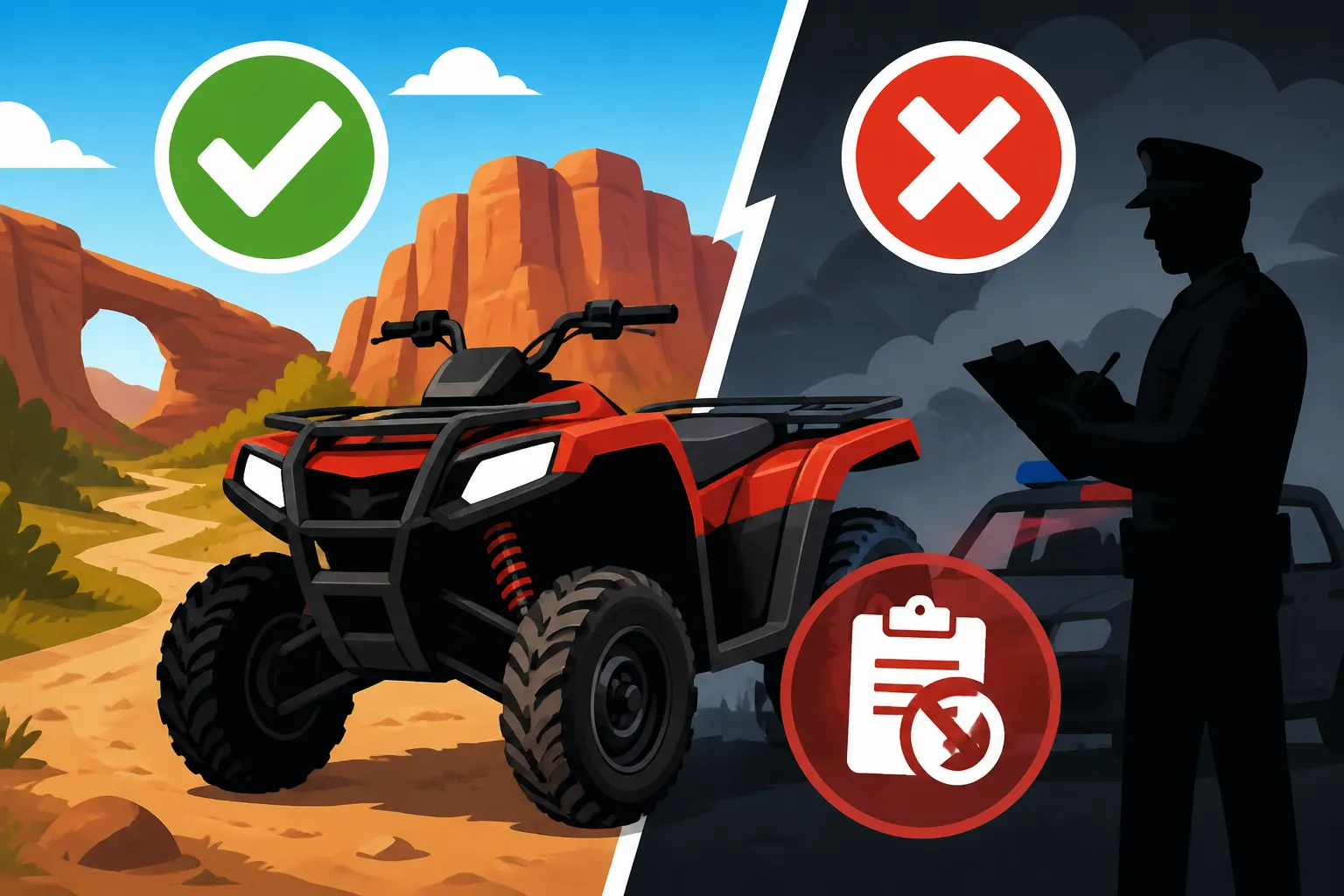
Here's a quick look at the stark differences between riding with and without proper registration:
| Feature/Consequence | Registered OHV | Unregistered OHV |
|---|---|---|
| Legal Riding Access | Access to most public lands, designated trails, state parks | Limited to private land (with owner permission); illegal on most public trails |
| Fines & Penalties | None for registration status | Significant fines, potential court appearances |
| Impoundment Risk | Very low (unless other violations occur) | High risk of impoundment, resulting in costly fees and recovery efforts |
| Proof of Ownership | Clear title and registration card from the state | Difficult to prove ownership, reliant on personal documents (e.g., bill of sale from LawDepot) |
| Sales Tax Compliance | Sales tax typically paid and accounted for at registration | Potential for unaddressed sales tax liabilities and fines |
| Selling/Transferring | Smooth process with clear title for buyer | Difficult to sell, lower market value, buyer apprehension, potential legal hurdles |
| Insurance Claims/Liability | Clear path for insurance claims, liability coverage often clearer | Complicated or denied claims, increased personal liability risk |
| Peace of Mind | High – ride without constant worry | Low – constant anxiety about being caught or facing unforeseen issues |
Ultimately, while the thought of doing paperwork can be a drag, the consequences of never registering your quad or UTV in Utah are far more daunting and costly than the initial effort. Taking the time to properly register your machine ensures you can enjoy Utah's incredible OHV opportunities legally, safely, and without the constant worry of fines, impoundment, or future headaches. It's an essential step for any responsible OHV owner.
Disclaimer
This article is for general informational purposes only and does not constitute professional advice. Laws, prices and regulations vary by location and change over time. Consult a qualified professional for guidance on your specific situation.