Permission for Private Land in Utah
A route on a map can look open while crossing land you cannot legally enter. In Utah, riding permission and OHV paperwork are separate questions: an owner’s approval does not necessarily cover nearby public roads or trails, and a permit does not give you access to private property. Here’s how to confirm who controls the land, ask for permission, and keep a ride within the agreed boundaries.
What Permission for Private-Land Riding Covers
Permission means the person with authority over the property has allowed you to enter and ride there, subject to any conditions they set. A trail’s appearance, an unlocked gate, tire tracks, or a route shown in an app is not a reliable substitute for permission.
Before unloading, establish whether the land is actually private and who can authorize your use. The owner may not be the only person with control: a land manager, tenant, ranch operator, or other authorized representative may handle access. If you are unsure who has authority, ask rather than assuming that a nearby resident or worker can grant it.
Permission is also specific to the property and activity. Approval to cross a parcel may not include permission to ride around, camp, hunt, build a fire, bring a large group, or use the land on a different date. The safest approach is to confirm the details directly with the owner or authorized manager.
| Situation | What to confirm before riding |
|---|---|
| A route crosses a private parcel | Permission to cross, where the route runs, and when access is allowed |
| You have permission to use a trail | Whether the permission covers every rider and machine in your group |
| A gate is open | Whether the landowner has authorized entry; an open gate alone is not permission |
| A public route meets private land | Where the public route ends and whether you may continue across the parcel |
| You are riding on a private property you own | Whether separate rules apply to registration, public-road use, or access to adjoining land |
| A landowner gives verbal approval | Whether you can confirm the route, dates, conditions, and contact details in writing |
Permission for one section of a ride does not authorize the rest. A landowner may approve a short crossing to reach a trail but not use of the surrounding property. Likewise, approval from one property owner does not cover neighboring parcels. If the route crosses several holdings, make sure you have permission for each section that is not open to public use.
Be especially careful with routes that appear to connect public land. A public trail or road may reach a boundary and then continue over private property. The existence of a route on an online map does not prove that every segment is open to the public. Use Private Land Crossings on Utah Routes to think through how a crossing can affect an otherwise public ride.
Private-Land Permission Is Not the Same as an OHV Permit
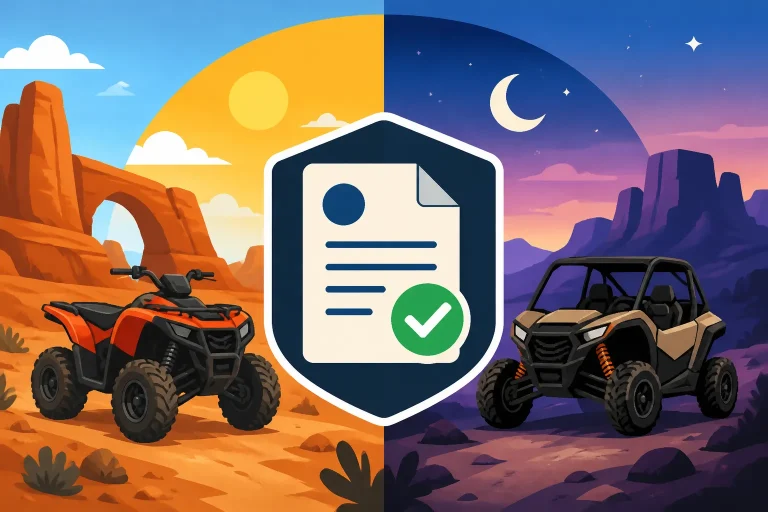
A landowner’s permission and government requirements answer different questions. Permission addresses whether you may enter a particular property. Registration, nonresident permits, education requirements, equipment rules, and other regulations address whether and how you may operate an OHV under applicable law.
That distinction matters when a ride starts on private land but uses a public road, trail, or access area to get there. It also matters when a route crosses between private and public property. Approval from a landowner cannot authorize use of a public route in a way that violates its rules, and a permit for public riding does not authorize entry onto a private parcel.
Utah has requirements for visitors operating OHVs on public land. The details can depend on the machine, the rider, where the machine will be used, and whether an exception applies. Review Utah’s Non-Resident OHV Permit Explained and Who Needs a Utah Non-Resident OHV Permit if you are visiting from outside Utah. For the broader requirements that can apply to visitors and their machines, see Visiting Utah With an Out-of-State Machine.
If you plan to ride only on private property, do not assume either that a public-land permit automatically applies or that private property automatically exempts you from every other requirement. Confirm current rules with the appropriate official source for your circumstances. The route matters: riding entirely within a private parcel is different from taking a public road to reach it or continuing onto a public trail.
The same caution applies to registration and street use. A machine’s status for private-land riding may not answer what is required if you drive it on a public road, even briefly. Check the rules for the road and machine before treating a short connection as an informal exception.
Before a mixed private-and-public ride, separate the questions:
- Which land sections are private, and who can authorize entry?
- Which sections are public, and what rules apply there?
- Does your machine need current registration or a permit for the planned public use?
- Do riders need an education certificate or other documentation?
- Is any part of the route on a public road, and is the machine allowed there?
The items riders must carry can differ according to the ride and the applicable rules. What Utah Riders Must Carry on Public Land is useful when a trip includes public routes. Public-land permissions and agency rules may apply alongside state requirements; BLM Rules That Sit on Top of Utah Permits explains why a state permit should not be treated as a substitute for every land manager’s rules.
How to Ask for Permission and Record the Terms
Ask before arriving, and be clear about the request. A landowner is more likely to give a useful answer when they know who is coming, what machines are involved, where you want to ride, and how long you expect to be there. Avoid asking for vague access to “the trails” if you can identify a specific crossing or route.
A practical request should cover:
- The proposed date or date range and the expected arrival and departure times
- The number of riders, machines, and support vehicles
- The trail or route you hope to use, including where you will enter and exit
- Whether you want to stop, unload, camp, or leave a vehicle on the property
- Any planned group activity, filming, organized event, or commercial use
- A contact number and a plan for reporting a problem or changing the route
For a short, one-time crossing, a brief conversation may be enough to clarify the request, but written confirmation is more dependable. A text or email can record what was agreed without turning the conversation into a complicated contract. For recurring access, a larger group, or a commercial activity, ask whether the landowner wants a more formal written agreement.
Keep the permission precise. It should identify the property or route well enough that your group can follow the approved path. If the owner says to stay on a particular track, do not take a tempting side route, even if it looks harmless. If the route is unclear, ask for landmarks or a map before the ride. A current map can help everyone understand the route, but it does not create permission; see Utah OHV Trail Maps and How to Read Them for map-reading context.
Confirm any conditions that matter to the owner, such as:
- Gates: whether to close or leave them as found
- Livestock: how to avoid disturbing animals and what to do if they are on the route
- Speed and noise: any limits or quiet areas
- Group size: whether the approval covers the entire group
- Stops: whether riders may park or take breaks
- Property use: whether camping, fires, or other activities are excluded
- Changes: who to contact if weather, a breakdown, or a delay alters the plan
Do not treat permission as permanent unless the owner clearly says it is. A landowner can set dates or other conditions, and access can change. Confirm again if your group, machine count, route, or timing changes. If the person who granted access is not the owner, make sure they are authorized to do so and that the permission reaches the parcel you intend to enter.
Carry a copy of the confirmation, along with a phone number for the person who granted access. A saved message is useful if someone in the group is unsure about a boundary or route. It is not a replacement for required registration, permits, certificates, or other documents.
Avoiding Boundary Mistakes and Disputes
The most common access mistake is assuming that a ride is public because it is established, appears in a mapping app, or has been used by other riders. Land boundaries can be hard to see on the ground, and maps may not show current access terms. Check route status and closures before towing to a trailhead; Checking Utah Trail Conditions Before You Tow can help with the planning side, but it cannot confirm permission from a private owner.
Use more than one source when the boundary is uncertain. Maps can help identify parcels and public routes, but treat them as planning tools rather than final proof of access rights. If a route depends on a private crossing, contact the landowner or the relevant land manager. When the crossing is not clearly authorized, turn back or choose another route.
Pay attention to signs, gates, fences, and instructions. Do not cut a fence, move a barrier, or assume a gate is open for recreational access. If a sign or barrier conflicts with what you understood, stop and resolve the issue before proceeding. Permission for one crossing does not give you authority to alter property or ignore conditions.
A group leader can reduce confusion by sharing the route and permission terms before the ride. Identify a lead rider and a sweep, keep the group together where practical, and make sure no one takes an unapproved spur. If someone gets separated, the agreed route and contact plan can prevent an attempt to rejoin the group by crossing land without permission.
If the owner asks your group to leave, comply calmly and promptly. Do not argue that a map, old message, or another rider’s past access overrides current instructions. If you believe there is a genuine misunderstanding, move out of the way and resolve it later through a clear conversation or official channel.
Respectful access can help prevent closures and preserve relationships between riders and landowners. Stay on the approved route, avoid disturbing livestock, pack out trash, and report damage or a problem as agreed. Leave gates as instructed, and do not bring additional riders or vehicles beyond the scope of the permission.
Before the trip, run through this short checklist:
- Identify every private parcel on the planned route.
- Confirm that the person granting access has authority over each parcel.
- Get permission for the specific dates, group, machines, and route.
- Record any conditions and share them with everyone riding.
- Check requirements for any public trail, road, or land section.
- Carry the permission confirmation and required OHV paperwork.
- Change plans if a boundary, closure, or access condition is unclear.
Permission makes a private-land ride possible; it does not remove the need to plan carefully. When you cannot confirm access, choose a route that is clearly open to the public or contact the land manager before entering.
Disclaimer
This article is for general informational purposes only and does not constitute professional advice. Laws, prices and regulations vary by location and change over time. Consult a qualified professional for guidance on your specific situation.