Getting Unstuck Alone in the Utah Desert
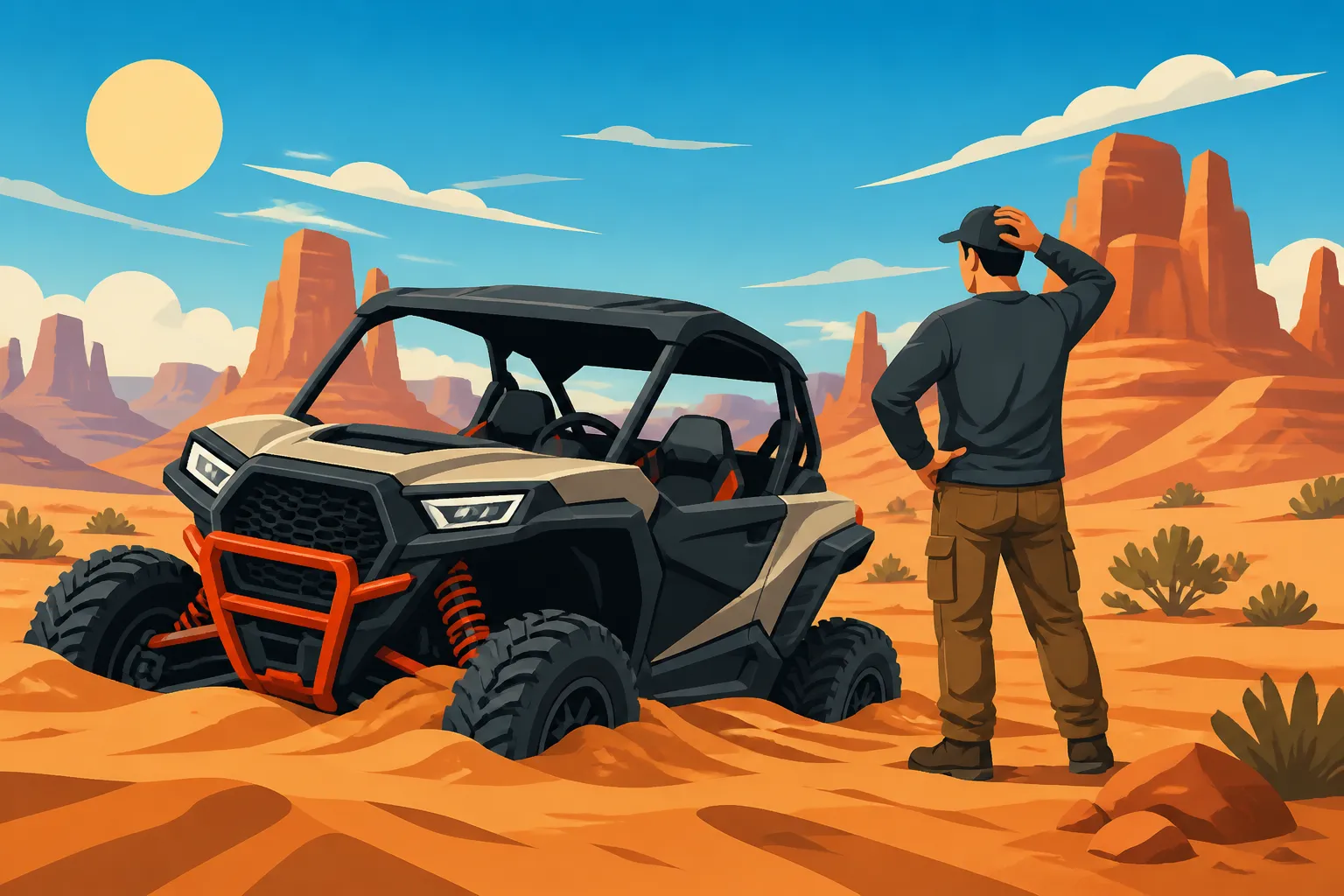
Getting stuck alone in the Utah desert can turn a routine ride into a serious problem, especially when the machine is buried, your phone has no signal, and the heat is building. This guide explains how to prepare, assess the situation, and attempt a careful self-recovery without making the problem worse—and when to stop and call for help.
Prepare before you ride alone
Solo riding always carries more risk: if you are hurt or your machine becomes disabled, there may be nobody nearby to help. The safest recovery often starts before you leave the trailer. Share your route and expected return time with someone who will notice if you do not check in, and take enough supplies to wait safely if self-recovery is not possible.
Plan for the route and the conditions
Utah’s riding areas vary sharply. Sand near Little Sahara or Sand Mountain behaves differently from slickrock around Moab, and a dry wash in the San Rafael Swell can become hazardous when rain falls nearby. Check the forecast for the riding area, not just the nearest town. Consider recent storms, heat, wind, daylight, and seasonal closures before deciding whether a solo trip makes sense.
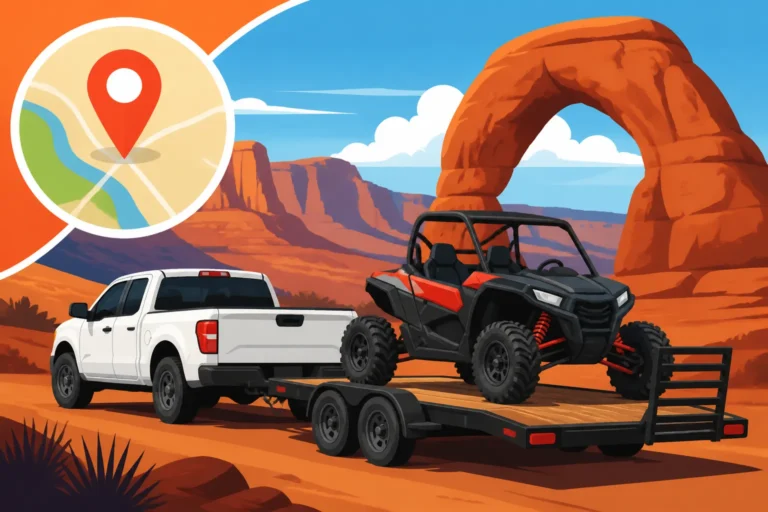
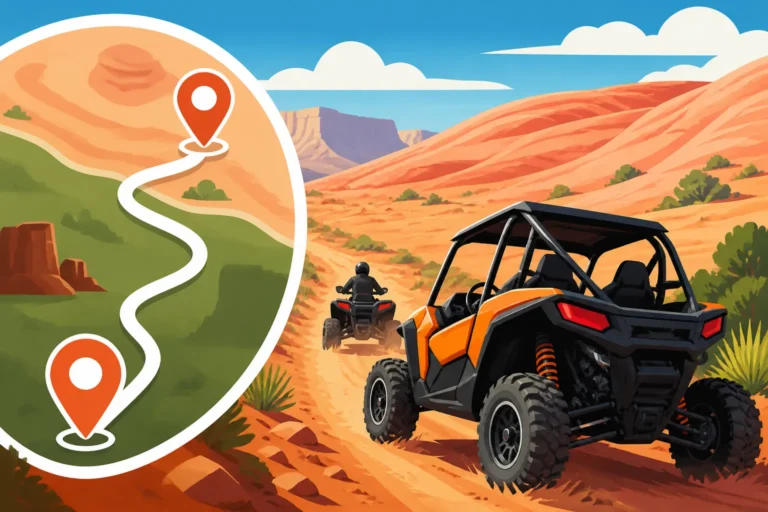
Download maps for offline use and confirm you can identify your trailhead, planned route, and a way back. A mapping app such as onX Offroad can help you save route information before you lose service, but a phone map is not a rescue plan. Keep a separate power source, know how to use your navigation tools, and carry a paper backup or another way to orient yourself. For route-planning basics, see Utah OHV Trail Maps and How to Read Them and Downloading Utah Trail Maps for Offline Use.
Tell a reliable person where you are going, what machine you are riding, and when to expect your check-in. Agree on what they should do if you miss it. “I’m going near Moab” is not a useful trip plan; a named staging area, intended route, and return time are far more helpful. For remote areas where cell coverage may be limited, a satellite messenger can provide a way to send a message or request help. Learn its operation before the trip and keep it accessible, rather than buried in a pack. Satellite Messengers for Remote Utah Rides covers the planning side of that decision.
Pack for recovery and for waiting
A shovel, traction boards, tire-pressure gauge, and portable compressor are useful on many desert rides, but gear only helps if it is suitable for your machine and you know how to use it. Carry recovery equipment that matches your vehicle’s weight and has a clear, safe method of attachment. Inspect straps and hardware for wear before the trip. A tow ball is not a recovery point; use only designated, rated points approved for your machine.
Bring water, food, sun protection, warm layers for changing conditions, a first-aid kit, and a light source. The quantity of water you need depends on heat, exertion, route length, and your own needs, so plan conservatively rather than assuming you can find more. Keep essential items where you can reach them if the machine is on its side or difficult to access. What to Carry on a Utah Day Ride and Water to Pack for a Summer Utah Ride can help you build a practical checklist.
Use onX Offroad or another mapping tool to review the route and identify nearby roads or staging areas before you head out. Save the map for offline access and confirm that the route is actually open to OHVs; a line on a screen does not establish permission to ride. Check closures and local conditions before towing, especially after storms. See Checking Utah Trail Conditions Before You Tow for more on that pre-trip step.
Diagnose why the ATV or UTV is stuck
Before pulling, digging, or airing down, stop and look carefully. A machine that is only mildly bogged down can become buried quickly if the wheels keep spinning. First make sure you are not in immediate danger from traffic, unstable ground, rising water, extreme heat, or a mechanical problem.
Identify the surface and the source of the problem
In soft sand, spinning tires may dig the vehicle down to its frame. In slickrock, the machine may be hung up on a ledge or high-centered rather than lacking traction. Mud can hide ruts, rocks, or water, while loose gravel can shift under a tire or jack. The right response depends on what is supporting the machine, so look at all four tires and the underside before trying to move it.
Ask yourself a few questions:
- Is the vehicle resting on its frame, skid plate, or differential?
- Are the tires buried, or are they on a surface where they cannot gain traction?
- Is a wheel wedged against a rock, ledge, or rut?
- Is the ground stable enough to stand and work on?
- Can the machine move in a direction that is both safe and legal?
If you cannot see what is holding the vehicle, do not assume that more throttle will solve it. Stop the wheels, turn off the engine if you need to inspect near moving parts, and clear loose material by hand or with a shovel from a safe position. Keep hands and clothing away from hot components and pinch points.
Decide whether to attempt self-recovery
A modest recovery may be reasonable if the machine is stable, the recovery point is accessible, the ground is safe, and you can work without standing in the path of the vehicle or a loaded line. It is not a good time to improvise if the machine is badly tilted, near a drop-off, in a wash with possible runoff, or damaged in a way that affects steering, braking, or fuel containment.
Heat and fatigue matter, too. If you feel dizzy, confused, nauseated, unusually weak, or unsteady, stop working and address your condition first. Move to shade if available, drink water, and contact help if symptoms are serious or do not improve. A difficult recovery can take longer than expected, and dehydration makes judgment worse.
If you are uncertain about the anchor, the attachment point, or the machine’s stability, do not test the setup by putting yourself near the line. A vehicle that shifts suddenly can cause severe injury. In remote country, a conservative decision to wait for assistance is often safer than a rushed recovery attempt.
Work through a careful self-recovery
Choose the simplest method that fits the situation. Often that means clearing material and restoring traction rather than pulling hard. Make one small change at a time, then reassess. If the machine does not move as expected, stop instead of adding more force.
Free the tires and build traction
For a machine buried in sand, remove loose material from in front of and behind the tires, and clear space beneath the chassis if it is resting on the ground. Use a shovel without reaching beneath an unstable vehicle. Place traction boards where the tires can climb onto them, following the product’s instructions and keeping yourself out of the vehicle’s possible path.
If the manufacturer’s guidance and your experience support it, reducing tire pressure can sometimes increase the tire’s contact area on soft ground. Make small, measured adjustments and avoid going below a safe level for the tire, load, and terrain. Carry a gauge and compressor so you can restore appropriate pressure before returning to faster or firmer surfaces. Do not drive at speed on an underinflated tire.
When the machine is free enough to move, use gentle, controlled throttle. Avoid repeated wheelspin, sharp steering, and sudden acceleration. If it starts moving, continue only far enough to reach stable ground. Then stop and check for damage, tire pressure, and loose gear. If the vehicle is high-centered or wedged, traction boards alone may not address the problem; forcing the machine can damage the underside or push it into a worse position.
Use a winch only with a safe setup
A winch can help when the machine has a suitable rated recovery point and you have a stable, appropriate anchor. In the Utah desert, a tree may not be available, and digging up vegetation or attaching to an unsuitable object can damage the landscape or create a dangerous setup. Use only an anchor method that is rated for the load, allowed in that location, and appropriate for the equipment. If you cannot identify one, do not improvise.
Before applying tension, inspect the cable or synthetic line, connections, and recovery point. Keep people clear of the line and the area where the vehicle could move. Use the winch according to its instructions, stand well away from the line, and operate it from a position that does not put you in the vehicle’s path. Do not wrap a recovery strap around a hitch ball, and do not use a strap, shackle, or anchor whose capacity or condition you cannot verify.
Solo operation makes it especially important to avoid shortcuts. Do not stand over a loaded line, reach into a moving winch, or lean on a vehicle that may shift. Keep the recovery as straight and controlled as possible, and stop if the anchor moves, the line behaves unexpectedly, or the machine begins to tip. A recovery setup that requires you to be beside a tensioned line is not a safe solo setup.
| Situation | Safer first step | Stop and reassess if |
|---|---|---|
| Tires buried in soft sand | Clear material and place traction boards | The chassis is buried or the machine keeps sinking |
| Machine high-centered | Inspect what is supporting the underside | It is unstable or wedged against a ledge |
| Tire trapped in a rut | Clear the wheel path and plan a slow, straight exit | Steering or suspension appears damaged |
| Winch recovery needed | Confirm rated points and a suitable anchor | You cannot verify the anchor or stay clear of the line |
| Heat, injury, or rising water | Move to safety and contact help | Your route out is uncertain or conditions are worsening |
Know when to stop and call for help
A safe recovery is not always a successful self-recovery. If the vehicle is unstable, the winch anchor is uncertain, the machine is damaged, or your health is deteriorating, stop. Contact your designated person or emergency services as appropriate, share your location, and conserve battery power. If you use onX Offroad, a saved location or route may help you explain where you are, but do not rely on a phone app to transmit your position when there is no signal.
Do not leave the machine without considering the terrain, weather, daylight, and your ability to reach a known road or staging area safely. A short walk can become a serious exposure risk in heat or remote terrain. If you must leave to seek help, take water, navigation, communication equipment, and sun protection. Make a deliberate plan for the machine and tell someone which direction you are going.
After the incident, check yourself and the vehicle before continuing. Look for leaks, damaged tires, loose steering or suspension parts, winch or recovery-point damage, and anything that could interfere with braking. If something seems wrong, do not ride farther just to avoid leaving the machine. Arrange a proper recovery instead.
Use the experience to adjust future plans: choose a less remote route, ride with another person, improve recovery training, or carry equipment better suited to your machine. Check route access and restrictions before entering unfamiliar land, and never bypass a closed route or gate to find another way out. What a Closed Gate Means on Public Land explains why a closure should be treated as a boundary, not an invitation to improvise.
Disclaimer
This article is for general informational purposes only and does not constitute professional advice. Laws, prices and regulations vary by location and change over time. Consult a qualified professional for guidance on your specific situation.