Child Seats in a Utah Side-by-Side
Navigating the world of off-highway vehicles (OHVs) with little ones can feel like a minefield of questions, especially when it comes to keeping them safe and sound in a side-by-side. Many of us want to share the incredible Utah trails with our children, but the thought of safely securing them, not to mention figuring out the rules, can be incredibly daunting. This comprehensive guide will walk you through the nuances of child seats in a Utah side-by-side, from understanding regulations to choosing and installing the right restraints, ensuring your family adventures are as safe as they are memorable.
Understanding Utah's Regulations for Children in Side-by-Sides
It's easy to assume that vehicle safety laws for cars translate directly to OHVs, but the reality is often much more complex and, frankly, less defined. Utah has specific rules for off-highway vehicles, and while they might not always explicitly detail every facet of child restraint for side-by-sides, they do lay down a foundational expectation for safety.
Age and Size Restrictions for Passengers
When you're loading up the family for a ride, the first thing on every parent's mind is, "Is my child even allowed to ride?" While Utah law doesn't specify a minimum age for passengers in a side-by-side, it's crucial to understand the spirit of the law, which is always about safety. For example, while there isn't a hard age cutoff, a child needs to be mature enough to understand and follow instructions and keep their hands and feet inside the vehicle at all times. More importantly, they must be able to sit upright and be properly secured by the machine's restraint system.
This is where the gray area often starts. Unlike passenger cars with their rigid car seat laws based on age, weight, and height, UTVs operate in a different legal space. However, the principle remains: if a child cannot be safely secured by the existing seat belts, an appropriate child restraint system is absolutely necessary. Think about it this way: if your child is too small for a standard seat belt in your car, they're certainly too small for the standard seat belt in a side-by-side, which is designed for adult body types. We're talking about children whose shoulders don't reach above the seat back or whose knees don't bend naturally at the edge of the seat. For young riders, you'll also want to be very familiar with [Youth Riding Age Minimums on Utah Public Land] to understand broader operational guidelines.
Seat Belts and Manufacturer Guidelines
Every side-by-side comes equipped with seat belts, usually three-point harnesses or even four-point harnesses in some models, designed to keep occupants secure. However, these are almost universally designed for average adult sizes. This creates a significant problem for younger children who are too small for the factory seat belts to provide adequate protection. A loose seat belt can do more harm than good in a sudden stop or impact, allowing the child to move too much within the vehicle's confines.
It's paramount to consult your UTV's owner's manual. Manufacturers often include warnings or guidelines regarding passenger age and size, and sometimes even recommendations for aftermarket safety equipment if children are to be passengers. Ignoring these guidelines isn't just risky; it could also void warranties or complicate insurance claims. The general rule of thumb for any vehicle, including a side-by-side, is that if a child cannot be properly restrained by the standard seat belt, meaning the belt fits snugly across their chest and low on their hips without riding up on their neck or stomach, they need an alternative. This includes basic considerations for [Passengers and Seat Belts on Utah Roads] when you are using your UTV in street-legal applications.
Choosing and Installing Child Seats in a Side-by-Side
This is where many parents get stumped. The thought of putting a traditional car seat, designed for an enclosed passenger vehicle, into an open-air, off-road machine can seem questionable. And often, it is. The unique environment of a UTV requires different considerations.
Types of Child Restraints for UTVs
When it comes to securing children in a side-by-side, you have a few options, each with its own set of pros and cons, especially given the dynamic nature of off-road riding.
First, there are traditional infant or toddler car seats, the kind you'd use in your car. While these offer excellent protection in a passenger vehicle, they are not specifically designed or crash-tested for the lateral forces, vibrations, and open-air elements common in a UTV. The biggest issue is often how to securely mount them, as UTVs lack the standardized LATCH systems or car seat anchors found in cars. They rely on the vehicle's seat belts, which, as discussed, might not provide a secure enough fit for the car seat itself. Plus, their bulky design can limit visibility for the child and be uncomfortable during long rides.
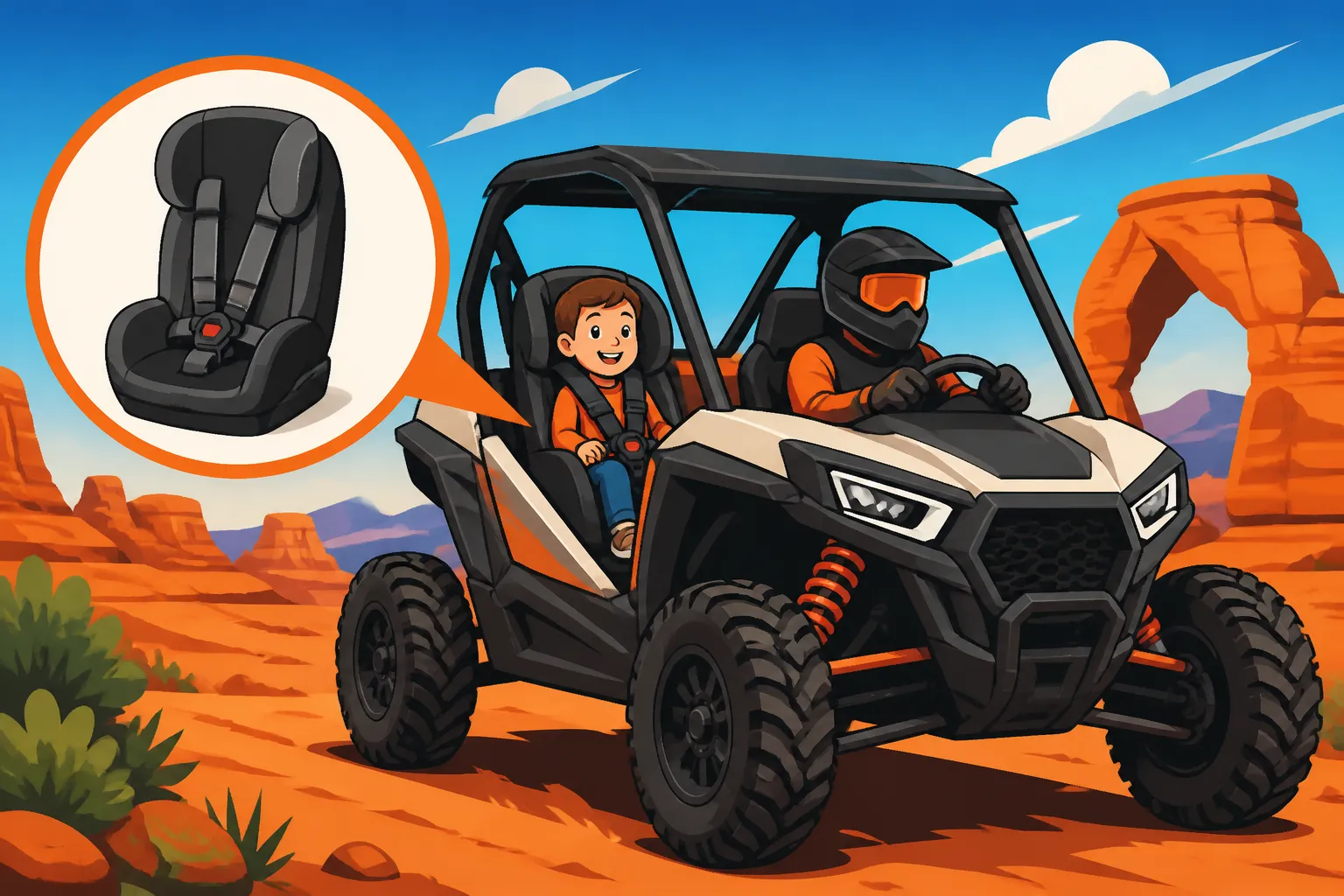
A more suitable option gaining popularity is UTV-specific child seats or harnesses. These are designed with the unique demands of off-road riding in mind. They often feature robust harnesses that attach directly to the roll cage or frame, providing a much more secure restraint than a standard seat belt. Some systems include cushioned seats or booster-style inserts that elevate smaller children to allow the UTV's factory three- or four-point harnesses to fit correctly. Companies like SuperATV offer a range of aftermarket accessories, and while they might not specifically sell dedicated "car seats," they are known for their heavy-duty roll cage components and harnesses that can be part of a comprehensive child safety setup. When looking at these, consider designs that offer side support for lateral stability during turns and rough terrain.
Finally, for older children who are still too small for factory seat belts but too large for a full toddler seat, a booster seat designed for UTVs can be a good compromise. These primarily raise the child to ensure the vehicle's existing seat belt fits correctly across their shoulder and lap. Again, the key is secure attachment and ensuring the booster itself doesn't shift. Remember, proper head and neck support is paramount, especially on bumpy trails.
Secure Installation and Compatibility Considerations
Proper installation is not just important; it's absolutely critical. A loosely installed child seat or booster is arguably more dangerous than no seat at all, as it can become a projectile or allow the child to be ejected.
The primary challenge in UTVs is the lack of standardized mounting points. Unlike cars, you won't find dedicated LATCH anchors. This means you'll typically rely on the UTV's existing seat belt system to secure the child seat or explore aftermarket solutions that bolt directly to the frame or roll cage. If using a traditional car seat, ensure that the UTV's seat belt can be routed through the car seat's designated paths and cinched down extremely tightly. You should not be able to move the child seat more than an inch in any direction once installed. However, many parents find this method less than ideal due to the open environment and vibrations.
For UTV-specific harnesses or booster systems, installation often involves using specialized clamps or brackets that attach to the roll cage. This provides a far more rigid and secure mounting point. Some systems might integrate directly with the existing seat mounting points. When choosing such a system, look for those that come with clear installation instructions and are designed to withstand off-road conditions. SuperATV, for instance, offers various UTV accessories, including harness bars and seat mounts, which, while not child seats themselves, can be integral components of a robust safety setup for securing aftermarket harnesses. Always double-check all bolts and clamps before each ride. It's not just about getting it in there once; it's about making sure it stays in there, ride after ride.
| Child Restraint Type | Pros | Cons | Best Use Case |
|---|---|---|---|
| Traditional Car Seat | Familiarity, high safety standards (for cars) | Not designed/tested for UTVs; difficult to secure properly; bulky; limited visibility | Short, very slow rides on smooth terrain; generally not recommended |
| UTV-Specific Harness/Seat | Designed for off-road forces; secure roll cage mounting; improved stability | Higher cost; specific to UTV models; may require permanent modification | Infants/toddlers who need maximum restraint and support in off-road conditions |
| UTV Booster Seat | Elevates child for proper seat belt fit; often integrates with UTV harness | Not a full restraint system; requires child to be able to sit upright and follow instructions | Older children who are still too small for factory seat belts |
Safety Best Practices Beyond the Seat Itself
While selecting and installing the right child restraint is a massive step, it's just one part of the overall safety equation when taking children out in a side-by-side. The off-road environment presents unique challenges that demand a holistic approach to safety.
Helmets, Gear, and Supervision
Even with the best child seat, proper gear is non-negotiable, especially for young riders. In Utah, [Utah Helmet Rules for Riders Under 18] are clear: any person under the age of 18 operating or riding an OHV on public lands must wear a properly fitted, DOT-compliant helmet. This isn't just a legal requirement; it's a life-saving measure. Helmets protect against head injuries from rollovers, impacts, or even just low-hanging branches on the trail. Make sure the helmet fits snugly, doesn't obstruct vision, and is comfortable enough for your child to wear for the duration of the ride.
Beyond helmets, appropriate riding gear is crucial. This includes eye protection (goggles or safety glasses to shield from dust, debris, and branches), sturdy over-the-ankle boots to protect feet, long pants, and long-sleeved shirts to prevent scrapes and sunburn. Gloves can also be beneficial for grip and protection. Dressing in layers is always a good idea in Utah's variable climate, and don't forget the sunscreen!
Finally, constant adult supervision and responsible driving are perhaps the most critical safety measures. An adult must be present and attentive at all times. This means maintaining a visual on the child, ensuring they keep their hands and feet inside the vehicle, and are not tampering with their restraints. As the driver, you are solely responsible for setting the tone. No aggressive driving, no sharp turns, and always be aware of your surroundings, especially when kids are aboard. Remind yourself of the [Supervision Rules for Young Utah Riders] and take them to heart.
Trail Selection and Driving Habits
Not all trails are created equal, especially when you have children in the UTV. Some of Utah's legendary trails, while thrilling for experienced adult riders, can be overly rough, steep, or technical for young passengers. The jostling and jarring on extreme terrain can not only be uncomfortable but also potentially unsafe, even with the best restraints. Think about the impact on a child's still-developing neck and spine.
When planning your ride with children, prioritize smoother, less technical trails or designated family-friendly OHV areas. Look for routes with gentle grades, wider paths, and fewer obstacles. Many of Utah's [The Best ATV and UTV Trails in Utah] have varying difficulty levels; opt for the "easy" or "moderate" rated routes. Pace yourself and drive conservatively. This means maintaining slower speeds, avoiding sudden acceleration or braking, and navigating bumps and dips gently. The goal is a smooth and enjoyable experience for everyone, not to conquer the toughest terrain.
Always carry a well-stocked first-aid kit, plenty of water, and snacks. Inform someone of your route and estimated return time. Being prepared for anything is part of responsible off-roading, and even more so when your most precious cargo is along for the ride. Knowing [What to Carry on a Utah Day Ride] is essential for all trips, but especially with kids.
Common Concerns and Misconceptions
Despite the best intentions, parents often grapple with specific questions or misunderstandings about child safety in UTVs. Addressing these head-on can help clear up confusion and promote safer practices.
The "Car Seat in a UTV" Debate
One of the most frequently asked questions is, "Can I just use my child's regular car seat in my side-by-side?" This is a hot topic, and while it might seem like a simple solution, it's fraught with potential issues. The fundamental difference lies in their design and testing. Car seats are rigorously crash-tested to meet Federal Motor Vehicle Safety Standards for passenger cars, which involve specific types of impacts (front, side, rear) and restraint systems (LATCH, seat belts) found in cars. UTVs, however, operate in a completely different environment.
When a child's car seat is placed in a UTV, you immediately encounter several problems:
- Lack of Anchorage: UTVs do not have LATCH anchors, which are crucial for securely installing modern car seats. Relying solely on the UTV's seat belt to strap down a car seat can result in a less-than-secure fit, allowing the car seat to shift excessively during off-road movement.
- Different Dynamics: UTVs experience vibrations, lateral forces, and potential rollovers that are not part of passenger car crash testing. A car seat is not designed to protect a child in these unique off-road scenarios.
- Open Environment: The open nature of a UTV exposes children to dust, debris, and the elements in a way a car does not. This can impact the child's comfort and safety if not properly accounted for.
- Harness Compatibility: Even if you can strap a car seat in, the car seat's own internal harness system is designed to work within the car seat's structure, which itself is contained within a car. The forces an off-road vehicle exerts can be very different, potentially compromising the effectiveness of the car seat's harness.
While it might be technically possible to strap a car seat into a UTV, it is generally not recommended as the safest or most effective solution. Dedicated UTV child restraint systems, or robust aftermarket harnesses designed for the roll cage, offer a far superior and safer alternative by addressing the specific challenges of off-road riding.
Legal vs. Safe: Knowing the Difference
This is a critical distinction that every OHV enthusiast, especially parents, must understand. Sometimes, what is legally permissible isn't necessarily the safest course of action, and vice-versa. Utah's OHV laws, like those in many states, tend to focus on broad safety requirements rather than hyper-specific regulations for child passenger restraints in side-by-sides. For instance, the law might simply state that all passengers must be secured by a seat belt, but it doesn't specify how that seat belt must fit a two-year-old.
This lack of explicit legal detail can lead to a false sense of security. Just because there isn't a law saying you can't do something, doesn't mean it's safe to do it. Conversely, implementing safety measures that go above and beyond the minimum legal requirements is always the most responsible approach. For example, while the law might not mandate a five-point harness for a toddler in a UTV, common sense and a deep understanding of off-road dynamics strongly suggest it's the safest option.
As parents, we have a higher duty of care. It's about empowering yourself with knowledge, consulting your UTV manufacturer's recommendations, and choosing safety equipment designed for the specific environment you'll be riding in. Ultimately, prioritizing your child's well-being over simply adhering to the bare minimum legal standard will ensure your family creates incredible, safe memories on Utah's stunning trails.
Disclaimer
This article is for general informational purposes only and does not constitute professional advice. Laws, prices and regulations vary by location and change over time. Consult a qualified professional for guidance on your specific situation.