Helmet and Age Rules on Utah Roads
Riding your ATV or UTV on Utah's incredible trails is one thing, but venturing onto the open road with your street-legal machine brings a whole new set of considerations. Many riders, excited to connect trails or grab a bite in town, often feel a bit overwhelmed or unsure about who needs to wear a helmet and who can actually drive when they’re no longer on dirt. This guide is here to clear up that confusion, diving deep into the age and helmet requirements that apply to your street-legal off-highway vehicle (OHV) on Utah's public roads, so you can ride confidently and legally.
Understanding the Shift from Trail to Road Rules
It's a common misconception that once your OHV is street-legal, all the rules are the same as they were on the trail. While the freedom to ride from your campsite into town is amazing, it also means your machine and its occupants are now subject to the same traffic laws and safety regulations as cars, trucks, and motorcycles. This transition can feel like a jump from the wild west to the main street, and it pays to know the difference.
Why Road Rules Are Different for OHVs
When you're out on the trails, the focus is often on managing rough terrain, avoiding obstacles, and respecting the environment. The safety gear and operating guidelines are typically tailored to those specific off-road conditions, often with more flexibility for experienced adult riders. For instance, you might not always wear a helmet on a mild, private dirt road if you're over 18, and passenger rules can feel a bit more relaxed within your own group.
However, once you roll onto a paved public road, you're sharing that space with much larger, faster, and often less aware vehicles. The risks change dramatically. Suddenly, you're not just worried about a rock garden; you're concerned about merging with traffic, obeying speed limits, and being seen by distracted drivers. Road rules are designed with this complex interaction in mind, prioritizing the safety of all road users. This includes specific mandates for drivers' licenses, helmets for younger riders, and proper restraints for all passengers, because the stakes are simply higher when you're alongside 3,000-pound vehicles traveling at 50 miles per hour. The public perception shifts too; a street-legal UTV is viewed more like a small car than a recreational toy by law enforcement and other drivers.
The Legal Framework for Street-Legal OHVs in Utah
Navigating the legal landscape for street-legal OHVs in Utah means understanding which rulebook applies. When your OHV is operating solely off-highway, it falls under the purview of Utah's OHV program, managed by the Division of Outdoor Recreation. This program sets rules for trail access, registration, and safety education. However, the moment your machine meets the [Utah Street-Legal ATV Equipment Requirements] and you obtain a license plate, it largely transitions into the realm of general motor vehicle laws.
This means you're no longer just dealing with DWR rangers; you're also subject to local police, county sheriffs, and Utah Highway Patrol. These agencies enforce the Utah State Code for motor vehicles, which includes stipulations for driver licensing, vehicle equipment, traffic laws, and, yes, helmet and passenger requirements. It’s crucial to remember that your street-legal status doesn't exempt you from these broader motor vehicle laws; it simply grants you permission to join the flow of traffic, provided you follow all the same rules everyone else does. For example, while your OHV registration is still managed by the DMV, the enforcement of your driving conduct on public roads is under the same statutes that govern your daily commuter car.
Age Requirements for Driving Street-Legal OHVs on Utah Roads
One of the biggest questions that comes up when talking about street-legal OHVs is, "Who can actually drive this thing on the road?" It’s a completely different answer than for trail riding, and it's where many people get tripped up.
Driver License Requirements for OHVs on Paved Roads
Let's make this crystal clear: if you are driving your street-legal ATV or UTV on any public road in Utah, you need a valid driver's license. This isn't like an OHV education certificate, which is fantastic for trail safety but doesn't grant you road driving privileges. We’re talking about the same Class D driver's license required to operate a car or truck. You can't just have your OHV registered and plated; the person behind the wheel must also be legally licensed to drive on public roads.
This means if you're a parent with a teenager who has their OHV education certificate and is a fantastic rider on the trails, they still cannot drive the street-legal machine on the road unless they also hold a valid Utah driver's license or permit. If they have a learner's permit, they must adhere to all the restrictions that come with it, such as having a licensed adult 21 years or older in the passenger seat. This is a critical distinction that sometimes surprises people who are used to the more relaxed age rules for off-road operation. For more details, you can refer to information on [Driver License Rules on Utah Roads].
Minimum Age to Drive a Street-Legal UTV
So, what’s the absolute minimum age to drive a street-legal UTV on Utah roads? It's generally 16 years old, aligning with the standard age for obtaining a full Class D driver's license in Utah. If a minor is 15 years old and holds a learner's permit, they can operate a street-legal OHV on the road, but only with a licensed driver (21 years or older) in the passenger seat. They must also abide by any other restrictions on their learner's permit, such as hours of operation.
Imagine a family wants to drive their street-legal side-by-side from their rental cabin in Marysvale to the local diner for breakfast. If their 15-year-old, who just got their learner's permit, is itching to drive, they can do so only if a parent or other eligible adult is right there beside them. A 14-year-old, no matter how skilled on the trails, simply cannot legally operate that street-legal UTV on a public road, even if an adult is present. The age requirement for driving a street-legal machine on the road is fundamentally different from the age requirements for trail riding, which often allow younger, supervised riders. When in doubt, always default to the rules for driving a car. You can find more specific age guidelines in resources like [Age to Drive a Street-Legal ATV in Utah].
Exceptions and Special Circumstances
While the general rule is strict, there are a few narrow exceptions, though these rarely apply to recreational street-legal use. For instance, agricultural operations might have specific allowances for farm workers to cross or travel short distances on public roads with OHVs that are used primarily for farming or ranching purposes, even if those OHVs aren't fully street-legal. These are highly specific exemptions designed for utilitarian purposes and typically come with their own set of limitations.
It’s vital to understand that these agricultural exemptions do not translate into a free pass for general road use. They are not a loophole for pleasure riding or for commuting to the trail. If you are operating an OHV for any purpose beyond a very narrowly defined agricultural context, and you are on a public road, you must meet all the street-legal requirements, including the driver's license and age rules. Relying on an agricultural exemption for a casual ride into town could land you in hot water. For a deeper dive into these specific scenarios, refer to [Farm and Ranch Exemptions in Utah OHV Law].
Helmet Requirements for Street-Legal OHVs in Utah
The question of whether to wear a helmet is often a personal choice for adult riders off-road, but when you hit the pavement, state laws come into play, especially for younger riders. It's not just about protecting your head; it's about following the law and setting a good example.
Riders Under 18: Mandatory Helmets
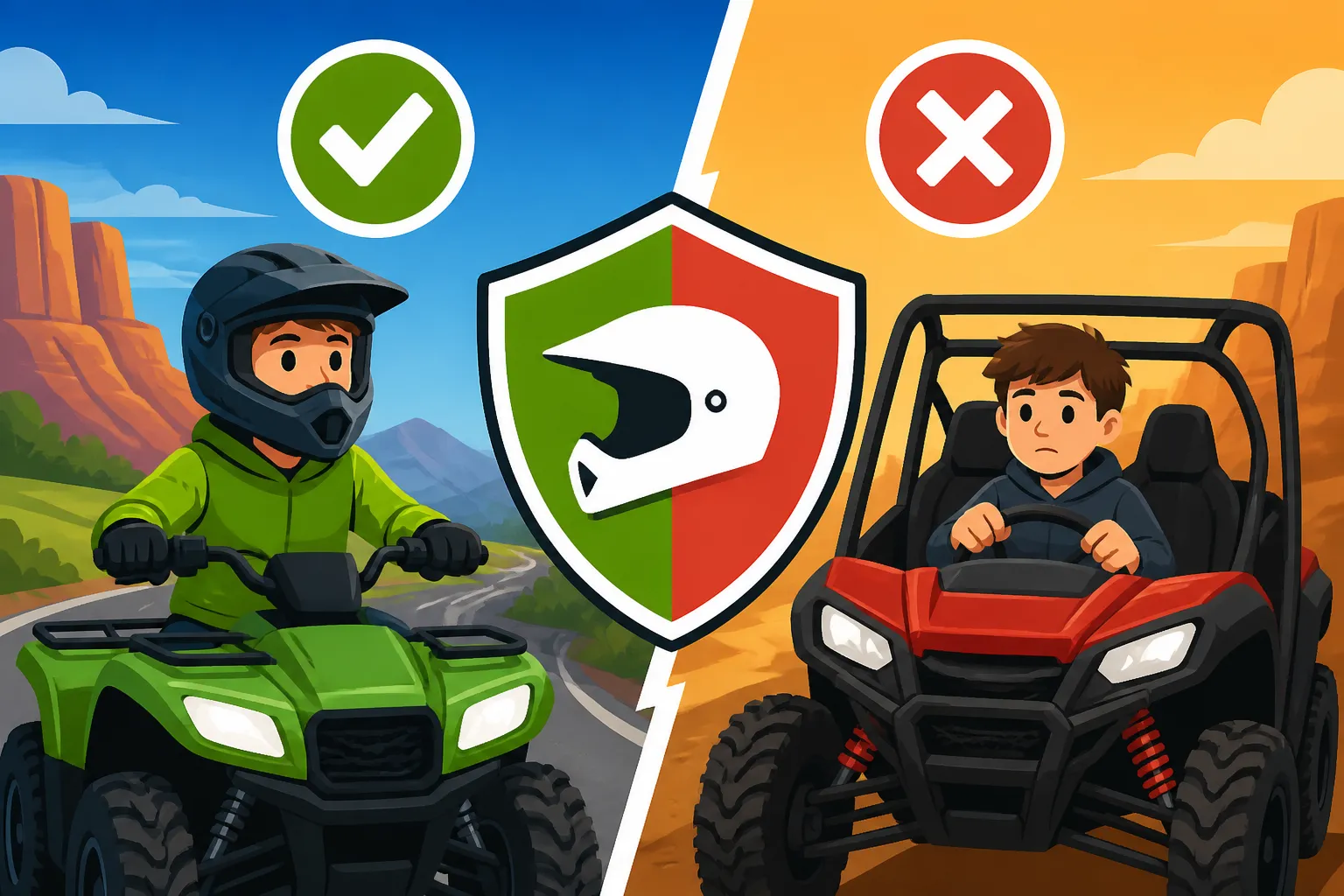
This is a non-negotiable point in Utah: anyone under the age of 18 operating or riding as a passenger on an OHV on a public road must wear a properly fitted, DOT-compliant helmet. This law is in place to protect the most vulnerable riders, who often have less experience, less developed judgment, and are physically smaller, making them more susceptible to serious injury in an accident. It doesn't matter if your UTV has a full windshield, doors, and a roof – if the occupant is under 18, their head needs to be protected by a helmet.
Consider a family driving their street-legal side-by-side through a town like Kanab on their way to Coral Pink Sand Dunes. The 17-year-old in the passenger seat, who might not wear a helmet on the dunes, is legally required to wear one on the paved roads of Kanab. The adult driver, on the other hand, might not be required to, which can sometimes create confusion for families. It’s important to educate all members of your riding party, especially minors, about this crucial safety and legal requirement. This rule applies uniformly across Utah's public roads and is an area frequently enforced by law enforcement. You can find more detailed rules on this topic in [Utah Helmet Rules for Riders Under 18].
Riders 18 and Older: When Helmets Are Optional
For adults aged 18 and over, the helmet rules for street-legal OHVs on public roads in Utah are generally more relaxed, depending on the type of machine. If you're riding a true ATV (the quad-style, saddle-seat machine), helmets are usually recommended and often required by default for all riders on public roads, even if street-legal. However, for most street-legal UTVs (side-by-sides) that are equipped with a windshield and seatbelts, adults 18 and older are generally not legally required to wear a helmet when operating on public roads.
This distinction is often based on how the UTV is classified and its safety features, which are seen as providing some level of protection similar to a car. So, if you're an adult cruising down Main Street in Moab in your side-by-side with a full windshield and proper seatbelts, the law doesn't mandate a helmet. However, just because it’s optional doesn't mean it's not a good idea. Many experienced riders choose to wear helmets regardless, understanding the inherent risks of open-air vehicles in traffic. For a complete understanding of this nuance, explore resources like [Are Helmets Required at 18 and Older in Utah?].
The Importance of Personal Choice and Safety Gear
While the law makes distinctions based on age and vehicle type, relying solely on legal minimums might not be the wisest approach when it comes to personal safety. The reality is that even low-speed collisions or rollovers can have devastating consequences, especially for open-air vehicles like OHVs. Many serious injuries in OHV accidents involve head trauma, which is often preventable or significantly mitigated by wearing a helmet.
Beyond helmets, a comprehensive approach to safety gear includes eye protection (whether a full windshield or goggles), sturdy footwear, and appropriate clothing like long sleeves and pants to protect against sun exposure, debris, and abrasions. Think about the variety of safety equipment available, from full-face helmets that offer maximum protection to open-face helmets with visors for better airflow. Companies like SuperATV offer a vast array of protective accessories, including robust windshields, mirrors that enhance visibility, and even custom cages that increase rollover protection. Making the conscious choice to wear a helmet, even when not legally required, demonstrates a commitment to your own well-being and sets an excellent example for younger riders. After all, the goal is to enjoy the ride and get home safely, not just to avoid a ticket.
Passengers and Child Restraints in Street-Legal UTVs
Taking your family and friends along for a ride is one of the joys of owning an OHV, especially a multi-passenger UTV. But when you move from the trail to the road, the rules for passengers, particularly children, become much more stringent and are often identical to those for passenger cars.
Passenger Age and Seating Rules
When your OHV is street-legal and traveling on public roads, every passenger must be seated in a designated seating position that is equipped with a seatbelt or other appropriate restraint system. This means no riding in the bed of a UTV, no sharing a single seatbelt, and no more passengers than the vehicle was designed for and equipped with restraints. If your UTV is a two-seater, you can only have one passenger. If it’s a four-seater, you can have three passengers, and so on.
These rules are not just suggestions; they are part of Utah’s motor vehicle code, just like they would apply to your car. Ignoring them can result in traffic citations and, more importantly, put your passengers at serious risk in the event of an accident. It's crucial to check your vehicle's manufacturer specifications to understand its intended passenger capacity and to ensure that all occupants are seated safely and properly restrained before you ever leave the driveway. This also ties into the overall rules for [Passengers and Seat Belts on Utah Roads].
Seatbelt Use and Child Seat Requirements
Here’s another key point where street-legal OHVs are treated just like cars: seatbelt use is mandatory for all occupants if the vehicle is equipped with them, and Utah's child restraint laws apply fully. This means if you have children riding in your street-legal UTV on public roads, you must follow the same guidelines for car seats and booster seats as you would in your family car.
For example, infants and toddlers typically require rear-facing car seats, followed by forward-facing seats, and then booster seats, all based on their age, weight, and height. It's not uncommon to see families outfitting their street-legal UTVs with proper car seats for their youngest adventurers, ensuring they meet legal requirements and, more importantly, remain safe. Companies like SuperATV offer a range of aftermarket seating and restraint options, though for child seats, you'll want to ensure any installation strictly follows child seat manufacturer guidelines and doesn't compromise the integrity of the vehicle's original restraint system. Always prioritize professional installation or consultation when it comes to child safety in any vehicle. The rules governing [Child Seats in a Utah Side-by-Side] are quite specific, so a review of current guidelines is always recommended.
Enforcement, Penalties, and What to Expect
No one wants to encounter law enforcement on a fun day out, but understanding what they're looking for and the potential consequences of non-compliance can help you avoid problems and ensure a smooth, legal ride.
What an Officer Looks for During a Stop
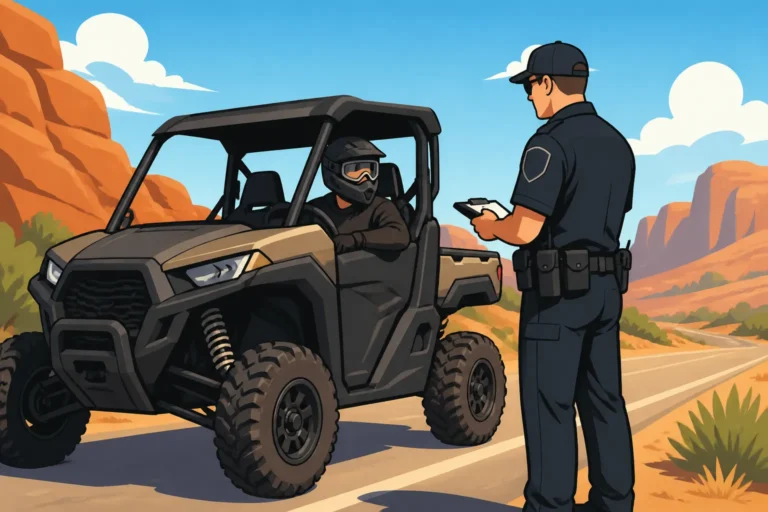
When you're driving your street-legal OHV on Utah roads, a law enforcement officer will be looking for the same things they would if you were driving any other motor vehicle, plus a few OHV-specific checks. First and foremost, they'll want to see proof of a valid driver's license for the operator. They'll also check for current [Utah OHV Decals and Where They Go] or a license plate, and proof of registration. If your street-legal machine requires insurance for road use, they'll expect to see that documentation as well.
Beyond paperwork, officers will pay close attention to occupants, especially minors. They'll confirm that anyone under 18 is wearing a DOT-compliant helmet and that all passengers are properly seated and utilizing seatbelts or child restraints as required by law. They might also quickly check for basic street-legal equipment like working headlights, tail lights, turn signals, and mirrors. The idea is that your street-legal OHV should blend seamlessly and safely into traffic, and compliance with these rules is key. For a comprehensive list of items an officer might check, refer to [What a Utah Officer Looks for on a Street-Legal ATV].
Fines and Consequences for Non-Compliance
Ignoring age, helmet, or child restraint laws on Utah roads can lead to more than just a stern talking-to. The fines for these infractions can vary, but generally, they are comparable to tickets issued for similar violations in a passenger car. For instance, a minor caught without a helmet on a public road could result in a citation for the driver. Failing to properly restrain a child in a car seat could also lead to a significant fine.
Repeated offenses or multiple violations during a single stop could compound the financial penalties. While it's rare for an OHV to be impounded solely for a helmet or seatbelt violation, continuous disregard for traffic laws or other serious infractions could escalate to more severe consequences. The goal of enforcement is safety, so these penalties are designed to encourage compliance and prevent accidents. It's always best to be overly cautious when it comes to safety and legality rather than risking a costly ticket or, worse, an injury.
Local Ordinances and Their Impact
While Utah State Code sets the baseline for helmet and age requirements, it's incredibly important to remember that individual cities and counties in Utah have the authority to establish their own local ordinances. These local rules can sometimes add restrictions or specific requirements that go beyond state law, especially concerning OHV operation on city streets. While a city cannot typically ban street-legal OHVs entirely if the state allows them, they can impose specific speed limits, noise restrictions, or even designate specific routes.
For example, a city might have a lower speed limit for OHVs on certain streets or have specific rules about parking. While it's less common for local ordinances to directly contradict state law on helmet or age requirements, they might clarify or emphasize these rules. It’s always a smart move to quickly check the local regulations for any town you plan to ride through on a street-legal machine. A quick search of the city's official website for "OHV ordinances" before you head out can save you from an unexpected citation. Understanding [City and County OHV Rules Across Utah] can be critical for a smooth trip.
Equipping Your Street-Legal OHV for Compliance and Safety
Making your OHV street legal isn't just about bolting on a few extra parts; it's about integrating safety and compliance into every aspect of your machine. This includes not only the required equipment but also your personal gear and ongoing diligence.
Essential Safety Gear Beyond the Helmet
Even when not legally mandated for adults, thinking beyond just the helmet can significantly enhance your safety on public roads. Eye protection is paramount. Whether it's a full windshield, goggles, or safety glasses, protecting your eyes from road debris, dust, and insects is crucial for maintaining visibility and avoiding serious injury. Many riders opt for a full windshield from companies like SuperATV to provide car-like protection.
Additionally, gloves can provide better grip on the steering wheel or handlebars and protect your hands in a minor incident. Sturdy, closed-toe footwear is a must, offering better control of pedals and protection for your feet. And while not legally required, appropriate clothing, such as long sleeves and pants, offers protection from sun exposure, windburn, and scrapes if you were to slide or be involved in a collision. Thinking holistically about your personal protective equipment (PPE) ensures you're ready for anything the road throws your way. The choice between a [Windshield or Eye Protection in Utah] is often one of personal preference and riding style, but protection is non-negotiable.
Ensuring Your UTV Meets Street-Legal Standards
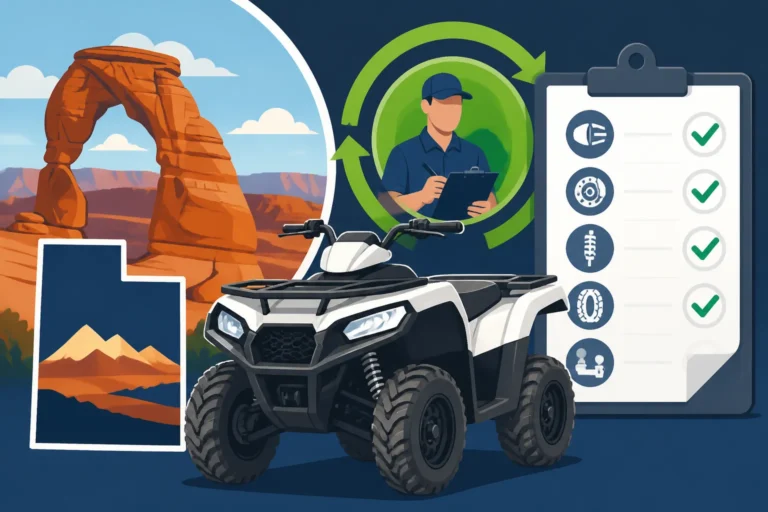
Beyond helmets and driver licensing, your actual OHV needs to meet specific equipment standards to be considered street-legal in Utah. This means having properly functioning headlights (with high and low beams), tail lights, brake lights, turn signals, at least one rearview mirror (though two are highly recommended), a horn, and a license plate light. Your exhaust system must also meet noise regulations, and your tires must be street-legal.
Before you even think about driving on public roads, ensure your machine has passed a [Utah's Street-Legal ATV Inspection, Step by Step] and all these components are in excellent working order. Regular pre-ride checks are a good habit, ensuring lights haven't burnt out, the horn still works, and your mirrors are adjusted correctly. A broken turn signal isn't just an inconvenience; it's a safety hazard and a potential reason for a traffic stop. This diligence ensures you're not just compliant with age and helmet rules but that your vehicle itself is legally and safely equipped for road use.
Staying Informed About Rule Changes
Laws and regulations, especially those pertaining to OHVs and their road use, can change. What was true last year might have been updated this year. It's the rider's responsibility to stay informed about any modifications to the Utah State Code or local ordinances. The best places to find current and official information are the Utah Division of Outdoor Recreation (which oversees the OHV program) and the Utah Division of Motor Vehicles (DMV) websites.
Make it a habit to check these resources periodically, perhaps at the beginning of each riding season, or before planning a trip to a new area. Joining local OHV clubs or forums can also be a great way to stay abreast of proposed changes or common enforcement practices, though always verify information from unofficial sources with official channels. An informed rider is a safer and more confident rider, ensuring your adventures on Utah's incredible roads and trails remain legal and enjoyable for years to come.
Summary of Age and Helmet Rules on Utah Roads
To help clarify everything we've covered, here’s a quick overview of the key age and helmet requirements for street-legal OHVs on Utah roads:
| Category | Driver License Requirement | Helmet Requirement | Passenger Rules | Child Restraint Rules |
|---|---|---|---|---|
| Driver (Under 18) | Learner Permit (15+) with licensed adult 21+ OR Full License (16+) | Mandatory DOT-compliant Helmet | Not applicable as driver | Not applicable as driver |
| Passenger (Under 18) | Not applicable | Mandatory DOT-compliant Helmet | Must be in designated seating with seatbelt | Yes, same as car (age/weight/height) |
| Driver (18 and Older) | Valid Class D Driver's License | Generally Optional for UTVs with windshields & seatbelts (Recommended) | Not applicable as driver | Not applicable as driver |
| Passenger (18 and Older) | Not applicable | Generally Optional for UTVs with windshields & seatbelts (Recommended) | Must be in designated seating with seatbelt | Not applicable (unless adult requires assistance) |
Remember, this table summarizes state-level requirements. Always check for local ordinances that might add further restrictions in specific cities or counties.
Disclaimer
This article is for general informational purposes only and does not constitute professional advice. Laws, prices and regulations vary by location and change over time. Consult a qualified professional for guidance on your specific situation.