Nevada Riders Heading to Sand Hollow
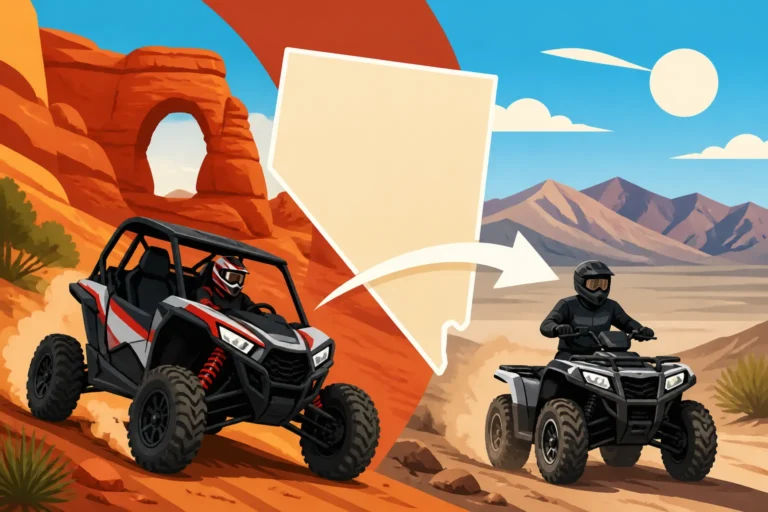
A Nevada registration sticker may keep your machine in order at home, but it does not automatically cover an off-highway ride in Utah. If you’re towing to Sand Hollow, the key is to sort out Utah’s visitor permit, rider education requirements and destination fees before unloading. Here’s how to separate those requirements and avoid mistaking one sticker or receipt for another.
Nevada registration does not replace Utah’s visitor permit
Utah no longer relies on the old OHV reciprocity arrangement that once let some out-of-state registrations stand in for a Utah permit. A Nevada-registered ATV or UTV used on Utah public land may need a Utah non-resident OHV permit, even if its Nevada paperwork is current. The practical takeaway: check Utah’s requirement for each machine you plan to ride, rather than assuming your home-state registration travels with you.
The permit is for operating an eligible out-of-state off-highway vehicle in Utah. It is not a substitute for Nevada registration, and it does not make an unregistered or improperly documented machine legal in Nevada. Keep your home-state paperwork with you as well. For the underlying rule and common exceptions, see Utah Ended OHV Reciprocity: What Visitors Do Now and Utah’s Non-Resident OHV Permit Explained.
Before paying for anything, identify what kind of vehicle you have and how you will use it. An ATV or UTV used as an off-highway machine is different from a vehicle that is genuinely registered and equipped for street use. A road plate alone does not mean every trail, sand area or public-land route is open to that vehicle. Check Street-Legal Vehicles and the Permit Question if your machine has street-legal registration, and confirm that the route itself allows your vehicle.
| What you have or need | What it covers | What it does not automatically cover |
|---|---|---|
| Nevada OHV registration | Registration requirements that apply in Nevada | Utah’s non-resident permit requirement |
| Utah non-resident OHV permit | Utah’s applicable visitor permit requirement for an out-of-state OHV | Utah state park admission, rider education requirements or trail access everywhere |
| Rider education certificate | Any operator education requirement that applies to the rider | Vehicle registration, a visitor permit or destination entry |
| Sand Hollow or recreation-area payment | The applicable entry or day-use charge for that area | Vehicle registration or the Utah non-resident permit |
This is the core distinction: registration, the Utah permit, rider education and destination fees are separate checks. Completing one does not necessarily satisfy the others. Requirements can depend on vehicle type, operator and where you ride, so use Who Needs a Utah Non-Resident OHV Permit to review the permit question for your specific situation.
Get one permit decision for every machine and rider
Plan around both the vehicles and the people operating them. A family hauling several quads should not assume that one purchase covers the whole trailer. Permit rules may apply by machine, while education requirements apply to operators. Check the current instructions before buying, especially if you are bringing a youth model, borrowing a vehicle, or traveling with a mix of ATVs and UTVs.
A straightforward preparation process looks like this:
- List each machine. Note whether it is an ATV, UTV, dirt bike or another type of vehicle, and whether it is registered as an off-highway or street-legal vehicle.
- Check Utah’s permit requirement for each one. Do not use a Nevada sticker as proof that the Utah permit is unnecessary. If a machine may fall under an exception, verify that exception before the trip.
- Check operator education requirements. Confirm whether each person who will drive needs an OHV education certificate and whether a certificate from Nevada is accepted. A passenger and an operator may not have the same requirements.
- Buy and display any required permit as directed. Follow Utah’s current instructions for the permit type and placement. Save the confirmation and any proof of purchase, but don’t assume a receipt replaces a required displayed permit.
- Check Sand Hollow’s separate charges and access rules. Find out which area you intend to enter and what admission or day-use payment applies there.
- Pack your records. Bring Nevada registration, any Utah permit proof, education certificates when required, and the information you need to show what each machine is.
The Utah permit process and the accepted forms of residency proof can change, so confirm those details through the current official purchase and rules pages. For step-by-step purchase information, see Buying the Non-Resident Permit Online. If you are unsure whether a particular machine qualifies for an exemption, check Machines Exempt From the Utah Permit before leaving home rather than trying to settle the question at a trailhead.
Education is easy to overlook because it is about the rider, not the vehicle. Utah has an OHV education program, and visitors should verify whether the operator’s age, residency and existing certificate affect what is required. Don’t assume that an out-of-state course automatically qualifies, or that a Utah permit includes the education credential. The details are covered in Certificates From Other States Utah Accepts and The Utah OHV Education Certificate.
It also helps to keep digital copies of receipts and certificates in a phone folder, but bring a practical backup if you may lose cell service. A screenshot can help you retrieve information; it does not override a rule requiring a physical decal, permit or original document. Check the display and proof requirements before relying on a digital copy.
Treat Sand Hollow access and OHV paperwork as separate questions
“Sand Hollow” can refer to more than one riding destination or access point in the area. Sand Hollow State Park and the nearby Sand Mountain riding area do not necessarily use the same payment or access process. Confirm the exact place you plan to unload, ride and park, then check that area’s current rules. A Utah non-resident permit should not be treated as an entrance ticket.
Likewise, paying an entrance or day-use fee does not replace OHV registration or a visitor permit. The fee may cover access to a particular recreation area, while Utah’s OHV requirements govern the machine’s use on public land. Review Sand Hollow and Sand Mountain: A Rider’s Guide for help distinguishing the riding areas, and check Entrance Fees at Utah’s Sand Hollow for the destination-payment question.
Before you head out, make sure your planned route is open to your machine and that you understand where the boundary between the riding area and other land or roads lies. A permit is not blanket permission to ride anywhere in Utah. Local restrictions, closures, land-manager rules and vehicle limitations can still apply. If your route leaves the designated riding area, check the applicable map and rules for that segment too.
For a simple trip plan, write down four separate answers:
- Is the machine properly registered for its use?
- Does that machine need a Utah non-resident OHV permit?
- Does each operator meet the applicable education requirements?
- What payment or reservation, if any, does the chosen Sand Hollow access point require?
Having four clear answers is more reliable than relying on a single sticker or receipt. If you are arriving with a street-legal UTV, rented machine or vehicle borrowed from someone else, check the rules for that case specifically. For example, a rental company may handle some paperwork, but you should verify what it covers and what the driver must still carry.
A final pre-trip checklist for Nevada riders
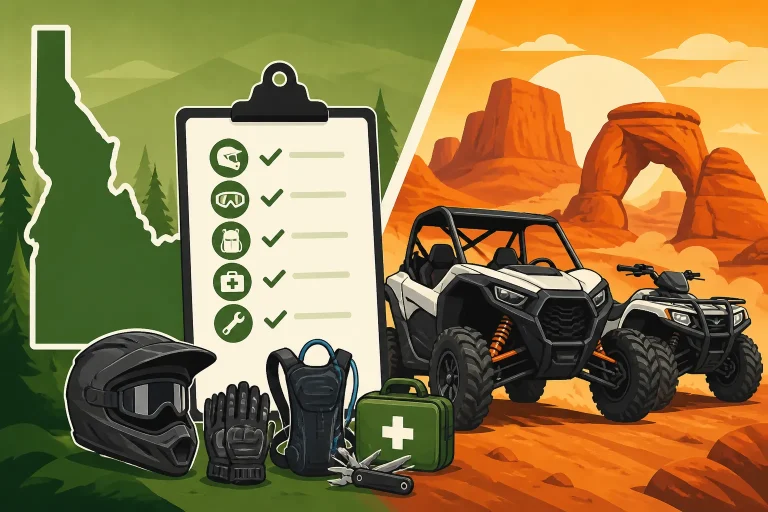
A little paperwork preparation can prevent an avoidable delay after the drive from Nevada. Use this checklist a few days before departure, then recheck any changing access or fee details close to your trip.
- Confirm the current Utah non-resident permit rule for every off-highway machine in your group.
- Check whether your operators need an OHV education certificate and whether their existing certificates are accepted.
- Purchase any required permit through the official channel and follow the display instructions.
- Bring the Nevada registration or other vehicle documents that apply to each machine.
- Identify the exact Sand Hollow destination and verify its current entry, parking and riding rules.
- Check closures, boundaries and permitted routes before unloading.
- Keep proof and contact details available even if you expect to have limited cell service.
- Don’t treat a state park payment, permit receipt or Nevada sticker as a substitute for a different requirement.
If something is unclear, ask the relevant Utah permit or recreation-area office before traveling. A precise question is more useful than a general one: give the vehicle type, its registration status, the operator’s situation and the specific place you intend to ride. That makes it easier to distinguish an actual exemption from an assumption.
For Nevada riders, the main point is simple: home-state registration and Utah riding requirements are not interchangeable. Check each machine, each operator and the specific Sand Hollow access point separately, and you’ll arrive with a much better idea of what is covered and what still needs attention.
Disclaimer
This article is for general informational purposes only and does not constitute professional advice. Laws, prices and regulations vary by location and change over time. Consult a qualified professional for guidance on your specific situation.