Course Rules for a Ten-Year-Old Rider
A ten-year-old can be eager to ride, but in Utah, enthusiasm alone is not enough for public-land riding. Families need to understand the youth OHV education requirement, what proof to keep, and how a certificate differs from registration, permits, and adult supervision. Here’s how to get a young rider ready without assuming one piece of paperwork covers everything.
What Utah requires of a ten-year-old rider
A ten-year-old falls within Utah’s youth age group for OHV education. Before a child in this age range operates an OHV on public land, the child generally needs to complete Utah’s youth OHV education requirement and receive a certificate. The certificate is intended to teach safe, responsible operation; it is not a license to ride any machine, anywhere, or without adult involvement.
Start with The Utah OHV Education Certificate to understand the certificate itself and where it fits in the larger rules. For a broader explanation of how age affects operation, see Age Limits in Utah OHV Education Law. Age rules and education rules are related, but they are not interchangeable: meeting the course requirement does not necessarily settle whether a particular child may operate a particular machine in a particular place.
| Item | What it does | What it does not do |
|---|---|---|
| Youth OHV education certificate | Shows the young rider completed the required education process | Register the machine or authorize riding on every route |
| OHV registration or decal | Helps show the machine meets applicable registration requirements | Prove the rider completed the education requirement |
| Non-resident permit, when required | Addresses a visitor’s permit requirement for riding in Utah | Replace the rider’s education certificate |
| Adult supervision | Helps keep a child safe and may be subject to separate rules | Substitute for required course completion |
The course requirement is only one part of preparing a child to ride. Before heading out, confirm the rules for the machine, the land, the route, and the rider’s age. Public land can include routes and areas managed by different agencies, and land managers may have additional restrictions. A certificate should never be treated as permission to ignore a closed route, local rule, or posted sign.
Also keep the machine’s paperwork separate from the child’s. If you are unsure whether the ATV or UTV is properly registered, What Paperwork Utah Riders Must Carry is a useful next check. If your family is visiting from out of state, review Who Needs a Utah Non-Resident OHV Permit as well. A child may need to meet the education requirement even when the machine already has paperwork from home.
How to complete the course and keep proof
Use Utah’s official OHV education course information to confirm the current steps before the child starts. Course delivery, completion instructions, and how certificates are issued can change, so rely on the current program rather than an old printout or a secondhand description. If the child has already taken an OHV course elsewhere, do not assume it is accepted automatically; check Certificates From Other States Utah Accepts.
A practical process looks like this:
- Confirm the child’s age and the kind of riding planned. A ten-year-old is in the youth group, but the machine and riding location still matter. A public trail, private property, and a street-legal road route can involve different rules.
- Find Utah’s current youth course instructions. Use the official course pathway and follow its directions for enrollment, learning materials, and completion.
- Have the child complete the course personally. An adult can help with reading or technology, but the child should engage with the safety material and understand the answers. The point is to build practical judgment, not simply produce a certificate.
- Save the certificate in more than one way. Keep a printed copy with the family’s riding documents and a digital copy on a phone or other device. A phone may have no service at a trailhead, so do not rely on being able to retrieve a file online.
- Check that the child can explain the basics. Ask what to do before starting, how to respond to changing terrain, and when to stop and ask for help. A certificate is a starting point; adult coaching is still essential.
- Recheck the requirements before the trip. Confirm current rules for the machine’s registration, the rider’s certificate, any visitor permit, and the area you plan to use.
Keep the proof accessible rather than buried in a folder at home. Details on carrying it are covered in Carrying Your Certificate and Permit on the Trail. A paper copy can be useful when devices are out of battery, damaged, or offline. If you keep digital copies, make sure an adult can find them quickly without depending on a trailhead connection.
Course completion should also be distinguished from an OHV education course for adults. Utah has separate information for adult riders, and a parent’s certificate does not stand in for a child’s requirement. Likewise, an adult who completed a course for one purpose should not assume the child is covered as a passenger or operator. The course is tied to the rider, not shared by a family.
What the certificate means on the trail
The certificate addresses education. It does not decide whether a ten-year-old is ready for a specific ATV, whether a route is suitable for beginners, or whether the child may ride without an adult nearby. Treat each of those as a separate decision.
Supervision and judgment
A child may understand course material and still need close, active supervision. Before the ride, agree on simple rules: stay within the adult’s sight, stop when signaled, do not pass the lead adult, and get off the machine only when an adult says it is safe. The adult should be able to reach the child promptly, not just be somewhere in the same riding area.
Check current Utah supervision rules rather than assuming that a certificate makes independent riding lawful. Supervision Rules for Young Utah Riders covers that separate question. Even where a particular situation may be allowed, a ten-year-old’s judgment, experience, and ability to handle the machine should guide the family’s plan.
Choose terrain that leaves room for mistakes. Avoid starting on steep climbs, deep sand, loose rock, narrow ledges, busy shared routes, or unfamiliar sections where a quick stop may be difficult. A quiet, manageable area lets a new rider practice starting, stopping, turning, and looking ahead without pressure from faster groups.
Machine size and passenger rules
Use a machine that is appropriate for the child’s size, strength, and skill. The child should be able to reach the controls, steer comfortably, and use the brakes effectively. A large machine that an adult can handle is not automatically suitable for a child. Check the manufacturer’s age and operating guidance, and do not rely on a rider’s height alone.
An ATV is designed for an operator, while a UTV has seating and restraint systems that may allow passengers. Do not carry a child on an ATV unless the machine is designed for a passenger and the applicable rules allow it. In a UTV, use the seat belt and any required protective equipment, and keep the child seated properly. Course completion does not change the machine’s design or make an unsafe passenger arrangement acceptable.
Protective gear and practice
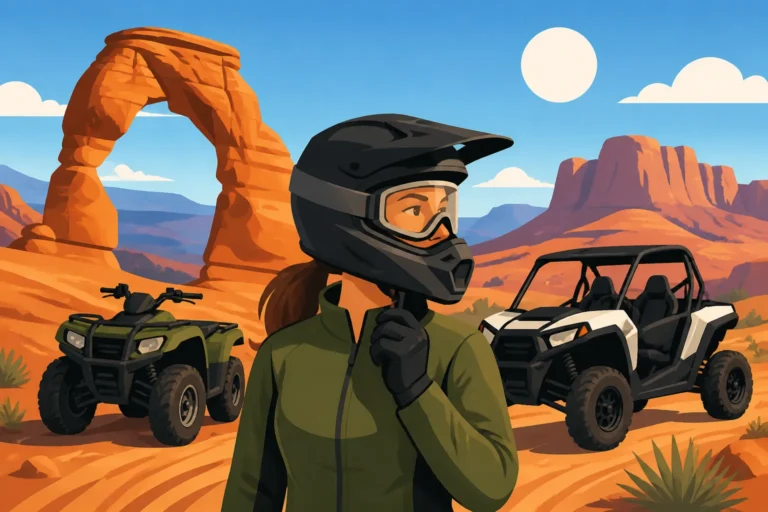
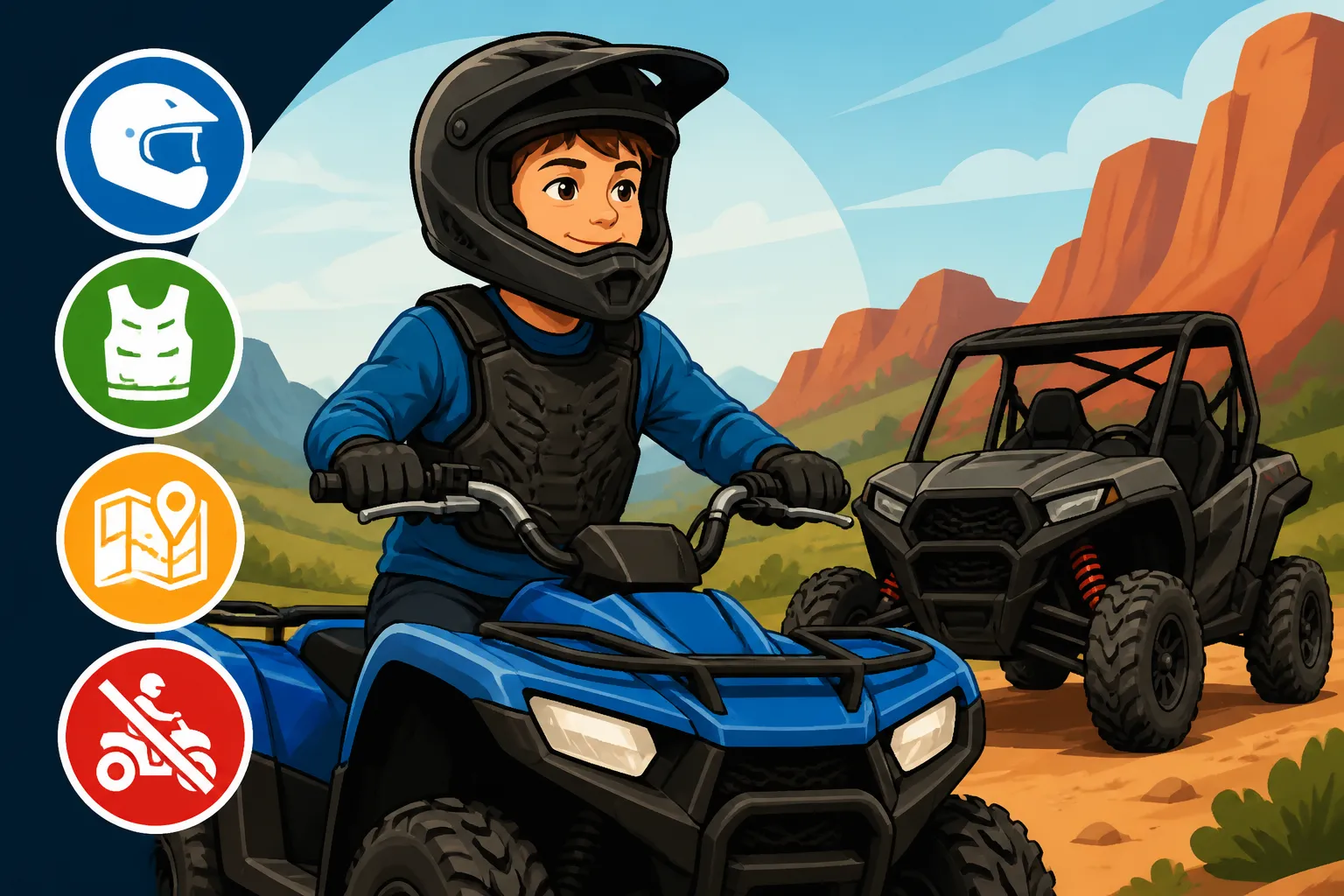
A properly fitted helmet is central to a child’s riding gear. Use eye protection, gloves, sturdy clothing, and over-the-ankle footwear suited to the ride. Check the helmet’s certification, fit, condition, and fastening before each trip. If comparing helmets or goggles through Amazon or another retailer, verify the safety markings and sizing rather than choosing by appearance alone.
Before entering a trail, practice in a controlled area. The child should demonstrate that they can:
- Start and stop smoothly.
- Use the controls without looking down for long periods.
- Turn both directions and keep a safe following distance.
- Stop when an adult gives the agreed signal.
- Identify when terrain or speed is beyond their ability.
Keep the first outing short. Fatigue, heat, dust, and excitement can make it harder for a child to follow directions. Build in water breaks and stop if the child becomes uncomfortable, distracted, or hesitant. A young rider who says a section feels too difficult should be able to turn around without being teased or pressured.
Other rules families can easily miss
Course completion does not automatically cover registration, permits, trail access, or local restrictions. Check each separately before loading the machine.
For a Utah-registered machine, verify that its registration is current and that the required decal is displayed as directed. For a visiting family, determine whether a Utah non-resident OHV permit applies to the machine and trip. The rider’s education certificate and the machine’s permit are different things, and a family should not assume one replaces the other. Utah OHV Rules for Visiting Families can help sort through the visitor questions.
Land access also deserves a separate check. A route may be open to some vehicle types but not others; it may have seasonal closures, width restrictions, or rules that affect youth riding. Consult current maps and signs, and check with the relevant land manager if a route’s status is unclear. A course certificate does not open closed roads or authorize travel across private land without permission.
Before leaving, use this family checklist:
- The ten-year-old has completed the required youth OHV education process and the family has proof.
- The machine is appropriate for the child and its registration or other required paperwork is current.
- Any applicable non-resident permit is in order.
- The selected route is open to that type of machine and appropriate for a young rider.
- The adult knows the current supervision requirements and will remain close enough to help.
- The child has a properly fitted helmet and suitable protective gear.
- The child has practiced controls and signals in a low-risk area.
- Everyone knows the plan for stopping, regrouping, and turning back.
If any answer is uncertain, pause and verify before riding. The official course information and the relevant land manager are better sources for current requirements than an old forum post or a friend’s memory. Getting the course right is important, but the safest plan combines education with an appropriate machine, close supervision, and a route the child can realistically manage.
Disclaimer
This article is for general informational purposes only and does not constitute professional advice. Laws, prices and regulations vary by location and change over time. Consult a qualified professional for guidance on your specific situation.