Replacing a Lost OHV Education Certificate
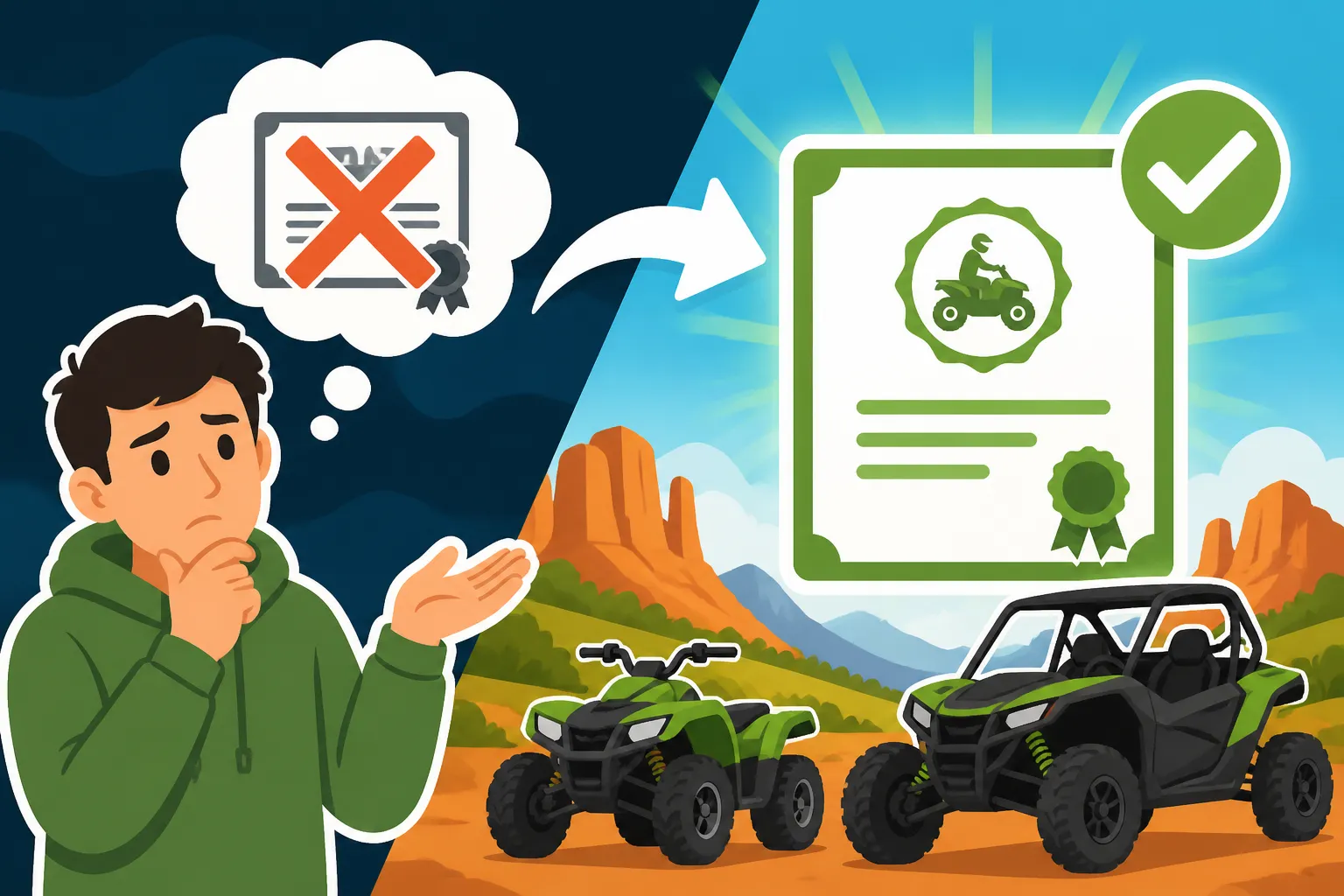
Losing your Utah OHV education certificate can leave you unsure whether you can ride, especially if a trip is coming up. The best first step is to recover the course record from the provider that issued it, then confirm what proof Utah currently accepts. Here’s how to look for a replacement, what information to gather, and what to do if the original record is hard to find.
First, confirm what document is missing
An OHV education certificate shows that a rider completed an approved safety course. It is not the same as an OHV registration, a nonresident permit, or an entry pass for a riding area. Replacing one document does not replace or renew the others.
Before you start searching, make sure the missing item really is the education certificate. Check any paperwork or digital files from the course and compare the document name with what you need for your ride. A registration card or permit may look like proof of authorization, but it does not necessarily show course completion.
The certificate may be required for some riders under Utah’s OHV education rules. Requirements can depend on factors such as the rider’s age, the type of machine, where it will be operated, and whether the rider is a Utah resident or visitor. Check the current rules for your situation rather than assuming that every rider has the same requirement. The overview in Utah OHV Education Certificate can help you identify which requirement applies.
It is also worth checking whether you need a Utah course certificate specifically. Utah has rules about which certificates from other states it accepts, and acceptance may depend on the issuing course or the rider’s circumstances. If you completed a course elsewhere, review Certificates From Other States Utah Accepts or ask the official Utah OHV program before paying for or repeating a course.
Keep these documents distinct:
| Document | What it generally shows | What it does not replace |
|---|---|---|
| OHV education certificate | Completion of an approved education course | Registration, a nonresident permit, or site entry fees |
| OHV registration | The machine is registered for the applicable use | A rider’s education certificate |
| Nonresident OHV permit | A visitor has the required permit for applicable Utah riding | The education certificate or machine registration |
| Riding-area pass or fee receipt | Payment or authorization for a specific area or facility | State registration or rider education |
If you are traveling from outside Utah, check both education and permit requirements. A certificate and a nonresident permit serve different purposes. Who Needs a Utah Non-Resident OHV Permit explains the permit question, while Carrying Your Certificate and Permit on the Trail covers keeping required proof available during a ride.
How to recover your certificate
Start with the course provider, not with a new course. The provider that recorded your completion is usually the best place to request a copy or confirm whether your record can be retrieved. If you took Utah’s official course, use the official course or OHV program contact information to find the current recovery process. Avoid relying on an old saved link or a third-party page that may no longer handle Utah certificates.
Search the account and email you used
Try to access the same account or email address you used when completing the course. Search your inbox, archived mail, and spam folder for terms such as “OHV,” “education,” “course,” “certificate,” and the provider’s name. Also check whether the certificate was downloaded to a phone, tablet, or computer, or saved in a cloud storage folder.
If you completed the course on a phone, check the device’s downloads folder and browser download history. If you used a family member’s email address or a shared device, search there too. Course records can be associated with the account used to enroll rather than the rider’s current email.
For more tips on completing or accessing the course online, see Taking the Utah OHV Course on a Phone. If you think you completed the course but cannot find the certificate, a course completion email, account history, or saved screenshot may help the provider locate the record.
Contact the issuer with useful details
If you cannot retrieve the certificate yourself, contact the official issuer and ask how to obtain a replacement or confirmation of completion. Gather the information that can help staff identify the record:
- The rider’s full name as it appeared on the course
- The email address or account used to enroll
- An approximate course completion date
- The rider’s date of birth, if requested through an appropriate channel
- Any confirmation number, completion email, or other course record you still have
Give only the information needed to locate the record. Do not send sensitive personal details through an unverified email address or an unofficial website. Use contact information published by the official program, and ask how to provide any additional identity information securely.
When you write or call, make your request specific: say that the rider completed the course, the certificate is lost, and you need a duplicate or written confirmation of completion. Ask whether the provider can email a file, restore access to the account, or issue another form of proof. The available process may differ depending on how and when the course was taken.
Confirm the replacement is usable
Once you receive a replacement, check that the rider’s name is correct and that the document clearly identifies the course or completion. Save a copy somewhere you can reach without relying on a single device. For a family, it can help to keep each rider’s certificate in a separate, clearly named folder.
Before traveling, ask whether a digital copy is acceptable for your situation or whether you should carry a printed copy. Do not assume that a photo of the certificate will satisfy every check. Carrying Your Certificate and Permit on the Trail is useful for planning how to keep proof accessible, particularly where phone service may be limited.
A duplicate certificate generally addresses the lost-document problem; it does not automatically answer whether the course still meets current requirements. If the certificate is old, issued by another state, or for a different rider, confirm acceptance with the official program before relying on it.
If the record cannot be found
A missing certificate does not always mean the course was never completed. The record may be under a different email address, an earlier name, or a separate account. Contact the issuer before enrolling again and explain what you have already checked. A staff member may be able to search by the rider’s details or tell you whether another proof of completion is available.
If the provider cannot find a record, ask what it recommends. It may request additional information, direct you to another record-keeping office, or advise you to retake the approved course. Do not assume that an old paper certificate, a parent’s account, or a course from another state will be accepted without confirmation.
Retaking the course may be the practical option if no completion record can be recovered, but first confirm that you are using the approved course and that completion will satisfy the current rule for that rider. The relevant requirements can differ by age and circumstances. The Adult OHV Education Course in Utah and How Utah Youth Riders Earn an OHV Certificate cover different rider situations.
If your trip is soon, do not treat a pending replacement request as proof that you meet the requirement. Ask the official program what documentation, if any, it will accept while a record is being recovered. If you cannot confirm that the rider has the required proof, the safest choice is to resolve the issue before riding on a route where the certificate may be required.
A few common assumptions can make the problem harder to sort out:
- A permit is not a replacement certificate. A nonresident permit and an education certificate serve separate purposes.
- Registration does not prove course completion. The machine’s paperwork and the rider’s education record are separate.
- A course from another state is not automatically accepted. Check Utah’s current acceptance rules before relying on it.
- A missing paper copy does not necessarily mean the record is gone. Search the original account and contact the course issuer first.
- Do not assume a certificate expires or remains accepted indefinitely. Ask the official program about the status of an older certificate or a course taken under earlier rules.
Once you have a usable copy, keep it with the rider’s other trip documents and make a backup. A digital copy can be convenient, but a printed copy is a sensible alternative if your phone battery dies or you lose service. Keep the certificate separate from machine registration and permit records so you can provide the right proof when asked.
Disclaimer
This article is for general informational purposes only and does not constitute professional advice. Laws, prices and regulations vary by location and change over time. Consult a qualified professional for guidance on your specific situation.